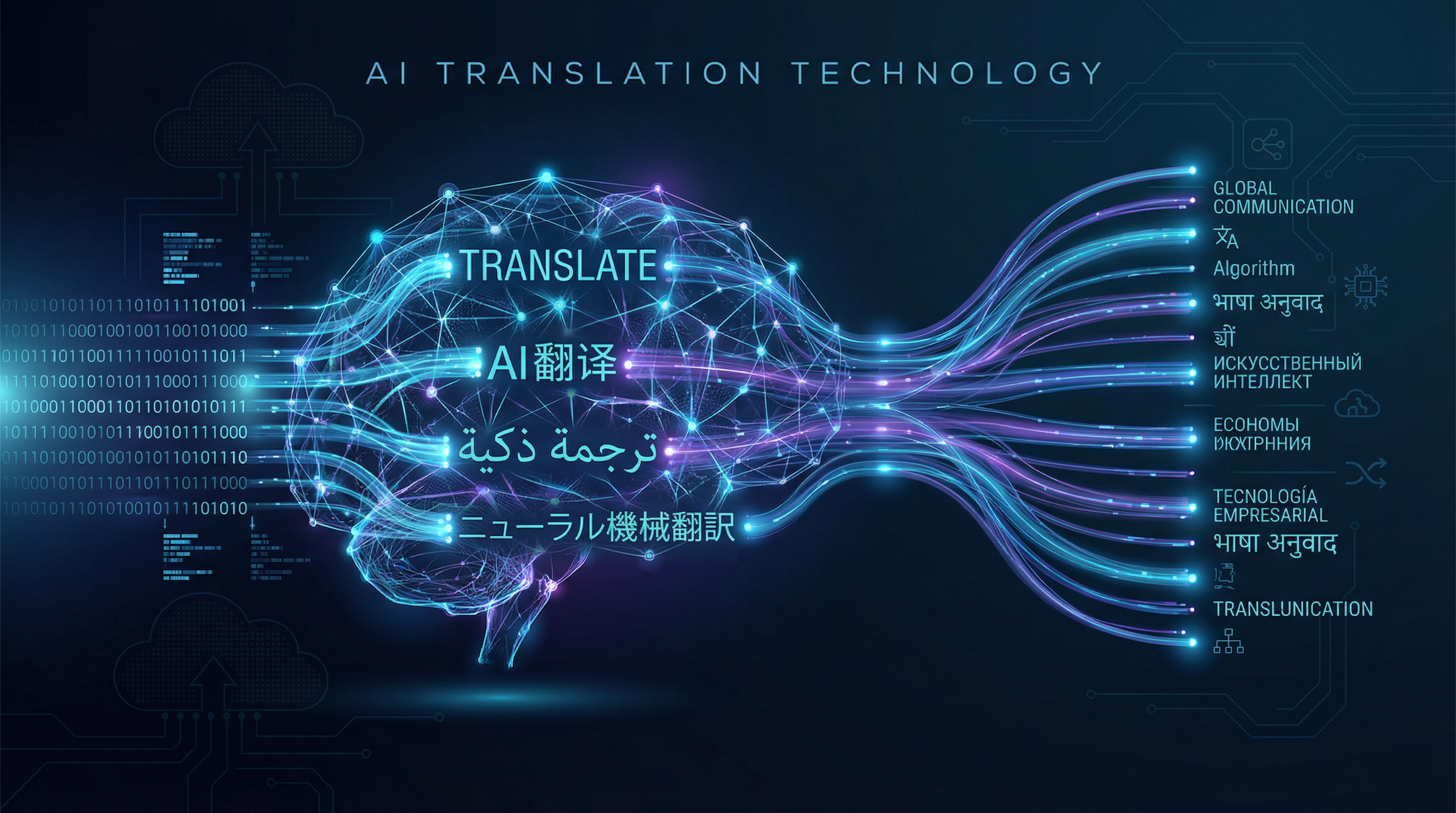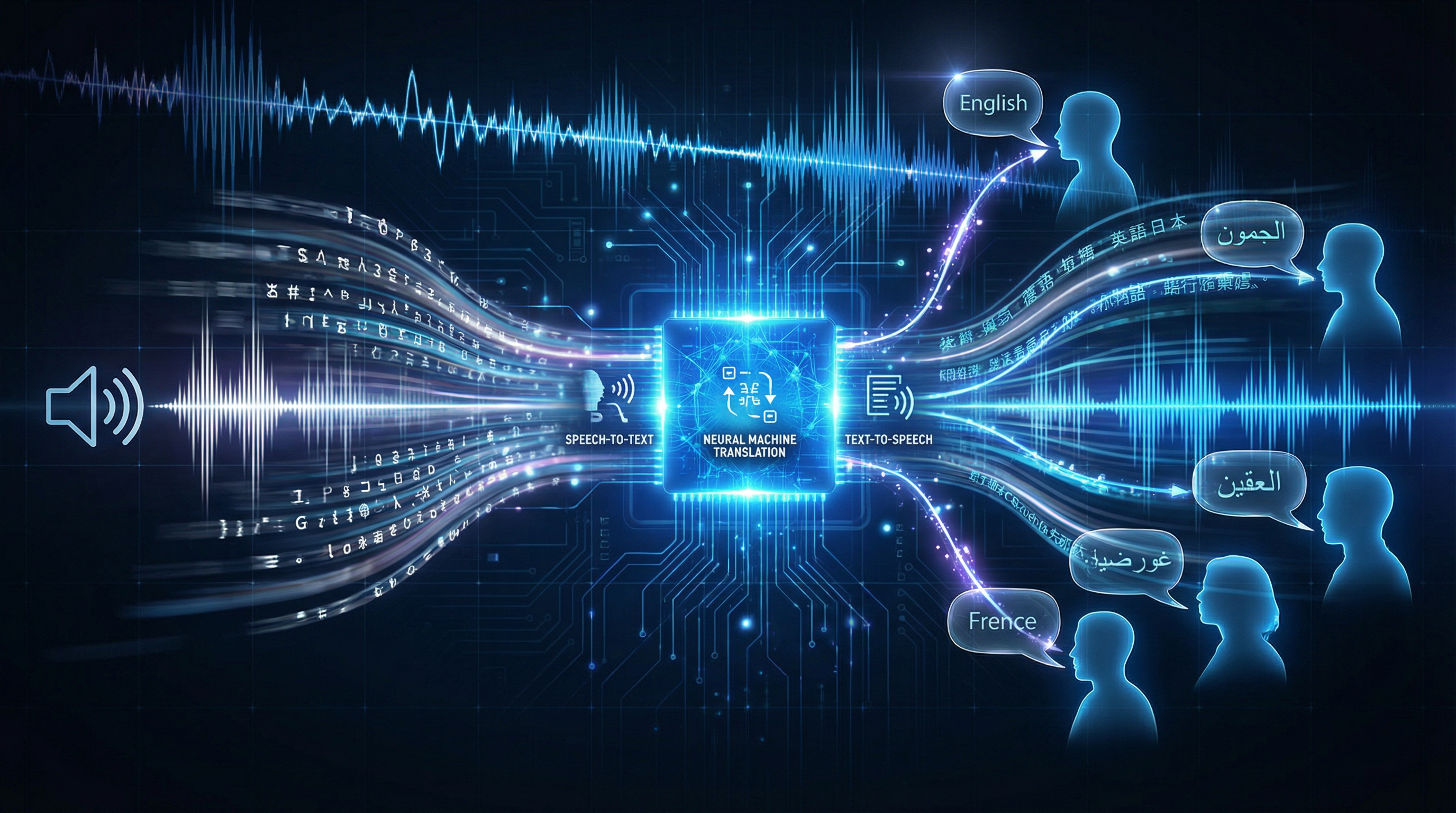
The convergence of automatic speech recognition, neural machine translation, and advanced text-to-speech synthesis has given rise to a transformative technology: AI interpretation systems capable of real-time speech-to-speech translation across dozens of languages. This comprehensive analysis examines the technological architecture, current capabilities, practical applications, and future trajectory of AI interpretation technology—a field poised to fundamentally reshape multilingual communication across conferences, healthcare, diplomacy, and everyday interactions.
Executive Summary: AI Interpretation Defined and Distinguished
Key Finding: AI interpretation represents a distinct technological category from text-based translation, requiring specialized architectures that handle the unique challenges of spoken language—including disfluencies, prosody, real-time constraints, and acoustic variability. The global market for AI interpretation solutions is projected to reach $2-4 billion by 2028, driven by enterprise demand for multilingual conferencing, healthcare communication, and customer service automation.
AI Interpretation Defined: At its core, AI interpretation technology enables real-time speech-to-speech translation, converting spoken input in one language into spoken output in another language with minimal latency. Unlike text translation systems that process written content asynchronously, interpretation systems must operate in near-real-time, typically targeting end-to-end latencies of 1-3 seconds to maintain conversational naturalness and speaker-listener synchronization.
The fundamental distinction between interpretation and translation lies in the medium and constraints. Translation systems process static text, allowing for batch processing, multiple revision passes, and consideration of extended context. Interpretation systems, conversely, must handle continuous audio streams, accommodate speaker variability (accents, speech rates, emotional states), manage turn-taking dynamics, and deliver output with latencies that preserve interaction flow. These constraints necessitate fundamentally different architectural approaches and performance optimization strategies.
Current Capabilities (2024-2025):Leading AI interpretation systems demonstrate impressive but bounded capabilities:
- Language Coverage: 50-100+ languages supported by major platforms, with varying quality levels across language pairs
- Latency Performance: End-to-end delays of 1-3 seconds for cascaded systems, with emerging end-to-end models achieving sub-second latencies
- Accuracy Levels: 85-95% semantic preservation for general conversation, declining for technical, idiomatic, or emotionally nuanced content
- Deployment Modes: Cloud-based solutions dominate, with growing edge/on-device capabilities for privacy-sensitive applications
- Use Case Maturity: Consumer travel and basic business communication are production-ready; high-stakes legal, medical, and diplomatic applications remain human-supervised
Key Limitations: Current AI interpretation systems face significant constraints that differentiate them from human interpreters: difficulty with nuanced cultural references, challenges in preserving emotional tone and speaker personality, limitations with overlapping speech and complex acoustic environments, and reduced accuracy for specialized terminology in fields like medicine, law, and engineering. These limitations establish boundary conditions for appropriate deployment scenarios.
Market Opportunity and Projections:The AI interpretation market represents a significant growth segment within the broader language technology ecosystem. Industry analysts project the market will expand from approximately $400 million in 2023 to $2-4 billion by 2028, reflecting a compound annual growth rate (CAGR) of 40-60%. This growth is driven by increasing globalization of business operations, rising demand for accessible healthcare communication, expansion of virtual and hybrid events requiring multilingual support, and cost pressures that make human interpretation economically impractical for many scenarios.
Primary Use Cases:
- Conferences and Events: Real-time interpretation for international conferences, virtual events, and hybrid meetings—providing accessibility at scale for dozens or hundreds of simultaneous language pairs
- Corporate Meetings: Multinational team collaboration, board meetings, training sessions, and all-hands events requiring cross-linguistic communication
- Customer Service: Call center support enabling agents to serve customers in their preferred language regardless of agent language capabilities
- Healthcare Communication: Patient-provider consultations, emergency medical situations, and mental health services where language barriers impede care
- Legal and Judicial: Court proceedings, depositions, attorney-client consultations, and immigration interviews (typically with human oversight)
- Travel and Hospitality: Tourist assistance, hotel interactions, restaurant ordering, and transportation navigation
- Education: Language learning, international student services, and accessible lecture interpretation
This analysis provides comprehensive examination of AI interpretation technology—covering the underlying technical stack, leading system implementations, operational modes, quality assessment frameworks, enterprise deployment considerations, and strategic recommendations for organizations evaluating this emerging capability.
The Technology Stack: ASR, MT, and TTS in Concert
AI interpretation systems represent the orchestrated integration of three distinct but interdependent technologies: Automatic Speech Recognition (ASR) for converting audio to text, Machine Translation (MT) for linguistic conversion, and Text-to-Speech (TTS) synthesis for generating spoken output. Understanding each component's architecture, capabilities, and limitations is essential for comprehending system-level behavior and performance boundaries.
Automatic Speech Recognition (ASR): The Input Foundation
ASR systems serve as the sensory layer of interpretation pipelines, converting acoustic signals into textual representations that downstream components can process. Modern ASR has evolved dramatically from the hidden Markov model (HMM) based systems of the 1990s and early 2000s to today's deep learning architectures that achieve near-human performance on many transcription tasks.
Acoustic Model Architectures:The dominant architectures in production ASR systems include:
- Wav2Vec 2.0 (Meta/Facebook AI): A self-supervised learning approach that trains on unlabeled audio data, learning powerful speech representations that transfer effectively to downstream recognition tasks. The model processes raw waveforms through a convolutional feature encoder, followed by transformer layers that capture temporal dependencies. Wav2Vec 2.0 achieves state-of-the-art results on benchmark datasets while requiring significantly less labeled data than supervised alternatives.
- Conformer (Google): A hybrid architecture that combines the local feature extraction capabilities of convolutional neural networks (CNNs) with the long-range dependency modeling of transformers. Conformer uses convolutional subsampling to reduce sequence length, followed by a series of conformer blocks that apply both self-attention and convolution operations in parallel. This architecture achieves excellent accuracy-computation tradeoffs, making it suitable for both cloud and edge deployment.
- Whisper (OpenAI): A large-scale, general-purpose speech recognition model trained on 680,000 hours of multilingual and multitask supervised data. Whisper uses an encoder-decoder transformer architecture trained to predict text transcripts from audio spectrograms. Unlike models optimized for specific languages or tasks, Whisper demonstrates strong zero-shot generalization across languages, accents, and domains—including transcription, translation, and language identification within a single model.
- Listen, Attend and Spell (LAS): An attention-based encoder-decoder architecture that directly maps acoustic features to character sequences without requiring pronunciation lexicons or HMMs. The encoder processes acoustic features through recurrent or convolutional layers, while the decoder uses attention mechanisms to focus on relevant encoder states when generating output.
Language Models for ASR: Modern ASR systems incorporate language models that capture statistical patterns of text, enabling better predictions by considering word sequence probabilities. These range from n-gram models (efficient but limited context) to large neural language models that can incorporate extensive context and domain knowledge. Integration approaches include shallow fusion (combining acoustic model scores with language model scores during beam search) and deep fusion (incorporating language model representations directly into the acoustic model architecture).
Speaker Diarization: Multi-speaker environments require identifying "who spoke when" to properly attribute recognized text to speakers. Speaker diarization systems typically combine:
- Change Point Detection: Identifying acoustic boundaries where speaker transitions likely occur
- Speaker Embedding Extraction: Using neural networks (x-vectors, d-vectors) to extract compact representations capturing speaker identity
- Clustering: Grouping segments by speaker identity using algorithms like spectral clustering or affinity propagation
Accent and Dialect Handling: ASR performance varies significantly across speaker populations. Major challenges include:
- Regional Accents: Systems trained predominantly on standard accents (e.g., General American English, Received Pronunciation British English) often exhibit elevated error rates for regional variants
- Non-Native Speech: Learner accents with phonological interference from native languages present recognition challenges
- Code-Switching: Bilingual speakers mixing languages within utterances require models capable of language identification and appropriate recognition strategies
Noise Robustness: Real-world deployment environments introduce acoustic challenges including background conversation, room reverberation, microphone quality variation, and environmental noise. Robust ASR systems employ techniques such as:
- Multi-Style Training (MTR): Training on data augmented with various noise types, reverberation, and microphone characteristics
- Signal Processing Front-ends: Noise suppression algorithms, beamforming for microphone arrays, and dereverberation techniques
- Spectrogram Augmentation: Training-time augmentation that masks time and frequency bands (SpecAugment) to improve generalization
Real-Time vs. Batch Processing:Interpretation systems require streaming ASR that processes audio incrementally rather than waiting for complete utterances. Streaming architectures use:
- Chunk-based Processing: Processing fixed-duration audio segments (typically 200-500ms) with overlap for continuity
- Trigger Word Detection: Identifying complete semantic units for translation triggering while maintaining low latency
- Endpointer Algorithms: Detecting speech boundaries to determine when to finalize hypotheses and trigger translation
Machine Translation for Speech: Beyond Text MT
While speech translation shares foundations with text-based machine translation, it presents distinct challenges that require specialized approaches. Speech translation must handle the informal, spontaneous, and often disfluent nature of spoken language—a domain where traditional text MT systems, trained on carefully edited written content, often struggle.
Differences from Text MT:
- Input Variability: ASR output contains errors, hesitations, repetitions, and incomplete sentences that text MT systems rarely encounter
- Context Limitations: Real-time constraints limit how much context can be considered, potentially reducing translation quality for ambiguous references
- Formality Spectrum: Speech translation must handle varying registers from highly formal presentations to informal conversational speech
- Structural Differences: Spoken and written language exhibit different syntactic patterns, vocabulary preferences, and discourse structures
Conversational Context Handling:Effective speech translation requires maintaining discourse context across multiple turns. Dialogue-specific MT systems incorporate:
- Coreference Resolution: Tracking references to people, objects, and concepts across turns (pronouns, demonstratives, definite descriptions)
- Discourse Coherence: Maintaining logical flow and rhetorical structure across the conversation
- Speaker State Modeling: Tracking what each participant knows, believes, and intends throughout the dialogue
Disfluency Handling: Spontaneous speech contains filled pauses ("um," "uh"), repetitions, restarts, and self-corrections that would be edited out of written text. Translation systems face choices:
- Literal Translation: Preserving disfluencies to maintain authenticity and speaking style
- Cleaning: Removing disfluencies for clarity, potentially losing personality markers
- Smart Handling: Selective preservation based on context and communicative intent
Prosody and Emotion Preservation Challenges:Speech conveys meaning beyond words through prosody—intonation, stress, rhythm, and speaking rate. Current text-based translation pipelines lose this information, though emerging multimodal approaches attempt to:
- Extract Prosodic Features: Identifying emotional state, emphasis, and syntactic boundaries from acoustic properties
- Map Cross-Linguistically: Transferring prosodic patterns between languages with different phonological systems
- Synthesize Appropriately: Generating target language speech with matched emotional and pragmatic properties
Text-to-Speech (TTS): The Voice Generation Layer
The final stage of the interpretation pipeline converts translated text into natural-sounding speech in the target language. Modern neural TTS has achieved remarkable naturalness, often approaching indistinguishability from human speech.
Neural TTS Architectures:
- Tacotron 2 (Google): An encoder-attention-decoder architecture that generates mel-spectrograms from text, followed by a WaveNet vocoder for waveform synthesis. The model uses character embeddings processed through convolutional and LSTM layers, with location-sensitive attention aligning text and spectrogram positions.
- VITS (Variational Inference with adversarial learning for end-to-end Text-to-Speech): A conditional variational autoencoder with adversarial training that generates high-quality speech in a single forward pass, eliminating the need for intermediate spectrogram representations. VITS achieves fast inference while maintaining naturalness comparable to two-stage systems.
- FASTSPEECH 2: A non-autoregressive model that generates mel-spectrograms in parallel rather than sequentially, dramatically improving inference speed while maintaining quality. Variance predictors model pitch, energy, and duration for natural prosody.
- YourTTS (Intel): A few-shot voice cloning approach that can synthesize speech in a target speaker's voice using only seconds of reference audio. Built on the VITS architecture with speaker encoder modifications.
Voice Cloning and Speaker Adaptation:Advanced interpretation systems can synthesize output in voices that match the original speaker's characteristics, preserving vocal identity across languages. Techniques include:
- Speaker Encoding: Extracting speaker embedding vectors that capture voice characteristics from reference audio
- Fine-tuning: Adapting pre-trained models to new speakers using small amounts of training data
- Few-shot Cloning: Generating speaker-matched output from minimal reference samples (seconds rather than hours)
Emotional Prosody Synthesis:Beyond speaker identity, systems increasingly attempt to preserve emotional expression—conveying happiness, sadness, urgency, or emphasis through synthesized speech. Approaches include:
- Reference-based Transfer: Using emotional reference speech to guide synthesis prosody
- Emotion Embedding: Conditioning synthesis on categorical or continuous emotion representations
- Acoustic Feature Control: Direct manipulation of pitch range, speaking rate, and energy to convey emotional states
Latency Considerations: TTS introduces additional latency beyond ASR and MT processing. Streaming TTS approaches begin generating audio before complete sentences are received, reducing perceived delay at the cost of potential prosody degradation. Techniques include:
- Lookahead Buffers: Waiting for limited future context before synthesizing to improve prosody
- Prosody Prediction: Predicting sentence-level prosodic contours from partial input
- Unit Selection: Concatenating pre-recorded speech segments for guaranteed low-latency scenarios
The End-to-End Pipeline: Cascaded vs. Direct Speech Translation
The architectural organization of these components significantly impacts system performance, latency, and error propagation characteristics.
Cascaded Systems: Traditional interpretation pipelines chain ASR, MT, and TTS as distinct sequential stages: Audio → ASR → Text → MT → Target Text → TTS → Target Audio. This approach offers:
- Modularity: Independent optimization and replacement of components
- Debugging: Clear intermediate representations for error analysis
- Flexibility: Mix-and-match components from different vendors
- Text Interface: Human-readable intermediate output for verification
However, cascaded systems suffer from:
- Error Compounding: ASR errors propagate to MT; MT errors propagate to TTS, with no mechanism for recovery
- Information Loss: Prosodic and paralinguistic information is discarded at the ASR text boundary
- Cumulative Latency: Each stage adds processing time, potentially exceeding acceptable delays
Direct Speech-to-Speech Translation:End-to-end models directly map source audio to target audio without intermediate text representation. Notable implementations include:
- Translatron (Google): A sequence-to-sequence model with attention that generates spectrograms in the target language directly from source language audio. Early versions retained source speaker voice characteristics, creating "voice transfer" effects where output speech sounded like the original speaker speaking the target language.
- Speech-to-Speech Translation (S2ST) with Unit-to-Unit:Representing speech as discrete units (pseudo-phonemes) learned through self-supervision, enabling direct unit-to-unit translation without explicit text representation.
- Multimodal Models: Emerging unified architectures that process and generate multiple modalities (audio, text, vision) within a single model, potentially learning implicit translation through joint representation spaces.
Direct approaches offer potential advantages in preserving prosody, reducing latency, and avoiding error compounding. However, they sacrifice the modularity and interpretability of cascaded systems and typically require larger training datasets.
Latency Budget Analysis: Human simultaneous interpretation typically operates with a delay of 2-3 seconds behind the speaker— interpreters begin rendering target language output while the source speech continues. AI systems target comparable or improved latencies:
- Human Baseline: ~2-3 seconds (varies by language pair and content complexity)
- Current AI Systems: 1-3 seconds end-to-end for cascaded systems; sub-second for optimized direct models
- Component Breakdown: ASR (200-500ms), MT (100-300ms), TTS (200-500ms), network/queuing (100-500ms)
Streaming vs. Turn-Based Architectures:
- Streaming Systems: Process continuous audio input and generate continuous output, suitable for simultaneous interpretation scenarios
- Turn-Based Systems: Wait for speaker pauses or explicit turn completion, then process entire utterances—similar to consecutive interpretation but automated
- Hybrid Approaches: Adaptive systems that switch modes based on detected speech patterns, conversation dynamics, or user preferences
Leading AI Interpretation Systems: A Competitive Landscape Analysis
The AI interpretation market features diverse offerings ranging from consumer mobile applications to enterprise-grade platforms designed for professional conference environments. Understanding the capabilities, limitations, and positioning of leading systems enables informed technology selection.
OpenAI Realtime API: Conversational AI with Speech Capabilities
OpenAI's Realtime API, introduced in 2024, represents a significant advancement in conversational AI—enabling natural voice-to-voice interaction with GPT-4o. While not primarily positioned as an interpretation system, its multilingual capabilities enable effective real-time interpretation use cases.
Technical Architecture: The Realtime API processes audio directly without requiring intermediate ASR and TTS stages. GPT-4o's native multimodal architecture can ingest audio, process linguistic content, and generate appropriate responses—all within a single inference pass. This integration eliminates latency overhead from component handoffs and potentially enables more natural conversation dynamics.
Performance Characteristics:
- Latency: ~300ms typical response time—substantially faster than cascaded systems
- Multilingual Support: Dozens of languages supported for both input and output
- Voice Quality: Natural-sounding synthesized voices with appropriate prosody
- Context Handling: Full conversational context maintained across multi-turn exchanges
Interpretation Applications: The Realtime API can function as an interpretation system by treating one participant's speech as input and requesting output in a different language. Use cases include one-on-one multilingual conversations, small group meetings, and customer service scenarios. However, the system is optimized for dialogue rather than formal presentation interpretation, and lacks specialized features for conference environments (multiple parallel language pairs, speaker isolation, terminology management).
Google Translate Live / Interpreter Mode
Google's Interpreter Mode, available through the Google Translate mobile app and Google Assistant, provides consumer-focused real-time conversation translation designed for travel, hospitality, and informal business interactions.
Capabilities:
- Language Coverage: 50+ languages for two-way conversation, with 100+ languages for one-way translation
- Interaction Modes: Automatic turn detection or manual button-press modes
- Offline Capability: Limited offline functionality for downloaded language packs
- Visual Features: Camera translation and transcribe mode for additional use cases
Google's speech translation pipeline leverages decades of research in ASR, MT, and TTS, integrated through Google's cloud infrastructure. The system benefits from massive training data scale and continuous model improvement through production deployment feedback loops.
Microsoft Azure Speech Translation: Enterprise-Grade Platform
Microsoft Azure's Speech Translation service provides enterprise-focused speech-to-speech and speech-to-text translation with emphasis on security, customization, and integration capabilities.
Key Features:
- Speech-to-Text + Translation + TTS: Complete cascaded pipeline as a unified service
- Custom Voice: Neural voice customization for brand-consistent or speaker-matched output
- Custom Models: Domain adaptation for specialized terminology (medical, legal, technical)
- Containerized Deployment: On-premise deployment options for data sovereignty and security
- Enterprise Security: Azure Active Directory integration, private endpoints, encryption
Azure's offering particularly appeals to organizations with existing Microsoft ecosystem investments, stringent security requirements, or need for hybrid cloud/on-premise deployment flexibility.
Meta SeamlessM4T: Open-Source Foundation Model
Meta's SeamlessM4T (Massively Multilingual & Multimodal Machine Translation), introduced in 2023, represents a significant contribution to open AI interpretation research—a unified model supporting automatic speech recognition, speech-to-text translation, speech-to-speech translation, text-to-text translation, and text-to-speech translation across nearly 100 languages.
Technical Significance: SeamlessM4T demonstrates that a single model architecture can handle diverse speech and translation tasks without task-specific fine-tuning. The model uses a unified representation space for speech and text, potentially enabling more coherent cross-modal transfer and reduced error accumulation compared to cascaded approaches.
Open-Source Impact: By releasing SeamlessM4T as open-source research, Meta has enabled:
- Academic Research: Access to state-of-the-art models for research institutions without proprietary licensing constraints
- Commercial Innovation: Startups and developers building applications on top of the foundation model
- Customization: Community fine-tuning for low-resource languages and specialized domains
- Transparency: Auditable systems for high-stakes applications requiring model inspection
KUDO AI and Interprefy: Professional Interpretation Platforms
Unlike general-purpose AI services, specialized interpretation platforms focus specifically on conference and event interpretation—incorporating features for multi-speaker scenarios, professional quality assurance, and event management.
KUDO AI: KUDO provides a hybrid interpretation platform supporting both human interpreters and AI interpretation within a unified interface. The platform emphasizes:
- Hybrid Models: Combining AI efficiency with human quality assurance for high-stakes content
- Event Management: Scheduling, participant management, and logistics tools for conference organizers
- Multiple Language Channels: Support for dozens of simultaneous language pairs in a single event
- Integration: Connectors for Zoom, Teams, and other video conferencing platforms
Interprefy: Interprefy specializes in remote interpretation solutions, including both human interpreter networks and AI interpretation capabilities. The platform serves enterprise events, international organizations, and government agencies requiring reliable multilingual communication infrastructure.
Specialized Solutions: Domain-Focused Offerings
Beyond general-purpose platforms, several vendors target specific use cases with optimized solutions:
Byrd: Focused on conference interpretation with features for:
- Presentation and keynote interpretation
- Slide content integration for context
- Audience Q&A handling
- Interpreter console interface for human-AI hybrid workflows
SpeakUS (formerly SpeakPlus):Targets government, NGO, and humanitarian applications with emphasis on:
- Low-resource language support
- Offline/air-gapped deployment for security
- Medical and legal terminology optimization
- Cultural sensitivity training integration
Waverly Labs: Consumer-focused wearables including:
- Over-ear translation devices for travelers
- In-ear "Pilot" earbuds for real-time conversation
- Offline capabilities for travel scenarios
Pocketalk: Handheld translation devices popular in:
- Healthcare settings (pocketalk.com/healthcare)
- Education (schools with multilingual students)
- Hospitality and tourism
- Emergency services
Modes of AI Interpretation: Simultaneous, Consecutive, and Hybrid
AI interpretation systems can be categorized by their operational mode—the temporal relationship between source speech and target output. Each mode presents distinct technical challenges, quality trade-offs, and appropriate use cases.
Simultaneous AI Interpretation: Real-Time Speech-to-Speech
Simultaneous interpretation, the gold standard for conference settings, requires rendering target language output while source speech continues— typically with a delay of 1-3 seconds. This mode demands streaming processing architectures capable of low-latency decision-making with incomplete context.
Technical Architecture: Streaming ASR processes audio chunks (200-500ms) as they arrive, generating partial hypotheses continuously. The translation layer must decide when to commit to translation—too early risks missing context that changes meaning; too late increases latency. Streaming TTS generates audio incrementally, potentially beginning synthesis before complete sentences are received.
Latency Requirements: Research suggests that latencies below 2 seconds are generally acceptable for most communication scenarios, while delays exceeding 3-4 seconds become disruptive to natural dialogue flow. Current leading systems achieve:
- Cloud-based cascaded systems: 2-4 seconds end-to-end
- Optimized cascaded systems: 1.5-2.5 seconds
- Direct speech-to-speech models: Sub-second to 1.5 seconds
Current Limitations: Simultaneous AI interpretation faces significant quality challenges:
- Context Window Constraints: Limited look-ahead impairs handling of long-range dependencies, ambiguous references, and delayed disambiguation
- Self-Correction Challenges: Unlike human interpreters who can revise output when source clarifies, AI systems typically cannot retract spoken output
- Accuracy Trade-offs: Speed-accuracy trade-offs favor faster output over careful translation, reducing quality for complex content
- Nuance Loss: Limited processing time reduces ability to capture idioms, cultural references, and subtle meaning distinctions
Suitable Use Cases: Simultaneous AI interpretation is most appropriate for:
- General business presentations where perfect accuracy is less critical than real-time comprehension
- High-volume events where human interpretation would be cost-prohibitive
- Overflow scenarios where human interpreters handle primary content and AI serves secondary channels
- Informal conversations where participants can clarify misunderstandings
Consecutive AI Interpretation: Chunk-Based Translation
Consecutive interpretation, where the speaker pauses while the interpreter renders complete segments, allows AI systems to process full context before generating output—potentially achieving higher accuracy at the cost of interaction flow.
Technical Approach: Consecutive AI systems buffer complete utterances or dialogue turns, then process the entire segment through ASR, MT, and TTS before output. This approach:
- Improves Translation Quality: Full context enables better disambiguation, reference resolution, and coherence
- Reduces Error Propagation: ASR can benefit from complete utterance context; MT can consider full source content
- Enables Post-Editing: Text-based output can be reviewed and corrected before speech synthesis (in hybrid human-AI workflows)
Turn-Taking Mechanisms:Automated consecutive interpretation requires reliable detection of speech boundaries to trigger translation. Approaches include:
- Silence Detection: Triggering translation after specified silence duration (e.g., 1-2 seconds)
- Semantic Completeness: Detecting grammatically complete units through linguistic analysis
- Explicit Triggers: Speaker-controlled buttons or voice commands to indicate turn completion
- AI Pacing: Systems that learn appropriate turn lengths for different speakers and contexts
Mobile App Implementations:Many consumer interpretation apps (Google Translate Conversation Mode, Microsoft Translator) implement consecutive-style interaction where users press buttons or wait for pauses to trigger translation. This pattern works well for:
- Travel conversations with service providers
- Healthcare intake and basic consultation
- Educational interactions
- Informal business discussions
Healthcare and Legal Applications:Consecutive AI interpretation is particularly appropriate for high-stakes domains where accuracy outweighs speed:
- Medical consultations where symptom descriptions require precise translation
- Legal proceedings where exact wording matters
- Mental health sessions where therapeutic alliance benefits from careful pacing
Whisper-Based Systems: Open Source and Privacy-First
OpenAI's Whisper model, released as open source in 2022, has enabled a generation of interpretation systems emphasizing privacy, customizability, and offline capability.
Whisper Architecture: Whisper uses an encoder-decoder transformer trained on 680,000 hours of multilingual audio. It supports:
- Multilingual ASR: Speech recognition in 99 languages
- Speech Translation: Direct translation from non-English languages to English (X→en)
- Language Identification: Automatic detection of spoken language
Translation Layer Integration:Full interpretation systems combining Whisper with translation typically use:
- Whisper for ASR → Text MT (NLLB, DeepL, Google Translate) → TTS
- Whisper for English ASR → English-to-target MT → Target TTS
Offline Capabilities: Unlike cloud-dependent services, Whisper can run entirely on local hardware—enabling:
- Privacy-Sensitive Applications: Medical, legal, and classified environments where data cannot leave premises
- Connectivity-Challenged Environments: Remote locations, aviation, maritime use cases
- Cost Efficiency: Elimination of per-minute API costs for high-volume applications
Remote AI Interpretation Platforms
Browser-based interpretation platforms enable multilingual communication without requiring application installation, reducing friction for occasional users and enabling rapid deployment.
Video Conferencing Integration:Modern platforms offer integration with:
- Zoom: AI interpretation through captioning APIs and third-party integrations
- Microsoft Teams: Native and third-party AI interpretation features
- Google Meet: Live caption and translation features
- WebRTC Platforms: Custom video conferencing with embedded interpretation
Multi-Speaker Handling:Conference interpretation requires isolating individual speakers in multi-participant environments. Techniques include:
- Speaker Diarization: Identifying "who spoke when" for attribution and separate processing
- Directional Microphones: Hardware-based speaker isolation in conference rooms
- AI-Based Separation: Neural source separation algorithms isolating overlapping speech
Quality and Accuracy Analysis: Measuring AI Interpretation Performance
Evaluating AI interpretation quality requires going beyond simple word-level metrics to assess semantic preservation, pragmatic appropriateness, and user experience factors. This section examines evaluation methodologies, quality challenges, and comparative performance across domains.
Accuracy Metrics: From Word Error to Semantic Preservation
Speech interpretation quality assessment employs diverse metrics capturing different aspects of system performance:
Word Error Rate (WER): The standard ASR evaluation metric calculates the minimum edit distance (insertions, deletions, substitutions) between recognized text and reference transcript, normalized by reference length. While widely used, WER has limitations:
- Treats all errors equally regardless of semantic impact (e.g., "not" deletion vs. synonym substitution)
- Penalizes acceptable paraphrasing and natural reformulation
- Does not capture interpretive quality beyond literal transcription
Translation Edit Rate (TER):Adapted for speech translation evaluation, TER measures edit operations required to transform system output into reference translation. TER recognizes that good translations may differ substantially from specific references while remaining valid.
BLEU and chrF++: These metrics compare n-gram overlap between system output and one or more reference translations. While widely used in MT research, they:
- Reward literal translation over natural target language expression
- Correlate poorly with human judgment for high-quality translations
- Are sensitive to reference quality and quantity
Human Evaluation Frameworks:For speech translation, human evaluation must consider:
- Adequacy: Is the meaning preserved? (even if expressed differently)
- Fluency: Is the output natural target language?
- Prosodic Appropriateness: Does synthesized speech match expected intonation, emphasis, and emotional coloring?
- Latency Impact: Does delay disrupt communication effectiveness?
Accuracy by Language Pair:Performance varies dramatically across language combinations:
- High-Resource Pairs: English ↔ Spanish, French, German, Chinese, Japanese achieve 90-95% adequacy for general content
- Medium-Resource Pairs: English ↔ Arabic, Hindi, Portuguese, Russian achieve 80-90% adequacy
- Low-Resource Pairs: Many African, Indigenous, and regional languages achieve 60-80% adequacy with significant quality gaps
Quality Challenges: Where AI Interpretation Struggles
Understanding failure modes is essential for appropriate deployment and risk management. Current AI interpretation systems face persistent challenges:
Technical Terminology Handling:Domain-specific vocabulary—medical conditions, legal concepts, engineering specifications—often requires:
- Specialized training data or terminology databases
- Consistent translation of polysemous terms (words with multiple meanings)
- Recognition of novel compound terms and acronyms
Named Entity Recognition in Speech:Proper names—people, organizations, locations, products—present challenges:
- ASR errors on uncommon names may propagate through the pipeline
- Name transliteration between writing systems requires cultural knowledge
- Ambiguous references ("Washington" as person, state, or city) require context for correct interpretation
Humor and Idiom Translation:Non-literal language often fails in AI interpretation:
- Idiomatic expressions may be translated literally, producing nonsense
- Wordplay and puns rarely survive cross-linguistic transfer
- Cultural humor references require shared background knowledge
Cultural Reference Transmission:Speech often references culturally-specific concepts—historical events, media figures, national institutions—that may not have direct equivalents:
- Systems may literalize or omit references entirely
- Explanatory glosses (adding explanatory context) are rarely attempted
Emotional Tone Preservation:While TTS can generate emotional prosody, mapping source speaker emotional state to appropriate target language expression remains challenging:
- Emotional expression patterns differ across cultures
- Sarcasm and irony are frequently misinterpreted
- Urgency markers may be lost or exaggerated
Comparative Performance: AI vs. Human Interpreters
Understanding the relative capabilities of AI and human interpretation enables appropriate deployment decisions and hybrid workflow design.
AI Advantages:
- Scalability: Can provide 50+ language pairs simultaneously without additional human resources
- Consistency: Terminology and style remain consistent across long events
- Cost: 90-99% lower cost per hour compared to professional human interpreters
- Availability: 24/7 operation without fatigue, breaks, or scheduling constraints
- Latency: Leading systems can achieve lower delay than human simultaneous interpretation
Human Interpreter Advantages:
- Cultural Mediation: Understanding implicit meaning, subtext, and cultural context
- Adaptability: Real-time adjustment for audience, register, and situation
- Error Recovery: Ability to self-correct and clarify when mistakes occur
- Emotional Intelligence: Conveying empathy, humor, and personality
- Critical Judgment: Knowing when to omit, summarize, or seek clarification
Accuracy by Domain:
| Domain | AI Adequacy | Human Preferred |
|---|---|---|
| General conversation | 85-95% | When nuance/culture critical |
| Technical presentation | 75-85% | Specialized terminology |
| Medical consultation | 70-80% | High accuracy required |
| Legal proceedings | 60-75% | Certified interpretation required |
| Diplomatic/High-stakes | Not recommended | Essential |
User Experience Factors
Beyond technical accuracy, user experience determines interpretation effectiveness:
Naturalness of Synthesized Voice:TTS quality significantly impacts listener acceptance:
- Robotic or monotonous output reduces engagement and comprehension
- Voice matching (synthesis in speaker-similar voice) improves perceived authenticity
- Prosodic variation prevents listener fatigue during extended sessions
Timing and Turn-Taking:Natural conversation rhythm is easily disrupted:
- Excessive latency creates awkward pauses and speaker uncertainty
- Premature cutoff (interrupting before speaker finishes) loses content
- Overlapping speech handling affects multi-party conversation dynamics
Error Recovery: When AI interpretation produces clear errors, recovery mechanisms matter:
- Fallback to human interpreters when confidence scores drop
- Text transcript display for verification
- Speaker clarification prompts when ambiguity detected
Enterprise Implementation: Deploying AI Interpretation at Scale
Enterprise adoption of AI interpretation requires careful analysis of use cases, technical requirements, integration patterns, and security considerations. This section provides frameworks for organizational deployment decisions.
Use Case Analysis: Where AI Interpretation Delivers Value
International Conferences and Events:AI interpretation addresses the scaling challenge of multilingual events:
- Capacity Expansion: Supporting language pairs where human interpreters are unavailable or prohibitively expensive
- Overflow Handling: Providing secondary language channels while human interpreters cover primary languages
- Accessibility: Enabling smaller events to offer multilingual support previously economically infeasible
Corporate Meetings: Multinational enterprises use AI interpretation for:
- Regular team meetings with geographically distributed members
- Training sessions and all-hands events
- Ad-hoc collaboration without scheduling interpretation services
- Board meetings where cost of human interpretation is acceptable
Customer Support Centers:AI interpretation enables agents to serve customers regardless of language barriers:
- Single-language agents supporting multilingual customer bases
- Reduced need for language-specific agent hiring
- Emergency support availability in all supported languages 24/7
Healthcare Communication:Medical interpretation applications include:
- Patient intake and medical history collection
- Basic consultation and follow-up communication
- Emergency situations requiring immediate communication
- Mental health services where patient comfort with technology is acceptable
Legal and Judicial: AI interpretation in legal contexts typically requires careful guardrails:
- Depositions and discovery with human verification
- Attorney-client consultation preliminary meetings
- Immigration interviews with transcript review
- Court proceedings typically require certified human interpreters
Educational Settings:
- International student services and orientation
- Parent-teacher conferences for multilingual families
- Accessible lecture interpretation in higher education
- Language learning practice and feedback
Integration Patterns: Connecting to Enterprise Systems
Video Conferencing Platforms:AI interpretation integration with popular meeting platforms:
- Zoom: Caption API integration for real-time translation display; third-party apps for audio interpretation channels
- Microsoft Teams: Native live caption translation; custom app integration for voice interpretation
- Google Meet: Live caption and translated caption features
- WebEx: Real-time translation features with AI support
Dedicated Interpretation Platforms:Purpose-built solutions offer advantages for professional use:
- KUDO, Interprefy, and similar platforms provide event management, multiple language channels, and quality controls
- Integration with event registration and attendee management systems
- Professional audio routing and channel management
Mobile App Deployment:For field and customer-facing applications:
- White-label mobile apps with embedded interpretation
- SDK integration into existing enterprise applications
- Offline capabilities for connectivity-limited environments
Kiosk and On-Site Installations:Fixed installations for specific locations:
- Healthcare facility check-in and triage kiosks
- Hotel concierge and information stations
- Government service centers and immigration offices
- Museum and tourist information points
Technical Requirements: Infrastructure and Specifications
Audio Quality Specifications:Interpretation quality is highly sensitive to input audio quality:
- Sample Rate: 16kHz minimum for ASR; 44.1kHz preferred for full-frequency capture
- Bit Depth: 16-bit minimum; 24-bit preferred for dynamic range
- Microphone Quality: Directional microphones for speaker isolation; headset microphones reduce acoustic echo
- Signal-to-Noise Ratio: >20dB SNR recommended for reliable recognition
Network Bandwidth Requirements:Cloud-based interpretation requires:
- Audio Streaming: ~64-128 kbps per direction for compressed audio (Opus, AAC)
- Control Signaling: Minimal bandwidth for API communication
- Redundancy: Dual-path connectivity for mission-critical applications
- Latency Budget: <150ms network latency for cloud services to maintain target end-to-end delay
Latency Tolerance by Use Case:
| Use Case | Max Acceptable Latency | Notes |
|---|---|---|
| Live conference presentation | 2-3 seconds | Comparable to human simultaneous |
| Business meeting dialogue | 1-2 seconds | Preserves turn-taking flow |
| Customer service call | 1-2 seconds | Agent and caller patience varies |
| Healthcare emergency | <1 second | Urgency demands minimal delay |
| Consecutive interpretation | 3-5 seconds | Pauses expected between turns |
Device Compatibility:Enterprise deployment must consider:
- Desktop/laptop support for conference room and office use
- Mobile device support (iOS, Android) for field applications
- Browser-based access without installation requirements
- Dedicated hardware (kiosks, interpretation booths) where appropriate
Security Considerations: Protecting Sensitive Communications
AI interpretation often processes confidential, regulated, or privileged content requiring appropriate security controls.
End-to-End Encryption:
- In Transit: TLS 1.3 for all data transmission; certificate pinning for mobile applications
- At Rest: Encrypted storage for any cached audio, transcripts, or logs
On-Premise vs. Cloud Deployment:
- Cloud Benefits: Scalability, continuous model improvement, reduced maintenance
- On-Premise Benefits: Data sovereignty, air-gapped security, predictable latency
- Hybrid Approaches: Sensitive processing on-premise; general processing in cloud
Data Retention Policies:
- Define retention periods for audio recordings, transcripts, and translation output
- Implement automatic deletion policies
- Provide user control over data persistence
Compliance Requirements:
- GDPR (EU): Data processing agreements, right to deletion, data localization options
- HIPAA (US Healthcare): Business Associate Agreements, audit logging, access controls
- SOC 2: Vendor security certification requirements
- Industry-Specific: Financial services, government, classified environments may have additional constraints
Event and Conference Applications: Professional Interpretation at Scale
Conferences and events represent one of the most demanding—and potentially transformative—applications for AI interpretation technology. This section examines deployment models, integration approaches, and appropriate use cases for professional event settings.
Conference Interpretation Setup: Technology Infrastructure
AI Interpretation Booths vs. Traditional:Professional simultaneous interpretation traditionally occurs from soundproof booths with dedicated audio feeds. AI interpretation offers alternatives:
- Virtual Booths: Cloud-based processing without physical infrastructure; interpreters (human or AI) work remotely
- Rack-Mounted Systems: On-site servers processing audio through venue sound systems
- Hybrid Models: AI handling overflow languages while human interpreters cover primary channels from traditional booths
Remote Participant Support:Hybrid and virtual events require interpretation delivery to remote attendees:
- WebRTC-based streaming with language selection
- Separate audio channels per language in video conferencing platforms
- Mobile app delivery for participants on smartphones/tablets
Multi-Track Handling: Large conferences with parallel sessions require:
- Independent interpretation processing per session
- Scalable cloud infrastructure for peak concurrent load
- Session switching for attendees moving between tracks
Mobile App for Attendees:Conference-specific apps enable:
- Personal language selection independent of seat location
- Live transcript display for accessibility and verification
- Q&A submission in attendee's language with translation to presenter
- Session scheduling with language preference indicators
Hybrid Events: Combining Human and AI Interpretation
Many professional events are adopting hybrid models that leverage the strengths of both human and AI interpretation.
Human + AI Combination Models:
- Primary/Secondary Split: Human interpreters for high-stakes content (keynotes, Q&A); AI for secondary sessions and overflow
- Language Pair Prioritization: Human coverage for most common language pairs; AI for less common languages
- Review Workflow: AI generating initial interpretation with human post-editing for critical content
Overflow Capacity Handling:AI interpretation enables elastic capacity:
- Handle unexpected increases in attendee counts
- Provide last-minute language additions without interpreter recruitment
- Support spontaneous breakout sessions without pre-arranged interpretation
Cost Reduction Strategies:
- Reduce human interpreter headcount for budget-constrained events
- Offer interpretation for events that previously couldn't afford it
- Reallocate savings to other event improvements or accessibility features
Case Studies: Real-World Deployments
UN Pilot Programs: The United Nations has explored AI interpretation for:
- Testing AI for informal meeting interpretation with human oversight
- Exploring coverage expansion for official languages plus regional languages
- Developing quality assurance frameworks for potential production use
Corporate Summit Implementations:
- Tech companies using AI interpretation for global all-hands meetings with 10,000+ employees across 50+ countries
- Pharmaceutical companies deploying hybrid human-AI models for regulatory training sessions
- Financial services firms implementing AI interpretation for earnings calls and investor presentations
NGO Humanitarian Applications:
- Emergency response coordination in multilingual disaster zones
- Refugee services where professional interpretation is unavailable
- Community health worker training across language barriers
Limitations for High-Stakes Events: Risk Assessment Framework
Understanding when AI interpretation is inappropriate is as important as knowing when to deploy it.
When to Use Human Interpreters:
- Diplomatic negotiations where nuanced communication and relationship dynamics matter
- Legal proceedings requiring certified interpretation and error accountability
- High-stakes business negotiations where misunderstanding could have major consequences
- Medical procedures where precise terminology and patient safety are paramount
- Events involving Indigenous or endangered languages where cultural mediation is essential
Risk Assessment Framework:Organizations should evaluate:
- Consequences of Error: What is the impact of interpretation mistakes?
- Error Detectability: Can errors be caught and corrected?
- Content Complexity: Technical terminology, cultural nuance, humor density
- Regulatory Requirements: Legal or contractual obligations
- Fallback Options: Availability of human backup or clarification mechanisms
Technical Challenges: The Frontier of AI Interpretation Research
Despite remarkable progress, AI interpretation faces fundamental technical challenges that distinguish it from text translation and limit deployment in demanding scenarios.
Real-Time Constraints: The Latency-Accuracy Trade-off
The defining challenge of simultaneous interpretation is the irreconcilable tension between processing time (which improves accuracy) and latency (which preserves interaction flow).
Latency Budget Management:End-to-end latency comprises multiple components:
- Audio Capture and Encoding: 50-100ms
- Network Transmission: 20-150ms (depending on infrastructure)
- ASR Processing: 100-500ms (streaming architectures)
- Translation: 50-300ms (depending on model size and length)
- TTS Synthesis: 100-500ms (can begin before full sentence)
- Audio Playback Buffering: 50-100ms
Current state-of-the-art systems achieve 1-3 seconds end-to-end, with emerging direct speech-to-speech models targeting sub-second performance.
Streaming Architecture Complexity:Incremental processing introduces challenges:
- Partial Hypothesis Instability: Early ASR predictions may change as more audio arrives, requiring translation revision
- Commitment Point Determination: When has enough context arrived to begin translation without excessive revision?
- Rollback Handling: How to revise already-spoken output when source clarification arrives?
Network Jitter Handling:Variable network conditions affect real-time systems:
- Adaptive buffering to smooth variable latency
- Packet loss concealment for audio continuity
- Quality of Service prioritization for interpretation traffic
Speech Phenomena: The Complexity of Spontaneous Communication
Spontaneous speech contains phenomena rarely found in written text, challenging systems designed on textual data.
Code-Switching Handling:Bilingual speakers frequently mix languages mid-utterance:
- "I need to go to the tienda to buy some milk"
- Systems must detect language switches and route appropriately
- Translation strategy depends on expected audience language capabilities
Filled Pauses and Disfluencies:Natural speech contains hesitations, restarts, and self-corrections:
- "The uh the meeting is scheduled for—no, wait—it was moved to Tuesday"
- Systems must decide whether to preserve, filter, or smooth these markers
- Over-smoothing loses authenticity; literal translation may confuse listeners
Overlapping Speech:Natural conversation includes interruptions, backchanneling ("mm-hmm"), and simultaneous speaking:
- Source separation required to isolate individual speakers
- Turn-taking detection must distinguish interruptions from handoffs
- Backchanneling may be filtered or preserved depending on target culture
Background Noise:Real-world acoustic environments challenge recognition:
- Conference room HVAC, audience noise, and movement sounds
- Outdoor events with traffic, wind, and environmental sounds
- Multi-speaker crosstalk in networking receptions
Long-Form Content: Maintaining Coherence Across Extended Discourse
Unlike short utterances, conference presentations and extended conversations require maintaining context over minutes or hours.
Context Maintenance:
- Entity tracking across turns ("the proposal I mentioned earlier")
- Discourse structure modeling (arguments, evidence, conclusions)
- Speaker goal and intention tracking
Reference Resolution:
- Pronoun resolution ("he," "she," "it," "they")
- Definite descriptions ("the third quarter results")
- Implicit references requiring world knowledge
Topic Shift Handling:Presentations often transition between topics:
- Detecting topic boundaries for appropriate transition markers
- Adjusting terminology models for new domains
- Managing discourse expectations across topic changes
Speaker Variability: Accommodating Human Diversity
Human speech varies dramatically across individuals, requiring robust generalization from limited training exposure.
Accent Adaptation:
- Regional accents within languages (Southern US English, Scottish English)
- Non-native accents with L1 interference patterns
- Idiosyncratic pronunciation patterns of individual speakers
Speaking Rate Variation:
- Very fast speech challenging recognition accuracy
- Slow, deliberate speech potentially signaling important content
- Variable rate within single utterances
Age-Related Speech Patterns:
- Children's higher-pitched voices and developing pronunciation
- Elderly speakers with potential articulation changes
- Lifelong speech patterns shaped by education and background
Hardware and Infrastructure: From Consumer Devices to Professional Equipment
AI interpretation deployment spans consumer gadgets to enterprise-grade infrastructure, each with distinct capabilities and trade-offs.
Consumer Devices: Accessibility and Portability
Pocket Translators:Dedicated devices like Pocketalk offer:
- Purpose-built hardware with integrated microphones and speakers
- Cellular connectivity for real-time cloud processing
- Offline capabilities for travel scenarios
- Ruggedized designs for field use
Translation Earbuds:Products like Waverly Labs Pilot and Timekettle WT2 Edge provide:
- Wearable form factor for hands-free operation
- Shared earpiece mode (each participant wears one earbud)
- Smartphone app pairing for processing and UI
- Lower latency than speaker-based systems (earbud-to-earbud)
Smartphone Apps:The most accessible deployment model:
- Google Translate, Microsoft Translator, iTranslate
- No additional hardware required
- Continuous updates and model improvements
- Integration with device capabilities (camera, location, contacts)
Professional Equipment: Enterprise and Event Infrastructure
AI Interpretation Booths:Purpose-built enclosures for professional events:
- Sound isolation for microphone input quality
- Rack-mounted processing servers
- Monitoring interfaces for audio quality and system status
- Redundancy for mission-critical deployments
Conference Room Installations:
- Ceiling microphone arrays for speaker capture
- Integrated speaker systems for interpretation output
- Touch panel controls for language selection
- Integration with room scheduling and video conferencing systems
Interpreter Consoles:Interfaces for human-AI hybrid workflows:
- Relay functionality (interpreting from AI output rather than original)
- Quality monitoring and fallback triggering
- Terminology glossaries and reference integration
Edge Computing: On-Device Processing
Edge deployment runs interpretation models locally, eliminating cloud latency and connectivity dependencies.
Privacy Advantages:
- Audio never leaves the device
- No data transmission to third-party servers
- Compliance with strict data sovereignty requirements
Accuracy Trade-offs:Edge models typically sacrifice capability for efficiency:
- Smaller model sizes (distilled or quantized) vs. cloud models
- Limited language coverage compared to cloud services
- Reduced domain adaptation capabilities
Hardware Requirements:
- Neural Processing Units (NPUs) or GPUs for real-time inference
- 4-8GB RAM for model loading and audio buffering
- Sufficient storage for language models (100MB-2GB per language pair)
Cloud Infrastructure: Scalable Processing
Scalability Requirements:
- Elastic scaling for peak event loads (10,000+ concurrent users)
- Load balancing across geographic regions
- GPU clusters for model inference at scale
Global Edge Deployment:
- Points of Presence (PoPs) near major markets to minimize network latency
- Regional data centers for data sovereignty compliance
- Content Delivery Network (CDN) integration for static resources
Redundancy and Failover:
- Multi-region deployment for disaster recovery
- Automatic failover when service degradation detected
- Graceful degradation (e.g., reduced language coverage rather than complete outage)
Cost Analysis and ROI: The Business Case for AI Interpretation
Economic analysis drives adoption decisions. Understanding pricing models, comparative costs, and return on investment enables informed deployment choices.
Pricing Models: Commercial Structure
Per-Minute Pricing:Most common for cloud-based services:
- $0.02-$0.15 per minute of audio processed (ASR)
- $0.05-$0.25 per minute for complete interpretation pipeline
- Volume discounts for enterprise commitments
- Tiered pricing by language pair (common pairs cheaper)
Per-User Pricing:
- Monthly subscriptions per seat ($10-$50/user/month)
- Active user definitions (distinct from licensed users)
- Unlimited usage within subscription tier
Enterprise Licensing:
- Annual contracts with usage tiers
- Unlimited or high-volume caps
- Included support and service level agreements (SLAs)
- Custom model training and terminology integration
Human-AI Hybrid Pricing:
- Base AI fee plus human review surcharge
- Dynamic pricing based on content complexity assessment
- Escalation fees when AI confidence drops below threshold
Cost Comparison: AI vs. Human Interpretation
Hourly Rates Analysis:
| Service Type | Approximate Cost/Hour | Notes |
|---|---|---|
| AI Interpretation (cloud) | $1-$10 | Per-minute pricing scaled |
| AI Interpretation (on-premise) | $0.50-$2 | Amortized hardware + electricity |
| Professional Human Interpreter | $100-$600 | Varies by language pair and specialization |
| Certified Legal/Medical Interpreter | $200-$800 | Premium for certification and liability |
| Conference Simultaneous (booth) | $500-$1,500 | Per interpreter, often need teams of 2-3 |
Volume Discounts:
- AI: Minimal marginal cost; cloud pricing may offer committed use discounts
- Human: Limited volume discounts; interpreter fatigue limits continuous hours
Hidden Costs:
- Setup and Integration: API integration, workflow design, testing (AI); travel, accommodation, briefing materials (human)
- Training: User adoption, system familiarization (AI); subject matter preparation (human)
- Quality Assurance: Monitoring, feedback collection, error correction workflows
ROI Calculation: Quantifying Value
Break-Even Analysis:
For an organization currently spending $50,000/year on human interpretation, switching to AI at $5,000/year yields:
- Direct cost savings: $45,000/year
- Payback period for integration investment: typically <6 months
Productivity Gains:
- Immediate Availability: No scheduling lead time required; ad-hoc multilingual meetings possible
- Expanded Coverage: More language pairs enable broader stakeholder inclusion
- Scalability: Unlimited concurrent sessions without resource constraints
- Recording and Transcription: Automatic documentation of interpreted content
Accessibility Benefits:
- Enable multilingual communication for organizations previously unable to afford it
- Support for rare languages lacking professional interpreter availability
- Democratization of global communication for individuals and small organizations
Total Cost of Ownership: Beyond Per-Minute Pricing
Setup and Integration:
- Initial API integration: 20-80 engineering hours
- Workflow design and testing: 40-120 hours
- Audio infrastructure setup (for on-premise): $5,000-$50,000
Training and Change Management:
- Staff training on system use and limitations
- User adoption support and documentation
- Change management for human interpreter transition (if applicable)
Ongoing Maintenance:
- API updates and compatibility management
- Terminology glossary maintenance
- Quality monitoring and feedback integration
- On-premise hardware maintenance (if applicable)
Ethical and Professional Considerations: Responsibility in Automated Communication
AI interpretation raises significant ethical questions regarding professional impact, accuracy responsibility, cultural sensitivity, and quality standards. Organizations deploying these systems must address these considerations proactively.
Interpreter Profession Impact: Job Displacement and Evolution
Job Displacement Concerns:
- Entry-level and generalist interpretation work increasingly automated
- Routine business interpretation may shift to AI in cost-sensitive organizations
- Freelance interpreter income pressure as AI captures low-end market
Upskilling Opportunities:
- AI post-editing and quality review roles
- Hybrid workflow design and management
- Terminology and domain expertise consulting
- High-stakes specialization where human judgment remains essential
Hybrid Model Ethics:
- Transparency requirements: Should users know AI is involved?
- Fair compensation when AI does initial work and human refines
- Liability allocation between AI provider, human reviewer, and deploying organization
Accuracy and Liability: Responsibility for Errors
High-Stakes Communication Risks:Errors in interpretation can have serious consequences:
- Medical miscommunication leading to treatment errors
- Legal misunderstanding affecting case outcomes
- Business negotiation errors causing deal failure
- Diplomatic incidents from nuance loss
Medical and Legal Implications:
- Regulatory frameworks for AI interpretation in healthcare (FDA, etc.)
- Court acceptance of AI-interpreted testimony varies by jurisdiction
- Informed consent requirements for AI interpretation disclosure
Insurance Considerations:
- Errors and omissions coverage for AI interpretation providers
- Corporate liability when deploying AI interpretation
- Unclear precedent for AI-mediated communication disputes
Cultural Sensitivity: Beyond Literal Translation
Loss of Cultural Mediation:Human interpreters serve as cultural bridges, not just linguistic converters:
- Explaining references that lack target-culture equivalents
- Adjusting register and formality based on cultural context
- Navigating taboo topics and sensitive subjects appropriately
- Recognizing and repairing pragmatic failures in real-time
Context and Nuance Preservation:
- Power dynamics and hierarchy encoded in language choices
- Politeness strategies and face-threatening act navigation
- Historical and political context underlying communication
Indigenous Language Support:
- AI training data scarcity for low-resource languages
- Risk of cultural appropriation or misrepresentation
- Importance of community consent and participation in development
Accessibility vs. Quality: The Democratization Debate
Democratization of Interpretation:
- AI makes interpretation accessible to populations previously unable to afford it
- Small businesses, individuals, and developing-world organizations benefit
- Language preservation and documentation potential
Quality Standards Debate:
- Should "good enough" interpretation be acceptable when alternatives are none?
- Minimum quality standards for specific application domains
- Disclosure requirements for AI interpretation use
Future Developments: The Trajectory of AI Interpretation Technology
AI interpretation is evolving rapidly. Understanding the development timeline enables strategic planning and investment decisions.
Near-Term (2025-2027): Incremental Improvements
- Latency Reduction Below 500ms: End-to-end speech-to-speech models will achieve sub-second latencies approaching imperceptible delay
- Emotion Preservation in TTS: Improved prosodic modeling will transfer emotional coloring and personality more faithfully
- Low-Resource Language Support: Expansion to 100+ new languages through multilingual transfer learning and data augmentation
- Domain Adaptation: Better handling of specialized terminology through fine-tuning and retrieval-augmented approaches
- Multi-Speaker Separation: Improved neural source separation for complex conversational environments
Medium-Term (2027-2030): Architectural Breakthroughs
- Brain-Computer Interface Speech: Direct neural decoding of intended speech for individuals unable to vocalize, with interpretation layer
- Real-Time Lip-Sync Translation: Video interpretation with facial animation matching translated audio to speaker video
- Universal Simultaneous Interpretation: True simultaneous processing with human-equivalent accuracy for general content
- Contextual Memory Systems: Extended context windows enabling coherence across hour-long conversations and presentations
- Cross-Modal Translation: Integration of gesture, expression, and visual context into interpretation
Vision 2035: The Babel Fish Realized
The science fiction concept of universal translation—embodied in the "Babel fish" from Douglas Adams' The Hitchhiker's Guide to the Galaxy—may approach reality:
- Seamless Multilingual Society: Language barriers reduced to the friction of accent differences within a language
- Wearable Universal Translation: Earbuds or implants providing continuous interpretation of ambient speech
- Human Interpreter Role Redefined: Focus on cultural mediation, high-stakes precision, and creative communication rather than routine conversion
- Language Learning Transformation: Reduced necessity for language learning for practical purposes; shift to cultural and aesthetic engagement
Implementation Recommendations: Strategic Deployment Framework
Organizations considering AI interpretation should follow a structured approach to pilot, evaluate, and scale deployment.
Pilot Project Design
- Start Low-Risk: Begin with internal meetings, training sessions, or non-critical external communications
- Limited Scope: Select 2-3 language pairs with good AI performance
- Parallel Operation: Run AI alongside existing interpretation for comparison during pilot
- Feedback Collection: Systematic gathering of user experience and quality assessment
- Defined Success Criteria: Quantitative metrics (accuracy, latency) and qualitative measures (user satisfaction)
Vendor Selection Criteria
- Language Coverage: Support for required language pairs at acceptable quality levels
- Latency Performance: Measured end-to-end delay in production conditions
- Integration Capabilities: APIs, SDKs, and connectors for existing infrastructure
- Security and Compliance: Certifications relevant to industry (SOC 2, HIPAA, GDPR compliance)
- Customization Options: Terminology management, domain adaptation, voice selection
- Support and SLA: Uptime guarantees, response times, escalation procedures
- Pricing Structure: Alignment with usage patterns (per-minute, per-user, enterprise licensing)
Quality Assurance Frameworks
- Confidence Thresholds: Automatic escalation or warning when system confidence drops
- Human-in-the-Loop: Review workflows for critical content before final delivery
- Continuous Monitoring: Ongoing quality metrics collection and analysis
- Feedback Integration: User error reports feeding model improvement
- Terminology Management: Maintaining and updating domain-specific glossaries
Change Management Strategies
- Stakeholder Communication: Clear messaging about AI role, capabilities, and limitations
- User Training: Education on system operation, appropriate use, and error handling
- Gradual Rollout: Phased expansion from pilot to full deployment
- Feedback Loops: Mechanisms for users to report issues and suggest improvements
- Human Interpreter Transition: Where applicable, support for interpreters moving to hybrid or specialist roles
Success Metrics Definition
Quantitative Metrics:
- Translation accuracy scores (adequacy/fluency ratings)
- Latency measurements (end-to-end delay)
- System uptime and availability
- Cost per minute vs. baseline (human interpretation or none)
- Usage adoption rates across user population
Qualitative Metrics:
- User satisfaction surveys
- Perceived communication effectiveness
- Naturalness of synthesized speech ratings
- Error impact assessment (critical vs. cosmetic)
Conclusion: Navigating the AI Interpretation Transformation
AI interpretation technology has progressed from research curiosity to practical deployment capability in a remarkably short timeframe. This analysis has examined the technology's current state, capabilities, limitations, and future trajectory— providing a foundation for informed decision-making.
Technology Maturity Assessment
As of 2024-2025, AI interpretation technology can be characterized as:
- Production-Ready: For general business communication, travel, and basic customer service in major language pairs
- Emerging: For healthcare, education, and specialized domains with appropriate guardrails
- Not Recommended: For high-stakes legal, diplomatic, and critical medical applications without human oversight
Strategic Adoption Roadmap
Organizations should approach AI interpretation adoption with clear-eyed assessment of use case appropriateness:
- Phase 1 (Now): Deploy for low-risk, high-volume scenarios where cost and availability drove previous non-communication
- Phase 2 (2025-2026): Expand to internal business processes, training, and customer support with quality monitoring
- Phase 3 (2027+): Evaluate for higher-stakes applications as accuracy and reliability improve; maintain human backup for critical scenarios
Final Recommendations by Use Case
| Use Case | Recommendation | Notes |
|---|---|---|
| Travel/Tourism | Deploy AI | Excellent fit; widely deployed |
| General Business Meetings | Deploy AI with monitoring | Review critical decisions |
| Customer Service | Deploy AI | Escalation to bilingual agents when needed |
| Conferences (General) | Hybrid Human-AI | AI for overflow/secondary languages |
| Healthcare (Routine) | Deploy AI with verification | Provider review of critical information |
| Healthcare (Emergency) | Deploy AI as backup | Human interpreters preferred when available |
| Legal Proceedings | Human only | AI may supplement, not replace |
| Diplomatic/High-Stakes | Human only | Cultural nuance essential |
The emergence of AI interpretation represents a democratization of multilingual communication—extending capabilities previously available only to well-resourced organizations to broader populations. This democratization, however, must be tempered with appropriate caution regarding quality limitations, particularly for high-stakes communication where error consequences are severe.
The technology will continue to improve, gradually expanding the domain of appropriate deployment. Organizations that begin exploring AI interpretation now—starting with low-risk applications and building internal expertise—will be positioned to capture value as capabilities mature. Those that ignore the technology risk being left behind in an increasingly interconnected world where language accessibility becomes a competitive necessity.
The future of multilingual communication is neither purely human nor purely artificial, but a thoughtful integration of both—leveraging AI for scale, availability, and cost efficiency while reserving human expertise for nuance, cultural mediation, and critical accuracy. The organizations that navigate this hybrid future most effectively will define the standards for global communication in the decades to come.
About the Translife AI Research Team
The Translife AI Research Team comprises computational linguists, speech technology engineers, and translation industry analysts dedicated to understanding and advancing AI-powered language technology. Our research focuses on the practical application of emerging technologies to real-world communication challenges across Southeast Asia and global markets.