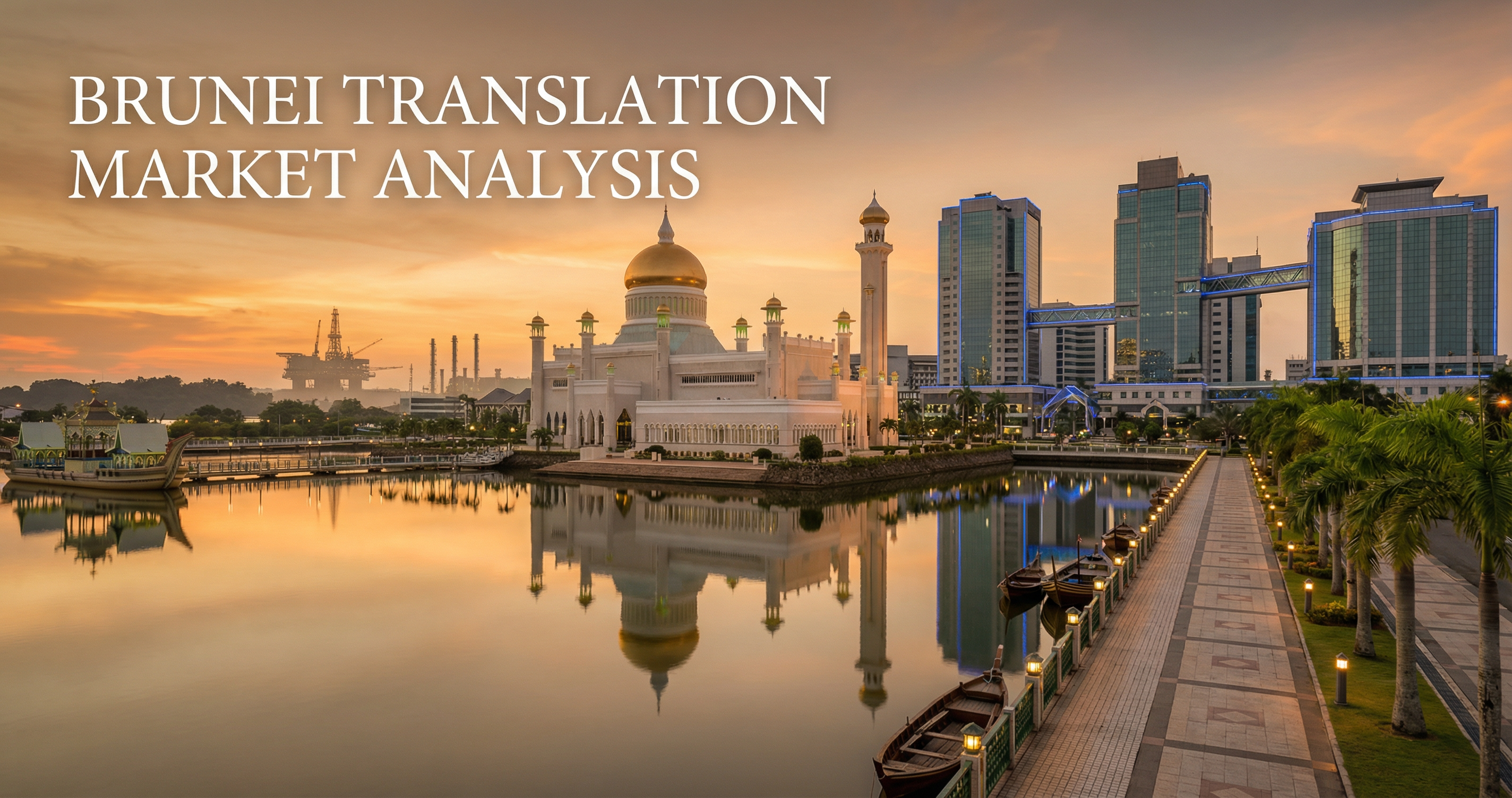
Brunei Darussalam presents one of the most distinctive translation markets in Southeast Asia—a government-centric ecosystem shaped by the nation's unique Malay Islamic Monarchy (MIB) philosophy, high-income oil economy, and bilingual Malay-English policy. With a population of just 450,000 people, Brunei's translation industry defies conventional market dynamics, operating as a specialized service primarily serving government institutions, the oil and gas sector, and Islamic affairs. This comprehensive analysis explores how a market valued at BND 8-15 million navigates the intersection of religious tradition, economic prosperity, and linguistic nationalism in one of ASEAN's most unique contexts.
Executive Summary
Brunei Darussalam's translation market represents a fascinating anomaly in the Southeast Asian language services landscape—a small, high-value ecosystem driven almost entirely by government demand rather than private enterprise. With an estimated market value of BND 8-15 million (approximately USD 6-11 million) and a conservative compound annual growth rate of 5-8%, the industry operates within parameters that bear little resemblance to its ASEAN neighbors.
The market's distinctive character stems from Brunei's unique national identity as a Malay Islamic Monarchy (MIB), where the Sultan serves as both head of state and head of religion, and where Malay culture and Islamic values form the foundation of governance. This philosophical framework creates translation requirements that extend far beyond conventional linguistic conversion—demanding cultural sensitivity, religious expertise, and adherence to royal protocol that few international language service providers can navigate effectively.
Government institutions constitute approximately 70-80% of translation demand, driven by the need to produce bilingual documentation for public services, international cooperation agreements, and the localization of materials supporting Wawasan Brunei 2035—the national vision for economic diversification and sustainable development. The remaining market segments serve Brunei's oil and gas industry (primarily Shell Petroleum and government-linked energy companies), the growing Islamic financial sector, and limited but strategically important tourism and education activities.
Unlike the fragmented freelance-heavy markets of Indonesia or the competitive agency landscape of Singapore, Brunei's translation industry features a small pool of highly specialized professionals, many of whom maintain government employment or long-term institutional relationships. Regional language service providers from Malaysia and Singapore serve supplementary demand, particularly for technical and commercial content, but MIB compliance requirements often necessitate local expertise or extensive quality assurance processes.
Key Market Indicators at a Glance
Brunei's Linguistic Profile: A Bilingual Nation with Deep Cultural Layers
Understanding Brunei's translation market requires deep appreciation of its complex linguistic ecosystem—a carefully maintained balance between Malay national identity, English practical necessity, and the preservation of diverse indigenous heritage languages. This linguistic architecture, deliberately constructed through decades of language policy, creates translation demands that are simultaneously narrow in volume and highly specialized in nature.
Malay Language and Brunei Dialect: The Foundation of National Identity
Malay serves as Brunei's official language and the cornerstone of its national identity, a status enshrined in the 1959 Constitution and reinforced through the MIB philosophy. However, the linguistic reality encompasses a fascinating duality: Standard Malay (Bahasa Melayu Baku) functions as the language of government, education, and formal communication, while Brunei Malay (Bahasa Melayu Brunei or "Kedayan") operates as the dominant spoken language among the ethnic Malay majority.
Brunei Malay differs substantially from Standard Malay in phonology, vocabulary, and grammatical structures. The dialect features distinct pronunciation patterns, including the use of /v/ sounds where Standard Malay uses /w/, and incorporates vocabulary from English, Chinese dialects, and indigenous languages that have shaped local communication over centuries. This linguistic distinction creates interesting translation dynamics: government documents must maintain Standard Malay purity for official purposes, while community-facing materials increasingly acknowledge Brunei Malay expressions to enhance accessibility and cultural resonance.
The Brunei Language and Literature Bureau (Dewan Bahasa dan Pustaka Brunei) plays a crucial role in language standardization, producing authoritative dictionaries and style guides that translation professionals must reference for government work. The Bureau's initiatives to promote "correct" Malay usage create ongoing demand for language review and editing services, effectively functioning as a quality assurance mechanism for official translations.
British Colonial English Legacy
English occupies a unique position in Brunei's linguistic hierarchy—as the language of commerce, higher education, and international engagement, yet formally subordinate to Malay in official contexts. This positioning reflects Brunei's British colonial history, which established English language education and administrative systems that persisted and evolved after independence in 1984.
The British legacy manifests in specific translation preferences that distinguish Brunei from neighboring Malaysia. Brunei English maintains British spelling conventions (colour, centre, organisation) and grammatical preferences, creating consistency requirements for localization projects. More significantly, the British educational influence established expectations for formal English that differ from American or ASEAN business English norms—particularly in government correspondence, legal documentation, and academic contexts.
The oil and gas industry, dominated by Shell's long-standing presence, reinforces British English conventions through technical documentation, safety protocols, and professional communication standards. Translators working in this sector must navigate the intersection of British English requirements, international petroleum industry terminology, and Malay localization needs—a specialized competency that commands premium rates in Brunei's limited translator pool.
Malay Islamic Monarchy (MIB) Language Policy
The MIB philosophy, formally articulated in 1990 and integrated into Brunei's national education system, creates perhaps the most distinctive translation environment in Southeast Asia. MIB mandates that Malay language serves not merely as a communication tool but as a vehicle for Islamic values and Malay cultural preservation—a conceptual framework that profoundly shapes translation requirements and quality expectations.
Under MIB principles, translation into Malay must preserve and promote Islamic terminology and cultural concepts. This creates specific challenges for technical and commercial content where Western concepts may not align with MIB values. Translators must exercise careful judgment in handling content related to entertainment, gender relations, financial practices, and social norms—areas where Western source materials may require cultural adaptation beyond linguistic conversion.
The government's National Malay Language Council (Majlis Bahasa Melayu Kebangsaan) actively promotes language purity and Islamic vocabulary enrichment, conducting regular workshops and terminology standardization exercises. These initiatives generate demand for specialized translation services that can navigate the evolving landscape of acceptable Malay terminology while maintaining practical communication effectiveness.
Brunei Malay vs. Standard Malay: Translation Implications
The tension between Brunei Malay (Kedayan) and Standard Malay creates practical translation challenges that extend beyond simple dialect variation. Government documents, educational materials, and official publications must adhere to Standard Malay norms, requiring translators to effectively "translate" from colloquial Brunei Malay when working with local source materials or community input. Conversely, public communication campaigns increasingly recognize the effectiveness of Brunei Malay for audience engagement, creating demand for translators who can authentically render content in the local dialect while maintaining appropriate tone and register.
This linguistic duality also affects interpretation services. Community meetings, healthcare consultations, and legal proceedings often involve participants more comfortable in Brunei Malay, requiring interpreters who can navigate between colloquial and formal registers while maintaining accuracy and cultural sensitivity. The relatively small population base means that qualified interpreters with this specialized competency command significant premiums for their services.
Indigenous Languages: Iban, Dusun, and Heritage Preservation
Brunei's indigenous communities maintain distinct linguistic heritages that, while small in absolute numbers, carry significant cultural importance. The Iban community, primarily residing in the Temburong district, speaks the Iban language (a Malayo-Polynesian language also spoken across the border in Sarawak, Malaysia). The Dusun and Murut communities in the interior regions maintain their own languages, which face the typical pressures of minority language survival in dominant Malay-speaking environments.
Translation demand for indigenous languages is extremely limited but strategically important for government relations, cultural preservation initiatives, and community health programs. The Brunei government maintains commitments to indigenous community engagement that occasionally require translation of public health information, educational materials, and cultural documentation. These specialized needs typically engage community-based translators rather than commercial language service providers.
Chinese Community Languages
Brunei's ethnic Chinese community, comprising approximately 10% of the population, primarily speaks Hokkien, Hakka, and increasingly Mandarin. Unlike Singapore or Malaysia, where Chinese languages maintain stronger institutional support, Brunei's Chinese linguistic presence operates primarily within community and family contexts, with limited official recognition or government translation requirements.
Commercial translation demand for Chinese languages emerges primarily from business relationships with Chinese companies in the oil and gas sector, construction industry, and emerging tourism partnerships. The Chinese business community in Brunei maintains connections across the South China Sea that occasionally require translation support, though most commercial communication proceeds in English or through Malaysia-based Chinese language service providers.
Bilingual Education System: Shaping the Translation Workforce
Brunei's education system operates on a dual-language foundation that systematically develops bilingual capabilities across the population. The National Education System for the 21st Century (SPN21), implemented in 2009, maintains Malay as the medium of instruction for core subjects while progressively expanding English language education. This structure produces graduates with varying degrees of bilingual proficiency, creating a translation workforce development pipeline that differs markedly from monolingual education systems.
The bilingual education policy generates specific translation needs within the education sector itself—curriculum materials, examination papers, and educational research must navigate between Malay and English in ways that support pedagogical objectives while maintaining linguistic standards. Universiti Brunei Darussalam (UBD) and other higher education institutions operate primarily in English, creating demand for academic translation services that support research publication, international collaboration, and student support materials.
However, the bilingual education system also presents challenges for translation workforce development. The emphasis on English for higher education and career advancement creates a "prestige gradient" that attracts the most capable language professionals toward English-medium careers, potentially limiting the pool of highly qualified Malay linguists available for translation work. This dynamic partially explains the government's reliance on institutional training programs and overseas scholarship programs to develop specialized translation capabilities.
Language Purity Movements and Their Impact
Brunei's language authorities actively promote Malay language purity through campaigns against excessive English borrowing and "language mixing" (campuran bahasa). The "Love Your Language" (Cintailah Bahasa Kebangsaan) campaign and similar initiatives create an environment where translation quality is judged not only on accuracy but on adherence to language purity standards that reject excessive loanwords and code-switching.
These purity movements generate demand for specialized editing and review services that "cleanse" translations of unwanted foreign influences. Government documents, in particular, undergo scrutiny for language purity that can delay publication schedules and increase revision costs. Translators working in Brunei must develop sensitivity to these concerns, often maintaining parallel vocabulary lists that offer "pure Malay" alternatives to common technical terms that might otherwise be rendered through English borrowing.
Economic and Political Context: Oil Wealth and Government Dominance
Brunei's translation market operates within an economic and political environment unlike any other in Southeast Asia. The country's status as a high-income oil economy, governed by an absolute monarchy with comprehensive welfare provision, creates a translation market shaped primarily by government priorities rather than private sector competitive dynamics.
Oil & Gas Economy: The Economic Foundation
Brunei's economy rests on hydrocarbon production, with petroleum and natural gas exports accounting for over 90% of export earnings and approximately 60% of GDP. This economic structure, dominated by the government through Brunei Shell Petroleum and various state-owned enterprises, creates translation demand patterns that reflect the industry's international orientation and technical complexity.
The oil and gas sector generates substantial translation requirements for technical documentation, safety protocols, environmental compliance reports, and international joint venture communications. These needs operate largely in English, with Malay localization required for government submissions, workforce training materials, and community engagement documents. The technical nature of petroleum industry content demands specialized translators with domain expertise—a limited resource pool that supports premium pricing.
Shell's long-standing presence in Brunei (dating to 1929) has established British technical English as the industry standard, creating consistency requirements that influence translator selection and quality expectations. International standards from API, ISO, and other technical bodies require careful localization that maintains precision while adapting to Brunei's specific regulatory and cultural context.
High-Income Status: Implications for Translation Services
Brunei's classification as a high-income economy (per capita GDP exceeding USD 35,000) creates a translation market with distinctive characteristics. The affluent population, supported by comprehensive government subsidies for housing, healthcare, and education, maintains purchasing power that supports quality expectations inconsistent with the small population base.
However, the high-income status paradoxically limits private sector translation demand. The small domestic market, combined with generous public sector employment opportunities, reduces entrepreneurial incentives for private business development. Most Bruneians enjoy comfortable government employment with extensive benefits, creating a labor market where freelance translation represents either a supplementary income source or a specialized government contract relationship rather than a competitive private sector career.
Government Dominance: The Primary Client
The Brunei government, as both the largest employer and primary economic actor, dominates translation demand to a degree unmatched elsewhere in ASEAN. Government ministries, departments, and agencies collectively account for approximately 70-80% of translation expenditure—a concentration that creates market dynamics more akin to monopoly procurement than competitive marketplaces.
This government dominance shapes translation service delivery in several ways. Procurement processes follow government tender procedures with extended timelines and specific compliance requirements. Quality standards reflect government expectations that may prioritize formal correctness and MIB alignment over speed or cost efficiency. Payment terms follow government fiscal cycles, creating cash flow considerations that favor established providers with financial reserves.
Wawasan Brunei 2035: National Vision and Translation Demand
Brunei's long-term development strategy, Wawasan Brunei 2035, articulates ambitions for economic diversification, human capital development, and international engagement that will shape translation demand over the coming decade. The vision's emphasis on developing a "globally competitive, entrepreneurial, and diversified economy" implies increasing international business activity—and corresponding translation requirements.
Specific Wawasan 2035 initiatives with translation implications include: development of the Islamic financial sector requiring Sharia-compliant documentation; tourism promotion requiring multilingual marketing materials; foreign investment attraction needing business communication support; and international education initiatives requiring academic translation services. The vision's emphasis on Malay Islamic Monarchy values reinforces the importance of MIB-compliant translation that preserves cultural and religious authenticity.
ASEAN and Islamic Cooperation Frameworks
Brunei's dual membership in ASEAN and the Organisation of Islamic Cooperation (OIC) creates distinctive translation demand patterns. ASEAN engagement requires translation for regional cooperation agreements, diplomatic communications, and participation in regional initiatives. The OIC membership generates requirements for Islamic affairs documentation, halal industry coordination, and engagement with the broader Muslim world.
Brunei's 2013 ASEAN chairmanship demonstrated the intensive translation requirements of regional leadership—ministerial meetings, summit documentation, public communications, and diplomatic correspondence all required sophisticated language services. While such peak demands are cyclical, ongoing ASEAN participation maintains baseline translation requirements that support specialized institutional capacity.
Market Size and Characteristics: Small but Distinctive
Quantifying Brunei's translation market requires acknowledging fundamental differences from conventional market analysis. The government-centric nature, limited private sector, and absence of commercial language service providers create a market structure where standard industry metrics—number of agencies, freelance market size, competitive pricing—provide limited insight.
Industry Valuation Methodology
Estimating Brunei's translation market at BND 8-15 million (USD 6-11 million) annually requires combining government expenditure analysis, oil industry service procurement patterns, and regional comparison benchmarking. This estimate encompasses direct translation services, localization projects, interpretation, and related language services across all sectors.
Government translation expenditure derives from ministry operational budgets, particularly the Prime Minister's Office, Ministry of Foreign Affairs, Ministry of Education, and Ministry of Religious Affairs. Analysis of government procurement records, combined with staffing levels for translation positions, suggests annual government translation expenditure of BND 6-10 million—representing the vast majority of total market value.
Private sector translation demand, while growing, remains relatively modest. The oil and gas industry accounts for BND 1.5-3 million in annual translation expenditure, primarily through international contractors and specialized technical documentation. Other private sector activity—tourism, retail, financial services—generates limited but increasing demand as Brunei pursues economic diversification under Wawasan 2035.
Growth Patterns: Conservative but Steady
The Brunei translation market demonstrates conservative growth patterns reflecting the broader economy's stability and government-driven dynamics. Estimated compound annual growth of 5-8% reflects: incremental expansion of government documentation requirements; increasing international cooperation activity; growing oil sector technical documentation needs; and gradual private sector development. This growth rate, while modest compared to dynamic ASEAN markets like Vietnam or Indonesia, offers stability absent from more volatile environments.
Government as Primary Client: Market Structure Implications
Government dominance as the primary translation client creates market characteristics that differ fundamentally from competitive private sector environments. Procurement follows public sector tender processes with extended timelines, detailed specification requirements, and formal evaluation criteria. Quality assurance emphasizes accuracy, MIB compliance, and adherence to government style guides over speed or cost minimization.
The government client relationship tends toward long-term institutional relationships rather than transactional project-based engagement. Translators who establish credibility with government ministries often enjoy ongoing work relationships spanning years, creating barriers to entry for new providers but supporting service continuity and institutional knowledge development.
Limited Private Sector: Constraints and Potential
Brunei's private sector, constrained by the small domestic market and government competition for talent, generates limited but strategically important translation demand. The oil and gas industry dominates private sector translation requirements, followed by emerging activity in Islamic finance, halal industry development, and limited tourism promotion. Private sector translation typically operates through international service providers, Malaysia-based agencies, or freelance arrangements rather than local commercial translation companies.
Small Absolute Size Due to Population Constraints
With a population of approximately 450,000—ASEAN's smallest—Brunei's translation market faces absolute size constraints that limit economies of scale and commercial viability of specialized services. The domestic market cannot support the range of specialized translation services available in larger ASEAN capitals, requiring import of expertise for niche requirements.
Population constraints also affect translator workforce development. The small talent pool means that specialized competencies—technical translation, legal translation, medical interpretation—remain scarce and expensive. This scarcity reinforces reliance on government employment for stable career paths, limiting freelance market development and competitive pricing dynamics.
Sector Analysis: Understanding Industry-Specific Translation Demand
Brunei's translation market segments reflect the country's economic structure and government priorities. Unlike more diversified ASEAN economies where multiple sectors generate substantial translation demand, Brunei's sector profile shows concentration in government services, oil and gas, and Islamic affairs—with emerging activity in areas targeted by Wawasan 2035 diversification initiatives.
Government & Public Sector: The Dominant Segment
Government and public sector translation constitutes approximately 70-80% of Brunei's translation market, reflecting the state's dominant role in economic and social activity. This segment encompasses diverse requirements across ministries and government agencies, each with specialized content needs and quality standards.
Policy Documents and Legislative Translation
Government policy documents, legislation, and official publications require the highest level of translation precision, often involving multiple review stages and formal approval processes. The translation of laws and regulations from English (the drafting language for many modern statutes) into Malay must preserve legal precision while maintaining Malay language purity standards—a demanding combination that engages senior government translators and external legal language specialists.
International Cooperation Documentation
Brunei's international engagement generates substantial translation requirements for diplomatic correspondence, treaty documentation, ASEAN cooperation materials, and OIC (Organisation of Islamic Cooperation) submissions. The Ministry of Foreign Affairs maintains specialized translation capabilities for these sensitive materials, with quality standards reflecting the diplomatic stakes of accurate communication.
Islamic Affairs Translation
The Ministry of Religious Affairs generates specialized translation requirements for Islamic materials, including educational content, Friday sermon translations, international Islamic conference documentation, and religious publication localization. These translations require not only linguistic expertise but Islamic scholarship to ensure theological accuracy and appropriate terminology. The specialized nature of religious translation creates a niche serviced by a small number of qualified practitioners.
Oil & Gas Industry: Technical Translation Excellence
Brunei Shell Petroleum and related energy sector activities generate sophisticated technical translation requirements that demand domain expertise alongside linguistic capability. The industry operates primarily in English, with Malay localization required for government compliance, workforce development, and community engagement.
Technical Documentation
Petroleum industry technical documentation—engineering specifications, safety protocols, environmental impact assessments, operational procedures—requires translation that maintains absolute precision in terminology and technical accuracy. The consequences of translation errors in safety-critical materials create quality assurance requirements that include multiple review stages and subject matter expert verification. Translators serving this sector typically combine language expertise with engineering or technical backgrounds.
International Standards Localization
Brunei's oil and gas industry operates within international standards frameworks (API, ISO, IEC) that require localization for local regulatory compliance and workforce training. Standards translation demands expertise in both technical content and regulatory frameworks, with accuracy requirements that preclude generalist translation approaches. These specialized requirements typically engage international service providers or highly qualified freelance specialists rather than generalist local translators.
Education: Bilingual System Requirements
Brunei's bilingual education system generates ongoing translation requirements for curriculum development, examination materials, educational research, and international academic collaboration. Universiti Brunei Darussalam (UBD) and other higher education institutions operate primarily in English while maintaining Malay language programs, creating dual-track translation needs.
Bilingual Curriculum Development
The Ministry of Education's bilingual curriculum requires translation and adaptation of educational materials across subject areas, maintaining pedagogical effectiveness while navigating between English and Malay language content. This work involves not merely translation but educational localization—adapting content to suit different linguistic and cultural learning contexts while maintaining educational standards.
Higher Education Internationalization
UBD's internationalization initiatives, including partnerships with overseas universities and recruitment of international students and faculty, generate academic translation requirements for research collaboration, joint program documentation, and institutional communications. The university's bilingual policy requires that official documents maintain parallel English and Malay versions, supporting ongoing translation activity.
Islamic Affairs: Specialized Religious Translation
Brunei's identity as an Islamic nation creates specialized translation requirements for religious materials, Islamic legal documentation, international Islamic cooperation, and halal industry development. These translations require Islamic scholarship alongside linguistic expertise, creating a specialized niche with limited practitioner availability.
Religious Materials
Translation of religious texts, educational materials, and theological content requires sensitivity to Islamic terminology, interpretive traditions, and the theological implications of translation choices. The Ministry of Religious Affairs and religious educational institutions require translation services that can navigate the complexities of Islamic discourse while maintaining accessibility for Brunei's Muslim population.
Halal Certification and Islamic Finance
Brunei's development of halal industry capabilities and Islamic financial services generates translation requirements for certification documentation, Sharia compliance materials, and international business communications. These specialized domains require translators with understanding of Islamic jurisprudence, financial terminology, and international halal standards—a rare combination that commands premium compensation.
Tourism: Limited but Growing
Brunei's tourism sector, while modest compared to ASEAN neighbors, generates increasing translation requirements as the country pursues diversification under Wawasan 2035. Tourism promotion materials, heritage site documentation, hospitality services, and visitor information require multilingual content that showcases Brunei's cultural attractions while maintaining MIB-appropriate messaging.
Legal & Sharia: Dual Justice System
Brunei's dual legal system—secular law based on English common law and Islamic Sharia law—creates specialized legal translation requirements. The implementation of the Syariah Penal Code Order 2013 expanded the scope of Islamic legal proceedings, generating demand for translation services that can navigate both legal traditions and their intersections. Legal translation in this context requires not merely linguistic precision but understanding of comparative legal systems and the cultural sensitivities of Brunei's legal environment.
Healthcare: Public Service Translation
Brunei's comprehensive public healthcare system generates translation requirements for medical documentation, public health campaigns, patient education materials, and international medical cooperation. The Ministry of Health operates primarily in English for professional contexts while providing Malay-language services for public communication, creating ongoing translation needs that support healthcare accessibility.
Government-Driven Market Dynamics: Understanding the Primary Force
The government-centric nature of Brunei's translation market creates distinctive dynamics that shape pricing, quality standards, service delivery models, and professional development pathways. Understanding these government-driven patterns is essential for any analysis of Brunei's translation industry.
Public Procurement Processes
Government translation services are procured through formal tender processes governed by Brunei's procurement regulations, which emphasize transparency, competitive evaluation, and compliance with government policies. These processes, while ensuring fair access to government contracts, create extended timelines and administrative requirements that favor established providers with dedicated administrative capacity.
Tender specifications typically include detailed requirements for translator qualifications, quality assurance processes, confidentiality protocols, and MIB compliance verification. Evaluation criteria prioritize quality and reliability over cost minimization, reflecting the government's capacity to pay for premium services and the high stakes of translation errors in official contexts.
Localization Policies and Government Mandates
Government policies mandating Malay language use in official contexts drive translation demand that might otherwise be handled in English alone. These localization mandates, reflecting MIB philosophy and language nationalism, require that government communications, publications, and public-facing materials maintain Malay versions parallel to English content—effectively doubling documentation requirements and ensuring sustained translation demand.
MIB Considerations in Translation Quality
MIB compliance extends beyond linguistic accuracy to encompass cultural appropriateness, Islamic values alignment, and Malay cultural authenticity. Government translation quality assurance includes review processes that assess content for MIB alignment, potentially requiring revisions that prioritize philosophical conformity over literal accuracy or source-text fidelity.
Translators working with government clients must develop sensitivity to MIB expectations—understanding not merely what translation is technically correct, but what content will receive government approval. This specialized knowledge, developed through experience and institutional relationships, represents significant professional capital in Brunei's translation market.
Religious Sensitivity and Content Standards
Government translation standards incorporate religious sensitivity requirements that may necessitate adaptation beyond linguistic conversion. Content involving religious themes, moral issues, or Islamic practice requires careful handling to ensure theological appropriateness and cultural respect. Translators must navigate the complex intersection of source content, target audience expectations, and government content standards—a challenge that distinguishes Brunei translation from more secular markets.
Regional Context: Geographic Distribution and Cross-Border Dynamics
Brunei's small size and concentrated population create geographic translation market patterns distinct from larger, more dispersed ASEAN countries. Understanding regional distribution provides insight into service delivery logistics, translator availability, and cross-border relationships that shape the industry.
Bandar Seri Begawan: The Government and Commerce Center
The capital city, Bandar Seri Begawan, concentrates the vast majority of Brunei's translation activity. Government ministries, the headquarters of Brunei Shell Petroleum, major educational institutions, and the limited commercial translation providers all locate in or near the capital. This concentration simplifies service delivery logistics but creates geographic limitations for services requiring local presence in other districts.
Kuala Belait: The Oil Town
The western district of Belait, centered on Kuala Belait and Seria, generates translation demand primarily from oil and gas operations. Shell's operational headquarters and related service companies maintain documentation and training requirements that support local translation activity, though most sophisticated services are sourced from Bandar Seri Begawan or international providers.
Tutong and Temburong: Limited but Strategic
The Tutong district, with its mixed agricultural and developing commercial base, and the isolated Temburong district (connected to the rest of Brunei by the spectacular Sultan Haji Omar Ali Saifuddien Bridge since 2020), generate limited but strategically important translation needs. Government services, education, and community development programs in these districts require localized translation support, often provided through mobile service delivery from the capital or digital remote services.
Cross-Border Relationships with Malaysia
Brunei's enclaved position within Sarawak, Malaysia, creates practical cross-border translation dynamics. Malaysian language service providers, particularly those based in Miri and Kuching, supplement Brunei's limited local capacity for specialized or high-volume projects. The close linguistic and cultural ties between Brunei and Malaysian Borneo facilitate these cross-border arrangements, though MIB compliance requirements often necessitate additional quality assurance for government work.
The Malaysia-Brunei border also enables "translation arbitrage"— accessing Malaysian translator talent at lower cost than Brunei's premium market rates. However, government procurement rules and MIB compliance considerations limit the extent of cross-border outsourcing, ensuring that significant government translation activity remains within Brunei-based providers.
Technology and Innovation: Digital Infrastructure and Translation Tools
Brunei's advanced digital infrastructure and government technology investments create an environment where translation technology adoption follows distinctive patterns—sophisticated in government implementation but limited in local technology development.
High Digital Infrastructure
Brunei boasts among the highest internet penetration rates in ASEAN, with widespread broadband access and advanced mobile connectivity. This infrastructure supports remote translation service delivery, cloud-based translation management, and digital collaboration tools that enable efficient workflow regardless of geographic location.
The country's small size facilitates comprehensive infrastructure coverage—unlike larger ASEAN countries with rural-urban digital divides, Brunei's entire population enjoys high-quality connectivity that enables sophisticated translation technology deployment.
Government Digitalization Initiatives
Brunei's e-Government initiatives and digital transformation programs create requirements for multilingual digital content, user interface localization, and automated translation integration. Government digital services must maintain Malay and English versions, driving demand for localization expertise alongside translation services.
The government's technological sophistication supports adoption of advanced translation tools—computer-assisted translation (CAT) tools, terminology management systems, and machine translation post-editing workflows find receptive implementation environments in government translation operations.
Limited Local Technology Development
Unlike Singapore or Malaysia, Brunei does not host significant translation technology development activity. The domestic market's small size cannot support technology investment, and the government-centric nature of translation demand reduces competitive pressure for technological innovation. Brunei's translation technology landscape primarily involves adoption of international tools rather than local development.
Import of Translation Solutions and Services
Brunei's translation technology ecosystem relies on imported solutions—international CAT tools, cloud-based translation management platforms, and machine translation services. This technology import pattern mirrors broader economic dynamics where the high-income, small-population context favors importing sophisticated solutions rather than local development.
Industry Structure: Participants and Professional Landscape
Brunei's translation industry structure reflects the market's government-centric character and small population base. The absence of a thriving commercial translation sector creates a professional landscape dominated by government employment and limited freelance activity, supplemented by regional service providers for specialized requirements.
Small Local Translator Pool
Brunei's professional translator pool is extremely limited in absolute numbers—likely fewer than 100 full-time professional translators serve the entire country, with the majority employed by government institutions. This constraint creates a "seller's market" where qualified translators enjoy strong bargaining positions and stable employment relationships.
The small talent pool also means that specialized competencies (legal translation, technical translation, medical interpretation) are scarce resources commanding premium compensation. Organizations requiring specialized translation often face extended procurement timelines and limited provider choice.
Government-Employed Linguists
The core of Brunei's translation capacity resides in government employment—ministries and agencies maintain in-house translation units that handle the majority of official translation requirements. These government linguists enjoy civil service employment conditions with job security, benefits, and pension provisions that compare favorably to freelance alternatives.
Government employment provides translators with institutional access to specialized training, government style guides, and institutional knowledge that enhances translation quality for official purposes. However, this employment structure also means that government translation capacity is not readily available to private sector clients, creating market segmentation between public and private translation services.
Regional LSPs: Malaysian and Singaporean Presence
Regional language service providers, particularly from Malaysia and Singapore, supplement Brunei's limited local capacity. Malaysian agencies in Miri and Kuching provide convenient cross-border services with cultural and linguistic familiarity. Singapore-based providers offer sophisticated technical and specialized capabilities that exceed local availability.
However, regional LSP presence in Brunei remains limited compared to larger ASEAN markets. The small market size, government procurement complexities, and MIB compliance requirements discourage sustained commercial investment by international providers. Regional involvement typically takes project-based rather than permanent establishment form.
Freelance Landscape: Limited but Established
Freelance translation activity in Brunei operates at limited scale, with most language professionals preferring government or corporate employment for income security. The small market means that freelance translators often maintain multiple income streams— teaching, government contracts, and private sector work—rather than pure translation specialization.
Challenges: Constraints and Industry Pressures
Brunei's translation industry faces distinctive challenges that reflect the market's unique characteristics—challenges that differ markedly from those confronting larger, more competitive ASEAN translation markets.
Small Market Size Constraints
The fundamental constraint of Brunei's small population (450,000) and correspondingly limited absolute translation demand creates structural challenges for industry development. The market cannot support specialized service diversification, technology investment, or competitive provider proliferation that characterize larger markets. This constraint limits service availability, increases costs for specialized requirements, and reduces competitive pressure that might drive quality improvement or innovation.
Limited Talent Pool and Workforce Development
The small population base limits translator workforce development, particularly for specialized domains requiring technical, legal, or medical expertise. Brunei cannot support dedicated translation training programs comparable to those in Malaysia or Singapore, relying instead on general education and on-the-job development. The most ambitious language professionals often pursue education and employment abroad, creating brain drain pressures that further limit domestic capacity.
Government Dependency Risks
The industry's heavy reliance on government demand creates vulnerability to fiscal constraints, policy changes, and government efficiency initiatives. Budget reductions, procurement process reforms, or decisions to develop in-house translation capacity could significantly impact market demand. The concentration of translation activity in government hands also limits private sector market development and competitive dynamics.
MIB Compliance Complexity
The specialized knowledge required for MIB-compliant translation creates barriers to entry that limit provider availability and increase costs. International translators and regional providers often lack the cultural and religious context necessary for government-quality work, requiring extensive briefing and review processes. The subjective nature of MIB compliance assessment introduces uncertainty into translation project delivery and quality assurance.
Economic Diversification Uncertainty
Wawasan Brunei 2035 articulates ambitious diversification goals, but uncertainty about implementation success creates planning challenges for translation service development. Private sector translation demand growth depends on successful economic transformation—if diversification falters, translation market expansion will remain constrained to incremental government demand growth rather than dynamic private sector development.
Opportunities: Growth Pathways and Strategic Potential
Despite structural constraints, Brunei's translation market presents specific opportunities aligned with national development priorities, regional positioning, and emerging economic sectors. Understanding these opportunities provides strategic guidance for market participants.
Wawasan Brunei 2035 Implementation
Successful implementation of Wawasan Brunei 2035 would generate substantial translation demand across multiple sectors: Islamic financial services development requiring Sharia-compliant documentation; tourism promotion requiring multilingual marketing content; foreign investment attraction requiring business communication support; and international education development requiring academic translation services. Translation providers aligned with these diversification priorities position themselves for demand growth as initiatives mature.
ASEAN Chairmanship and Regional Engagement
Brunei's periodic ASEAN chairmanship (most recently in 2013, with future rotation expected) creates peak translation demand periods that, while cyclical, generate substantial revenue opportunities and institutional capacity development. Regional engagement beyond chairmanship years—including participation in ASEAN sectoral bodies and working groups—maintains baseline demand for diplomatic and technical translation that supports specialized capability development.
Islamic Financial Services Development
Brunei's ambitions to develop as an Islamic financial center create specialized translation demand for Sharia-compliant documentation, Islamic banking materials, and international Islamic financial cooperation. This specialized domain requires translators with Islamic finance expertise—familiarity with Sharia principles, Islamic banking terminology, and international Islamic financial standards. Early development of these specialized capabilities positions providers for growth as the sector expands.
Halal Industry Expansion
Brunei's halal industry development—from food production to logistics and certification services—generates translation requirements for international market access. Halal certification documentation, export compliance materials, and international business development content require translation that navigates both technical accuracy and Islamic compliance requirements. The global halal market's growth trajectory suggests sustained demand expansion for these specialized services.
English-Malay Bridge Role for Regional Markets
Brunei's sophisticated bilingual environment positions the country as a potential hub for English-Malay translation services serving regional markets—particularly for Islamic and MIB-compliant content requiring cultural expertise that Malaysian or Singaporean providers may lack. Developing this regional service niche could expand market opportunity beyond domestic demand limitations.
Unique Considerations: Factors Distinctive to Brunei
Several factors make Brunei's translation market genuinely unique within ASEAN—considerations that shape service delivery, quality expectations, and professional requirements in ways that differ fundamentally from neighboring markets.
MIB Compliance in Content Standards
MIB compliance represents more than a quality consideration—it constitutes a gatekeeping mechanism for government and official translation work. Translators must develop sophisticated understanding of MIB expectations: appropriate treatment of religious themes, proper respect for Malay cultural values, alignment with Islamic principles, and maintenance of Malay language purity. These requirements extend quality assurance beyond linguistic accuracy to encompass cultural and philosophical conformity.
Islamic Terminology and Religious Sensitivity
Islamic terminology requires handling that respects theological nuances and interpretive traditions. Translation of religious concepts, Sharia principles, and Islamic practices demands expertise that extends beyond linguistic competence to encompass Islamic scholarship. The consequences of inappropriate religious terminology can extend beyond translation quality to cause genuine offense and institutional damage.
Royal Protocol Language
Brunei's absolute monarchy creates distinctive translation requirements for royal protocol—proper forms of address, appropriate reference to royal institutions, and suitable language for communications involving the Sultan and royal family. These protocol requirements, while infrequently relevant for general translation work, become crucial for government communications, international correspondence, and ceremonial documentation. Specialized knowledge of royal protocol represents significant professional expertise in Brunei's context.
Regional Malay Variations and Brunei Specificity
Brunei Malay differs from Malaysian and Indonesian Malay in ways that create translation considerations. Vocabulary choices, idiomatic expressions, and pronunciation preferences that may be acceptable in Kuala Lumpur or Jakarta may not suit Brunei government standards. Translators working with Brunei content must develop sensitivity to these Brunei-specific preferences, effectively mastering a "Brunei register" of Malay that may differ from their experience with other Malay varieties.
Strategic Recommendations
Based on this comprehensive analysis, the following recommendations provide actionable guidance for different stakeholders in Brunei's translation market.
For Government Clients
- Develop specialized translator training programs to expand the qualified talent pool, particularly for technical, legal, and Islamic content domains.
- Establish clear MIB compliance guidelines for translation quality assurance, reducing subjectivity and accelerating approval processes.
- Invest in translation technology infrastructure to improve efficiency and support consistent quality across government agencies.
- Create regional cooperation frameworks with Malaysian and Indonesian language authorities to share terminology resources and translator training capacity.
For International Businesses
- Engage local partners for MIB compliance rather than relying solely on international translation providers. Cultural sensitivity requires local expertise.
- Plan extended timelines for translation projects involving government submission or public communication, recognizing review and approval processes.
- Invest in relationship development with government agencies and local translators to build institutional knowledge and facilitate future projects.
- Prioritize quality over cost given the high stakes of MIB compliance and the relatively limited provider options in the Brunei market.
For Translators
- Develop MIB expertise as a core competency, studying the philosophical framework and government expectations that shape translation requirements.
- Pursue specialization in high-demand domains (Islamic content, oil and gas, legal/ Sharia) where limited supply supports premium pricing.
- Build government relationships through consistent quality delivery and cultural sensitivity, recognizing the importance of institutional trust in Brunei's market.
- Maintain technology proficiency to efficiently serve a market where digital infrastructure supports sophisticated translation workflows.
Conclusion: Market Outlook and Niche Positioning
Brunei Darussalam's translation market defies easy comparison with ASEAN neighbors. Its government-centric structure, MIB philosophical framework, high-income small-population context, and specialized quality requirements create an ecosystem that operates according to logic distinct from the competitive marketplaces of Singapore, Malaysia, or Indonesia.
The market outlook remains cautiously positive, with growth prospects tied to Wawasan Brunei 2035 implementation, Islamic financial sector development, and gradual economic diversification. However, fundamental constraints—small population, limited talent pool, government dependency—suggest that Brunei's translation market will remain a specialized niche rather than a dynamic, rapidly expanding sector.
For market participants, success in Brunei requires embracing these unique characteristics rather than attempting to impose models from larger, more competitive markets. The translation professionals and service providers who thrive in Brunei will be those who develop genuine MIB expertise, build lasting government relationships, and position themselves as trusted partners in a market where institutional trust matters more than competitive pricing or technological sophistication.
Brunei's translation market ultimately rewards specialization, cultural integration, and patience—a market environment that mirrors the broader characteristics of this distinctive Southeast Asian nation, where tradition, prosperity, and careful modernization combine to create opportunities for those who understand and respect its unique context.
About This Analysis
This comprehensive market analysis was prepared by Translife.co's research team, drawing on government publications, industry interviews, and regional comparison analysis. Data reflects conditions as of 2025. For ongoing market updates and country-specific translation intelligence, subscribe to our ASEAN Translation Market Monitor.