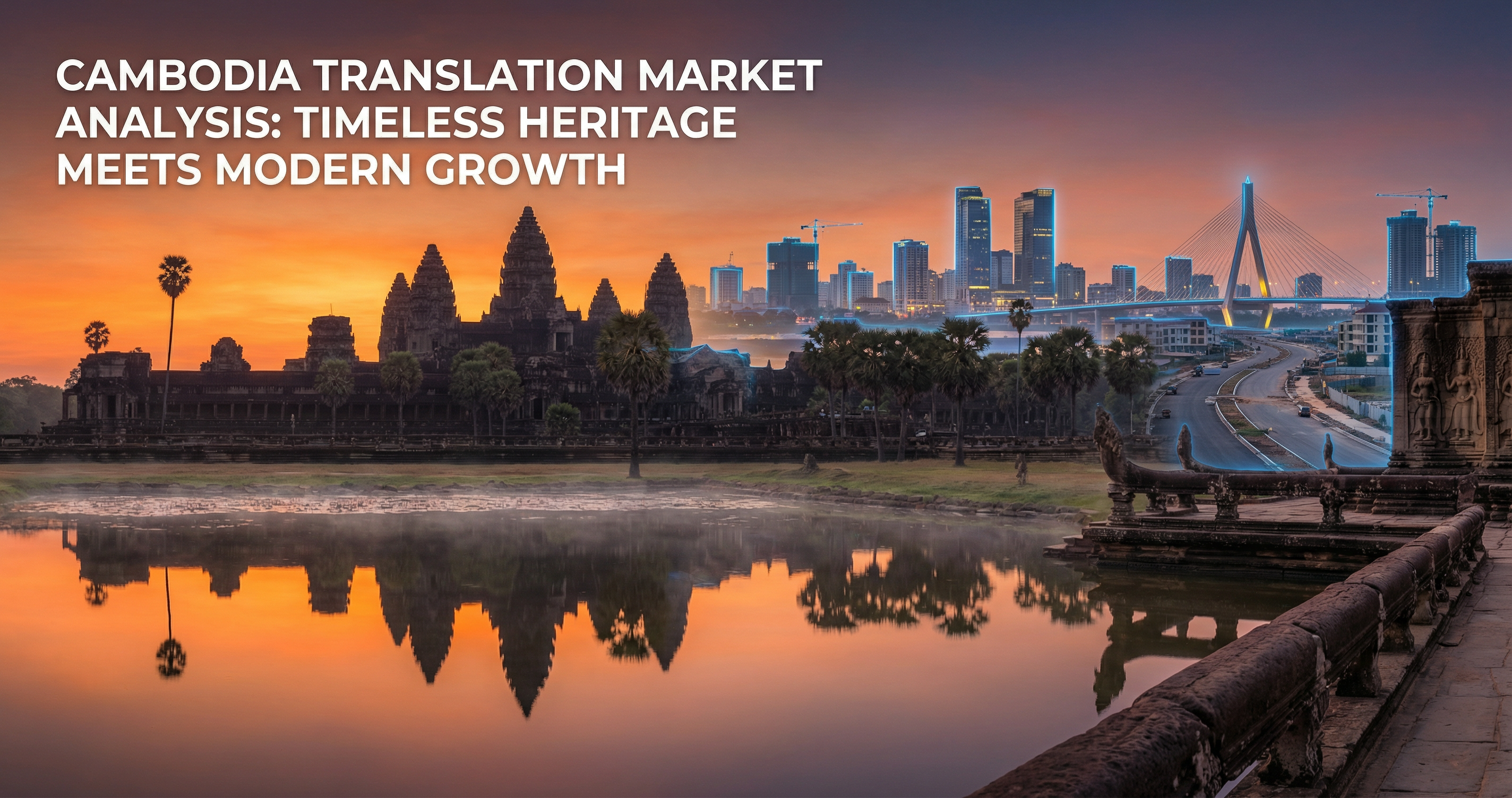
Cambodia presents one of Southeast Asia's most distinctive translation market profiles. Unlike the manufacturing-driven markets of Vietnam or the financial services hubs of Singapore, Cambodia's translation industry is fundamentally shaped by international development priorities, humanitarian imperatives, and post-conflict reconstruction needs. With a population of over 17 million people, the legacy of French colonial administration, and the profound scars of the Khmer Rouge era, Cambodia's linguistic landscape reflects a nation navigating between historical preservation and rapid modernization. The market, valued between KHR 80-150 billion (USD 20-37 million), operates under dynamics distinct from anywhere else in ASEAN—a development-driven ecosystem where donor priorities, NGO mandates, and capacity-building imperatives drive demand more than commercial considerations.
Executive Summary: Cambodia's Development-Driven Translation Landscape
Cambodia's translation market occupies a unique niche within Southeast Asia's language services ecosystem. While neighboring countries have developed translation industries driven primarily by manufacturing FDI, financial services, or technology sectors, Cambodia's market remains fundamentally structured around international development priorities. This development-centric character stems from the nation's post-conflict context, where international aid organizations, UN agencies, and non-governmental organizations (NGOs) have played outsized roles in reconstruction and capacity building since the 1990s.
The market size, estimated at KHR 80-150 billion annually (approximately USD 20-37 million), reflects both Cambodia's smaller population base and the specific nature of translation demand. Growth rates of 12-16% compound annual growth rate (CAGR) indicate steady expansion, though significantly below the explosive growth seen in Vietnam or Indonesia. This moderate growth reflects the mature state of development-sector translation demand alongside nascent private sector development.
Key structural characteristics distinguish Cambodia from regional peers. The development and NGO sector accounts for over 50% of total market value—likely the highest proportion in ASEAN. French maintains surprising relevance due to colonial history and ongoing francophone development partnerships, while Chinese language demand grows rapidly alongside investment flows. The Khmer language itself presents unique challenges: an ancient script with complex orthography, limited digital infrastructure compared to Latin-based languages, and ongoing Unicode standardization efforts that affect translation workflows.
Looking forward, Cambodia's translation market faces both opportunities and structural challenges. ASEAN integration continues to drive English language demand, Chinese Belt and Road Initiative investments create new linguistic requirements, and tourism recovery post-COVID generates hospitality translation needs. However, professional capacity limitations, quality standardization gaps, and the small scale of the domestic private sector constrain market development. The next five years will determine whether Cambodia can diversify beyond development-sector dependency toward a more balanced translation economy.
Cambodia Market at a Glance
Cambodia's Linguistic Heritage: Ancient Scripts and Colonial Legacies
Understanding Cambodia's translation market requires deep appreciation of the nation's complex linguistic heritage—a tapestry woven from ancient Khmer civilization, French colonial administration, post-colonial nation-building, and contemporary ASEAN integration pressures. This linguistic landscape shapes translation demand patterns, quality expectations, and market dynamics in ways distinct from Cambodia's neighbors.
The Khmer Language: Characteristics and Complexity
Khmer (ភាសាខ្មែរ), the official language of Cambodia, belongs to the Austroasiatic language family, sharing distant historical roots with Vietnamese. Unlike Thai or Lao—which adopted Brahmic scripts but evolved into tonal languages—Khmer maintains non-tonal characteristics while using a script derived from ancient Pallava scripts of South India. This unique linguistic profile creates specific translation challenges not encountered in tonal Southeast Asian languages.
The Khmer script comprises 33 consonants, 24 dependent vowels, 12 independent vowels, and various diacritical marks. This orthographic complexity presents substantial challenges for digital processing. Unlike Latin-based scripts where keyboard input directly corresponds to characters, Khmer requires complex rendering rules where consonant clusters (called "subscript consonants") stack vertically beneath base consonants. These rendering complexities have historically complicated translation memory systems, terminology management tools, and machine translation integration.
Khmer's grammatical structure differs markedly from Indo-European languages. The language lacks inflection—words do not change form to indicate tense, number, or case. Instead, grammatical relationships are expressed through word order, particles, and context. This analytic structure creates translation equivalence challenges: English sentences with complex verb tenses must be reconstructed entirely differently in Khmer, often requiring translators to add temporal context that the source text implies but Khmer must state explicitly.
Register and social hierarchy profoundly influence Khmer language use. The language incorporates multiple registers indicating social status, Buddhist religious context, and royal contexts. Translation for development purposes must navigate these registers carefully: rural community materials require different linguistic registers than government correspondence or materials for the educated urban elite. Professional Khmer translators must make deliberate register choices that match target audiences—a complexity absent from English source materials that may not encode such distinctions.
Ancient Script and Digital Challenges
The transition of Khmer from ancient manuscript traditions to digital workflows presents ongoing challenges for the translation industry. Khmer was among the more complex scripts to implement in Unicode, with standardization finalized only in Unicode 5.0 (2006). Even today, inconsistencies in font rendering, input method implementations, and cross-platform compatibility create practical complications for translation workflows.
Computer-Aided Translation (CAT) tool support for Khmer historically lagged behind major Asian languages. While leading tools like SDL Trados and memoQ now support Khmer, implementation quality varies. Segment alignment—matching source and target text segments—faces particular challenges with Khmer's complex syllable structures and the variable character counts between English source text and Khmer translations. Translation memory utilization rates in Khmer-English language pairs typically remain below those achievable with Latin-based or simpler Brahmic scripts.
Font availability and standardization continue affecting translation quality. Multiple competing Khmer font systems exist (KhmerOS, Khmer Unicode, legacy APSARA fonts), and document sharing between organizations sometimes encounters font substitution issues that corrupt Khmer text rendering. Professional translators must verify that target audience systems can display translated materials correctly—a quality assurance step unnecessary for Latin-script translations.
French Colonial Legacy: Persistent Influence
French colonial administration (1863-1953) left indelible marks on Cambodia's linguistic landscape that continue influencing translation market dynamics. Unlike neighboring Vietnam—where colonial language influence diminished significantly after independence and war—Cambodia maintains stronger French institutional connections through continued francophone development partnerships and educational ties.
French remains the second most significant foreign language in Cambodia after English, particularly in government, legal, and development sector contexts. French language translation demand concentrates in specific domains: legal documentation (inherited from the French civil law system), government correspondence with francophone development partners, higher education materials for institutions maintaining French-medium programs, and technical documentation from French development agencies.
The Organisation Internationale de la Francophonie (OIF) maintains active language programs in Cambodia, including support for French-Khmer translation capacity building. French development agencies (AFD, Expertise France) and francophone NGOs constitute a distinct client segment with specific translation requirements. This francophone ecosystem creates bilingual professional opportunities and training pathways that differ from English-dominant markets elsewhere in ASEAN.
ASEAN Integration and the English Imperative
Cambodia's 1999 ASEAN accession accelerated English language adoption across government, business, and education sectors. English has progressively displaced French as the primary foreign language for international communication, creating sustained translation demand growth. However, Cambodia's English proficiency development faces structural challenges that affect translation market dynamics.
The devastating impact of the Khmer Rouge period (1975-1979) on Cambodia's educated classes—including teachers, professors, and professionals—created generational discontinuities in English language capacity. Unlike neighboring countries that maintained educational continuity through the Cold War era, Cambodia essentially rebuilt its English language education system from near-zero in the 1980s. This historical trauma continues affecting professional translation capacity: while younger Cambodians increasingly achieve English fluency, professional-grade translation expertise—requiring nuanced understanding of both Khmer and English registers—remains scarcer than demographic comparisons with Thailand or Vietnam would suggest.
ASEAN integration requirements drive specific translation demand categories: legal harmonization documents, trade agreement implementations, regional policy coordination materials, and cross-border business documentation. Cambodia's role in ASEAN increasingly requires bidirectional translation between Khmer and other ASEAN languages, particularly Thai, Vietnamese, and Indonesian—language pairs where professional capacity remains even more limited than Khmer-English.
Growing Chinese Influence
Chinese language influence in Cambodia has expanded dramatically over the past decade, fundamentally reshaping certain translation market segments. China represents Cambodia's largest foreign investor, dominant infrastructure financier, and increasingly significant development partner. This economic gravity translates directly into translation demand growth.
Chinese-Khmer translation demand concentrates in construction and infrastructure (Chinese contractor documentation, technical specifications, safety protocols), real estate development (Chinese investor materials, property documentation), gaming and casino operations (Chinese customer services, regulatory compliance), and agricultural investment (land concession documentation, contract farming agreements). The Chinese business community in Cambodia—concentrated particularly in Sihanoukville and Phnom Penh—generates sustained translation requirements that often bypass traditional development-sector translation workflows.
Chinese language education has expanded rapidly, with Confucius Institutes, private Chinese schools, and government-sponsored scholarships increasing Chinese language capacity among younger Cambodians. However, professional Chinese-Khmer translation capacity—particularly for technical, legal, and business domains—remains limited relative to demand growth. This supply-demand imbalance creates premium pricing for qualified Chinese-Khmer translators and opens market opportunities for Chinese LSPs establishing Cambodian operations.
Vietnamese Minority and Regional Languages
Cambodia hosts significant ethnic Vietnamese populations, estimated between 5-10% of the total population depending on classification criteria. This community maintains Vietnamese language use while generally achieving Khmer proficiency for daily commerce. Vietnamese-Khmer translation demand arises from cross-border trade documentation, minority community services, and occasional legal proceedings involving Vietnamese nationals.
More significantly, Cambodia recognizes 19 indigenous minority languages spoken by various highland ethnic groups (Cham, Jarai, Tampuan, Kreung, Bunong, and others). These communities, concentrated in northeastern provinces (Ratanakiri, Mondulkiri, Stung Treng), present specific translation challenges for development programming targeting indigenous peoples. International development guidelines increasingly require "meaningful access" in appropriate languages, creating niche demand for minority language translation and interpretation services.
Minority language translation capacity is extremely limited. Few professional translators work between these languages and Khmer or English, and standardized orthographies for some minority languages remain developing. Development organizations often rely on bilingual community members rather than professional translators for minority language needs—a quality gap that organizations increasingly recognize but struggle to address given capacity constraints.
Language Education System
Cambodia's language education system produces the translator pipeline that feeds professional market demand. The system comprises public education, private language institutes, university programs, and international scholarship pathways—each contributing differently to translation capacity development.
Public education Khmer language instruction emphasizes classical and modern Khmer literacy, but curriculum limitations affect advanced writing skills development. English language instruction begins in primary school but quality varies dramatically between urban and rural schools, wealthy and poor districts. The Ministry of Education has progressively strengthened English requirements, but teacher training gaps constrain implementation quality.
University-level translation programs exist but remain limited. The Royal University of Phnom Penh (RUPP) and similar institutions offer language and linguistics programs, but dedicated translation and interpretation degree programs are fewer than regional peers. Many professional translators enter the field through language degree pathways combined with practical experience rather than formal translation education—contributing to quality standardization challenges across the industry.
Historical Development: From Angkor to Modern Market
Cambodia's translation industry history cannot be separated from the nation's extraordinary political and social trajectory. From the sophisticated cosmopolitanism of the Angkor Empire through colonial administration, devastating conflict, and reconstruction, translation practices have evolved through dramatic historical discontinuities that shape today's market structure.
Angkor Era Translation Traditions
The Khmer Empire at its zenith (9th-15th centuries) represented one of Southeast Asia's most sophisticated civilizations, with Angkor Wat standing as the world's largest religious monument. This cosmopolitan empire engaged in extensive diplomatic, religious, and commercial exchanges across Asia, necessitating translation capabilities for Sanskrit religious texts, Chinese diplomatic correspondence, and regional trade negotiations.
Religious translation dominated this early period, particularly the adaptation of Sanskrit Buddhist and Hindu texts into Khmer. The complexity of translating philosophical and theological concepts between linguistically unrelated languages (Sanskrit is Indo-European; Khmer is Austroasiatic) established translation practices that influenced Khmer literary development. These historical translation traditions, while distant from contemporary professional practice, established cultural precedents for linguistic adaptation and cross-cultural communication.
French Colonial Period: Institutional Foundations
French colonial administration (1863-1953) established the institutional foundations of modern Cambodian translation practice. The French Protectorate created a bilingual administrative apparatus requiring systematic French-Khmer translation for governance, legal proceedings, education, and documentation. This colonial translation infrastructure trained Cambodia's first generation of professional translators and established French-Khmer as a significant language pair that persists today.
Colonial educational institutions—lycées, teacher training colleges, and the eventual university establishment—created bilingual Cambodian elites capable of professional translation work. The French legal system's introduction required extensive translation of civil codes, commercial law, and administrative procedures. These colonial-era translations often remain authoritative references, with some legal terminology in contemporary Cambodian law still reflecting French conceptual origins.
Post-Independence: Growth and Turbulence
Cambodia's 1953 independence initiated a period of nation-building that expanded translation activities beyond colonial administrative confines. The Sangkum Reastr Niyum period (1955-1970) under Prince Sihanouk pursued ambitious modernization programs requiring international technical cooperation and documentation translation. International aid began flowing from diverse sources—French, American, Soviet, Chinese—each requiring translation services for project implementation.
The Khmer Republic period (1970-1975) and subsequent war disrupted these developing translation capacities, but simultaneously created new demands. Military assistance programs, refugee operations, and international humanitarian interventions generated substantial translation requirements even amid conflict. Professional translators became essential personnel for international organizations operating in Cambodia during this chaotic period.
Khmer Rouge Devastation: The Lost Generation
The Khmer Rouge regime (1975-1979) represents one of history's most devastating disruptions to educated society. The regime's systematic elimination of intellectuals, professionals, and anyone associated with "foreign influence" devastated Cambodia's linguistic and translation capacity. An estimated 90% of teachers, professors, and educated professionals perished or fled. Foreign language speakers—particularly those with French, English, or Vietnamese proficiency—were specifically targeted as potential counter-revolutionary elements.
The trauma of this period continues affecting Cambodia's translation industry today. The generational gap in professional capacity means that senior translation expertise remains scarcer than demographic factors would predict. Many highly experienced Cambodian translators working today either survived the Khmer Rouge period as children or learned their profession after 1979, placing practical limits on the depth of accumulated institutional knowledge in the translation field.
Reconstruction Period: International Aid and Translation Demand
The post-1979 reconstruction period, following Vietnam's intervention that ended the Khmer Rouge regime, established the development-driven translation market structure that persists today. International aid organizations flooded into Cambodia to address humanitarian crises, creating immediate and massive translation demand. UN agencies, the Red Cross, and emerging NGOs required translation for refugee operations, food distribution, medical programs, and governance assistance.
The 1991 Paris Peace Accords and subsequent UNTAC (United Nations Transitional Authority in Cambodia) mission marked the apex of international intervention. UNTAC represented the UN's largest and most expensive peacekeeping operation of its era, with thousands of international personnel requiring extensive translation and interpretation services. This period trained a generation of Cambodian translators and established professional networks that continue operating today. Many contemporary Cambodian LSPs trace their origins to UNTAC-era translators who built businesses from initial UN contract experience.
Recent Economic Growth and Market Diversification
The 2000s and 2010s brought economic growth that began diversifying Cambodia's translation market beyond development-sector dominance. Garment manufacturing expansion created technical documentation translation demand. Tourism growth generated hospitality translation requirements. Real estate development and Chinese investment added commercial translation segments. While development organizations remained the largest single client category, private sector translation demand began establishing independent market dynamics.
Cambodia's 2012 WTO accession and deepening ASEAN integration accelerated private sector translation needs. Legal and regulatory translation grew as Cambodian legislation harmonized with international standards. Business process outsourcing emerged as a small but growing sector requiring multilingual documentation capabilities. These trends suggest gradual market maturation toward patterns more typical of regional peers, though development-sector influence remains disproportionately significant.
Market Size and Structure: Quantifying Cambodia's Translation Economy
Quantifying Cambodia's translation market presents methodological challenges reflecting the industry's development-sector dominance. Unlike commercial markets where transactions generate clear financial records, development-sector translation often flows through donor-funded projects, in-house NGO staff translators, and international procurement systems that obscure market transparency. Nevertheless, available data permits reasonable market estimation and structural analysis.
Industry Valuation
Cambodia's translation market is estimated at KHR 80-150 billion annually (approximately USD 20-37 million at current exchange rates). This places Cambodia among the smaller translation markets in ASEAN—significantly below Vietnam's USD 60-100 million market, Thailand's USD 80-120 million, or the Philippines' USD 50-80 million market. However, as a percentage of GDP, Cambodia's translation market share roughly parallels regional peers, reflecting proportionate demand for a smaller economy.
Market composition differs markedly from regional norms. Development organizations, NGOs, and international agencies account for approximately 50-60% of total market value—likely the highest development-sector proportion in ASEAN. Private sector commercial translation represents 25-30%, government/public sector 10-15%, with remaining demand scattered across education, media, and individual clients. This structure contrasts with Vietnam (manufacturing-dominated), Singapore (financial services-dominated), or Thailand (tourism-dominated).
Growth Trajectory: 12-16% CAGR
Cambodia's translation market has grown at a compound annual growth rate (CAGR) of 12-16% over the past decade—moderate compared to Vietnam's explosive 15-20% growth but respectable for a smaller market. Growth drivers include: expanding NGO operations (particularly in health and education), ASEAN integration requirements, Chinese investment inflows, tourism recovery, and gradual private sector development.
COVID-19 disruptions temporarily reversed growth trends (2020-2021), particularly affecting tourism-related translation and certain development programs. However, post-pandemic recovery has generally restored growth trajectories, with some sectors (health translation, digital project documentation) exceeding pre-pandemic levels. Looking forward, projections suggest continued 12-15% annual growth through 2030 barring major economic or political disruptions.
Development Sector Dominance
The outsized role of development organizations in Cambodia's translation market creates distinctive structural characteristics. Major donors—USAID, EU, AusAID, JICA, GIZ, and numerous private foundations—fund projects requiring substantial translation components. UN agencies (WHO, UNDP, UNICEF, UNHCR, ILO, FAO) maintain significant Cambodia operations with ongoing translation requirements. International NGOs (World Vision, Oxfam, CARE, Save the Children, and hundreds of smaller organizations) generate steady translation demand for program implementation.
Development-sector translation concentrates in specific domains: public health (disease prevention, maternal health, nutrition, COVID-19 response), education (curriculum development, teacher training materials, literacy programs), governance (election support, legal reform, anti-corruption), agriculture (food security, climate adaptation, market development), and humanitarian response (disaster preparedness, refugee services). Each domain requires specialized terminology expertise that shapes translator skill requirements.
Private Sector Emergence
Cambodia's private sector translation market, while smaller than the development sector, shows encouraging diversification. Garment manufacturing—the country's largest export sector—generates technical documentation translation for factory operations, compliance certification, and buyer communications. Tourism and hospitality require website localization, marketing materials, and visitor services content. Real estate development and construction need legal documentation, technical specifications, and marketing translation.
Banking and financial services translation has grown with sector development, including regulatory compliance materials, product documentation, and customer communications. Emerging sectors (technology startups, e-commerce platforms, business process outsourcing) generate modern translation demands that differ from traditional development-sector patterns. These private sector segments, while currently smaller, represent the market's primary growth opportunity and diversification pathway.
Foreign Direct Investment Impact
FDI patterns significantly influence Cambodia's translation market. Chinese investment, particularly in infrastructure, real estate, and gaming, has created Chinese-Khmer translation demand growth that outpaces other language pairs. Chinese companies often employ in-house translators or contract through Chinese-owned LSPs rather than traditional Cambodian providers—creating a somewhat separate market segment with distinct pricing and quality standards.
Other FDI sources generate additional translation demand. Korean garment manufacturers require Korean-Khmer translation (often with English intermediation). Japanese development and commercial investments involve Japanese language needs. European investment, particularly in sustainable agriculture and renewable energy, generates French and German translation requirements. These diverse FDI sources create Cambodia's multilingual translation demand that extends well beyond the standard Khmer-English pairing.
Sector Analysis: Where Translation Demand Concentrates
Understanding Cambodia's translation market requires sector-by-sector analysis, given the development-driven demand patterns that distinguish Cambodia from commercial-market-dominated neighbors. Each sector presents unique translation requirements, client profiles, quality expectations, and growth trajectories.
Development & NGO Sector: 50%+ of Market
The development and NGO sector represents Cambodia's largest translation market segment by a substantial margin. This dominance reflects the post-conflict context where international development organizations have played outsized roles in reconstruction, capacity building, and service delivery. Understanding this sector is essential for any market participant seeking to engage with Cambodia's translation economy.
Aid and Humanitarian Translation
Humanitarian translation supports emergency response, disaster preparedness, and crisis communications. Cambodia faces recurring floods, periodic droughts, and health emergencies requiring rapid translation of public safety information, evacuation procedures, and aid distribution protocols. Humanitarian translators must work under tight deadlines with life-safety implications, often translating public health messaging, emergency alerts, and relief coordination documents.
Health Program Translation
Health translation represents a major sub-segment within development work. Cambodia's health system, heavily supported by international partners, requires extensive translation for disease prevention campaigns, maternal and child health programs, nutrition initiatives, and health system strengthening. Major health translation clients include WHO, USAID health programs, Global Fund initiatives, and numerous NGO health projects. Technical accuracy is paramount—errors in health translation can have serious public health consequences.
COVID-19 dramatically expanded health translation demand. Public health messaging, testing protocols, vaccination information, and treatment guidelines required rapid, accurate translation at unprecedented scale. This emergency response demonstrated both Cambodia's translation capacity and its limitations, highlighting the need for robust health-translation infrastructure.
Education Initiative Translation
Education sector translation supports curriculum development, teacher training materials, literacy programs, and educational policy documentation. Cambodia's education system, rebuilding from the Khmer Rouge devastation, relies heavily on international support for quality improvement and capacity building. Translation needs span early childhood education through higher education, including technical and vocational training materials.
Governance Project Translation
Governance and democracy support generates translation for election materials, legal reform documentation, anti-corruption initiatives, and public administration strengthening. Organizations like UNDP, IFES, International IDEA, and numerous rule-of-law NGOs require translation for programs supporting Cambodia's democratic institutions. This work often involves sensitive political content requiring translators with both linguistic expertise and contextual awareness.
Tourism & Hospitality: Angkor's Global Draw
Cambodia's tourism sector, anchored by UNESCO World Heritage Site Angkor Wat, generates substantial hospitality translation demand. Pre-pandemic tourism arrivals exceeded 6 million annually, creating requirements for multilingual visitor services, marketing materials, hospitality training content, and tourism infrastructure documentation.
Tourism translation concentrates in specific content types: website localization for hotels, resorts, and tour operators; visitor information for archaeological sites and cultural attractions; restaurant menus and hospitality service descriptions; and tourism marketing materials targeting diverse international markets. Chinese tourism growth particularly expanded Chinese language needs—Chinese visitors became Cambodia's largest tourist demographic before COVID-19, and post-pandemic recovery shows similar patterns.
Garment & Manufacturing: Factory Documentation
Garment manufacturing—Cambodia's largest export sector employing over 800,000 workers—generates significant technical translation demand. Factory operations require translation of standard operating procedures, safety protocols, quality control documentation, and compliance materials. International buyer requirements (particularly from EU and US markets) necessitate extensive documentation translation for social compliance auditing, environmental standards, and quality certification.
This sector's translation needs differ markedly from development-sector patterns. Technical precision, standardized terminology, and rapid turnaround predominate over the narrative, culturally-adapted approaches common in development work. Factory translators must understand manufacturing processes, quality management systems, and industrial safety standards—domain expertise beyond general translation competence.
Construction & Real Estate: Building Boom Translation
Cambodia's construction and real estate boom, particularly in Phnom Penh and Sihanoukville, generates substantial technical and legal translation. Chinese-funded infrastructure projects, condominium developments, and Special Economic Zone construction require translation of technical specifications, engineering drawings, construction contracts, and regulatory compliance documentation. This sector's translation demand correlates strongly with Chinese investment flows.
Legal & Government: Regulatory Translation
Government and legal translation supports Cambodia's legislative process, international treaty implementation, and regulatory harmonization. Translation of laws, regulations, decrees, and sub-decrees from Khmer into English (and occasionally French) enables international business compliance, investor due diligence, and development program alignment. Conversely, translation of international standards, donor requirements, and technical guidance into Khmer supports policy implementation.
Banking & Finance: Emerging Demand
Cambodia's banking and financial sector has expanded rapidly, with translation needs growing proportionally. Commercial banks, microfinance institutions (Cambodia has one of the world's highest microfinance penetration rates), insurance companies, and the emerging securities market require translation of product documentation, regulatory compliance materials, customer communications, and financial reporting.
Development Sector Deep Dive: The Engine of Cambodia's Translation Market
Given the development sector's outsized role in Cambodia's translation market, deeper analysis of this segment reveals the structural dynamics shaping the entire industry. Understanding development-sector translation requirements, procurement patterns, quality expectations, and capacity challenges illuminates why Cambodia's translation market differs so markedly from commercial-driven neighbors.
NGO Localization Needs: Beyond Translation
Development organizations increasingly recognize that effective communication requires more than linguistic translation—it demands cultural adaptation, community engagement, and localization that respects local contexts. This "localization" approach shapes how development-sector translation differs from commercial translation practice.
Localization in the Cambodian development context involves adapting content not just linguistically but culturally. Health messaging must account for traditional medicine beliefs and community health practices. Agricultural guidance must align with local farming systems and seasonal patterns. Governance programs must navigate Cambodia's complex political sensitivities and social hierarchies. This cultural layer adds complexity beyond standard translation requirements.
International Organization Requirements
Major international organizations maintain specific translation standards and procurement procedures that shape Cambodia's translation market structure. UN agencies follow UN translation protocols, terminology databases, and quality assurance procedures. Multilateral development banks (World Bank, ADB) have their own translation requirements for project documentation. Bilateral donors (USAID, DFAT, GIZ, JICA) each maintain distinct translation procurement systems.
These institutional requirements create demand for translators familiar with specific organizational standards. "UN-experienced" translators command premium rates for their institutional knowledge. World Bank project experience constitutes a credential for accessing similar projects. This institutional specialization partially compensates for the lack of universal professional certification in Cambodia's translation market.
Capacity Building Focus
Development-sector translation increasingly emphasizes capacity building rather than one-time service delivery. International partners seek to strengthen Cambodian translation capacity as a sustainable system rather than indefinitely providing external translation support. This capacity building takes multiple forms: training programs for Cambodian translators, institutional support for local Language Service Providers, technology donations for translation infrastructure, and mentorship programs linking international and Cambodian translation professionals.
Sustainability Challenges
Development-sector translation faces inherent sustainability challenges. Donor funding fluctuations directly impact translation demand—project terminations, budget cuts, or strategic shifts immediately affect translation providers dependent on development clients. Cambodia's gradual graduation from least-developed-country status, while developmentally positive, may eventually reduce concessional funding and associated translation demand.
Technology and Innovation: Digital Adoption in Cambodia's Translation Industry
Technology adoption in Cambodia's translation industry presents a mixed picture: widespread mobile connectivity and digital enthusiasm coexist with limited professional translation technology infrastructure and slower adoption of CAT tools, translation management systems, and machine translation workflows common in more mature markets.
Digital Adoption Patterns
Cambodia's digital landscape has transformed dramatically over the past decade. Mobile penetration exceeds 100% (multiple subscriptions per person), smartphone adoption is widespread, and internet connectivity— while varying in quality—reaches most urban and many rural areas. This digital foundation creates potential for translation technology adoption that is gradually being realized.
Young Cambodians demonstrate high digital literacy and enthusiasm for technology adoption. Many translators entering the market today are digital natives comfortable with cloud-based tools, collaborative platforms, and mobile-first workflows. This generational shift suggests accelerating technology adoption as younger translators establish professional practices.
Mobile-First Translation Workflows
Cambodia's mobile-first digital environment influences translation workflows in distinctive ways. Many Cambodian translators work partially or primarily from mobile devices, editing documents on tablets, communicating with clients through mobile messaging apps, and managing projects through mobile-accessible platforms. This mobile orientation differs from desktop-centric translation workflows common in developed markets.
Machine Translation Adoption: Limited but Growing
Machine translation (MT) adoption in Cambodia remains limited compared to global trends, constrained by Khmer language support limitations and quality concerns. Major MT engines (Google Translate, Microsoft Translator) support Khmer but quality varies significantly by domain. General content MT may achieve usable results; technical, legal, or nuanced content requires substantial post-editing that may exceed translation from scratch.
MT post-editing (MTPE) workflows remain relatively rare in Cambodia's professional translation market. Development organizations, prioritizing quality over cost efficiency, generally prefer human translation for critical materials. However, cost pressures and growing MT quality may gradually shift this balance, particularly for high-volume, lower-stakes content where MTPE cost advantages outweigh quality trade-offs.
Unicode and Font Challenges
Technical challenges specific to Khmer digital text continue affecting translation workflows. While Unicode standardization resolved many historical encoding issues, font compatibility, rendering inconsistencies, and input method variations persist. Professional translators must navigate multiple Khmer font systems and verify rendering across different platforms and applications.
Industry Structure: Who Provides Translation in Cambodia
Cambodia's translation provider ecosystem reflects the market's development-driven character. Unlike mature translation markets with clearly tiered LSP hierarchies, Cambodia's industry comprises overlapping categories of individual translators, NGO-employed linguists, local LSPs, and regional/international providers serving distinct market segments.
Local Translator Ecosystem
Individual Cambodian translators form the market's foundation. Many work as freelancers serving multiple clients; others maintain exclusive relationships with specific organizations. Translator backgrounds vary: some trained through formal language programs; others developed expertise through practical experience, often beginning as bilingual staff in international organizations and transitioning to dedicated translation work.
Cambodia lacks a professional translator association equivalent to those in Thailand, Vietnam, or the Philippines. This organizational gap affects professional standards, certification pathways, and collective representation. Individual translators negotiate rates, quality expectations, and working relationships without industry-wide frameworks that could establish baseline professional standards.
INGO-Employed Linguists
International NGOs employ significant in-house translation capacity. Major organizations maintain language teams or dedicated translator positions rather than relying entirely on external providers. This in-house capacity provides linguistic support for rapid-turnaround needs, sensitive content requiring internal handling, and quality control for externally translated materials.
Local Language Service Providers
Cambodia hosts a growing number of local LSPs offering structured translation services beyond individual freelancer capabilities. These range from small operations (owner-translators managing small teams) to more established providers with multiple staff, quality processes, and diverse client portfolios. Local LSPs compete primarily on relationship networks, pricing, and specialized domain expertise rather than technology infrastructure or scale.
Regional and International LSP Presence
Regional ASEAN LSPs (Thai, Vietnamese, Singaporean providers) and global translation companies maintain varying presence in Cambodia. Some operate through local offices; others serve Cambodian clients remotely from regional hubs. International LSPs generally focus on large development organization contracts or multinational corporate clients, competing on quality assurance, technology infrastructure, and brand reputation.
Regional Analysis: Geographic Distribution of Translation Activity
Cambodia's translation activity concentrates heavily in urban centers, particularly Phnom Penh, with secondary centers in tourism and economic zones. This geographic concentration reflects both population distribution and the location of development organizations, government institutions, and commercial activity requiring translation services.
Phnom Penh Dominance
Phnom Penh, Cambodia's capital and largest city, accounts for an estimated 70-75% of national translation market activity. This dominance reflects multiple factors: concentration of government ministries and agencies; headquarters location for major NGOs and UN agencies; commercial and financial sector concentration; educational institutions producing translation talent; and the physical presence of translation providers.
Siem Reap: Tourism Translation Hub
Siem Reap, gateway to Angkor Wat and Cambodia's tourism capital, generates substantial hospitality-focused translation demand. Tourism translation—website localization, visitor information, hospitality training materials—concentrates here alongside tourism-dependent economic activity. However, Siem Reap's translation market remains smaller and more specialized than Phnom Penh's diversified demand.
Sihanoukville: SEZ and Chinese Investment
Sihanoukville, Cambodia's primary coastal city and Special Economic Zone location, presents a distinctive translation market profile shaped by Chinese investment and casino/gaming industry expansion. Chinese-Khmer translation dominates, serving construction projects, casino operations, and Chinese business community needs. The translation market here operates somewhat separately from Phnom Penh's development-sector focus.
Provincial Gaps and Rural Access
Cambodia's provinces outside major urban centers face significant translation access gaps. Rural development projects, provincial government offices, and community organizations often struggle to access professional translation services. Remote location, limited budgets, and transportation challenges create barriers that concentrate professional capacity in cities while rural needs go underserved.
Challenges: Constraints on Cambodia's Translation Industry Development
Cambodia's translation industry faces structural challenges that constrain professional development, quality standardization, and market growth. Understanding these challenges is essential for realistic assessment of market opportunities and limitations.
Quality Standardization Gaps
Cambodia lacks robust translation quality standardization mechanisms. Unlike markets with established professional associations, certification systems, and quality benchmarks, Cambodia's translation quality varies widely with limited institutional frameworks ensuring consistency. Translation buyers—particularly new entrants unfamiliar with Cambodian market norms—face difficulties assessing provider quality and establishing appropriate expectations.
Professional Development Limitations
Translator professional development pathways remain underdeveloped. Limited specialized translation degree programs, scarce continuing education opportunities, and insufficient professional community infrastructure constrain skill advancement. Many Cambodian translators develop expertise primarily through on-the-job experience rather than structured professional education—a pathway that produces capable practitioners but may limit exposure to international best practices and specialized domain knowledge.
Economic Limitations
Cambodia's lower-income economy affects translation market development in multiple ways. Limited disposable income restricts individual translation demand. Budget constraints in domestic organizations limit translation investment. Translator income ceilings affect professional retention— capable bilingual professionals may pursue higher-paying careers outside translation. These economic factors create a market where skilled translators can command premium rates for quality work, but overall market volume remains constrained by purchasing power limitations.
Brain Drain and Talent Retention
Cambodia experiences ongoing brain drain as educated professionals, including skilled translators, seek opportunities abroad. Migration to Australia, Canada, the United States, and other destinations removes experienced professionals from the domestic market. While diaspora connections can create international translation opportunities, the net effect reduces available senior translation capacity within Cambodia.
Technology Infrastructure Gaps
Professional translation technology adoption lags behind regional peers. CAT tool penetration remains lower than in Vietnam or Thailand. Translation management system adoption is limited. Terminology management infrastructure is underdeveloped. These technology gaps affect efficiency, consistency, and scalability—constraints that become particularly apparent when handling large development-sector projects or attempting to compete with regional LSPs.
Opportunities: Growth Pathways for Cambodia's Translation Market
Despite challenges, Cambodia's translation market presents significant opportunities for growth, diversification, and professional development. Strategic positioning to capture these opportunities requires understanding emerging demand patterns and enabling factors.
ASEAN Integration Benefits
Deepening ASEAN integration creates sustained translation demand growth. Cambodia's economic integration with regional neighbors generates cross-border trade documentation, regional policy harmonization, and intra-ASEAN business communication requiring translation services. Regional Comprehensive Economic Partnership (RCEP) implementation expands these requirements, creating demand for Khmer-ASEAN language pairs beyond traditional English focus.
Tourism Recovery and Expansion
Post-COVID tourism recovery, combined with Cambodia's ongoing tourism infrastructure development, presents hospitality translation growth opportunities. Cambodia's tourism strategy emphasizes diversification beyond Angkor Wat to coastal resorts, ecotourism, and cultural experiences—each requiring multilingual content development. Chinese tourism market expansion, in particular, drives sustained Chinese language demand growth.
Regional Trade Growth
Cambodia's role in regional supply chains, while currently smaller than Vietnam's, continues expanding. Garment manufacturing growth, emerging electronics assembly, and agricultural exports generate trade-related translation demand. Border trade with Thailand and Vietnam creates specific translation requirements for cross-border commerce, logistics, and regulatory compliance.
Chinese Investment Continuation
Despite controversies and challenges, Chinese investment in Cambodia appears likely to continue, sustaining Chinese-Khmer translation demand. Infrastructure projects under Belt and Road Initiative frameworks, ongoing real estate development, and economic zone expansion all require translation services. Providers developing Chinese-Khmer expertise and relationships with Chinese business networks position themselves for this growing segment.
Digital Transformation
Cambodia's ongoing digital transformation creates technology-focused translation opportunities. E-government initiatives require platform localization. E-commerce growth demands marketplace and payment system localization. Fintech expansion generates regulatory and product documentation translation. These digital-economy translation segments represent Cambodia's convergence with regional translation market trends.
Recommendations: Strategic Guidance for Market Participants
Based on this comprehensive market analysis, the following strategic recommendations address different stakeholder groups seeking to engage effectively with Cambodia's translation market.
For Development Actors
- Prioritize capacity building over perpetual external translation procurement—invest in training, mentoring, and professional development for Cambodian translators to create sustainable capacity.
- Develop long-term relationships with quality Cambodian LSPs rather than purely transactional procurement to incentivize provider investment in quality systems and domain expertise.
- Support professional association development to create industry-wide standards, certification pathways, and quality frameworks.
- Invest in translation technology infrastructure—including CAT tools, terminology management systems, and quality assurance platforms—to elevate industry technical capabilities.
- Plan for gradual transition from external translation support to Cambodian-led localization as part of broader localization and capacity building strategies.
For Businesses Entering Cambodia
- Engage experienced local translation providers with demonstrated quality track records rather than defaulting to regional hubs—local expertise provides value beyond cost considerations.
- Budget appropriately for quality translation—Cambodia's market is smaller and less price-competitive than regional peers; unrealistic budget expectations compromise quality outcomes.
- Invest in relationship-building with translation providers—Cambodian business culture values personal relationships and long-term partnerships over purely transactional engagement.
- Consider Chinese language needs early—if engaging with Chinese investment zones or business partners, Chinese-Khmer translation capabilities are essential.
- Understand development sector influence—even commercial businesses may interact with development-funded initiatives requiring development-sector translation familiarity.
For Cambodian Translators
- Pursue specialization in high-demand domains (health, legal, technical) rather than remaining generalists—specialized expertise commands premium rates and career advancement.
- Invest in professional translation technology skills—CAT tool proficiency, terminology management, and quality assurance platforms differentiate professional practitioners.
- Develop Chinese language capabilities alongside English—Chinese demand growth creates opportunities for Chinese-Khmer translators.
- Seek international training opportunities, online courses, and professional development resources to build expertise beyond locally available training.
- Consider collaborative provider models—forming or joining LSP structures provides access to larger projects, quality systems, and professional development beyond individual freelancer limitations.
Conclusion: Cambodia's Translation Market Outlook 2025-2030
Cambodia's translation market stands at an inflection point. The development-sector dominance that has characterized the market since the 1990s reconstruction period is gradually giving way to modest diversification as private sector translation demand grows. However, this transition remains incomplete—Cambodia's translation industry will likely retain its development-driven character for the foreseeable future, even as commercial segments expand.
The outlook through 2030 suggests continued 12-15% annual market growth, with potential upside if private sector development accelerates or major infrastructure projects create sustained translation demand. Key growth drivers include: ongoing development organization presence; Chinese investment continuation; ASEAN integration deepening; tourism recovery and expansion; and gradual digital economy development. Constraining factors include: professional capacity limitations; quality standardization gaps; economic scale constraints; and technology infrastructure deficits.
For translation market participants, Cambodia presents a distinctive market requiring tailored approaches. Development-sector experience constitutes essential market entry knowledge. Relationship-based business culture demands patient network building. Quality expectations vary widely between development and commercial segments. Language pairs extend well beyond Khmer-English to include Chinese, French, and eventually other ASEAN languages.
Cambodia's translation market ultimately reflects the nation's broader development trajectory: emerging from post-conflict reconstruction toward gradual economic modernization while retaining distinctive characteristics shaped by unique history and international partnerships. Understanding and respecting these contextual factors—while positioning for emerging opportunities—will determine success for organizations and individuals engaging with Cambodia's evolving translation economy.
About Translife Cambodia
Translife provides professional translation and interpretation services tailored to Cambodia's unique market context. Our Cambodian team combines linguistic expertise with deep understanding of development sector requirements, supporting NGOs, international organizations, and businesses operating in Cambodia's distinctive translation environment.
From Phnom Penh to provincial project sites, we deliver Khmer, English, French, and Chinese language services with the cultural awareness and technical precision that Cambodia's translation demands require.