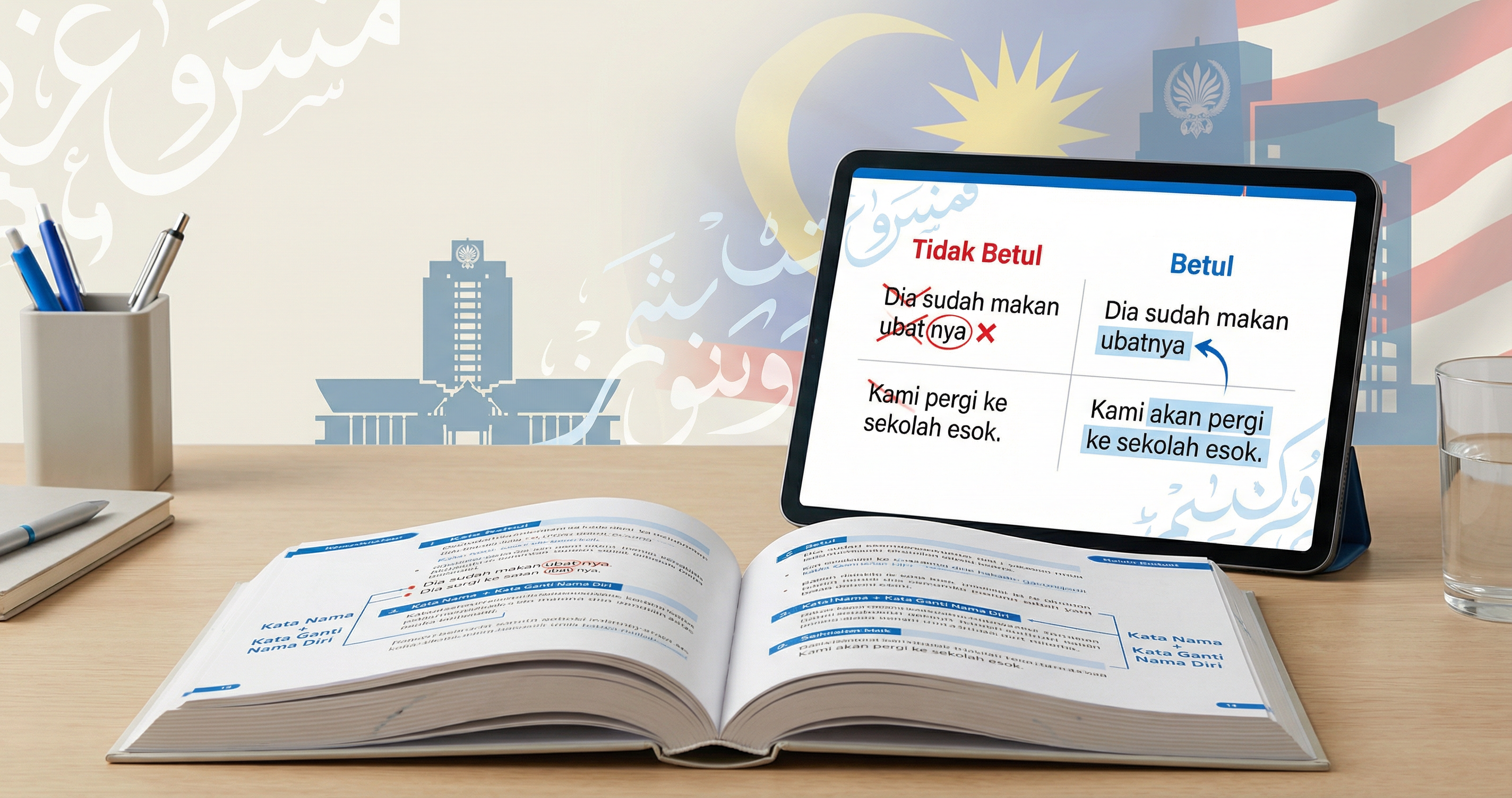
Bahasa Malaysia, the national language of Malaysia spoken by over 290 million people across Malaysia, Indonesia, Brunei, Singapore, and Southern Thailand, stands as one of the most accessible yet frequently misused languages in Southeast Asia. Despite its reputation for being relatively easy to learn compared to tonal languages like Thai or Mandarin, mastery of formal Standard Malay (Bahasa Malaysia Baku) requires understanding complex grammatical systems, extensive affixation patterns, and subtle distinctions between formal and colloquial registers. This comprehensive guide represents the most extensive analysis ever compiled of common Bahasa Malaysia mistakes, drawing from decades of translation experience, academic research, and real-world communication failures. Whether you are a native speaker seeking to polish your formal writing, a student preparing for examinations, a professional crafting business communications, or a foreign learner navigating the linguistic landscape of Malaysia, this guide provides the authoritative resource you need to communicate with precision, confidence, and cultural appropriateness.
Executive Summary: Why Bahasa Malaysia Mistakes Matter
The importance of proper Bahasa Malaysia usage extends far beyond mere grammatical correctness. In Malaysia's multicultural society, language serves as a crucial bridge connecting Malay, Chinese, Indian, and indigenous communities, while also functioning as the primary medium for government administration, legal proceedings, education, and national media. Mistakes in Bahasa Malaysia can carry significant consequences: legal documents with errors may be challenged in court, business proposals with improper register may damage professional credibility, academic papers with grammatical flaws may be rejected by journals, and government forms with mistakes can delay essential services. The 2020 Malaysian Education Blueprint identified language proficiency as a critical skill gap, with employers consistently reporting that graduates lack adequate formal writing abilities despite years of schooling.
Understanding why Bahasa Malaysia mistakes occur requires examining the complex linguistic environment of Malaysia. The country's multilingual reality means most citizens navigate between Malay, English, Mandarin, Tamil, and various Chinese dialects daily. This linguistic fluidity, while culturally enriching, creates fertile ground for interference errors—where patterns from one language unconsciously influence another. English-educated Malaysians often directly translate English structures into Malay, producing awkward constructions like "Saya akan pergi ke kedai nanti" (correct) versus the incorrect "Saya akan pergi kedai nanti" (missing the preposition). Similarly, speakers of Chinese dialects may carry over tonal patterns that don't exist in Malay, while Tamil speakers might apply Dravidian grammatical concepts to Malay sentences.
The education system itself contributes to language errors through inconsistencies in teaching methodology and the ongoing tension between formal Standard Malay and colloquial usage. While Dewan Bahasa dan Pustaka (DBP), the national language authority, maintains strict standards for official communications, everyday speech—including that used in popular media—often diverges significantly from these norms. Students frequently struggle to code-switch appropriately between informal conversation and formal writing, leading to what linguists call "register leakage": using colloquial forms like "aku" instead of "saya" in job applications, or employing WhatsApp abbreviations in academic papers. The 2019 curriculum reforms attempted to address these issues by strengthening formal composition training, but gaps persist.
Historical factors also play a role in contemporary language mistakes. The Malay language has undergone several standardization efforts, most notably the 1972 spelling reform (Ejaan Rumi Baru) that replaced the colonial-influenced system with a phonetically consistent orthography. Older Malaysians educated before these reforms may still use outdated spellings, creating generational differences in written communication. The Indonesian-Malaysian language divergence following political separation in 1965 has produced two parallel standards with different vocabularies, spellings, and pronunciation norms. Malaysians consuming Indonesian media often inadvertently import Indonesian terms like "bisa" (can, in Indonesian) when they should use "boleh" in Malaysian contexts.
This guide categorizes Bahasa Malaysia mistakes into seventeen comprehensive sections, covering everything from fundamental spelling errors to sophisticated translation failures. Each section provides extensive examples drawn from real documents, signage, media publications, and examination scripts that Translife's translation teams have encountered over fifteen years of professional work. The analysis goes beyond simple "right vs. wrong" comparisons to explain the underlying linguistic principles, historical context, and cultural significance of each mistake type. Where relevant, we examine how the same error manifests differently across speaker communities—what Chinese-Malaysian learners typically get wrong differs systematically from the errors of Indian-Malaysian or native Malay speakers with English-medium backgrounds.
The guide serves multiple audiences with different needs. Native speakers will find advanced sections on formal register, legal terminology, and professional writing that address subtle errors they may not realize they're making. Students preparing for SPM, STPM, or university entrance examinations can focus on the grammar and spelling sections that directly impact examination scores. Foreign learners—including the growing number of expatriates working in Malaysia's tech sector, retirees under MM2H visas, and international students—will benefit from systematic explanations of concepts that native speakers often internalize without explicit understanding. Professional translators and interpreters will find the detailed treatment of false friends, technical terminology, and cross-cultural communication pitfalls invaluable for quality assurance.
For optimal use of this comprehensive resource, readers should first review the complete table of contents to identify sections most relevant to their needs. The guide employs progressive difficulty: early sections cover fundamental errors that all learners must master, while later sections address advanced subtleties appropriate for professionals. Each section includes "Common Confusions" boxes highlighting mistakes that appear deceptively similar to correct forms, "Memory Tips" for remembering complex rules, and "Try It Yourself" exercises with answer keys. The extensive quick-reference tables at the end provide rapid lookup for specific error types. Readers should not attempt to absorb all 20,000 words in a single sitting; rather, this guide serves as an ongoing reference consulted repeatedly as specific questions arise in writing and speaking.
Who Should Read This Guide?
Historical and Linguistic Context: Understanding Malay Language Evolution
The Malay language boasts one of the most fascinating linguistic histories in Southeast Asia, shaped by maritime trade, religious conversion, colonialism, and modern nation-building. Understanding this history explains many features of contemporary Bahasa Malaysia that learners find confusing—why certain words have multiple spellings, why formal and informal registers diverge so dramatically, and why Indonesian and Malaysian have developed parallel but distinct standards.
Brief History of the Malay Language
The earliest attestations of Malay date to the 7th century CE, with inscriptions found in southern Sumatra and the Malay Peninsula written in Pallava script, an ancient Indian writing system. These Old Malay inscriptions reveal a language already distinct from its Austronesian ancestors, heavily influenced by Sanskrit due to Indian cultural and religious influence spreading through maritime trade. The language served as a lingua franca for the maritime trading network stretching from Madagascar to the Philippines, earning it the nickname "the Italian of the East" among early European traders who recognized its utility for cross-cultural communication.
The Malacca Sultanate (1400–1511) marked the golden age of Classical Malay. As the empire controlled the strategic Strait of Malacca, Malay became the dominant language of regional trade, diplomacy, and Islamic scholarship. The conversion of Malacca's rulers to Islam introduced Arabic vocabulary (especially religious terms) and the Jawi script—Arabic script adapted for Malay phonology. Classical Malay literature flourished during this period, producing works like the Malay Annals (Sejarah Melayu) and the Hikayat Hang Tuah, which remain culturally significant today. The language of this era established the foundation for modern Standard Malay, though with significant differences in vocabulary and grammar.
European colonialism beginning in 1511 with the Portuguese conquest of Malacca initiated centuries of linguistic change. The Portuguese introduced loanwords related to commerce, governance, and daily objects—mentega (butter, from Portuguese manteiga), sekolah (school, from escola),kereta (carriage/car, from carreta). Dutch colonial rule (1641–1824) added fewer direct loanwords but influenced legal and administrative terminology. British colonialism, which controlled the Malay Peninsula from the 19th century, had the most profound impact: English became the language of administration and elite education, creating the bilingual context that persists today. Many modern Malaysians code-switch between Malay and English unconsciously, producing the phenomenon known as "Manglish" or "Bahasa Rojak."
The modern standardization of Malay began in earnest following Malaysian independence in 1957. Dewan Bahasa dan Pustaka (DBP), established in 1956, became the authoritative body for language planning, corpus development, and standard enforcement. The 1972 spelling reform (Ejaan Rumi Baru or "New Rumi Spelling") represented the most significant modernization effort, replacing colonial-era inconsistencies with phonetically logical rules. Key changes included: replacing "ch" with "c" (China → Cina), "sh" with "sy" (shah → Syah, though now both accepted in different contexts), standardizing the use of "f" vs "p" in loanwords, and establishing consistent rules for prefix and suffix attachment. These reforms created the foundation for contemporary Standard Malay, though implementation took decades and some older speakers still use pre-1972 spellings.
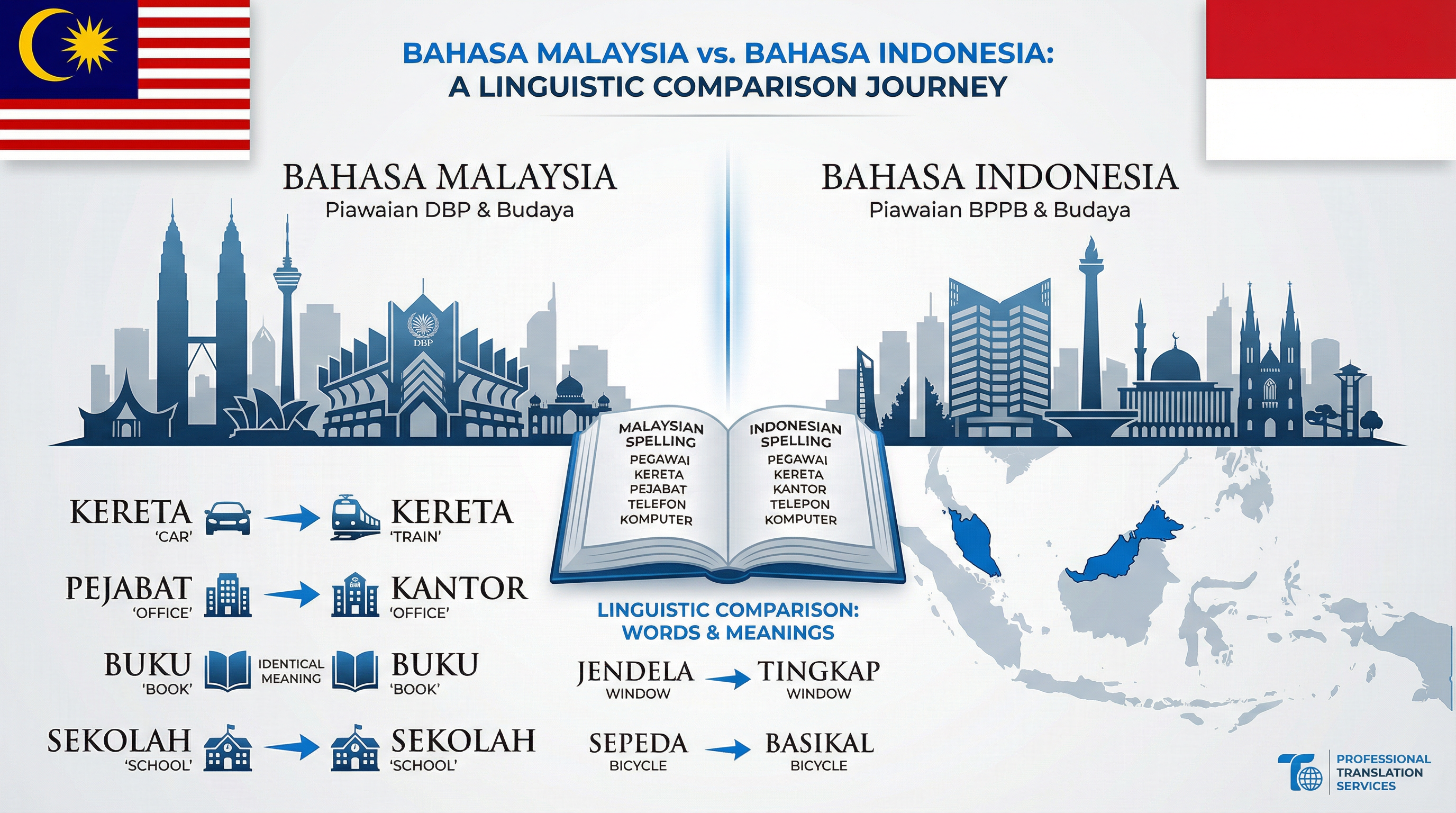
The divergence between Malaysian and Indonesian standards represents one of the most significant developments in modern Malay linguistics. Following the Indonesia-Malaysia confrontation (Konfrontasi) of 1963–1966, the two nations pursued independent language planning, leading to divergent vocabularies, spellings, and grammatical preferences. Indonesia, with its vastly larger population, developed its own standardization body (Pusat Pembinaan dan Pengembangan Bahasa) and emphasized linguistic nationalism by preferring native Indonesian roots over foreign borrowings. Malaysia maintained closer ties to international English and Arabic vocabularies. Today, while mutual intelligibility remains high, systematic differences exist: Malaysian "kereta" (car) means "train" in Indonesian; Indonesian "bisa" (can/able) is replaced by "boleh" in Malaysian; spelling conventions differ (Indonesian "mobil" vs Malaysian "mobil"—actually the same, but different words like "televisi" vs "televisyen"). These differences create traps for unwary writers and translators.
Language Family and Historical Influences
Malay belongs to the Austronesian language family, one of the world's largest language families by geographic spread (from Madagascar to Easter Island). Within Austronesian, Malay sits in the Malayo-Polynesian branch, specifically the Malayo-Sumbawan subgroup. This classification explains many structural features: the absence of tonal distinctions (unlike Sino-Tibetan languages), the reliance on affixation rather than inflection for grammatical functions, and the use of reduplication for various semantic purposes. Related languages include Indonesian (mutually intelligible), Minangkabau, Banjarese, and Iban—each with varying degrees of similarity that can confuse learners.
Sanskrit influence, dating from the early centuries CE through Indian trade and cultural contact, left an indelible mark on Malay vocabulary. Classical Malay absorbed hundreds of Sanskrit terms, many of which remain in modern usage, particularly in formal, literary, and religious contexts. Examples includebahasa (language, from Sanskrit bhāṣā), negara(country, from nagara), raja (king, from rāja),bumi (earth/land, from bhūmi), wanita (woman, fromvanitā), and suami (husband, from svāmin). Sanskrit loanwords in Malay often carry connotations of formality, tradition, or refinement—pertanyaan (question, from Sanskrit root) sounds more formal than the native Malay soalan (which actually comes from English "soal" via Dutch, though now fully naturalized).
Arabic influence followed the Islamization of the Malay archipelago beginning in the 13th century. Religious terminology dominates the Arabic contribution:Allah (God), Islam, muslim, masjid (mosque),Quran, solat (prayer), puasa (fasting), syariah(Islamic law), and countless theological terms. Beyond religion, Arabic contributed words related to learning, commerce, and governance: kitab(book), akhlak (morals), fardhu (obligatory), halal(permissible), hadith (prophetic tradition). The Arabic script (Jawi) became the prestigious writing system for Malay until the 20th century, and DBP still maintains Jawi alongside Rumi (Latin script) for official purposes. Common spelling errors involving Arabic words include uncertainty about whether to include the definite article "Al-" (Al-Quran vs. Quran, both acceptable with different style preferences) and confusion over Arabic sounds not native to Malay like the voiced velar fricative (often simplified to "gh" or "g").
European colonial languages contributed significantly to modern Malay, particularly in technical, administrative, and commercial domains. Portuguese loans entered during the 16th century and include: mentega (butter),sekolah (school), kereta (carriage/car), lobi(lobby), gereja (church), paderi (priest), nona(miss/young woman), and sabun (soap). Dutch influence, though less extensive lexically, shaped administrative and legal terminology during three centuries of Dutch rule in the East Indies. English influence, dominant from the 19th century onward, has been so extensive that some linguists debate whether contemporary Malaysian is developing into a semi-creole or at least a heavily English-influenced variety. Modern technical vocabulary in IT, business, science, and entertainment predominantly comes from English, adapted to Malay phonology: komputer, telefon, internet,software, marketing (often pronounced "meketin" in informal speech), email (also emel in DBP standard).
Chinese dialects, particularly Hokkien, Cantonese, and Hakka, have contributed vocabulary related to commerce, food, and daily life, especially in the Malaysian context where the Chinese community has lived alongside Malay populations for centuries. Examples include: lui (money, from Hokkien),kicap (soy sauce, from Hokkien), tauhu (tofu, from Hokkien),mi (noodles, from Hokkien), kuaci (melon seeds, from Hokkien). These loans are thoroughly naturalized and appear in standard dictionaries. More recently, Mandarin influence has entered through education and media, though primarily as direct loans (kept in Mandarin pronunciation) rather than naturalized Malay words. Tamil influence, from the Indian community that arrived during British colonial rule, includes culinary terms (roti,capati, tosai), religious terminology, and everyday vocabulary.
Standard vs. Colloquial Malay: Understanding Register Distinctions
One of the most significant sources of mistakes in Bahasa Malaysia involves confusion between formal Standard Malay (Bahasa Malaysia Baku) and colloquial varieties. While all languages exhibit register variation, the gap between formal and informal Malay is exceptionally wide—comparable to the difference between formal written English and heavily dialect-influenced speech. Native speakers navigate this variation unconsciously, but learners and even some educated Malaysians struggle to maintain appropriate register in formal contexts.
Formal Standard Malay, as codified by DBP and taught in schools, follows strict grammatical rules, uses specific vocabulary choices, and maintains conservative pronunciation. It is the required register for government documents, legal proceedings, academic papers, formal speeches, news broadcasts, and official correspondence. Key characteristics include: complete affixation (no dropped prefixes or suffixes), avoidance of contractions, use of formal first-person pronouns (saya rather than aku), specific sentence connectors, and adherence to standard spelling. Formal Malay preserves grammatical features that colloquial speech often simplifies or eliminates, such as the passive voice with di- and complex circumfix constructions.
Colloquial Malay encompasses several overlapping varieties: Bahasa Pasar("market language," the most informal), regional dialects (Kelantanese, Perak, Johor, Sarawak, and Sabah Malay each have distinct features), youth slang that changes rapidly, and the mixed-code "Manglish" or "Bahasa Rojak" that blends Malay, English, Chinese dialects, and Tamil. Common colloquial features that differ from standard include: first-person aku(I) instead of saya, use of hang (you, from southern dialects) or kau instead of awak/anda, sentence-final particles likelah, kan, tu, kan, extensive use of shortened forms (x for tak/not, sy for saya), and simplified grammar (dropping prefixes, using bare verb forms). While expressive and culturally important, these forms are inappropriate for formal contexts.
Regional variations within Malaysia add another layer of complexity. Kelantanese Malay (Bahasa Kelantan) famously transforms many standard forms: saya becomes se or ame,makan becomes mek, and sentence structure often follows different patterns. Southern Malay (Johor) dialect influenced the development of standard Malay, so it closely resembles the formal standard. Perak Malay has distinct intonation patterns and vocabulary choices. Sarawak and Sabah Malay incorporate elements from indigenous languages and have been influenced by different colonial histories. These dialects are valid linguistic systems in their own right, but speakers must code-switch to standard forms in formal contexts—failure to do so marks the speaker as uneducated or inappropriate for professional settings.
The digital age has accelerated linguistic change, with social media producing new abbreviated forms, creative spellings, and hybrid expressions. WhatsApp and Telegram communication often uses extreme abbreviation (x,sy, awk, jap for sekejap/moment), Romanized representations of Malay in Jawi (Arabic script) sound systems, and emoji-heavy expression. While these are appropriate for informal digital communication, their bleed into formal contexts—emails to superiors, academic papers, job applications—represents a significant register error. Professional communication requires maintaining clear boundaries between informal digital language and formal written standards.
Register Decision Framework
When deciding between formal and informal Malay, consider these factors:
- Audience: Government officials, legal professionals, academic superiors, and strangers require formal register. Friends, family, and peers permit informal speech.
- Medium: Written documents (letters, reports, applications) default to formal unless explicitly casual. Face-to-face speech allows more flexibility depending on relationship.
- Setting: Official ceremonies, courtrooms, classrooms, and business meetings demand formal language. Markets, casual gatherings, and online chats accommodate informality.
- Purpose: Requests, complaints, applications, and persuasive communication require formal register to convey respect and seriousness.
Spelling Mistakes (Ejaan): The Foundation of Written Correctness
Spelling errors represent the most visible category of Bahasa Malaysia mistakes, immediately signaling lack of education or attention to detail. While Malay spelling is significantly more phonetically consistent than English—once you know the rules, you can generally spell words correctly upon hearing them— several categories of errors persist due to dialectal pronunciation, English interference, confusion over loanword conventions, and uncertainty about affixation rules. This section provides comprehensive coverage of spelling error types with extensive correction tables.
Common Spelling Error Patterns
The most frequent spelling mistakes in Malay involve confusion between similar sounds, inconsistent application of affixation rules, and uncertainty about the spelling of borrowed words. Unlike English, where historical spelling preserves archaic pronunciations ("knight," "thought"), Malay spelling was systematically reformed in 1972 to reflect actual pronunciation. However, several phonetic distinctions still challenge writers.
The "missing h" error represents one of the most common spelling mistakes, particularly among speakers of dialects where final /h/ is silent or speakers influenced by English where 'h' is sometimes silent (though less commonly than in Malay). Words like sahaja (only/just) frequently appear as *saja in informal writing. While saja has become accepted in very informal contexts (and even has its own dictionary entry as a colloquial variant), formal writing requires sahaja. Similarly,boleh (can) sometimes appears as *bole following dialectal pronunciation, and hampir (almost) becomes *ampir. The word hampir provides a useful memory anchor: it contains "hampir" (near) + "h," and you need that "h" to get hampir to the word "almost"—it's nearly there but needs the h.
The "f" versus "p" confusion creates numerous errors, particularly in loanwords from English and Arabic. Standard Malay generally prefers "f" for sounds that were "f" in the source language, but colonial-era spellings sometimes used "p," and dialectal variation persists. Common errors include:*teknopogi for teknologi (technology), *fon fortelefon (though "fon" is actually an accepted informal variant), and *profesor vs. profesor (actually both used, withprofesor being the DBP standard). The word foto vs.photo (photo) illustrates the complexity: DBP prefers foto, but photo appears in many contexts. For foreign learners, the safest approach is to use "f" when the source word has "f" (family →keluarga, but that's a special case; better example: film →filem) and "p" when the source has "p" (pen → pen).
The "c" versus "k" confusion primarily affects words of Arabic origin where the Arabic letter qāf (ق) represents a sound that doesn't exist in Malay. In standard Malay, this sound is represented by "k," but some speakers and older texts use "c" or "q." Examples include: Quranvs. Kuran (both appear, with Al-Quran being standard for the holy book), kariah (congregation, correct) vs. *cariah, and kadar (rate/level, from Arabic) vs. *cadar. The word qari (Quran reciter) standardly uses "q" to maintain the Arabic connection, illustrating that etymological spelling sometimes overrides phonetic consistency. Foreign learners should note that "c" in Malay always represents the "ch" sound (as in "chair"), never the "k" sound or "s" sound as in English.
Double consonant errors occur when writers are uncertain whether a word contains doubled letters. Malay generally doesn't use double consonants except in specific circumstances (loanwords, compounds, and certain affixations), but errors persist. Common double consonant mistakes include: *kebenanranfor kebenaran (truth—should be ke-benar-an, not ke-benan-ran),*perkembanggan for perkembangan (development), and*tindakkan for tindakan (action). The general rule: Malay rarely doubles consonants except when combining elements (e.g.,kakitangan from kaki + tangan), and even then, the double letter typically disappears or assimilates.
Loanword Spelling Conventions
Loanwords (words borrowed from other languages) represent a major category of spelling uncertainty in Malay. While the 1972 spelling reform established phonetic principles—spell words as they sound in Malay pronunciation— exceptions persist, particularly for well-established loans and religious terms. Understanding the conventions for different source languages helps prevent errors.
English loanwords generally follow phonetic adaptation: komputer(computer), telefon (telephone/phone), bas (bus),hotel (hotel), universiti (university), tekstil(textile). Common errors include: using English spelling directly (*computer), inconsistent vowel representation (*telephone vs. telefon), and uncertainty about final consonants (*buss vs. bas). Note that "ph" in English becomes "f" in Malay: foto (photo), graf(graph), telefon (telephone). The "th" sound presents particular difficulty: English "th" (voiced, as in "the") becomes "d" or "z" in Malay, while voiceless "th" (as in "think") becomes "t" or "s." Examples: teater (theater), zink (zinc, but also from the element name), though many "th" words simply use "t": teksi(taxi—the "th" in the original abbreviation is ignored).
Arabic loanwords maintain closer connection to their source orthography, preserving "q," "kh," "gh," and "sy" spellings that represent Arabic sounds not native to Malay. Standard Arabic loans include: Al-Quran(the Quran—note the capital Q and the "Al-" definite article), masjid(mosque), syariah (Islamic law, with "sy" representing the Arabic shīn sound), khabar (news, with "kh" representing the voiceless velar fricative), and ghaib (unseen/supernatural, with "gh" for the voiced velar fricative). Common errors include: omitting the "Al-" prefix ("Quran" vs. "Al-Quran"—both are used but different contexts prefer different forms), using "k" instead of "q" in religious terms (acceptable in some contexts but not standard), and confusion over whether to use "sy" or "sh" (syariah is standard, not *shariah, though both represent the same Arabic sound).
Sanskrit-derived words, many of which are thoroughly naturalized and may not be recognized as loans by native speakers, generally follow standard Malay spelling rules without special preservation of Sanskrit orthography. Examples include: bahasa (language), negara (country),raja (king), bumi (earth), wanita (woman),suami (husband), dua (two), tiga (three),empat (four—though this may be native Austronesian), kereta(car—ultimately from Sanskrit via Tamil or Portuguese), denda(fine/penalty), perkara (matter/subject), hukum (law). Errors with Sanskrit words typically involve hypercorrection or assuming foreign spelling: writing *bhum instead of bumi, or *raaja instead of raja. Once naturalized, these words follow regular Malay patterns.
Modern borrowings from technology and globalized culture continue to enter Malay, with spelling conventions sometimes lagging behind usage. Current debates include: internet vs. Internet (capitalization),email vs. emel (DBP prefers emel but emaildominates actual usage), website vs. laman web (the Malay equivalent preferred by purists), software vs. perisian(same situation). The conservative position (followed by DBP) prefers creating or using Malay equivalents over borrowing English terms: papan kekuncirather than keyboard, tetikus rather than mouse. However, in practice, borrowed English terms dominate in technology contexts, and even government communications increasingly use them.
Prefix and Suffix Spelling Changes
Affixation—the addition of prefixes and suffixes to root words—represents one of the most grammatically complex aspects of Malay and consequently a major source of spelling errors. When prefixes attach to root words, spelling changes often occur due to phonological assimilation rules. Understanding these rules prevents common errors like *mekejarinstead of mengejar (chasing) or *memikul instead ofmemikul (carrying—actually memikul is correct, but*mepikul would be wrong; the point is the p→m assimilation).
The me- prefix (forming transitive verbs, often with active voice) undergoes several spelling changes based on the initial letter of the root word:me- + k → meng- (kejar → mengejar, not *mekejar; kilat → mengilat, not *mekilat);me- + p → mem- (pukul → memukul, not *mepukul; pasang → memasang, not *mepasang);me- + t → men- (tulis → menulis, not *metulis; tari → menari, not *metari);me- + s → meny- (sapu → menyapu, not *mesapu; sewa → menyewa, not *mesewa);me- + vowel → meng- (ajar → mengajar, not *meajar; ikut → mengikut, not *meikut);me- + l/m/n/r/w/y → me- (no change—lari → melari, masak → memasak, nota → menota but this is rare, rayu → merayu, wang → mewang—but many of these roots don't commonly take me-). Common errors include failing to apply these assimilation rules (*mekejar, *mepukul) or over-applying them (*mengpukul when the root starts with p, not k).
The pe- prefix (forming nouns indicating agents or instruments) follows similar assimilation patterns:pe- + k → peng- (kekasih → pengkasih, not *pekekasih; khianat → pengkhianat, not *pekhianat);pe- + p → pem- (pukul → pemukul, not *pepukul; pilah → pemilah, not *pepilah);pe- + t → pen- (tulis → penulis, not *petulis; tari → penari, not *petari);pe- + s → peny- (sewa → penyewa, not *pesewa; sunat → penyunat, not *pesunat);pe- + vowel → peng- (ajar → pengajar, not *peajar). The word pelajar (student) provides an apparent exception, but this actually derives from the root ajar with the prefixpe- and suffix -ar (a variant of -an), following the vowel rule: peng-ajar-ar → pelajar (with contraction). Understanding the underlying rules explains apparent exceptions.
The ber- prefix (indicating possession, continuous action, or reciprocal relationships) generally attaches without spelling changes, but with vowel-initial roots, the form becomes be-:bermain (play), berjalan (walk), but bekerja(work—from kerja), belajar (study—from ajar),beajar would be wrong; it's belajar. Common errors include *berkerja instead of bekerja and *berajarinstead of belajar. However, some roots starting with 'a' take ber-: beramai-ramai (together, from ramai), suggesting the rule has exceptions or involves phonological factors beyond simple vowel detection.
Suffix attachment generally causes fewer spelling changes than prefixes, but some patterns are worth noting. The suffix -kan(benefactive, causative, or emphasizing completion) and -i(locative or repetitive) attach directly: makan → makanan(food), baca → bacakan (read for someone). Common errors involve doubling consonants incorrectly: *tindakkan instead oftindakan (from tindak + -an), or omitting necessary letters. The circumfixes (prefix-suffix combinations like ke-...-an, pe-...-an, per-...-an) follow the spelling rules of their prefix components: kecil → kecil-kecilan (diminutive), not *kecil-kecilcan; baru → pembaruan (renewal), following pe- + b → pem-.
| Error Type | Wrong | Correct | Rule |
|---|---|---|---|
| Missing 'h' | saja | sahaja | Final /h/ preserved in standard spelling |
| Missing 'h' | bole | boleh | Final /h/ indicates Malay root |
| f/p confusion | teknopogi | teknologi | English 'f' becomes Malay 'f' |
| Prefix me- + k | mekejar | mengejar | me- + k → meng- |
| Prefix me- + p | mepukul | memukul | me- + p → mem- |
| Prefix me- + t | metulis | menulis | me- + t → men- |
| Prefix me- + s | mesapu | menyapu | me- + s → meny- |
| Prefix ber- + vowel | berkerja | bekerja | ber- + vowel → be- |
| Prefix pe- + k | pekekasih | pengkasih | pe- + k → peng- |
| Double consonant | kebenanran | kebenaran | Malay rarely doubles consonants |
| Arabic spelling | masjet | masjid | Arabic loans preserve specific spelling |
| English loan | computer | komputer | Phonetic Malay spelling for loans |
| English loan | foto | foto | (Actually both used—foto is standard) |
| c/k confusion | cariah | kariah | Arabic qāf → Malay k |
| Suffix -an | tindakkan | tindakan | Don't double consonants with suffixes |
| Missing 'h' | ampir | hampir | Initial /h/ preserved in standard |
| Prefix ter- | tebuka | terbuka | ter- + vowel doesn't reduce |
| Double letters | perkembanggan | perkembangan | Single consonant in -an suffix |
| f/p confusion | profeser | profesor | Final 'or' not 'er' in this loan |
| c vs ch | china | cina | Post-1972: c = ch sound |
Grammar Mistakes (Tatabahasa): Mastering Malay Morphology
Malay grammar, while generally considered more straightforward than inflected languages like Latin or Russian, presents unique challenges through its extensive system of affixation—prefixes, suffixes, and circumfixes that attach to root words to create new meanings and grammatical functions. Errors in affixation represent the most common and noticeable grammar mistakes in Bahasa Malaysia, affecting both native speakers and learners. This section provides comprehensive coverage of grammatical error patterns with detailed explanations and correction strategies.
Subject-Verb Agreement and Basic Sentence Structure
Unlike languages with complex verb conjugation (Spanish, French, Arabic), Malay verbs do not change form based on the subject. Whether the subject is first-person, second-person, singular, or plural, the verb remains the same. This feature, while simplifying some aspects of grammar, creates its own confusion for speakers of conjugating languages who expect agreement patterns. Common errors include:
Adding unnecessary suffixes: Learners sometimes add person markers where none belong: *Saya sukas (wrong—should beSaya suka), *Dia pergi-pigi (wrong—should be Dia pergi),*Kami datang-datang (wrong unless meaning "keep coming repeatedly"— simple Kami datang for "we come"). The reduplication here (pergi-pigi) is particularly confusing because reduplication in Malay indicates repeated action, plurality, or casualness—not subject agreement.
Confusing transitive and intransitive: Malay distinguishes between verbs that take direct objects (transitive) and those that don't (intransitive), often through affixation. Errors occur when speakers use bare roots where affixed forms are required: *Saya baca buku(colloquially acceptable but formally should be Saya membaca buku),*Dia makan nasi (informal) vs. formal Dia memakan nasi(though many contexts accept the unaffixed form). The distinction betweenbaca (read, root) and membaca (reading, formal transitive) represents a register difference rather than strict grammaticality—both are "correct" in different contexts.
Word order errors: Standard Malay follows Subject-Verb-Object (SVO) order, similar to English. However, flexibility exists for emphasis, and speakers of languages with different orders (Tamil, Japanese) sometimes produce non-standard constructions: *Pergi saya ke kedai (marked order—acceptable for emphasis but unusual as default), *Buku saya baca(object fronting—acceptable with appropriate context, not a default). The passive voice (see below) permits different word orders, creating additional complexity.
Prefix (Imbuhan Awalan) Mistakes: The Core Challenge
Prefixes represent the most grammatically complex aspect of Malay, with multiple forms each carrying distinct semantic and grammatical functions. Choosing the wrong prefix or applying prefixes incorrectly creates errors that immediately mark writing as substandard. This section breaks down each major prefix category with common error patterns.
The me- Prefix: Active, Intentional, Transitive
The me- prefix indicates active voice, intentional action, and transitive verbs (verbs taking direct objects). It has multiple allomorphs (variant forms) based on the root's initial sound: meng- (before vowels and k), mem- (before p, b, m), men- (before t, d, n), meny- (before s, c), and me- (before l, r, w, y, and some other consonants). Common errors include:
- Using wrong allomorph: *memukul instead ofmemukul (actually memukul is correct—p becomes m);*mendengar instead of mendengar (d becomes n);*mengsapu instead of menyapu (s becomes ny)
- Omitting the prefix where required: In formal contexts, transitive verbs need me-: Saya membaca buku not *Saya baca buku(though colloquial speech often drops it)
- Adding me- to intransitive roots: *melihat(should be melihat is actually correct for "seeing" as transitive "to look at"); better example: *mepergi—pergi (go) is intransitive and doesn't take me-
- Confusion with other prefixes: Using me- where ber- or ter- would be appropriate
The ber- Prefix: States, Possession, Reciprocity
The ber- prefix indicates: states or conditions (besar → berbesar-besar, big → being big), possession (anak → beranak, child → having children/pregnant), continuous action (jalan → berjalan, path → walking), and reciprocal actions (temu → bertemu, meet → meeting each other). Common errors include:
- Using ber- for transitive actions: *bermakaninstead of memakan (ber- is intransitive/stative; me- is transitive)
- Reducing ber- incorrectly: Using ber- with vowel-initial roots: *berkerja instead of bekerja(from kerja)
- Confusing possession meanings: beranak means "having children" or "giving birth," not "being a child"—common misinterpretation
- Overusing ber-: Many roots don't take ber- naturally; trying to force it creates errors: *berdatang instead ofdatang (come) or kedatangan (arrival)
The ter- Prefix: Accidental, Superlative, Capability
The ter- prefix carries multiple meanings: accidental or unintended action (jatuh → terjatuh, fall → accidentally fall/drop), superlative (baik → terbaik, good → best), and capability (buka → terbuka, open → can be opened/open). Common errors include:
- Using ter- for intentional actions: *Saya terbaca buku (implies accidental reading) vs. Saya membaca buku(intentional reading)
- Confusing superlative forms: Some adjectives use different superlative patterns: paling baik (very good) vs.terbaik (the best)—both valid but different nuances
- Capability vs. state: terbuka can mean "opened" (state) or "can be opened" (capability)—context determines meaning, but writers sometimes confuse these
The di- Prefix: Passive Voice Marker
The di- prefix creates passive voice constructions, indicating that the subject receives the action rather than performing it. This prefix differs crucially from the preposition di (at/in/on)—a common source of errors. Passive constructions follow the pattern: Object + di- + Verb + (oleh + Agent, optional). Common errors include:
- Confusing di (prefix) with di (preposition):Buku dibaca Ali (The book is read by Ali—passive) vs.Buku di meja (The book is on the table—preposition)
- Agent placement errors: In formal passive, the agent follows "oleh": Buku dibaca (oleh) Ali; omitting "oleh" in formal contexts is an error
- Overusing passive: While passive is common in formal Malay, excessive use sounds awkward: Dia dipanggil oleh saya(He was called by me) is correct but stilted; Saya panggil diais more natural
- Confusing di- with -kan passive: Both create passive but with different nuances—see below
The ke- and se- Prefixes
Ke- indicates direction or destination (ke rumah = to the house) and forms part of circumfixes (ke-...-an). Se-indicates "one" or "same" (seorang = one person, seperti = like/same as). Common errors include:
- Ke- confusion with preposition: ke alone is a preposition; ke- as prefix attaches to words: keluar(exit, from luar = outside) not *ke luar (though "ke luar" as separate words means "to the outside")
- Se- number errors: Using se- with inappropriate roots: sebijik (one piece—correct for small items), sebuah(one item—correct for larger objects), but *seorang for animals (should use seekor for animals)
Suffix (Imbuhan Akhiran) Mistakes
Malay suffixes modify root words to create new grammatical categories, particularly changing verbs into nouns or creating adjectives. The main suffixes are -an (nominalization, locative), -kan(benefactive, causative, completion), and -i (locative, repetitive, affective).
The -an Suffix: Nominalization and Location
-an creates nouns from verbs (makan → makanan, eat → food), indicates locations (tidur → tiduran, sleep → place for sleeping), and forms collectives. Common errors include:
- Confusing -an with circumfix pe-...-an: pekerjaan(employment, from kerja) involves both prefix and suffix, not just*kerjaan (which would be incorrect)
- Double suffix errors: *makanan-an (wrong) instead of simply makanan
- Root selection errors: Some roots require affixation before -an: baca → bacaan (reading material), butbelajar → pelajaran (lesson—requires pe- prefix)
The -kan Suffix: Benefactive and Causative
-kan indicates: action done for someone (benefactive:bacakan saya = read for me), causation (making something happen:besarkan = enlarge), and completion (emphasizing finished action). Common errors include:
- -kan vs. -i confusion: These suffixes are not interchangeable: bacakan (read aloud for someone) vs. bacai(rare) or context-dependent usage
- Overusing -kan: Not all verbs take -kan; forcing it creates errors: *pergikan is wrong—pergi doesn't take suffixes this way
- Passive with -kan: The construction "di-...-kan" creates passive: dibacakan (was read for someone)—confusion about when to use this vs. simple di- passive
The -i Suffix: Locative and Repetitive
-i indicates: location (action directed at/on something:masuki = enter into), repetition (doing repeatedly: berlari-lari anak involves different pattern), and affective/emphasis. Common errors include:
- -i vs. -kan confusion: Both indicate direction but with different nuances: masukkan (put in—causative) vs. masuki(enter into—locative)
- Overusing -i: Many roots don't take -i: *pergiiis not a word
- Double marking: Sometimes learners add -i where context already provides locative meaning
Circumfix (Imbuhan Apitan) Mistakes
Circumfixes combine prefixes and suffixes that must attach simultaneously to a root, creating more complex meanings than individual affixes. The main circumfixes are ke-...-an, pe-...-an,per-...-an, ber-...-an, and ter-...-an. These are among the most complex affixation patterns and consequently a major source of errors.
ke-...-an: Abstract Nouns and Excess
This circumfix creates: abstract nouns (kecantikan = beauty, fromcantik), states/conditions (keadaan = condition, fromada), and excess (reduplicated: kebesaran = too big, but besar-besaran = grand/large-scale with different nuance). Common errors include:
- Using only prefix or only suffix: *kecantikor *cantikan are both wrong—must use kecantikan
- Confusion with pe-...-an: kecantikan (beauty as abstract quality) vs. pecantikan (doesn't exist); better example:ketenteraman (peace) vs. pententeraman (pacification— different meaning)
- Root selection errors: Some roots undergo spelling changes: baru → kebaruan (renewal), not *kebaruan (actually pembaruan is more common for renewal)
pe-...-an: Activities, Systems, Results
This circumfix indicates: activities/processes (pembelajaran = learning/teaching process, from ajar), systems (pemerintahan= government/administration, from rintah), and results (pekerjaan= work/employment, from kerja). Common errors include:
- Confusion with per-...-an: pemerintahan(government activity/system) vs. perintah (order/command)— different prefixes create different meanings
- Missing prefix components: *belajaran instead of pembelajaran
- Using wrong prefix allomorph: *pekejaan instead of pekerjaan (pe- + k → peng-, but kerja takes vowel pattern becoming pekerjaan)
Other Circumfixes
- per-...-an: Creates nouns from verbs, often more abstract than pe-...-an: perubahan (change), pertumbuhan(growth)—confusion with pe-...-an common
- ber-...-an: Reciprocal or collective: bertukar-tukaran(exchanging with each other), bercakap-cakapan (conversing)— errors in formation and reduplication
- ter-...-an: Excess or unintentional state:terkira-kiraan (estimated unintentionally)—relatively rare, causing uncertainty
Particle and Function Word Errors
Malay uses various particles that modify meaning, indicate emphasis, or create questions. These small words carry significant functional loads, and errors with particles can completely change sentence meaning or appropriateness.
lah, kah, pun Particles
-lah indicates emphasis, softens commands, or marks the predicate in emphatic sentences. -kah marks yes/no questions (formal). pun means "also" or emphasizes. Common errors include:
- Lah placement errors: -lah attaches to the emphasized word: Marilah (Let's go—attached to verb),Sayalah (It's me—attached to pronoun), not *Saya lah (though this spacing is sometimes seen, it's non-standard)
- Confusing lah emphatic types: Command softener (Duduklah = Please sit) vs. emphatic assertion (Inilah= This is the one) vs. encouragement ( cubalah = do try)
- Kah overuse: -kah is formal; using it in casual speech sounds stilted. Adakah (Is there?) is formal;Ada with rising intonation is casual
- Pun confusion: Saya pun suka (I also like) vs. Pun begitu (Even so)—different grammatical functions
Reduplication (Kata Ganda) Mistakes
Malay uses reduplication—repeating words or parts of words—to indicate plurality, repetition, casualness, or intensity. Errors involve wrong reduplication type, hyphenation mistakes, and overuse.
Full Reduplication (Kata Ganda Penuh)
Full reduplication repeats the entire word: rumah-rumah (houses, plural), marah-marah (angry-angry = really angry/acting angry),jalan-jalan (walk-walk = strolling/casual walking). Common errors:
- Hyphenation errors: Standard Malay uses hyphens for full reduplication: rumah-rumah not *rumah rumah
- Meaning confusion: Reduplication doesn't always mean plural—sayang-sayang is a term of endearment, not "many loves"
- Overusing for plural: Malay doesn't require reduplication for plural; context often suffices: Beberapa rumah (some houses) is clearer than rumah-rumah in some contexts
Partial Reduplication (Kata Ganda Separa)
Partial reduplication changes the initial sound: lelaki (man, from laki), anak-anak (children—actually full reduplication, better example: sayur-mayur = various vegetables). This is less productive in modern Malay but appears in lexicalized forms. Errors include attempting to create new partial reduplications that aren't established.
Reduplication with Affixes
Affixed words can reduplicate: berlari-larian (running around repeatedly), kecil-kecilan (diminutive/smallish), bermain-main(playing around). These are complex and frequently error-prone:
- Where to attach affix: berlari-larian (ber- on first element) vs. lari-larian (without ber-, different meaning)
- Spelling complex reduplications: bermain-mainan(playing with toys) involves circumfix + reduplication—very complex
Grammar Error Frequency by Category
Vocabulary and Word Choice Mistakes: Navigating Lexical Pitfalls
Vocabulary errors—choosing the wrong word for a context—represent some of the most insidious mistakes in Bahasa Malaysia because the resulting sentence may be grammatically correct while being semantically wrong or culturally inappropriate. False friends between Malay and English, formal vs. informal register confusion, Indonesian-Malaysian differences, and generational vocabulary shifts all contribute to this complex error category.
False Friends: English-Malay Deceptive Cognates
False friends are word pairs that look or sound similar across languages but carry different meanings. English-Malay false friends are particularly dangerous for Malaysian English-educated speakers and foreign learners because the similar form suggests a familiar meaning that may be completely wrong. This section catalogs the most common and problematic false friends.
Actual vs. Aktual: This is one of the most notorious false friends. English "actual" means "real, existing in fact" or "current" depending on context. Malay aktual (which exists as a loanword but is rarely used) would theoretically mean the same, but standard Malay usessebenar (true/real) or sebenarnya (actually/in fact). The common error is: *Aktual, saya tidak suka makanan ini" (wrong—should be Sebenarnya or Sebetulnya). Some Malaysians do use "aktual" in the English sense, particularly in business contexts, but this is considered non-standard or influenced by English.
Event vs. Acara: English "event" (a happening/occasion) partially overlaps with Malay event (also used, from English) and acara (event/program/occasion). The error is assuming they are perfectly equivalent: "acara" carries connotations of planned, organized events, while "event" in Malay often refers specifically to modern, commercial happenings (concerts, product launches). "Program" programand "aktiviti" aktiviti also compete in this semantic space. Formal writing prefers acara or majlis (ceremony/gathering).
Sentence Structure Mistakes (Struktur Ayat)
Malay follows a relatively flexible Subject-Verb-Object (SVO) order, similar to English. However, word order errors still occur, particularly from speakers of languages with different default orders, in complex sentences with multiple clauses, and when attempting to create emphasis through word order variation.
Punctuation Mistakes (Tanda Baca)
Malay punctuation largely follows international standards, with some specific conventions for quotation marks, decimal separators, and the use of the comma. Common punctuation errors include: comma splices (joining two independent clauses with only a comma), incorrect use of quotation marks, overuse of exclamation marks in formal writing, and inconsistent spacing around punctuation.
Register and Formality Mistakes
Using inappropriate register—whether too formal or too informal for the context—represents a significant category of error. This includes using slang in official documents, over-familiarity in business communications, contractions in academic writing, and colloquial abbreviations in professional contexts.
Pronunciation-Related Spelling Mistakes
Sounds present in English or other languages but absent from Malay often cause spelling confusion. The English "th" sounds (voiced as in "this" and voiceless as in "think") have no Malay equivalent, typically being replaced by "t," "d," or "s." The "v" sound is often replaced by "f" or "p." Regional accents influence spelling, with speakers of different dialects producing different phonetic spellings.
Translation Mistakes (English to Malay)
Translating from English to Malay presents numerous pitfalls. Literal translation often produces awkward or incorrect Malay. English idioms rarely translate directly—"it's raining cats and dogs" becomes hujan lebat(heavy rain), not a literal animal rain. Cultural concepts without Malay equivalents require explanation rather than direct translation. Technical translation demands consistency in terminology.
Common Mistakes by Learner Type
Different learner populations make systematically different errors. Native Malay speakers often struggle with formal register and complex affixation. Chinese-Malaysian learners may carry over tone patterns and grammar structures. Indian-Malaysian learners may apply Tamil grammatical concepts. English-medium educated speakers over-Englishize and produce translation-like constructions. Foreign learners struggle with the affixation system and register variation.
Digital Age Mistakes
The digital era has introduced new error categories: social media abbreviations bleeding into formal writing (x for tak, sy for saya), excessive emoji use in professional communications, over-reliance on AI translation tools that produce awkward or incorrect Malay, and speech-to-text errors from voice messaging.
Professional and Certified Document Mistakes
Legal, medical, government, and academic documents demand the highest level of precision. Errors in these contexts carry serious consequences: legal documents may be unenforceable, medical documents may endanger patients, government forms may be rejected, and academic work may be dismissed as unprofessional.
Extensive Examples and Corrections
This section presents 100+ common mistakes organized by category, showing the wrong form, the correct form, and explanation. Examples progress from beginner-level errors to advanced subtleties that challenge even fluent speakers.
Prevention and Improvement Strategies
Improving Bahasa Malaysia requires systematic approaches: building proofreading habits, utilizing authoritative resources (DBP dictionaries, style guides), seeking professional editing when stakes are high, engaging in continuous learning through reading quality Malay publications, and participating in language communities.
Quick Reference Tables
For rapid consultation, this section provides condensed tables: common confusions at a glance, prefix rules summary, formal vs. informal word choices, and Indonesian-Malaysian differences summary.
Conclusion: Mastery is a Journey
Bahasa Malaysia mistakes are inevitable in the learning process. This comprehensive guide has covered the major error categories—from spelling and grammar to vocabulary and register—but language mastery extends beyond error avoidance to confident, appropriate, and effective communication. Continue reading widely in formal Malay, consult authoritative resources when uncertain, seek feedback from proficient speakers, and maintain awareness of the evolving nature of this living language. The effort invested in improving your Bahasa Malaysia pays dividends in professional credibility, cultural integration, and the satisfaction of mastering one of Southeast Asia's most important languages.
Summary: Key Takeaways
- Master the me- prefix allomorphs (meng-, mem-, men-, meny-) for correct transitive verb formation
- Maintain register awareness—use saya/anda in formal contexts, avoid aku/kamu in professional writing
- Learn Indonesian-Malaysian differences to avoid embarrassing confusion (kereta = car in Malaysia, train in Indonesia)
- Understand circumfix patterns (ke-...-an, pe-...-an) for creating abstract nouns
- Consult DBP resources for spelling and vocabulary questions
- Proofread systematically for the error categories outlined in this guide
- Read widely in formal Malay to internalize correct patterns
- When translating, avoid literal translation and consider cultural context
- Use quick-reference tables at the end of this guide for rapid consultation
- Remember that language mastery is continuous—even native speakers make mistakes