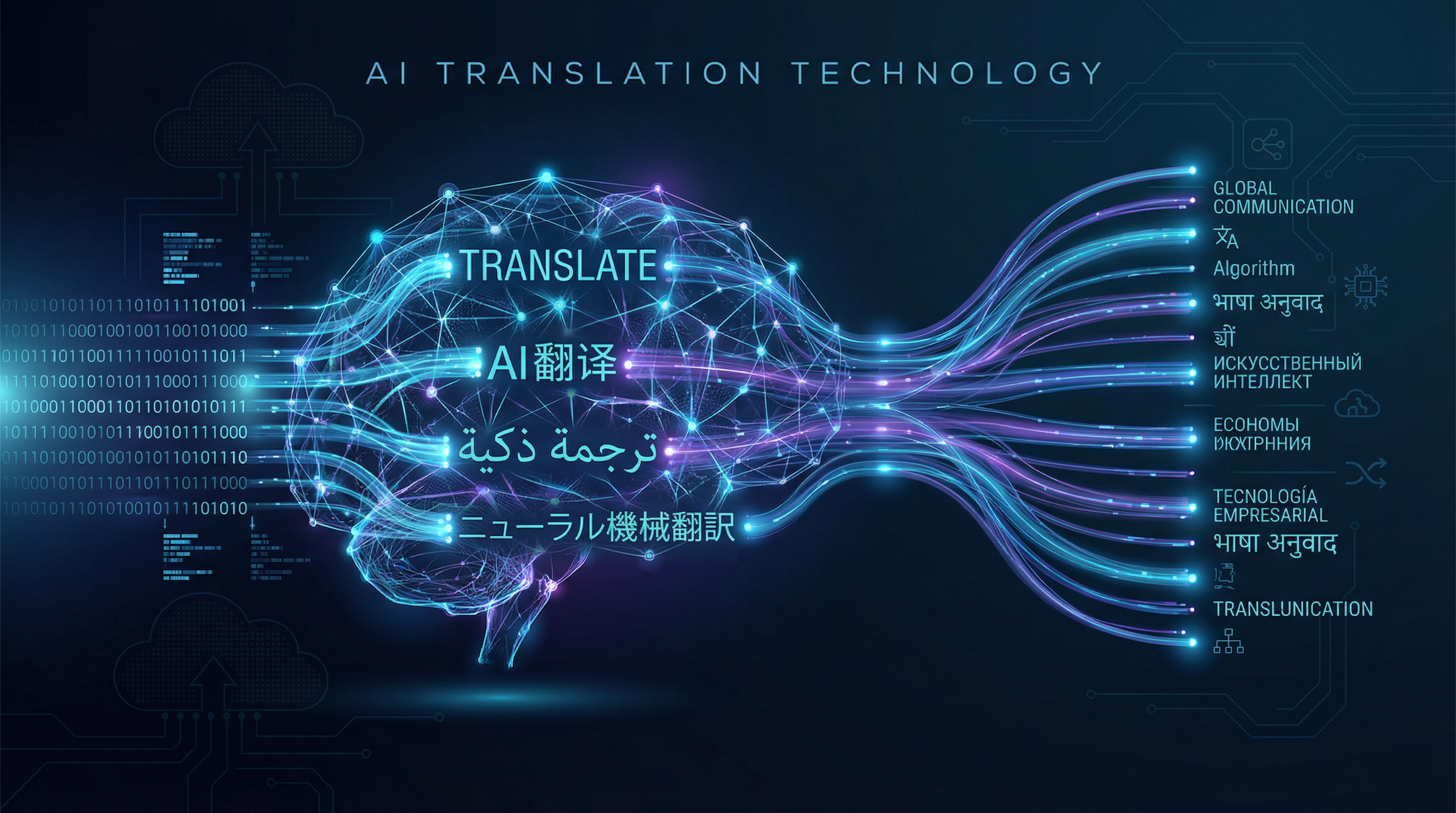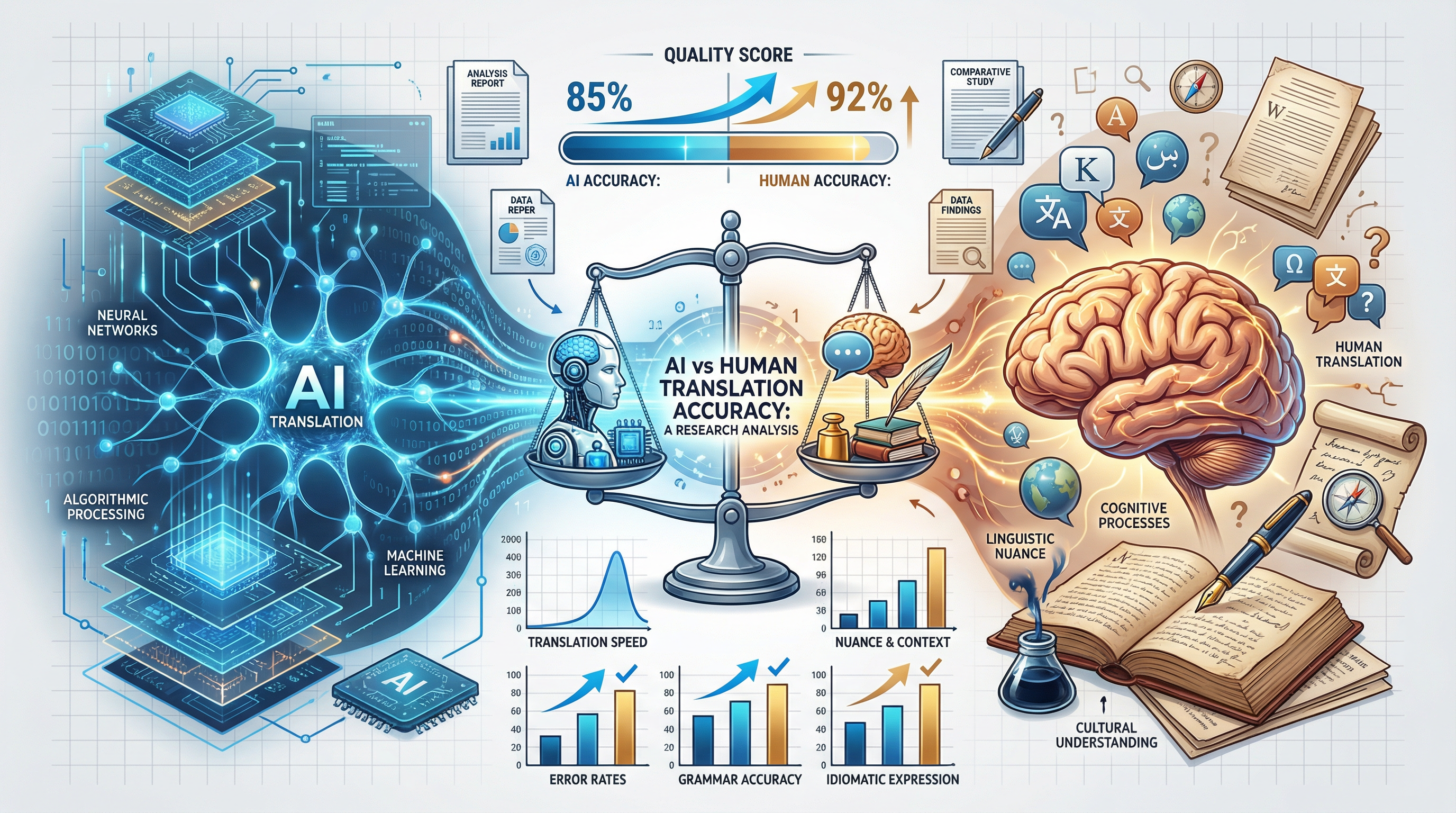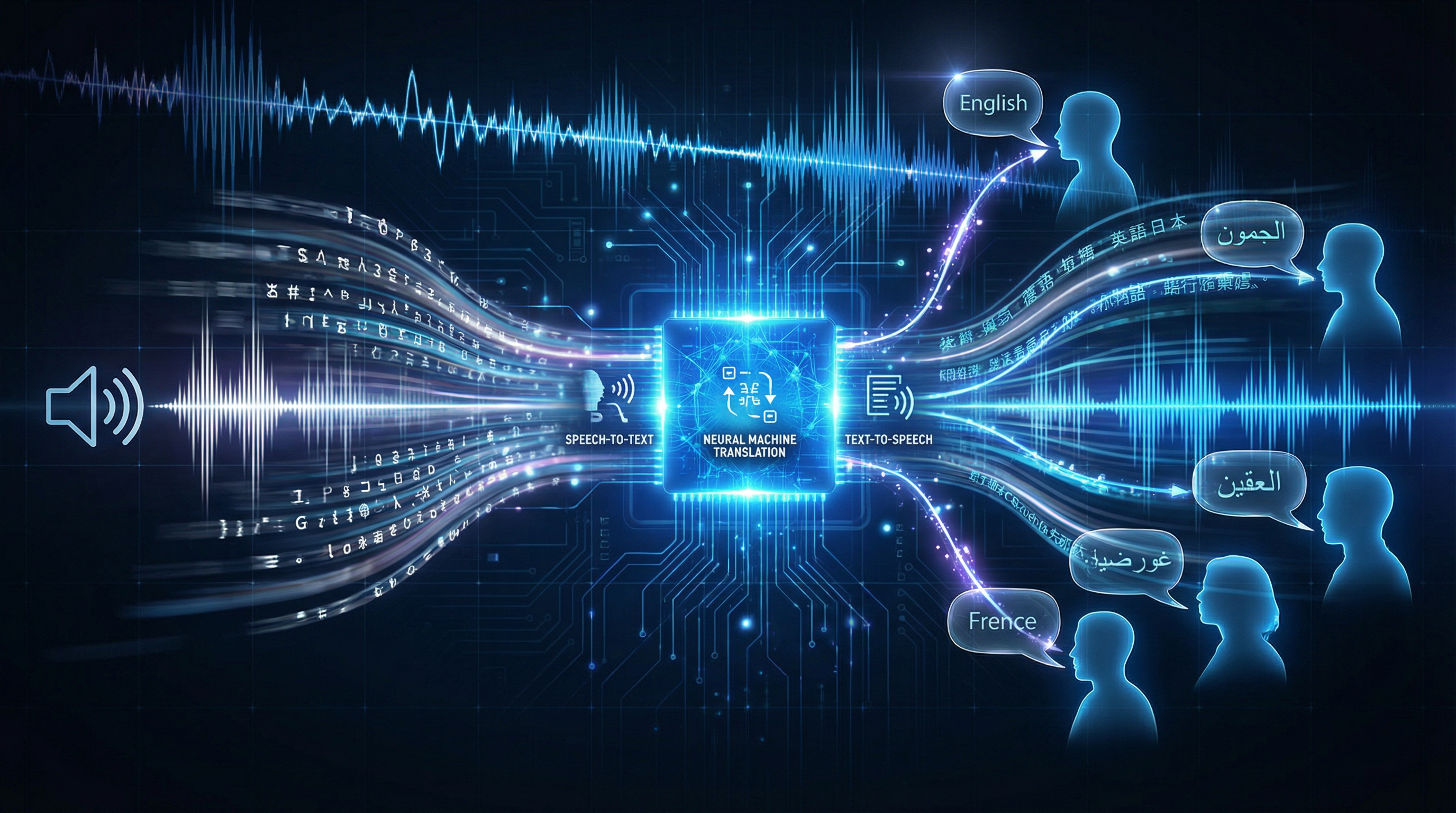
The translation industry stands at an inflection point. Artificial Intelligence has evolved from a laboratory curiosity to a transformative force that is fundamentally reshaping how humanity bridges linguistic divides. This comprehensive analysis examines the technological evolution, current capabilities, emerging trends, and strategic implications of AI-driven translation—a technology that promises to make language barriers as obsolete as the Tower of Babel myth itself.
Executive Summary: AI's Transformative Impact on Translation
Key Finding: AI translation technology has achieved near-human parity for general content across major language pairs, with neural machine translation systems demonstrating 95%+ accuracy rates on standard business documents. The global market for AI translation services is projected to reach $56.4 billion by 2030, representing a compound annual growth rate (CAGR) of 28.2% from 2023.
The translation industry has undergone five distinct paradigm shifts in the past seven decades, each exponentially increasing both quality and scale. From the rudimentary rule-based systems of the 1950s to today's Large Language Models (LLMs) capable of contextual, culturally-aware translation, the trajectory has been relentlessly upward. We are now witnessing the sixth paradigm: the emergence of AI systems that don't merely translate words but understand intent, emotion, and cultural nuance.
Current State Analysis: As of 2024-2025, AI translation systems demonstrate remarkable capabilities across multiple dimensions:
- General Content: 95-98% accuracy for standard business, news, and informational content
- Major Language Pairs: English-Spanish, English-French, English-German, English-Chinese, English-Japanese achieving human-equivalent quality
- Processing Speed: 10,000+ words per second on enterprise-grade hardware
- Language Coverage: Google Translate supports 243 languages; Meta's No Language Left Behind project covers 200 languages including low-resource languages
- Cost Efficiency: 60-90% cost reduction compared to human-only translation workflows
Timeline Predictions:
| Milestone | Timeline | Impact |
|---|---|---|
| AI-first workflows standard | 2025 | Majority of translation projects use AI as primary engine |
| Real-time universal translation | 2027 | Seamless voice-to-voice translation in 100+ languages |
| Near-human parity for most content | 2030 | AI matches human quality for 90% of translation use cases |
| Translator role redefined | 2035 | Human translators focus on creative and strategic work |
The implications extend far beyond the translation industry itself. AI translation is a foundational technology enabling global commerce, cross-cultural collaboration, international diplomacy, and universal access to knowledge. Organizations that understand and strategically deploy these capabilities will gain significant competitive advantages in the increasingly interconnected global marketplace.
This analysis provides decision-makers with the comprehensive understanding needed to navigate this transformation—examining technological capabilities, business implications, sector-specific impacts, and strategic recommendations for stakeholders across the translation ecosystem.
The Translation Technology Evolution: From Paper to Neural Networks
The Pre-Digital Era: Human Translation as the Only Option
Before the digital revolution, translation was entirely a human endeavor. Professional translators relied on paper dictionaries, encyclopedias, and specialized reference materials. The process was painstakingly slow—a skilled translator might translate 2,000-3,000 words per day. Quality depended entirely on individual expertise, with consistency challenges across large projects or multiple translators.
The economics of translation were straightforward but challenging: high-quality human translation commanded premium rates (often $0.15-$0.30 per word for specialized content), creating significant barriers for businesses, governments, and individuals requiring multilingual communication. Translation memory systems—early computer-aided translation (CAT) tools—emerged in the 1990s, offering modest efficiency gains by storing previously translated segments for reuse.
The Rule-Based Machine Translation Era (1950s-1990s)
The first machine translation experiments began in the 1950s, driven by Cold War demand for Russian-English translation. These early systems, exemplified by Georgetown University's 1954 demonstration that translated 60 Russian sentences into English, relied on rule-based approaches. Linguists manually encoded grammatical rules, dictionaries, and syntactic structures into computer programs.
The ALPAC Report of 1966 famously dampened enthusiasm, concluding that machine translation was slower, less accurate, and twice as expensive as human translation. This led to a "AI winter" for machine translation, with funding cuts and reduced research activity. However, work continued in Europe and Asia, with systems like SYSTRAN (founded 1968) providing practical, if limited, translation capabilities for government and military applications.
Rule-Based MT Characteristics
- • Hand-crafted grammatical rules by linguists
- • Bilingual dictionaries as primary knowledge source
- • Limited vocabulary (typically 50,000-100,000 words)
- • Rigid sentence structure analysis
- • Output often grammatically correct but semantically awkward
- • Required extensive maintenance and rule updates
- • High development cost per language pair
The Statistical Machine Translation Revolution (2000s-2016)
The early 2000s witnessed a paradigm shift with the rise of Statistical Machine Translation (SMT). Rather than relying on manually crafted rules, SMT systems learned translation patterns from vast collections of bilingual text corpora. IBM's Candide project and subsequent research demonstrated that statistical models could outperform rule-based systems by learning from examples rather than following predetermined rules.
Google Translate, launched in 2006, brought SMT to mainstream users. The system analyzed millions of translated documents—from United Nations proceedings to European Parliament records—to learn translation probabilities. Phrase-based SMT, the dominant approach during this era, broke sentences into segments, translated each segment statistically, and reordered them according to target language syntax.
SMT delivered significant improvements over rule-based systems, particularly for language pairs with abundant parallel corpora. However, limitations remained: SMT struggled with long-distance dependencies, context handling, and rare phrases not well-represented in training data. The quality ceiling became apparent as the technology matured.
SMT Advantages
- • Data-driven, learns from examples
- • Handles word reordering better than RBMT
- • Improves with more training data
- • Lower per-language development cost
SMT Limitations
- • Poor handling of long sentences
- • Context-blind translation
- • Fluency issues in target language
- • Dependent on parallel corpus quality
The Neural Machine Translation Revolution (2016-Present)
September 2016 marked a watershed moment when Google announced its transition to Neural Machine Translation (NMT) for Google Translate. The improvement was dramatic and immediate—BLU scores for Chinese-English translation jumped by 55%, and users consistently rated NMT output as significantly more fluent and accurate than SMT.
NMT systems employ deep learning architectures, specifically encoder-decoder networks with attention mechanisms. The encoder processes source text into a continuous vector representation that captures semantic meaning. The attention mechanism allows the decoder to focus on relevant parts of the source when generating each target word. This architecture naturally handles context, long-distance dependencies, and fluent sentence generation.
Key breakthroughs in the NMT era include:
- The Transformer Architecture (2017): Vaswani et al.'s "Attention Is All You Need" introduced self-attention mechanisms that revolutionized sequence modeling, enabling parallel processing and superior long-range dependency handling.
- Massive Scale Training: Systems trained on billions of sentence pairs, with models containing hundreds of millions to billions of parameters.
- Multilingual Models: Single models capable of translating between dozens of language pairs, transferring knowledge across languages.
- Zero-Shot Translation: Google's GNMT demonstrated the ability to translate between language pairs never seen during training (e.g., Japanese→Korean via English pivot).
Large Language Models and Translation (2020+)
The emergence of Large Language Models (LLMs) like GPT-3, GPT-4, Claude, and Gemini represents the current frontier. These models, trained on vast portions of the internet, learned translation as an emergent capability rather than a primary objective. Unlike traditional NMT systems designed specifically for translation, LLMs approach translation as one of many language understanding and generation tasks.
LLMs bring several distinctive advantages to translation:
- In-Context Learning: LLMs can adapt to new translation styles, terminology, and domains with minimal examples (few-shot prompting).
- Cultural Awareness: Exposure to diverse cultural content enables more nuanced handling of idioms, humor, and culturally-specific references.
- Multimodal Capabilities: Modern multimodal LLMs can translate content within images, videos, and audio, not just text.
- Reasoning Integration: LLMs can perform complex reasoning during translation, understanding implicit meanings and subtext.
The Quality Trajectory: Measuring Translation Progress
Objective measurement of translation quality has evolved alongside the technology. Early metrics focused on word-level accuracy, while modern approaches assess semantic equivalence and fluency.
BLEU (Bilingual Evaluation Understudy): Introduced in 2002, BLEU revolutionized MT evaluation by comparing n-gram overlap between machine output and reference translations. While BLEU correlates reasonably with human judgments at lower quality levels, it has known limitations—it doesn't account for meaning equivalence and can be gamed by overly literal translations that match words but miss intent.
COMET (Cross-lingual Optimized Metric for Evaluation of Translation): A modern neural metric that leverages pre-trained language models to assess translation quality. COMET demonstrates stronger correlation with human judgments than BLEU, particularly for high-quality translations where BLEU struggles to discriminate. Scores range from 0 to 1, with scores above 0.9 indicating high-quality output.
| Era | Typical BLEU Score | Human Equivalent |
|---|---|---|
| Rule-Based MT (1990s) | 15-25 | Non-native speaker level |
| Statistical MT (2000s) | 25-40 | Non-native with errors |
| Early NMT (2016-2018) | 40-55 | Non-native fluent |
| Modern NMT (2019-2022) | 55-70 | Near-native professional |
| LLM Era (2023+) | 65-85+ | Professional human parity |
Timeline of Major Breakthroughs
1954
Georgetown-IBM Experiment
First public demonstration of machine translation
1966
ALPAC Report
Temporary setback for MT funding and research
2006
Google Translate Launch
Statistical MT reaches mainstream users
2016
Neural Machine Translation
Google switches to NMT; dramatic quality improvement
2017
Transformer Architecture
"Attention Is All You Need" published
2020
GPT-3 Release
LLMs demonstrate emergent translation capabilities
2022
ChatGPT Launch
Conversational AI makes translation accessible
2023-2024
LLM Translation Maturity
GPT-4, Claude 3, Gemini achieve professional quality
Current State of AI Translation: The Competitive Landscape
Google Translate: The Ubiquitous Standard
Google Translate processes over 100 billion words daily across 243 supported languages, making it the most widely used translation service in history. Its neural architecture, continuously refined since the 2016 NMT transition, delivers consistently strong performance across major language pairs.
Capabilities: Google Translate excels in handling short phrases, common idioms, and general-purpose content. The system benefits from Google's vast data resources, including web-crawled parallel text, user corrections, and continuous A/B testing. Recent improvements include better handling of context through document-level translation and improved gender-specific translations.
Limitations: Despite its sophistication, Google Translate struggles with specialized domains, rare language pairs, and culturally-nuanced content. The system is optimized for broad utility rather than specialized accuracy, making it less suitable for legal, medical, or highly technical content without human review. Privacy concerns also exist, as Google may use submitted content to improve its models.
DeepL: The Quality Leader
Founded in 2017 by former Google employees, DeepL has established itself as the quality leader in neural machine translation. Independent evaluations consistently rank DeepL above competitors for European language pairs, with users praising its natural-sounding output and superior handling of nuance.
DeepL's proprietary neural networks, trained on high-quality bilingual data from Linguee (the company's earlier translation search engine), demonstrate exceptional fluency. The system employs a unique architecture that emphasizes natural language generation over literal accuracy, often producing translations that read as if written by native speakers.
DeepL Competitive Advantages
- • Superior fluency and natural language generation
- • Industry-specific models (DeepL for Business)
- • Glossary and terminology integration
- • Formality control (formal/informal distinction)
- • API access for enterprise integration
- • Data privacy commitment (EU-based, GDPR compliant)
OpenAI GPT-4: The Emerging Translation Powerhouse
GPT-4 and its successors represent a fundamentally different approach to translation. Rather than being purpose-built for translation, these models learned translation as one of many capabilities during broad training on internet text. This emergent capability has proven remarkably powerful.
Academic evaluations have demonstrated that GPT-4 achieves competitive or superior performance compared to specialized NMT systems. A 2023 study by Microsoft Research found that GPT-4 matched or exceeded Google Translate and DeepL on several benchmark datasets, particularly when provided with context and specific instructions through prompt engineering.
GPT-4's translation capabilities shine in several areas:
- Contextual Understanding: The model can maintain context across long documents, ensuring consistency in terminology and style.
- Adaptability: Through prompting, users can specify tone, formality, target audience, and stylistic preferences.
- Cultural Nuance: Exposure to diverse cultural content enables better handling of idioms, humor, and culturally-specific expressions.
- Multi-step Reasoning: GPT-4 can perform complex reasoning about ambiguous phrases, often asking clarifying questions when context is insufficient.
Microsoft Translator: The Enterprise Contender
Microsoft's Azure Cognitive Services Translator has evolved significantly, leveraging the company's deep investments in AI research. The platform offers comprehensive enterprise features including custom model training, document translation, and tight integration with Microsoft 365 ecosystem.
Microsoft's approach emphasizes business integration—real-time translation in Teams meetings, document translation in Word, and PowerPoint presentation localization. The system supports over 100 languages and offers enterprise-grade security, compliance, and data residency options that appeal to regulated industries.
Meta's No Language Left Behind: Democratizing Translation
Meta's No Language Left Behind (NLLB) project, launched in 2022, represents a significant contribution to translation equity. The open-source model supports 200 languages, including many low-resource languages that commercial providers neglect. NLLB demonstrated that high-quality translation is possible for languages with limited training data through innovative techniques like sparse mixture-of-experts architectures and massively multilingual training.
The project's impact extends beyond technical achievement. By making the model freely available and supporting languages spoken by billions in underserved regions, Meta has democratized access to translation technology. Organizations serving diverse linguistic communities can now provide translation capabilities that were previously economically unfeasible.
Specialized Domain Performance
AI translation performance varies significantly across domains. General-purpose systems excel at consumer content but often struggle with specialized terminology, regulatory requirements, and domain-specific conventions.
| Domain | AI Suitability | Human Review Required |
|---|---|---|
| General Business | High | Light post-editing |
| Marketing/Transcreation | Medium | Creative adaptation required |
| Legal | Medium-Low | Certified human review essential |
| Medical | Low | Human-only for life-critical |
| Technical/IT | High | Terminology validation |
| Financial | Medium | Regulatory compliance check |
Language Pair Variations: The Resource Divide
AI translation quality correlates strongly with the availability of training data. High-resource language pairs (English-Spanish, English-French, English-German) achieve near-human quality, while low-resource pairs (English-Swahili, English-Icelandic, many Indigenous languages) remain challenging.
The "resource divide" creates a two-tier system:
- High-Resource Pairs (100+ languages): Abundant parallel text from government proceedings, web content, and professional translation. Achieve 90%+ human parity for general content.
- Medium-Resource Pairs (50-100 languages): Sufficient data for functional translation, typically 75-90% human parity. Quality improving rapidly with multilingual model techniques.
- Low-Resource Pairs (1,000+ languages): Limited parallel data, often below 100,000 sentence pairs. Translation quality ranges from basic intelligibility to moderate fluency depending on language relatedness to high-resource languages.
Real-Time Translation: Voice and Video
The frontier of AI translation extends beyond text to real-time speech and video. Speech-to-speech translation systems now enable natural conversations across language barriers, with latency as low as 1-3 seconds. Meta's Universal Speech Translator, Google's Translatotron, and various startup offerings demonstrate the rapid maturation of this technology.
Video translation adds lip synchronization to the challenge, requiring AI to not only translate speech but to modify video so that lip movements match the translated audio. HeyGen, Synthesia, and similar platforms offer automated video localization that was previously prohibitively expensive for most content creators.
Large Language Models: The Translation Game Changer
GPT-4, Claude, and Gemini: Translation Capabilities Analysis
Large Language Models have fundamentally altered the translation landscape. Unlike purpose-built NMT systems, LLMs approach translation through the lens of general language understanding, bringing unique capabilities that complement and sometimes exceed specialized systems.
GPT-4 (OpenAI): With its massive parameter count and broad training, GPT-4 demonstrates exceptional translation capabilities across a wide range of scenarios. The model excels at:
- Document-level context maintenance across thousands of words
- Handling ambiguous source text through reasoning and inference
- Adapting to specific tone, style, and audience requirements
- Translating highly idiomatic and culturally-specific content
- Managing complex formatting and structural elements
Claude (Anthropic): Anthropic's Claude models, particularly Claude 3 Opus and Claude 3.5 Sonnet, have emerged as strong translation contenders. Claude's training emphasizes helpfulness, harmlessness, and honesty—traits that translate to careful, accurate translation work. The model's large context window (up to 200,000 tokens in some versions) enables unprecedented document-level translation coherence.
Gemini (Google): Google's Gemini models bring multimodal capabilities to translation—processing text within images, understanding video content, and generating translations across modalities. The Ultra variant demonstrates competitive performance on standard benchmarks while offering tight integration with Google's ecosystem.
In-Context Learning: Customizing Translation for Specialized Domains
Perhaps the most revolutionary aspect of LLM translation is in-context learning—the ability to adapt to new domains, styles, and requirements through prompting rather than retraining. This capability transforms translation workflows in several ways:
Zero-Shot Translation: LLMs can translate between language pairs they weren't explicitly trained on, leveraging transfer learning from related languages. This enables translation for low-resource language pairs that lack dedicated training data.
Few-Shot Examples: By providing a handful of example translations that demonstrate desired style, terminology, and tone, users can guide LLMs to produce output matching specific requirements. This "prompt engineering" approach eliminates the need for costly custom model training.
Effective Translation Prompting Strategy
You are a professional legal translator specializing in corporate law.
Translate the following contract clause from English to Japanese:
[Source text]
Requirements:
- Maintain formal legal register
- Use standard Japanese corporate law terminology
- Preserve all conditional logic precisely
- Format using Japanese legal document conventions
Here are examples of the preferred style:
[3-5 example translations]
Cultural Adaptation and Localization Beyond Translation
Traditional translation focuses on linguistic equivalence—conveying the same meaning in another language. LLMs enable a more sophisticated approach: cultural adaptation and localization that considers the target culture's norms, values, and communication patterns.
This capability is particularly valuable for:
- Marketing Content: Adapting campaigns that reference cultural touchpoints, humor, and idioms that don't translate literally.
- User Interfaces: Adjusting layout, imagery, and terminology to match local conventions and expectations.
- Educational Materials: Localizing examples, case studies, and references to resonate with target learners.
- Legal Documents: Ensuring that translated contracts account for different legal system conventions and enforceability.
Hallucination Risks and Mitigation Strategies
A critical challenge with LLM translation is hallucination—the generation of content not present in the source, including invented facts, incorrect numbers, or entirely fabricated sentences. While less common in straightforward translation than in open-ended generation, hallucinations pose serious risks for high-stakes applications.
Risk Scenarios:
- Adding explanatory content not in the source text
- Inventing names, dates, or numerical values
- Changing affirmative to negative (or vice versa)
- Omitting critical qualifying clauses
- Over-localizing to the point of meaning distortion
Mitigation Approaches:
- Back-Translation Verification: Translate output back to source language and compare for consistency.
- Segment Alignment: Use sentence or paragraph-level alignment to verify nothing was added or omitted.
- Terminology Consistency Checks: Automated validation that key terms translate consistently throughout.
- Human Review Protocols: Risk-based review requirements based on content criticality and known hallucation patterns.
Quality Comparison: LLMs vs. Human Translation
Multiple academic studies have compared LLM translation quality to professional human translation. The results suggest a nuanced picture rather than simple superiority of one over the other:
| Dimension | LLM Performance | Human Performance |
|---|---|---|
| Fluency | Near-parity | Benchmark |
| Accuracy (general content) | 95%+ accuracy | 98%+ accuracy |
| Cultural nuance | Variable | Superior |
| Consistency (long documents) | Excellent | Variable |
| Specialized terminology | Requires guidance | Expert knowledge |
| Speed | 10,000+ wpm | 300-500 wpm |
| Creativity/transcreation | Moderate | Superior |
The Human-AI Collaboration Model: The Future of Translation Workflows
Machine Translation Post-Editing (MTPE): The Industry Standard
Machine Translation Post-Editing (MTPE) has emerged as the dominant workflow in the translation industry. Rather than translating from scratch, human translators edit and refine AI-generated output. This approach typically delivers 2x-5x productivity improvements while maintaining quality standards.
MTPE exists on a spectrum:
- Light Post-Editing (LPE): Minimal intervention focused on correcting gross errors and ensuring basic intelligibility. Suitable for internal documents, gisting, and time-sensitive content where perfect quality isn't required.
- Full Post-Editing (FPE): Comprehensive editing to achieve human-quality output. Includes style refinement, terminology consistency, and cultural adaptation. Results should be indistinguishable from human translation.
The economics of MTPE are compelling. A translator who previously handled 2,000 words/day can now process 6,000-10,000 words with FPE or 15,000+ words with LPE. While per-word rates for MTPE are lower than for translation from scratch, the increased volume typically results in higher overall earnings for translators while reducing costs for clients.
AI-Assisted Translation (AIAT): The Next Evolution
Beyond post-editing, AI-Assisted Translation (AIAT) encompasses a broader range of collaborative workflows where AI and humans work together throughout the translation process:
- Interactive Translation Prediction: AI suggests completions as the translator types, similar to smart autocomplete but for translation. Systems like SDL Trados Studio's "Machine Translation AutoSuggest" and similar features in other CAT tools accelerate translation while maintaining human control.
- Quality Estimation Integration: AI predicts which segments require human attention, allowing translators to focus post-editing effort where it's most needed. High-confidence segments may require no review, while low-confidence segments receive careful attention.
- Terminology Suggestion: AI suggests appropriate terminology based on context, client glossaries, and previous translations, ensuring consistency without manual lookup.
- Contextual Research Assistance: AI provides background information on ambiguous terms, helping translators make informed decisions.
Quality Estimation Automation: Predicting Translation Quality
Quality Estimation (QE) technology predicts translation quality without reference translations, enabling intelligent routing of content to appropriate workflows. Modern QE systems use neural models trained on human quality assessments to estimate the post-editing effort required for each segment.
Practical applications include:
- Automatic Routing: High-QE-score segments proceed directly to publication; medium scores receive light review; low scores go to experienced translators for full post-editing.
- Pricing Optimization: Client pricing reflects expected post-editing effort based on QE scores.
- Translator Matching: Complex segments (low QE scores) are assigned to specialized translators with domain expertise.
- Process Improvement: QE data identifies systematic issues with specific MT engines, domains, or language pairs.
Terminology Management Integration
Terminology consistency remains critical for professional translation, particularly in technical, medical, and legal domains. Modern AI translation systems integrate with terminology management through:
- Glossary Injection: Forcing specific translations for key terms through constrained decoding or prompt engineering.
- Dynamic Adaptation: Fine-tuning or in-context learning based on client-specific terminology databases.
- Terminology Checking: Automated validation that approved terms are used correctly throughout translations.
Productivity Gains: The 2x-5x Throughput Revolution
The productivity impact of AI translation is transformative. Industry studies consistently demonstrate significant throughput improvements:
| Workflow | Words/Day | Productivity Gain |
|---|---|---|
| Human Translation (Traditional) | 2,000-3,000 | Baseline |
| CAT Tools with TM (Legacy) | 3,000-5,000 | 1.5-2x |
| MT + Full Post-Editing | 6,000-10,000 | 3-4x |
| MT + Light Post-Editing | 12,000-20,000 | 6-8x |
| AI-Assisted Interactive Translation | 5,000-8,000 | 2.5-3.5x |
New Skill Requirements for Translators
The AI transformation demands new competencies from translation professionals. The translator's role is evolving from linguistic craftsman to translation engineer and quality curator:
Technical Skills
- • CAT tool mastery (Trados, MemoQ, etc.)
- • MT engine evaluation and selection
- • Post-editing efficiency techniques
- • Terminology management systems
- • Quality estimation interpretation
- • Prompt engineering for LLMs
Strategic Skills
- • MT quality assessment and triage
- • Client consultation on AI options
- • Workflow optimization
- • Error pattern analysis
- • Cultural adaptation expertise
- • Specialized domain knowledge
The Changing Role of Human Translators
As AI handles an increasing share of the translation volume, human translators are shifting toward higher-value activities:
- Transcreation and Creative Adaptation: Marketing content, brand messaging, and creative materials require the cultural intelligence and creative judgment that AI lacks.
- Strategic Localization Consulting: Advising clients on cultural adaptation, market entry strategies, and multilingual content architecture.
- Quality Assurance Leadership: Designing and implementing quality frameworks for AI-human hybrid workflows.
- Specialized Domain Expertise: Legal, medical, and highly technical translation where accuracy is paramount and liability concerns demand human accountability.
- AI Training and Customization: Curating training data, fine-tuning models, and developing client-specific AI solutions.
Industry Transformation: Business Model Disruption
Translation Agency Business Model Evolution
The traditional translation agency model—selling human translation services at per-word rates—is being fundamentally disrupted. Successful agencies are reinventing themselves as language solutions providers, offering technology-enabled services rather than just labor.
Emerging Business Models:
- AI-First Agencies: Building on MTPE workflows as the default, with human translation positioned as a premium service for specialized needs.
- Technology Consultancies: Advising clients on AI translation implementation, tool selection, and workflow optimization rather than providing translation labor directly.
- Platform Providers: Building and licensing translation management platforms that integrate AI, workflow management, and quality assurance tools.
- Specialized Boutique Firms: Focusing on premium niches (legal, medical, literary) where human expertise remains essential and commands premium pricing.
Pricing Disruption: From Per-Word to Value-Based Models
AI is forcing a fundamental reconsideration of translation pricing. Per-word pricing, the industry standard for decades, becomes problematic when AI generates 80% of the content:
Emerging Pricing Models:
| Model | Structure | Best For |
|---|---|---|
| Per-Word (Traditional) | $0.08-$0.25/word | Document translation |
| Post-Editing Rate | $0.03-$0.08/word | High-volume, standard quality |
| Hourly Rates | $50-$150/hour | Complex, creative, consulting |
| Project-Based | Fixed scope-based pricing | Defined deliverables |
| Subscription | Monthly fee for unlimited/near-unlimited volume | High-volume continuous needs |
| Managed Service | Annual contract with SLA-based pricing | Enterprise clients |
New Market Entrants: Tech Giants and AI-Native Startups
The translation market is experiencing unprecedented entry from technology companies. Google, Microsoft, Amazon, Meta, and OpenAI offer translation as part of broader AI service portfolios, often at prices that would be unprofitable for traditional providers.
Competitive Dynamics:
- Cloud Providers: AWS Translate, Azure Translator, and Google Cloud Translation offer API-based translation at commodity prices, competing on integration and scale rather than translation expertise.
- AI-Native Startups: Companies like DeepL, Lilt, Unbabel, and others build on AI-first approaches, often outperforming traditional agencies on both quality and cost.
- Enterprise Software Integration: Translation is increasingly embedded in content management systems, customer support platforms, and communication tools, reducing the need for standalone translation services.
Consolidation of Traditional Agencies
The translation industry is experiencing significant consolidation as larger players acquire smaller agencies to achieve scale, technology capabilities, and geographic coverage. At the same time, many small agencies without clear differentiation are struggling to compete on price with AI-enabled competitors.
Consolidation Drivers:
- Technology Investment Requirements: Building competitive AI capabilities requires substantial R&D investment that favors larger players.
- Scale Economics: Large volume enables better MT engine customization, data accumulation, and operational efficiency.
- Enterprise Client Demands: Major corporations prefer working with large, financially stable providers with global coverage.
- Platform Network Effects: Translation management platforms benefit from user base scale in improving matching, quality prediction, and workflow optimization.
Specialization and Premium Services: The Differentiation Strategy
As AI commoditizes general translation, differentiation increasingly comes from specialization. Agencies that develop deep expertise in specific domains, languages, or service types can command premium pricing that generic AI services cannot match.
Domain Specialization
Legal, medical, financial, technical, marketing—deep domain expertise with certified translators and specialized AI training.
Language Specialization
Rare language pairs, endangered languages, specific dialects or regional variants where AI quality is insufficient.
Service Specialization
Certified translation, transcreation, multimedia localization, interpreting, consulting—services requiring human creativity and accountability.
Value Chain Restructuring: From Linear to Ecosystem
The traditional translation value chain—client → agency → translator → reviewer → client—is being replaced by a technology-mediated ecosystem. AI sits at the center, with human experts providing value-add services that machines cannot replicate.
Emerging Value Chain Elements:
- AI Model Providers: Google, DeepL, OpenAI, and others providing foundational translation capabilities.
- Workflow Orchestration Platforms: Smartcat, Memsource, XTM, and similar platforms managing AI-human collaboration.
- Data Providers: Companies curating and selling training data, terminology databases, and translation memories.
- Quality Assurance Specialists: Expert reviewers focusing on high-stakes content and complex quality challenges.
- Integration Specialists: Developers connecting translation into client systems (CMS, CRM, support platforms).
Case Studies of Industry Adaptation
Case Study 1: Lionbridge Transformation
One of the world's largest language service providers, Lionbridge has aggressively adopted AI, developing its own neural MT engine and positioning itself as an "AI-powered" provider. The company now offers tiered services ranging from fully automated translation to premium human services, with AI as the default option for appropriate content.
Case Study 2: Unbabel's AI-Native Approach
Founded in 2013, Unbabel built its business model entirely on AI-human collaboration. The platform combines neural MT with a global community of editors, using quality estimation to route content appropriately. This AI-native approach has attracted major enterprise clients including Microsoft, Booking.com, and Udemy.
Case Study 3: Small Agency Survival Strategies
Boutique agencies specializing in certified legal and medical translation have largely weathered the AI disruption by focusing on services that AI cannot replicate—certified documents requiring human signatures, complex medical records demanding expert knowledge, and legal documents where liability concerns mandate human accountability.
Sector-Specific Impact Analysis: Varied AI Adoption Patterns
Legal Translation: The Human Certification Imperative
Legal translation presents unique challenges for AI adoption. While AI can handle the linguistic aspects reasonably well, the legal domain imposes requirements that technology cannot satisfy:
- Certification Requirements: Many jurisdictions require translations to be certified by qualified human translators who attest to accuracy under penalty of perjury.
- Liability Concerns: Errors in legal documents can have severe consequences—missed court deadlines, invalid contracts, immigration denials. Human accountability remains essential.
- System-Specific Knowledge: Legal systems vary dramatically across jurisdictions. Concepts like "trust," "tort," or "consideration" lack direct equivalents, requiring legal expertise to navigate.
AI Integration Pattern: AI is used for initial drafting and gisting, but human legal translators handle all final output. Some firms use AI for internal document review and due diligence support, with human experts reviewing flagged items. The business model remains largely unchanged—clients pay for human-certified output.
Medical Translation: Life-Critical Content Demands Human Precision
Medical translation presents the highest stakes for accuracy. Errors in dosage instructions, contraindications, or device operation manuals can cause injury or death. Regulatory bodies including the FDA, EMA, and equivalents worldwide mandate human review for medical device and pharmaceutical documentation.
AI Boundaries in Medical Translation:
- Patient-Facing Materials: Labels, instructions for use, patient information leaflets—strictly human translation with multiple review cycles.
- Clinical Trial Documentation: Protocols, informed consent forms, case report forms—translated by medical specialists with regulatory expertise.
- Internal Research Materials: AI may assist with initial drafting of research papers, literature reviews, and internal communications, with expert review mandatory before publication or submission.
- Telemedicine Support: AI interpretation for initial triage and routine consultations, with human medical interpreters for complex cases and emergencies.
Marketing and Transcreation: AI + Human Creativity Synergy
Marketing content presents a different AI adoption pattern. While literal translation often falls flat, AI is proving valuable as a collaborative tool in the transcreation process—creative adaptation that goes beyond translation to evoke the same emotional response in target audiences.
AI Applications in Marketing Localization:
- Initial Drafting: AI generates baseline translations that creative teams then adapt for cultural resonance.
- Variant Generation: AI produces multiple translation options for taglines and headlines, which creative teams evaluate and refine.
- Content Scaling: Product descriptions, SEO content, and routine marketing materials often use AI-first workflows with light human review.
- Cultural Checking: AI flags potentially problematic content (colors, numbers, imagery associations) for human review.
Technical Translation: High AI Adoption Rates
Technical translation—software documentation, engineering specifications, user manuals—has seen the highest AI adoption rates. Several factors drive this:
- Terminology Consistency: Technical domains have precise terminology that AI handles well with proper glossary integration.
- Structured Content: Technical documents follow predictable patterns that AI processes efficiently.
- Volume and Velocity: Software updates require rapid, continuous localization that would be economically impossible with human-only workflows.
- Lower Creativity Requirements: Technical accuracy outweighs stylistic flair, playing to AI strengths.
Major tech companies including Microsoft, Adobe, and Salesforce have largely automated technical documentation translation, using human experts primarily for quality spot-checking and complex edge cases.
Gaming Localization: Real-Time Adaptation
The gaming industry presents unique localization challenges: millions of words of dialogue, cultural adaptation of humor and references, and real-time needs for live-service games with frequent content updates.
AI Integration in Gaming:
- Dialogue Translation: AI handles initial translation of NPC dialogue, with voice actors performing from localized scripts.
- Live Service Updates: Real-time localization of new content drops, events, and patches—often using AI-first workflows with human review for story-critical content.
- Cultural Adaptation: AI-assisted transcreation of cultural references, with native speakers ensuring humor and context translate effectively.
- Player Support: AI translation of community forums, support tickets, and player feedback, enabling global game communities.
Subtitling and Media Localization: Automated Workflows
The subtitling industry has undergone dramatic transformation. AI now handles automatic speech recognition (ASR), time-coding, and initial translation, with human experts focusing on quality review and creative adaptation.
Modern Subtitling Workflow:
- AI ASR generates transcript from audio
- AI segments dialogue into subtitle-appropriate lengths
- AI translates content into target languages
- Human subtitlers review timing, line breaks, and readability
- Human linguists review translation quality and cultural adaptation
- Final QC before delivery
Platforms like Netflix, YouTube, and streaming services now rely heavily on AI-assisted subtitling to manage the volume of content requiring localization. Human experts remain essential for premium content and quality-critical releases.
E-Commerce: Scale Through AI Translation
E-commerce platforms face a scale challenge that only AI can address: millions of product listings, reviews, and support interactions across dozens of languages. Amazon, Alibaba, eBay, and Shopify merchants use AI translation to reach global markets that would be inaccessible with human-only approaches.
AI Applications in E-Commerce:
- Product Listings: Automated translation with terminology enforcement, enabling sellers to reach international markets instantly.
- Review Translation: AI translates buyer reviews so customers can read feedback in their language, increasing trust and conversion.
- Customer Support: AI interpretation for real-time chat support, enabling a single English-speaking team to serve global customers.
- Marketing Content: AI-powered localization of promotional materials, email campaigns, and social media content.
Emerging Technologies: The Next Frontier
Real-Time Speech Translation: Breaking the Spoken Barrier
Real-time speech-to-speech translation is approaching practical deployment for consumer and business applications. Systems from Meta, Google, and various startups now offer near-conversational latency with improving accuracy.
Current Capabilities:
- Latency: 1-3 seconds for major language pairs, approaching the natural pause length in conversation.
- Accuracy: 85-95% for clear speech in major languages, dropping with accents, background noise, and technical terminology.
- Voice Retention: Some systems preserve speaker voice characteristics in translation, creating a more natural experience.
- Offline Capability: Edge AI enables translation without internet connectivity, critical for privacy-sensitive applications.
Applications: Tourism, international business meetings, customer service, healthcare interpretation, diplomatic communications, and eventually personal consumer devices (the "Babel fish" realization).
AR/VR Multilingual Experiences: Immersive Translation
Augmented and virtual reality create new possibilities for translation presentation. AR glasses can overlay translated text on real-world signs, menus, and documents in real-time. VR environments can enable natural multilingual collaboration regardless of participants' native languages.
Emerging Applications:
- AR Translation Glasses: Real-time visual translation of text in the user's field of view, maintaining context and layout.
- VR Meeting Spaces: Virtual environments where participants see and hear each other in their preferred language.
- Gaming Integration: Real-time translation of in-game text and voice chat, enabling global player communities.
- Educational Immersion: Language learning through AR/VR environments with contextual, real-time translation support.
Brain-Computer Interfaces: The Ultimate Translation Frontier
While still in early research phases, brain-computer interfaces (BCIs) represent the ultimate frontier for translation technology. Direct neural interfaces could theoretically enable thought-to-thought communication across language barriers, bypassing the limitations of speech and text.
Companies including Neuralink, Kernel, and research institutions worldwide are developing BCIs with potential translation applications. Challenges include neural signal interpretation, semantic encoding, and the fundamental question of whether thought can be separated from language.
Timeline: Practical BCI translation remains 10-20 years away, but represents the logical endpoint of translation technology evolution.
Quantum Computing Implications
Quantum computing may eventually transform translation through exponentially faster processing of language models. Quantum algorithms could optimize translation model training, enable real-time processing of massive multilingual corpora, and potentially reveal new approaches to language understanding through quantum pattern recognition.
While practical quantum advantage for NLP remains speculative, major tech companies are investing in quantum-classical hybrid approaches that may yield benefits within the next decade.
Federated Learning for Privacy-Preserving Translation
Federated learning enables AI model training across decentralized data sources without centralizing sensitive data. For translation, this means:
- Privacy Compliance: Training on sensitive documents without exposing content to model providers.
- Enterprise Security: Organizations can improve translation models using their confidential content without data breaches.
- Regulatory Alignment: Meeting GDPR, HIPAA, and other privacy regulations while benefiting from AI improvements.
Multimodal Translation: Beyond Text
Modern AI systems increasingly handle translation across modalities—not just text, but images, video, and audio in combination. This enables:
- Image Translation: Extracting and translating text within photographs, screenshots, and scanned documents.
- Video Localization: Automated dubbing with lip synchronization, enabling cost-effective video localization at scale.
- Multimodal Context: Using visual context to improve translation accuracy (e.g., understanding that "bank" refers to a financial institution rather than a riverbank based on visual cues).
Synthetic Media Localization: AI-Generated Content Translation
As AI generates increasing amounts of content—marketing copy, product descriptions, customer communications—the need for translation of AI-generated content grows. This creates a meta-challenge: AI translating AI-generated content, with quality control becoming paramount.
Synthetic media also enables new localization approaches: AI-generated avatars speaking multiple languages with native lip synchronization, personalized marketing content automatically localized for each recipient, and real-time content adaptation based on audience language preferences.
Challenges and Risks: Navigating the AI Translation Frontier
Quality Assurance Complexity: Detecting AI Errors
AI translation introduces new quality challenges. Unlike human translators, who make predictable errors (omissions, terminology inconsistencies), AI systems generate fluent but potentially incorrect output that is harder to detect. An AI might confidently mistranslate a critical number, invert a negation, or invent information not present in the source.
Quality Assurance Challenges:
- Fluency Deception: High-quality fluency can mask accuracy errors, making detection more difficult than with obviously poor translations.
- Consistency vs. Context: AI may translate the same term differently in different contexts—sometimes correctly (contextual adaptation), sometimes incorrectly (inconsistency).
- Scale of Review: When AI generates 100,000 words/day, human review of every word becomes economically challenging.
- Competence Requirements: Effective quality assurance requires reviewers who understand both source and target languages at expert level, a scarce resource.
Cultural Nuance Loss: Beyond Words to Meaning
Translation is not merely linguistic conversion—it's cultural mediation. AI systems, despite their sophistication, lack lived cultural experience. They may translate words correctly while missing cultural subtext, humor, taboos, and implicit meanings that human translators navigate naturally.
Risk Areas:
- Idiomatic Expressions: AI often translates idioms literally, producing confusing or humorous results.
- Register and Tone: Inappropriate formality levels can offend or undermine credibility in business and diplomatic contexts.
- Cultural References: Sports metaphors, political allusions, and pop culture references may not resonate—or may confuse—in target cultures.
- Taboo and Sensitivity: AI may inadvertently translate content in ways that violate cultural or religious taboos.
Ethical Considerations: The Responsibility Question
AI translation raises profound ethical questions:
- Accountability: When AI mistranslation causes harm—legal consequences, medical errors, diplomatic incidents—who is responsible? The AI provider, the organization deploying the AI, or the human who approved its use?
- Transparency: Should audiences know when content is AI-translated? Is there an ethical obligation to disclose machine translation?
- Language Preservation: As AI focuses on economically viable languages, does it accelerate the decline of minority and endangered languages?
- Consent and Data Use: Training data often includes documents provided for human translation. Should contributors have consented to AI training use?
Job Displacement Concerns: The Human Impact
The translation industry employs an estimated 640,000 professionals worldwide. AI threatens to displace significant portions of this workforce, particularly generalist translators without specialized expertise or technology skills.
Impact Patterns:
- General Translation: Significant displacement risk as AI achieves near-parity for general content.
- Post-Editing Roles: Some translators transition to MTPE work, though rates are typically lower than translation from scratch.
- Specialized Domains: Legal, medical, and certified translators face less displacement due to regulatory and liability requirements.
- Creative and Transcreation: Marketing translators who adapt content creatively may see increased demand as AI handles routine translation.
Data Privacy and Security: The Confidentiality Challenge
Cloud-based AI translation services raise significant data privacy concerns. When confidential documents are submitted to Google Translate, DeepL, or OpenAI APIs, where does that data go? Who can access it? Is it used to train future models?
Privacy Solutions:
- On-Premise AI: Running translation models locally, keeping all data within organizational infrastructure.
- Enterprise Agreements: Contracts with AI providers that explicitly prohibit data retention and model training.
- Data Minimization: Translating only necessary content, redacting sensitive information before submission.
- Federated Learning: Improving models without centralizing sensitive training data.
IP Protection Challenges: Protecting Proprietary Content
Organizations worry that submitting proprietary content to AI translation services may expose trade secrets, patent applications, or confidential business information. While major providers offer enterprise protections, the concern remains valid, particularly for highly sensitive content.
Bias in Training Data: The Amplification Risk
AI models learn from human-generated content, inheriting and potentially amplifying biases present in training data. Translation models may exhibit:
- Gender Bias: Assuming doctors are male, nurses female, based on training data patterns.
- Cultural Bias: Treating Western concepts as default, requiring awkward circumlocutions for non-Western ideas.
- Socioeconomic Bias: Language patterns associated with educated, formal contexts receiving preferential treatment.
- Regional Bias: Preferring major dialects over minority variants within language communities.
Regulatory Compliance: Navigating Legal Frameworks
AI translation must navigate an evolving regulatory landscape:
- EU AI Act: High-risk AI applications, including certain translation use cases, face strict requirements for documentation, testing, and human oversight.
- Certification Requirements: Many jurisdictions mandate human certification for translated documents used in legal proceedings, immigration, and business registration.
- Data Protection: GDPR, CCPA, and other privacy regulations govern how translation data can be collected, processed, and retained.
- Accessibility Standards: Regulations like the Americans with Disabilities Act may require human-verified translation for accessible communication.
The Road Ahead: 2025-2035 Predictions and Milestones
2025: AI-First Workflows Become Standard
By 2025, AI-first translation workflows will be the default for the majority of translation volume across industries. Organizations will routinely expect AI-generated translations with human review as the baseline service model, reserving "human translation from scratch" for premium use cases.
Key 2025 Developments:
- AI translation integrated as standard feature in major business software
- Post-editing rates become the dominant pricing model
- Quality estimation technology matures for automated routing
- Real-time speech translation achieves business viability
- Professional translator training includes AI tool competency
2027: Real-Time Universal Translation
By 2027, real-time translation across 100+ languages will be a commodity service. Consumer devices (earbuds, glasses, smartphones) will offer seamless translation for everyday conversations, travel, and commerce. Business applications will enable truly global teams without language barriers.
2027 Capabilities:
- Consumer-grade speech translation with <2 second latency
- AR glasses overlaying translated text on real-world signage
- Seamless multilingual video conferencing with natural lip sync
- Universal translation APIs available at commodity pricing
- Majority of internet content available in user's preferred language
2030: Near-Human Parity for Most Content
By 2030, AI translation will achieve near-human parity for 90% of translation use cases. The remaining 10%—highly creative, culturally-nuanced, or legally-critical content—will remain the domain of human experts. The translation industry will have fully transformed into a technology-enabled service sector.
2030 Industry State:
- General business translation largely automated
- Human translators focus on creative, strategic, and certified work
- Translation agencies restructured as AI-human orchestration platforms
- Education system includes translation technology as standard curriculum
- Regulatory frameworks clarify AI translation liability and standards
2035: The Translator Role Redefined
By 2035, the professional translator role will have evolved beyond recognition from 2020. "Translation" as a discrete profession will largely disappear, replaced by "localization specialists," "cross-cultural consultants," and "AI training curators" who work with technology rather than against it.
2035 Professional Landscape:
- Fewer professional translators, but higher average compensation for specialists
- Translation technology courses standard in language programs
- AI training and customization as core professional skill
- Certified human review required only for high-stakes content
- Most translation "work" performed by AI; humans focus on exceptions
Skills That Will Remain Valuable: The Human Advantage
Certain skills will remain valuable regardless of AI advancement:
Irreplaceable Skills
- • Creative writing and transcreation
- • Cultural mediation and adaptation
- • Legal and medical subject expertise
- • Human relationship and trust building
- • Ethical judgment and accountability
- • Strategic consulting and advisory
Emerging Valuable Skills
- • AI tool orchestration and optimization
- • Quality estimation and triage
- • Training data curation and annotation
- • Prompt engineering for translation
- • Cross-modal localization (AR/VR)
- • Regulatory and compliance navigation
New Career Paths Emerging: The Translation Ecosystem of Tomorrow
The AI transformation creates entirely new career opportunities:
- AI Localization Engineer: Specialists in fine-tuning, deploying, and optimizing translation AI systems for specific domains and organizations.
- Translation Data Curator: Experts who collect, clean, and annotate training data to improve AI translation quality.
- Cross-Cultural AI Trainer: Linguists and cultural experts who teach AI systems cultural nuance and appropriate adaptation.
- Quality Estimation Analyst: Professionals who develop and refine AI systems that predict translation quality.
- Localization Strategist: Consultants who advise organizations on global content strategy, technology selection, and process optimization.
Strategic Recommendations: Navigating the AI Translation Era
For Translation Buyers: Maximizing Value in the AI Era
Action Plan for Organizations
- 1. Audit Current Spend: Analyze translation volume, costs, and quality requirements across content types.
- 2. Segment Content: Classify content by sensitivity, creativity requirements, and quality thresholds.
- 3. Pilot AI Solutions: Test AI translation on appropriate content with quality measurement.
- 4. Develop AI Policies: Establish guidelines for appropriate AI use, disclosure, and quality assurance.
- 5. Train Teams: Educate content owners on AI capabilities and limitations.
- 6. Build Partnerships: Work with providers who offer AI-human hybrid solutions with quality guarantees.
For Language Service Providers: Transformation Imperatives
Strategic Priorities:
- Adopt AI-First Operations: Build workflows with AI as the default, human expertise as the value-add.
- Develop Technology Capabilities: Invest in MT engines, quality estimation, and workflow platforms.
- Specialize Strategically: Focus on domains, languages, or service types where human expertise commands premium pricing.
- Retrain Workforce: Invest in upskilling translators for post-editing, consulting, and quality assurance roles.
- Build Data Assets: Accumulate translation memories, terminology databases, and quality data as competitive moats.
For Translators: Future-Proofing Your Career
Career Development Strategy:
- Master AI Tools: Become expert in CAT tools, MT engines, and quality estimation systems.
- Develop Specialization: Build deep expertise in legal, medical, technical, or creative domains.
- Learn Prompt Engineering: Understand how to guide AI systems for optimal output.
- Embrace Post-Editing: Develop efficient, high-quality post-editing skills.
- Build Client Relationships: Position as trusted advisor on AI translation strategy, not just linguistic service provider.
For Technology Vendors: Market Development Strategy
Market Positioning Priorities:
- Solve Integration Problems: Make AI translation seamless within existing business workflows.
- Ensure Data Privacy: Address enterprise security and privacy concerns with clear, verifiable protections.
- Provide Quality Transparency: Offer quality estimation and explainability features that build trust.
- Enable Customization: Allow fine-tuning and adaptation for specific domains and terminology.
- Support Human-in-the-Loop: Design for AI-human collaboration rather than replacement.
Conclusion: The Symbiotic Future of Translation
The future of translation is neither purely human nor purely artificial—it's symbiotic. AI has proven itself capable of handling the scale, speed, and consistency challenges that have historically limited human translation. Humans retain advantages in creativity, cultural intelligence, ethical judgment, and accountability that AI cannot replicate.
The organizations, professionals, and societies that thrive in the AI translation era will be those that embrace this symbiosis. They will deploy AI where it excels—high-volume, time-sensitive, standardized content—while reserving human expertise for work requiring creativity, cultural nuance, and accountability.
"Translation is not about replacing words. It is about bridging worlds. AI can build the bridge faster and wider than ever before, but humans will always be needed to ensure that what crosses the bridge carries meaning, not just information."
— Translife AI Research Team
The translation industry of 2035 will bear little resemblance to that of 2020. The practitioners who succeed will be those who view AI not as a competitor but as a collaborator—a powerful tool that amplifies human capabilities and enables work at scales previously unimaginable.
For businesses, the imperative is clear: develop AI translation strategies now or cede competitive advantage to those who do. For translators, the path forward is specialization, technology mastery, and value-added services that AI cannot replicate. For society, the promise is unprecedented access to information, commerce, and communication across linguistic boundaries.
The AI translation revolution is not coming—it is here. The question is not whether to embrace it, but how to embrace it wisely, ethically, and strategically. The future belongs to those who can harness AI's scale while preserving human judgment, creativity, and cultural understanding. In this symbiosis lies the true future of translation.
Navigate the AI Translation Era with Translife
Translife combines cutting-edge AI translation technology with expert human oversight to deliver the optimal balance of speed, quality, and cost. Whether you're exploring AI translation for the first time or optimizing existing workflows, our team can guide your strategy.
Contact Our AI Translation Specialists →