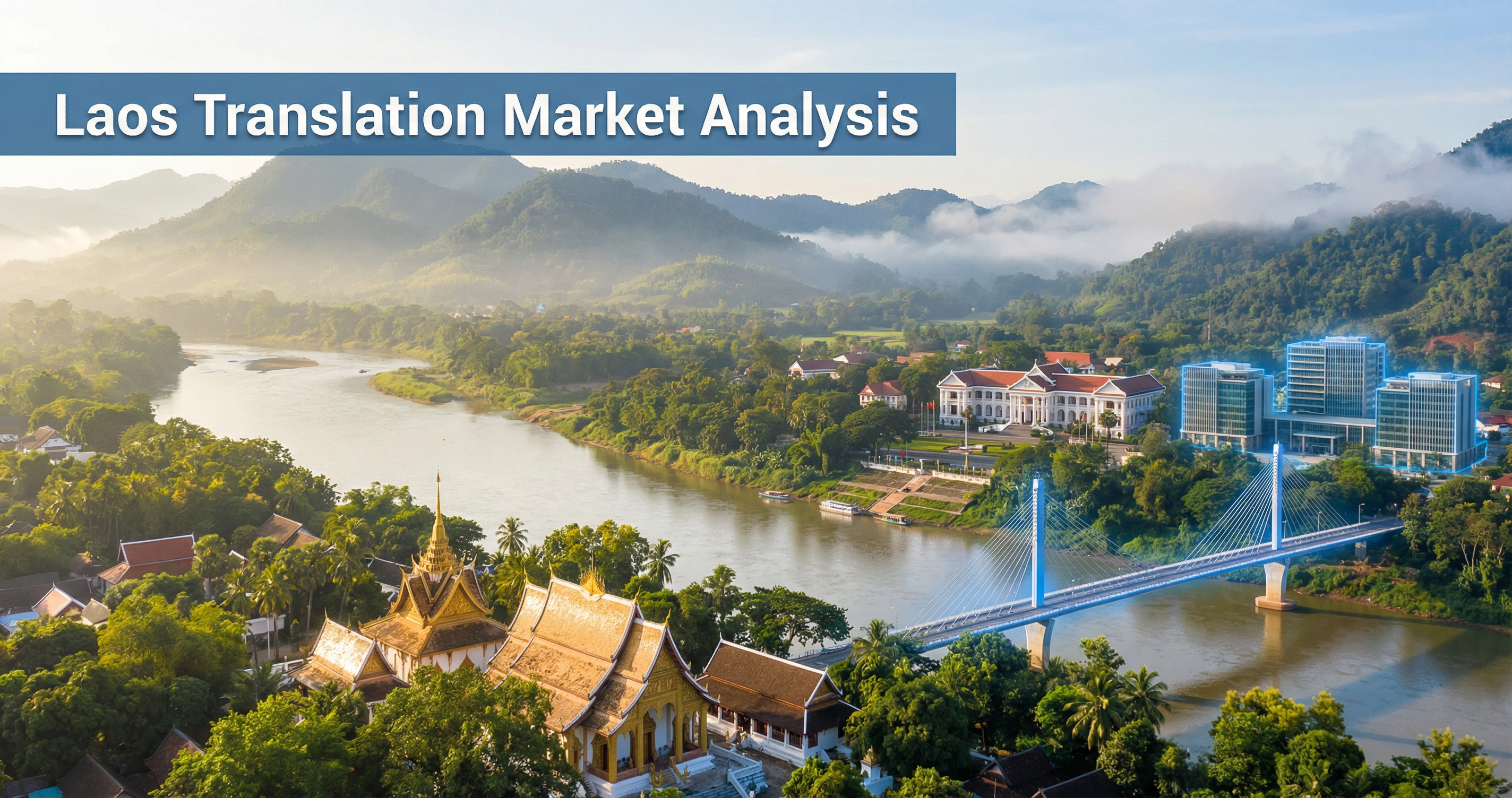
Laos represents one of Southeast Asia's most distinctive yet underexplored translation markets. As the only landlocked ASEAN nation and the region's least developed economy, this country of 7.5 million people presents a unique confluence of challenges and opportunities for language services professionals. With a translation market valued between LAK 100-200 billion (USD 12-24 million) and constrained by its Least Developed Country status, Laos offers a fascinating case study in how development aid, linguistic diversity, and geographic isolation shape professional translation demand in emerging economies.
Executive Summary: Understanding Laos' Translation Market
Laos occupies a distinctive position within ASEAN's translation services landscape. With the smallest population among Southeast Asian nations (approximately 7.5 million people) and the distinction of being the region's only landlocked country, Laos faces economic and geographic constraints that fundamentally shape its translation industry structure. The market, valued between LAK 100-200 billion (approximately USD 12-24 million), represents a modest but strategically significant segment within the broader ASEAN language services ecosystem.
The Lao translation market is characterized by several defining features that distinguish it from regional counterparts. First, the development sector— comprising United Nations agencies, international non-governmental organizations (INGOs), and bilateral aid programs—dominates professional translation demand. Unlike the private sector-driven markets of Singapore, Thailand, or Vietnam, Laos' translation industry derives the majority of its revenue from aid-funded initiatives focused on rural development, health systems strengthening, education, and governance. This aid dependency creates both stability (through sustained multi-year program funding) and vulnerability (to donor priorities and economic shocks).
Second, the Lao language's relationship with Thai creates a unique linguistic dynamic. As fellow members of the Tai-Kadai language family, Lao and Thai share approximately 60-70% lexical similarity and mutual intelligibility in basic communication. This proximity facilitates informal cross-border translation but also complicates professional quality assurance, as bilingual individuals may overestimate their capability to handle complex technical or legal content. The prevalence of Thai media and entertainment in Laos further blurs the distinction between the languages in popular consciousness.
Third, Laos' landlocked geography and limited infrastructure create significant operational challenges for translation service providers. Connectivity between Vientiane (the capital), Luang Prabang (the cultural center), and provincial hubs like Savannakhet remains constrained by road quality and seasonal weather patterns. Internet penetration, while growing rapidly among urban youth, remains limited in rural areas where much development work occurs. These infrastructure limitations affect both the delivery of translation services and the development of professional translator capacity.
Growth projections for the Lao translation market suggest a 10-15% compound annual growth rate (CAGR) through 2030, driven primarily by ASEAN integration commitments, infrastructure development projects, and gradual LDC graduation preparations. However, this growth trajectory remains contingent on sustained foreign aid flows, successful economic diversification beyond natural resources, and improvements in education quality that expand the pool of English-proficient professionals.
Key Market Indicators at a Glance
Laos' Linguistic Landscape: Tai-Kadai Heritage and Beyond
Understanding the Lao translation market requires deep appreciation of the nation's complex linguistic heritage. Lao, the official language of the Lao People's Democratic Republic, belongs to the Tai-Kadai language family, sharing ancestry with Thai, Shan (Myanmar), and Zhuang (China). This linguistic classification has profound implications for translation practice, cross-border communication, and the professional development of Lao linguists. Approximately 60% of the Lao vocabulary corresponds to Thai, creating opportunities for mutual intelligibility alongside challenges for professional quality control.
The Lao Language: Distinctive Characteristics
Lao is a tonal language with six distinct tones (low, mid, high, rising, high falling, and low falling) that determine lexical meaning. Like Thai, Lao employs an abugida writing system derived from the ancient Khmer script, characterized by circular characters with inherent vowel sounds modified by diacritical marks. The script presents particular challenges for digital typography and early computing systems, though modern Unicode support has substantially resolved these technical barriers.
The Lao language demonstrates significant diglossia between formal written Lao (used in government, education, and literature) and colloquial spoken Lao (characterized by simplified grammar, contracted forms, and extensive code-mixing). For translation professionals, this sociolinguistic variation necessitates careful register matching: development documents typically require formal Lao, while community health materials may employ colloquial registers for accessibility. The Vientiane dialect serves as the prestige standard, though regional variations exist.
Lao vocabulary reflects the nation's historical position at the crossroads of Southeast Asian civilizations. Core vocabulary derives from Proto-Tai roots, while significant layers of Pali and Sanskrit influence permeate religious, philosophical, and academic terminology—a legacy of Theravada Buddhism's thousand-year presence. French colonial rule (1893-1953) introduced European vocabulary in administration, law, cuisine, and technology. More recently, English has become the primary source of loanwords in business, technology, and development domains, creating a complex lexical stratification that challenges translation consistency.
The Thai-Lao Relationship: Opportunities and Pitfalls
The linguistic proximity between Lao and Thai creates a unique dynamic within the regional translation market. Shared vocabulary, similar tonal systems, and comparable grammatical structures enable basic communication between speakers of both languages without formal training. This mutual intelligibility extends to approximately 60-70% of everyday vocabulary, though technical, legal, and academic registers diverge more substantially.
For translation professionals, this proximity presents both opportunities and challenges. Thai-Lao bilingual individuals can often provide reasonably accurate gist translations for general content, creating an informal translation economy along the border regions. However, this apparent ease of translation masks significant quality risks. False friends— words that appear similar but carry different meanings—abound between the languages. For example, Thai "khao" (เข้า) typically means "enter," while Lao "khao" (ເຂົ້າ) can mean "rice" or "enter" depending on tone. Such distinctions, subtle to non-specialists, can dramatically alter meaning in technical or legal contexts.
The cultural and economic asymmetry between Thailand and Laos further complicates the translation relationship. Thai media, entertainment, and educational materials dominate Lao popular culture, creating receptive bilingualism where Lao speakers commonly understand Thai but reverse comprehension is limited. This imbalance means that Thai-to-Lao translation often requires less effort than Lao-to-Thai, affecting market pricing and translator specialization patterns. Professional LSPs serving both markets typically charge premium rates for Lao-to-Thai work reflecting the specialized expertise required.
Regional Dialects and Variation
While the Vientiane dialect serves as the national standard, Lao exhibits regional variation that can affect translation and interpretation quality. The Northern dialect region (centered on Luang Prabang) maintains distinctive phonological features and preserves vocabulary that has fallen out of use in the capital. The Southern dialect (around Champasak and Pakse) shows influences from neighboring Cambodia and Vietnam. These variations, while not as pronounced as Thai dialect divergence, can nonetheless affect comprehension in community-based development work where local dialect familiarity enhances communication effectiveness.
French Colonial Legacy: Enduring Linguistic Influence
French colonial rule, which lasted from 1893 until Laos' independence in 1953, left an indelible mark on Lao linguistic culture that persists in the contemporary translation market. French became the language of administration, higher education, and elite culture during the colonial period, creating a francophone Lao elite whose influence extended well beyond independence. Today, French maintains a presence in diplomatic contexts, certain legal frameworks, and the education system—particularly at the tertiary level where French-language institutions like the Institut Français du Laos and Franco-Lao schools operate.
For translation professionals, this French legacy manifests in several ways. Legal documentation often contains French-derived terminology, particularly in administrative and judicial contexts. Franco-Lao bilingual translators remain in demand for work with Francophone development agencies, including French bilateral aid programs and Belgian cooperation initiatives. The Lao-French relationship also creates niche demand for translation services supporting business relationships with Francophone African countries, where Lao agricultural and mining interests increasingly seek markets.
Ethnic Minority Languages: Hmong, Khmu, and Beyond
Laos' ethnic diversity creates significant multilingual translation requirements that distinguish it from more linguistically homogeneous ASEAN neighbors. The Lao government officially recognizes 49 ethnic groups speaking languages from four major families: Tai-Kadai (including Lao), Mon-Khmer, Hmong-Mien, and Sino-Tibetan. This diversity is not evenly distributed—ethnic minorities comprise approximately 40% of the population but are concentrated in remote, mountainous regions where development indicators lag significantly behind lowland Lao areas.
The Hmong language (Hmong-Mien family) represents the largest minority language community, with approximately 450,000 speakers primarily in the northern provinces. Hmong is mutually unintelligible with Lao, creating substantial communication barriers in development work targeting Hmong communities. Translation needs extend beyond simple Lao-Hmong bilingualism to include the development of written materials in Hmong (traditionally an oral language that acquired standardized writing systems only in the 20th century). Health education, agricultural extension, and legal awareness programs targeting Hmong populations require specialized translation and interpretation services.
Khmu, a Mon-Khmer language spoken by approximately 600,000 people primarily in northern Laos, presents similar translation challenges. The Khmu script remains less standardized than Hmong, and Khmu-Lao bilingual professionals are scarcer than Hmong speakers. Development organizations working in Khmu areas often face difficult choices between investing in expensive multilingual translation or accepting limited communication effectiveness through Lao-only programming.
English Education: Constraints and Gradual Improvement
The availability of English-proficient professionals fundamentally constrains Laos' translation market capacity. English education in Laos has historically lagged behind regional peers, reflecting limited resources, teacher training gaps, and the historical prominence of French in elite education. While English has gained ground since the 1990s economic opening, proficiency levels remain lower than in Vietnam, Thailand, or Cambodia.
This English constraint creates a challenging environment for professional translation development. High-quality Lao-English translators are scarce and command premium rates, while demand continues to grow with ASEAN integration and international engagement. The scarcity particularly affects technical domains requiring specialized vocabulary—legal translation, medical translation, and engineering documentation all face capacity constraints that can delay project implementation.
Recent developments show gradual improvement. English has become increasingly prominent in higher education, with many Lao universities offering English-medium programs or requiring English proficiency for graduation. International scholarship programs, including Australia Awards, Japanese JICA programs, and various ASEAN scholarships, send growing numbers of Lao students abroad for English-intensive graduate education. These investments in human capital will gradually expand the professional translator pool, though the full effects may take a decade or more to materialize.
Script and Digital Considerations
The Lao script presents specific technical challenges for digital translation workflows. While modern Unicode support has largely resolved earlier encoding problems, inconsistencies remain between different software platforms. Lao fonts may render differently across operating systems, creating potential quality control issues when documents are transferred between Windows, macOS, and mobile environments. CAT tools and translation memory systems have historically offered limited Lao support, though major platforms like SDL Trados and MemoQ now include Lao among supported languages.
Mobile technology adoption in Laos has implications for translation delivery and quality assurance. With smartphone penetration exceeding 80% in urban areas, mobile-friendly document formats and responsive design have become translation requirements. This creates tension with traditional document formats preferred by government and development agencies, which often rely on PDF or Microsoft Word formats that display inconsistently on mobile devices. Translation workflows must increasingly account for multi-channel delivery requirements.
Economic Context: Least Developed Status and Graduation Ambitions
Laos' translation market cannot be understood independently of the nation's broader economic circumstances. Designated by the United Nations as a Least Developed Country (LDC) since the category's inception in 1971, Laos faces structural economic constraints that fundamentally shape its language services industry. The government has committed to meeting the criteria for LDC graduation by 2026, a target that remains ambitious given recent economic challenges including debt distress and the COVID-19 pandemic's lingering effects.
Least Developed Country Status: Implications for Translation Demand
LDC designation creates both constraints and opportunities for the translation sector. On one hand, limited domestic purchasing power suppresses private sector translation demand—businesses cannot afford professional language services at international rates, and government agencies face budget constraints that limit procurement. On the other hand, LDC status attracts substantial development assistance that constitutes the primary revenue source for professional translation in Laos.
The composition of LDC-linked aid directly influences translation demand patterns. Multilateral agencies like the World Bank, Asian Development Bank, and UN agencies require extensive translation of policy documents, technical guidelines, training materials, and community-facing content. Bilateral donors including Australia, Japan, Korea, and the European Union maintain country programs requiring Lao language support. The cumulative effect is a translation market disproportionately dependent on development funding rather than commercial activity.
Landlocked Geography: Economic Constraints and Regional Integration
Being the only landlocked country in ASEAN imposes fundamental economic disadvantages that affect the translation market. Transportation costs for trade are substantially higher than coastal neighbors, limiting export competitiveness and foreign investment in trade-dependent sectors. The historic reliance on Thai and Vietnamese ports for international shipping creates dependency relationships that complicate Lao economic autonomy and, by extension, the development of indigenous translation capacity.
However, this landlocked position also drives regional integration initiatives that generate translation demand. The Lao-China Railway, opened in 2021, has transformed north-south connectivity and catalyzed new economic relationships requiring Chinese-English-Lao trilingual communication. Planned rail extensions to Thailand and Vietnam will further integrate Laos into regional supply chains, creating demand for logistics, customs, and trade documentation translation. The landlocked geography, in other words, creates both structural disadvantages and specific translation opportunities linked to infrastructure development.
Recent Economic Growth and Setbacks
Laos experienced remarkable economic growth during the 2000s and early 2010s, with GDP expansion averaging 7-8% annually. This growth, driven primarily by natural resource exports (hydropower, mining, and timber) and infrastructure investment, created expanding translation demand in extractive industries, energy sector documentation, and construction. However, the commodity-dependent growth model proved vulnerable to external shocks and unsustainable debt accumulation.
Recent years have brought significant economic challenges. The COVID-19 pandemic devastated tourism revenues and disrupted supply chains. The 2022 debt crisis, triggered by unsustainable borrowing for infrastructure projects (particularly the Lao-China Railway and various hydropower dams), led to sovereign credit rating downgrades and financing difficulties. High inflation and currency depreciation have eroded purchasing power, affecting both consumer translation demand and the cost structure for translation service providers.
These economic challenges have direct implications for the translation market. Development aid has become more critical as a revenue source as private sector demand contracts. Translator retention has become more difficult as skilled linguists seek higher-paying opportunities abroad or in emerging sectors like IT and finance. Currency volatility creates pricing uncertainty for translation services contracted in foreign currency but delivered domestically.
Foreign Aid Dependency: The Development Sector Economy
Laos remains among the most aid-dependent countries in Southeast Asia, with official development assistance (ODA) comprising approximately 10-15% of government expenditure. This aid dependency creates a parallel economy that sustains professional translation services. Development organizations operate with international funding denominated in hard currency, enabling them to pay translation rates that would be unsustainable for domestic clients. This dual-rate system—international rates for development work, domestic rates for private sector work—shapes the translation labor market and incentivizes translator concentration in the aid sector.
The major bilateral and multilateral donors in Laos each generate distinct translation requirements. Australian aid emphasizes governance, education, and rural development, requiring translation of policy frameworks and technical guidelines. Japanese assistance focuses heavily on infrastructure, creating demand for engineering and construction document translation. Korean programs emphasize agriculture and rural development. European Union support spans governance, human rights, and sustainable development. Each donor's priorities create specialized translation niches linked to their sectoral focus.
Investment Climate: Opportunities and Obstacles
Laos' investment climate presents a mixed picture for foreign investors and, consequently, for translation service demand. The government has established special economic zones (SEZs) offering tax incentives and streamlined procedures, particularly in Vientiane, Savannakhet, and near the Chinese border. Chinese investment has surged, particularly in energy, agriculture, and real estate. However, governance concerns, corruption, regulatory uncertainty, and the recent debt crisis have dampened broader foreign investment interest.
Translation demand from the investment sector reflects these patterns. Chinese-Lao translation requirements have grown substantially with the influx of Chinese capital and workers. Legal translation supporting investment agreements, due diligence, and regulatory compliance remains in demand, though the volume is smaller than in more open economies like Vietnam or Thailand. The manufacturing sector, which drives substantial translation demand elsewhere in ASEAN, remains underdeveloped in Laos, limiting associated language services growth.
Market Size and Structure: A Quantitative Overview
Estimating the precise size of Laos' translation market presents methodological challenges common to informal economies and LDC contexts. Professional translation—the segment involving qualified translators, formal contracts, and quality assurance processes—represents only a portion of total language service activity. Informal translation by bilingual staff, volunteer interpretation in communities, and cross-border linguistic support from Thai sources significantly expand the effective market beyond measured professional activity.
Industry Valuation: Professional and Informal Segments
The professional translation market in Laos is estimated at LAK 100-200 billion annually (approximately USD 12-24 million at current exchange rates). This represents a small fraction of the estimated ASEAN-wide translation market of USD 3-4 billion, reflecting Laos' demographic scale and economic development level. However, the market shows consistent growth at an estimated 10-15% compound annual rate, outpacing overall economic growth and reflecting the increasing international engagement of Lao institutions.
The informal translation economy, by contrast, defies precise measurement but likely exceeds the professional segment in aggregate value. Government agencies routinely rely on bilingual civil servants for ad hoc translation. Community-based organizations use volunteer interpreters for grassroots work. Thai-Lao bilingualism enables cross-border linguistic support that bypasses formal translation procurement. While these informal channels provide valuable language access, they also create quality risks and may suppress demand for professional services that would otherwise develop.
Growth Patterns: Drivers and Trajectory
Multiple factors drive the Lao translation market's 10-15% annual growth. ASEAN integration commitments require increasing regulatory harmonization and cross-border communication, expanding demand for policy and legal translation. Infrastructure development—particularly the Lao-China Railway and associated projects—creates immediate translation needs for technical documentation, safety protocols, and community engagement materials. The gradual expansion of tourism, though interrupted by COVID-19, drives hospitality translation requirements. Education sector internationalization, including partnerships with foreign universities, requires academic translation support.
Growth is not evenly distributed across market segments. Development sector translation has maintained steady expansion as donor funding remains robust despite economic challenges. Energy and mining sector translation has grown with hydropower development and mineral extraction. Tourism-related translation has shown volatility linked to international travel patterns. Manufacturing translation remains limited due to the sector's underdevelopment compared to regional peers.
Formal vs. Informal Economy: Quality and Capacity Implications
The coexistence of formal professional translation and informal bilingual support creates a bifurcated market with distinct quality and pricing dynamics. Formal sector translation, typically conducted through LSPs or freelance professionals with established credentials, adheres to quality standards, uses CAT tools and translation memory, and offers revision and quality assurance processes. Informal translation, by contrast, relies on individual bilingual capacity without systematic quality control.
The informal sector's prevalence creates both challenges and opportunities. Quality risks are substantial when untrained bilinguals handle complex technical or legal content. However, the informal sector also serves as a training ground where individuals develop translation skills that may eventually professionalize. For development organizations, informal community interpretation often provides culturally nuanced communication that formal translation cannot replicate.
Aid Sector Dominance: Market Concentration and Risk
The development sector's outsized role in Lao translation creates market concentration that poses strategic risks. United Nations agencies, international NGOs, and bilateral donor programs collectively account for an estimated 60-70% of professional translation revenue in Laos. This concentration means that shifts in donor priorities, global economic conditions, or political relationships can rapidly affect market conditions.
The major international organizations operating in Laos each maintain distinct translation procurement patterns. The UN system (including UNDP, UNICEF, UNFPA, WHO, and FAO) typically contracts translation through global procurement frameworks that may engage international LSPs with Lao capacity rather than local providers directly. Major INGOs like Save the Children, World Vision, and Oxfam often maintain in-house translation capacity or work with established regional partners. Bilateral programs may use direct contracting with local translators for smaller assignments.
Limited Private Sector: Commercial Translation Constraints
Laos' private sector generates relatively limited translation demand compared to regional peers. The small domestic market, limited manufacturing base, and nascent service sector mean fewer companies require professional translation for international business operations. Domestic businesses operating across the Thai border often rely on informal bilingual support rather than formal translation services.
However, specific private sector segments do generate meaningful translation activity. Tourism businesses require multilingual marketing materials, websites, and guest communications. Real estate developers marketing to foreign buyers (particularly Chinese investors) require property documentation and marketing translation. Legal translation supports commercial transactions, contract negotiations, and dispute resolution. As Laos gradually diversifies its economy beyond natural resources, private sector translation demand is expected to grow, though from a modest base.
Sector Analysis: Where Translation Demand Originates
Understanding the Lao translation market requires granular examination of demand patterns across economic sectors. Each sector generates distinct translation requirements reflecting its operational needs, international relationships, and regulatory environment. The following analysis examines major demand segments, their translation characteristics, and growth trajectories.
Development & NGO Sector: The Market Foundation
The development and NGO sector represents the backbone of Laos' professional translation market, generating an estimated 60-70% of formal translation revenue. This dominance reflects both the sector's substantial international funding and its programmatic focus on grassroots engagement that requires Lao language communication. Unlike some development contexts where English serves as a working language, Laos' relatively low English proficiency among rural populations necessitates extensive translation and interpretation for program effectiveness.
United Nations Agencies: The UN system maintains substantial translation requirements across its Lao operations. UNDP, as the lead development agency, requires translation for governance programs, sustainable development goal (SDG) implementation, and climate change initiatives. UNICEF's education and child protection programs generate substantial needs for community-facing materials, training content, and policy documentation. WHO and FAO health and agriculture programs require technical translation for guidelines, training manuals, and research materials. UNFPA's work on reproductive health and gender requires culturally sensitive translation for sensitive topics.
International NGOs: Major international NGOs including Save the Children, World Vision, Plan International, Oxfam, and CARE operate extensive Lao programs requiring multilingual support. These organizations' translation needs span the full program cycle: proposal development and donor reporting (English), partnership agreements with government agencies (Lao), community engagement materials (Lao and ethnic minority languages), training content (Lao with international source materials), and internal policies and procedures (English with Lao versions for local staff).
Rural Development: Development work in Laos has a pronounced rural focus reflecting the country's demographic distribution and poverty geography. Approximately 60% of the Lao population lives in rural areas, often in remote, mountainous regions with limited infrastructure. Translation supporting rural development—including agriculture extension, water and sanitation education, and rural financial services—must account for low literacy levels and linguistic diversity. Visual materials, community radio scripts, and verbal interpretation often supplement written translation in rural contexts.
Health Programs: Health sector translation encompasses diverse content types with varying complexity. Public health messaging for disease prevention (malaria, dengue, COVID-19) requires accessible language and cultural adaptation. Clinical training materials demand precise medical terminology and quality assurance. Health system strengthening documentation involves policy translation that must navigate between international standards and Lao regulatory frameworks. Reproductive health and HIV/AIDS programming requires sensitive handling of culturally complex topics.
Education Initiatives: Education sector translation supports curriculum development, teacher training, and policy reform. Laos' ongoing education sector reform, including transition to a new curriculum framework and competency-based learning, requires extensive translation of international best practices, assessment materials, and training content. Higher education internationalization, including partnerships with Australian, Thai, and Vietnamese universities, creates demand for academic translation supporting joint programs and research collaboration.
Energy & Natural Resources: Hydropower and Mining Focus
The energy and natural resources sector represents Laos' second-largest translation demand source, driven by the country's aggressive hydropower development strategy and expanding mining operations. Laos aspires to become the "battery of Southeast Asia," exporting electricity to Thailand, Vietnam, and China through an expanding network of dams. This ambition generates substantial technical translation requirements for engineering documentation, environmental impact assessments, and regulatory compliance materials.
Hydropower Projects: Hydropower development creates multi-dimensional translation needs throughout project lifecycles. Feasibility studies and environmental and social impact assessments (ESIAs) require translation of technical reports, baseline studies, and consultation documentation. Engineering specifications, equipment manuals, and construction documentation must be accessible to Lao contractors and regulators. Power purchase agreements with neighboring countries require legal translation of complex commercial and technical provisions. Community engagement and resettlement documentation demands accessible Lao language materials for affected populations.
The technical complexity of hydropower documentation creates quality challenges that few Lao translators can meet independently. Dam engineering involves specialized terminology in geology, hydrology, structural engineering, and electrical systems. Environmental assessment requires familiarity with biodiversity, aquatic ecology, and climate science vocabulary. Translators serving this sector typically combine language expertise with technical background or extensive experience in similar projects. The sector increasingly relies on subject matter expert review of translations to ensure technical accuracy.
Mining Sector: Mining operations in Laos, including copper, gold, and potash extraction, generate translation needs for exploration documentation, extraction permits, safety protocols, and community relations materials. Chinese, Australian, and Canadian mining companies dominate the sector, creating demand for multilingual communication between international technical teams, Lao government regulators, and local communities. The sector's environmental and social risks necessitate careful translation of community consultation materials and grievance mechanisms.
Tourism: Heritage and Adventure Niches
Tourism represents a growth sector for Lao translation, though one severely impacted by COVID-19 and recovering gradually. Prior to the pandemic, tourism generated approximately USD 1 billion annually and employed hundreds of thousands of Lao workers. The sector's translation needs span hospitality marketing, tour operations, heritage interpretation, and regulatory compliance for international visitors.
Luang Prabang Heritage Tourism: The ancient royal capital of Luang Prabang, designated a UNESCO World Heritage Site in 1995, represents Laos' premier cultural tourism destination. Heritage interpretation requires translation of historical narratives, temple descriptions, museum exhibitions, and cultural guidelines for respectful visitor behavior. The UNESCO designation creates international visibility that attracts visitors from across Asia and beyond, necessitating multilingual visitor services in English, French, Chinese, Korean, and other languages.
Adventure and Ecotourism: Laos' mountainous terrain, karst landscapes, and river systems support adventure tourism including trekking, caving, rock climbing, and kayaking. Adventure tour operators require translation of safety briefings, equipment instructions, liability waivers, and environmental guidelines. The sector's risk profile necessitates precise legal translation for insurance and liability documentation. Marketing materials targeting adventure tourists in source markets (Europe, North America, Australia, East Asia) require localization that captures the distinctive appeal of Lao landscapes and experiences.
Agriculture: Traditional and Emerging Opportunities
Agriculture employs approximately 60% of the Lao workforce and remains central to rural livelihoods, yet generates relatively limited professional translation demand compared to other sectors. The sector's translation needs primarily arise from agricultural development programs, export-oriented commercial farming, and integration into regional supply chains. Smallholder-dominated production, limited technology adoption, and local market orientation constrain translation requirements in traditional agriculture.
Export Agriculture: Emerging export-oriented agriculture generates translation needs for quality certification, phytosanitary documentation, and supply chain compliance. Coffee exports to specialty markets in Europe and Japan require translation of origin documentation, processing descriptions, and marketing narratives emphasizing Laos' distinctive highland coffee terroir. Banana and other fruit exports to China require compliance documentation translation. The organic certification movement creates demand for translation of standards, audit reports, and product claims.
Agricultural Development: Development programs supporting agricultural modernization generate substantial translation for training materials, technical guidelines, and research dissemination. Rice intensification programs, livestock vaccination campaigns, and farmer field school methodologies all require Lao language materials adapted from international source content. The translation challenge in agricultural extension lies not only in language conversion but in adapting concepts to local farming systems, ecological conditions, and cultural contexts.
Manufacturing: Nascent Sector with Limited Translation Demand
Laos' manufacturing sector remains underdeveloped compared to regional peers, with garment production representing the primary manufacturing activity. The sector's translation needs are accordingly modest, concentrated in factory-level documentation, labor compliance, and export processing. Special economic zones (SEZs) hosting manufacturing operations generate some translation for regulatory compliance, utilities, and worker housing management.
The limited manufacturing translation demand reflects structural economic constraints. Laos lacks the deep supply chains, industrial clusters, and export manufacturing scale that drive translation requirements in Thailand, Vietnam, or Malaysia. Foreign investors in Lao manufacturing typically come from neighboring countries (Thailand, China, Vietnam) where linguistic proximity reduces translation needs. However, as Laos seeks to diversify beyond natural resource dependence, manufacturing translation demand may grow, particularly if the country successfully attracts electronics, automotive parts, or other higher-value manufacturing investment.
Government & Legal: Regulatory and Diplomatic Requirements
Government translation requirements span diplomatic communication, legal harmonization, and regulatory documentation. As a member of ASEAN, the World Trade Organization, and various international conventions, Laos must translate treaty obligations, regional agreements, and compliance documentation. The government's international engagement generates ongoing demand for diplomatic protocol translation, summit documentation, and bilateral meeting support.
Legal and Judicial Translation: The Lao legal system's ongoing development creates translation needs for commercial law, investment regulations, and judicial procedures. Foreign investors require translation of investment licenses, concession agreements, and regulatory guidance. Commercial disputes involving international parties necessitate legal translation for arbitration and court proceedings. The legal translation sector faces particular quality challenges given the scarcity of translators combining legal expertise with bilingual proficiency.
ASEAN Integration Requirements: ASEAN membership generates specific translation obligations and opportunities. Regulatory harmonization initiatives require translation of ASEAN directives, standards, and guidelines for domestic implementation. Cross-border trade facilitation demands translation of customs documentation, rules of origin, and trade facilitation agreements. The ASEAN Economic Community's professional services liberalization creates demand for translation supporting mutual recognition arrangements and professional mobility.
Development Sector Focus: Localization and Sustainability
The development sector's dominance in Lao translation merits deeper examination of its distinctive operational characteristics. Unlike commercial translation markets driven by profit motives and market expansion, development sector translation is shaped by aid effectiveness principles, localization requirements, and sustainability commitments. Understanding these dynamics is essential for LSPs and translators seeking to serve this market segment effectively.
Aid Localization Requirements: Beyond Simple Translation
Contemporary development practice emphasizes localization—the adaptation of international programs and materials to local contexts. This goes beyond linguistic translation to encompass cultural adaptation, contextual relevance, and community appropriateness. For translators, localization requirements mean that faithful linguistic conversion may be insufficient; development clients often require adaptive translation that modifies content to suit Lao cultural contexts while maintaining program fidelity.
Donor agencies increasingly mandate local language provision as a condition of funding. The OECD's development effectiveness principles, adopted by major bilateral donors, emphasize country ownership and local capacity development. This creates institutional pressure for Lao language documentation that drives translation procurement. The localization mandate particularly affects community-facing materials where direct engagement with Lao-speaking populations is essential for program effectiveness.
Capacity Building: Developing Local Translation Expertise
Development organizations increasingly recognize that sustainable translation capacity must be built within Laos rather than imported through international LSPs. Capacity building initiatives include translator training programs, professional development workshops, and mentorship arrangements pairing international translation professionals with emerging Lao linguists. These investments aim to create a self-sustaining professional translation ecosystem that can serve both development and emerging commercial demand.
The Lao Association of Translators (LAT), established with development sector support, plays a central role in professional capacity building. LAT organizes training workshops, maintains professional standards, and advocates for translator recognition and fair compensation. While still developing its institutional capacity, LAT represents an important step toward professionalizing Lao translation and creating career pathways for language professionals.
Sustainability Challenges: Aid Dependency and Market Viability
The development sector's dominance raises sustainability concerns for the broader translation market. Professional translation skills developed through aid-funded projects may not readily transfer to commercial contexts if private sector demand remains limited. Translator career progression depends on sustained aid flows that, while currently robust, remain subject to global economic conditions and shifting donor priorities. A sudden reduction in development funding could create market disruption and talent migration.
The sustainability challenge also affects translation technology adoption. Development organizations can afford CAT tools, translation management systems, and quality assurance processes that enhance efficiency and quality. However, these technology investments may not be commercially viable for the broader Lao market given limited private sector demand. The risk of a two-tier market emerges: development clients enjoying technology-enhanced professional services while domestic clients rely on less efficient, lower-quality informal translation.
Technical Terminology: Standardization Challenges
Development sector translation requires consistent handling of technical terminology across diverse fields including public health, education, governance, and climate change. The lack of standardized Lao terminology for many development concepts creates translation inconsistency that can confuse end-users and undermine program effectiveness. Terminology development—creating and standardizing Lao equivalents for international technical concepts—has become an important sub-field within development translation.
International organizations have invested in terminology resources to address this challenge. UNDP, UNICEF, and WHO maintain Lao terminology databases for their respective sectors, though coordination between agencies remains limited. The Lao government, through the Science, Technology and Environment Organization, has undertaken terminology standardization for scientific and technical fields. These resources, while helpful, remain incomplete and inconsistently applied across the translation market.
Regional Considerations: Geography and Urban-Rural Dynamics
Laos' geography profoundly affects translation market structure and service delivery. The mountainous terrain, limited infrastructure, and uneven population distribution create distinct regional markets with varying characteristics. Understanding these geographic factors is essential for market entry, service delivery planning, and talent sourcing strategies.
Vientiane: The Translation Market Hub
Vientiane, the capital and largest city, concentrates the majority of professional translation activity. Government ministries, international organization headquarters, INGO country offices, and the limited private sector corporate presence all center on Vientiane. The city's translator pool benefits from proximity to universities, international institutions, and training opportunities. Most LSPs with Lao operations maintain Vientiane offices or representation.
Vientiane's translation market shows characteristics of a small professional services cluster. Translator networks are tightly knit, with reputation and relationships playing significant roles in client acquisition and collaboration. Word-of-mouth referrals dominate client acquisition for freelancers and small agencies. Co-location of clients and service providers enables in-person consultation, revision discussions, and relationship building that remote working cannot easily replicate.
Luang Prabang: Cultural Tourism and Heritage Focus
Luang Prabang, the former royal capital and UNESCO World Heritage Site, generates translation demand distinct from Vientiane's development sector focus. Heritage tourism drives hospitality translation, interpretation services for cultural sites, and marketing localization. The city's Buddhist temples and monastic institutions create demand for religious and philosophical translation. The provincial government and development programs targeting northern provinces generate additional requirements.
Savannakhet and Southern Hubs: Trade and Connectivity
Savannakhet, strategically located on the Second Thai-Lao Friendship Bridge and the East-West Economic Corridor, represents an emerging translation market linked to trade and logistics. The Savan-Seno Special Economic Zone attracts manufacturing and logistics investment requiring multilingual documentation. Border trade with Thailand and Vietnam generates interpretation and translation needs for customs, immigration, and commercial transactions. The Lao-China Railway's southern extension will further enhance Savannakhet's commercial significance.
Border Areas: Cross-Border Dynamics
Laos shares borders with five countries—Thailand, Vietnam, Cambodia, China, and Myanmar—creating diverse cross-border translation dynamics. The Thai border, spanning most of Laos' western frontier, shows the most intensive translation activity given the linguistic proximity and extensive trade, tourism, and family connections. Thai-Lao bilingualism is common in border provinces, enabling informal translation services that may not be captured in professional market estimates.
The Vietnamese border generates translation linked to development cooperation, trade, and the substantial Vietnamese commercial presence in Laos. Chinese border areas have seen intensified translation demand following the Lao-China Railway completion and associated investment inflows. The border with Myanmar, in remote northwestern Laos, shows minimal formal translation activity due to limited connectivity and cross-border commerce.
Rural-Urban Divide: Access and Infrastructure
The sharp divide between urban and rural Laos affects translation service availability and delivery. Urban areas enjoy relatively strong internet connectivity, mobile coverage, and transportation infrastructure that support professional translation workflows. Rural areas, where much development work occurs, face connectivity gaps that complicate remote translation collaboration and quality assurance processes.
Development organizations have adapted to rural service delivery challenges through mobile translation teams, regional hub offices, and extended field assignments. Translators working on rural development content may spend extended periods in provincial locations, gathering local knowledge and ensuring contextual appropriateness. This field presence requirement affects translator career structures and compensation models.
Technology Context: Digital Infrastructure and Translation Tools
Technology adoption in Lao translation reflects broader patterns of digital development in a least developed country context. While mobile penetration and internet usage have grown rapidly, particularly among urban youth, professional translation technology infrastructure remains less developed than in regional peers. This technology gap shapes translation workflows, quality capabilities, and market efficiency.
Internet Penetration: Rapid Growth with Persistent Gaps
Internet penetration in Laos has grown dramatically, from negligible levels in the early 2000s to approximately 60-70% of the population today. Mobile internet, accessed through smartphones, dominates connectivity patterns. However, this aggregate figure masks significant disparities: urban connectivity substantially exceeds rural access, and network quality varies dramatically between Vientiane and remote provinces.
For translation services, internet connectivity enables remote collaboration, cloud-based CAT tools, and online resource access. However, connectivity constraints in rural areas complicate attempts to decentralize translation work beyond major urban centers. Backup connectivity strategies, offline working capabilities, and asynchronous workflows remain important for reliable service delivery.
Mobile Adoption: Smartphone-First Communication
Laos exhibits smartphone penetration rates exceeding 80% among urban populations, with mobile devices serving as the primary internet access point for most users. This mobile-first environment affects translation delivery requirements: document formats must be mobile-readable, communication occurs through messaging apps (Facebook Messenger and WhatsApp dominate), and payment systems increasingly rely on mobile banking and e-wallets.
Mobile technology also enables innovative translation delivery models. Community health workers in rural areas use smartphones to access translated health information. Farmers receive agricultural extension content via SMS and mobile apps. These mobile delivery channels require translation formats adapted to small screens, limited bandwidth, and audio-visual supplementation for populations with limited literacy.
Digital Infrastructure Gaps: Constraints on Remote Work
Despite rapid mobile adoption, gaps in digital infrastructure constrain sophisticated translation workflows. Fixed-line broadband remains limited and expensive, affecting upload/download speeds for large translation projects. Power reliability, particularly in provincial areas, creates service continuity risks. Data costs, while declining, remain substantial relative to average incomes, potentially limiting translator access to online resources and continuous learning opportunities.
Limited CAT Tool Usage: Technology Adoption Barriers
Computer-Assisted Translation (CAT) tool adoption in Laos lags behind regional peers and global standards. Major commercial CAT platforms (SDL Trados, MemoQ, Wordfast) have limited penetration due to cost barriers, limited local training availability, and relatively limited Lao language support in earlier software versions. Development organizations increasingly deploy enterprise CAT licenses for their Lao translation teams, but this technology remains confined to the professional development sector.
Machine Translation (MT) and Neural Machine Translation (NMT) present particular challenges for Lao. Major MT engines offer limited Lao support compared to higher-resource languages. The Thai-Lao linguistic proximity sometimes enables Thai-to-English MT with manual Lao adaptation, but this workaround introduces quality risks. As global MT capabilities expand, Lao may eventually benefit from improved automated translation, but current quality limitations necessitate professional human translation for most use cases.
Industry Structure: Translators, LSPs, and Professional Organization
The Lao translation industry exhibits a fragmented structure typical of small emerging markets. Professional capacity is limited, concentrated primarily in Vientiane, and heavily weighted toward development sector requirements. Understanding the industry's organizational structure is essential for clients seeking translation services and for professionals considering market entry.
Small Local Translator Pool: Capacity Constraints
The professional Lao translator pool is estimated at fewer than 500 individuals working primarily or substantially as translators. This small number reflects the limited market size, constrained education system output, and career competition from higher-paying sectors. Translator demographics skew toward mid-career professionals, with limited entry-level opportunities creating barriers for new graduates.
Translator specialization patterns follow market demand. The majority of professional translators focus on development sector content— health, education, governance, and rural development. Technical translators (engineering, legal, finance) are scarcer and command premium rates. Literary translation remains extremely limited, with few professional opportunities in this segment. The imbalance between development-focused generalists and scarce specialists creates market inefficiencies and quality challenges for complex technical work.
INGO-Employed Linguists: In-House Capacity
Major international NGOs and UN agencies employ substantial in-house translation capacity that is not captured in standard market estimates. These institutional translators enjoy stable employment, comprehensive benefits, and predictable workloads unavailable to freelance counterparts. However, their output is typically dedicated to their employing organization, reducing market supply for external clients.
The in-house translator model reflects development organizations' need for reliable, high-quality translation capacity integrated with program operations. In-house linguists develop deep subject matter expertise in their organization's focus areas and institutional knowledge that external translators cannot readily replicate. This model has implications for freelance translator market access and pricing, as significant translation volume is captured internally.
Regional LSPs: Thai and Vietnamese Presence
Regional Language Service Providers (LSPs) from Thailand and Vietnam serve much of the Lao market's sophisticated translation demand. Thai LSPs leverage Thai-Lao linguistic proximity and established relationships with Thai-funded development programs. Vietnamese LSPs benefit from growing Vietnamese investment in Laos and bilateral cooperation frameworks. International LSPs with ASEAN-wide operations (such as Translife, Asian Languages, and similar regional providers) maintain Lao capacity as part of broader Southeast Asian service portfolios.
The limited presence of international LSPs beyond regional providers reflects market size constraints. Major global LSPs (TransPerfect, Lionbridge, RWS) do not maintain dedicated Lao operations, instead handling Lao requirements through regional offices or subcontracting arrangements. This limited global presence may change if market growth accelerates or if specific large-scale projects (major infrastructure, significant foreign investment) create temporary demand spikes.
Lao Association of Translators (LAT): Professional Development
The Lao Association of Translators (LAT) represents the translation profession's collective interests and supports professional development. Established with development sector support, LAT provides training programs, professional networking opportunities, and advocacy for translator recognition and fair compensation. While still developing its institutional capacity, LAT plays an important role in the market's professionalization trajectory.
LAT's activities include organizing annual professional development workshops, maintaining a translator directory for client referrals, and engaging with government agencies on translation policy. The association faces challenges including limited funding, volunteer dependency, and the need to serve a geographically dispersed membership. Nevertheless, LAT represents an essential institution for market development and professional community building.
Challenges: Obstacles to Market Development
The Lao translation market faces structural challenges that constrain growth, quality improvement, and professional development. Understanding these challenges is essential for stakeholders seeking to navigate the market effectively or invest in its development.
Small Market Size: Limited Revenue and Career Opportunities
The fundamental challenge facing Lao translation is market size. With a total addressable professional market of USD 12-24 million distributed across diverse sectors and clients, individual translators and LSPs face limited revenue potential. This constraint affects career attractiveness, technology investment justification, and the viability of specialized service offerings that might be sustainable in larger markets.
The small market size also limits the development of specialized niches. In larger markets, translators can build sustainable practices focused on specific domains (medical translation, legal translation, technical documentation). In Laos, domain specialization may not generate sufficient volume to support dedicated practice, forcing translators to work across diverse content types where quality may suffer.
Limited Talent Pool: Education and Brain Drain
The small translator pool reflects broader education system constraints. English language education, while improving, remains limited compared to regional peers. Higher education capacity for language and translation studies is restricted. The most capable bilingual professionals often pursue higher-paying opportunities in international development, government, or abroad, reducing the talent available for translation careers.
Brain drain to neighboring countries, particularly Thailand, further depletes the professional pool. Lao translators with advanced qualifications can command substantially higher compensation in Bangkok's larger market. The open border and cultural similarity facilitate migration. While some maintain remote working relationships with Lao clients, physical absence reduces the in-country capacity available for time-sensitive or complex projects.
Quality Assurance: Limited Review Capacity
Quality assurance in Lao translation faces structural challenges. The scarcity of senior translators with capacity to review and revise junior colleagues' work limits quality control in the professional pipeline. Revision services command premium rates that budget-constrained clients may resist paying. Informal translation by bilingual staff without quality review creates risks of errors propagating into published materials.
Economic Constraints: Affordability and Investment
Economic challenges including currency depreciation, inflation, and limited foreign exchange availability affect translation market operations. Clients face budget constraints that may lead to accepting lower quality or informal translation. LSPs and freelancers struggle to invest in technology, training, and professional development when revenue is uncertain. The economic environment creates pressure on translation rates that may not reflect the skill and effort required for quality work.
Geographic Isolation: Connectivity and Access
Laos' landlocked geography and mountainous terrain create logistical and connectivity challenges. Road conditions limit travel between Vientiane and provincial areas where development work occurs. Internet connectivity gaps in rural areas complicate remote translation collaboration. The geographic dispersion of potential translator talent across remote provinces makes capacity development and professional networking more difficult than in geographically compact markets.
Technology Gaps: Efficiency and Quality Limitations
Limited CAT tool adoption, minimal machine translation support, and insufficient terminology management systems constrain translation efficiency and consistency. Translators may work with basic word processing tools that lack translation memory, terminology verification, and quality assurance features standard in mature markets. Technology gaps reduce productivity, increase error rates, and limit the volume of work that the existing translator pool can handle.
Opportunities: Growth Pathways and Strategic Potential
Despite significant challenges, the Lao translation market presents strategic opportunities for stakeholders positioned to capitalize on emerging trends. These opportunities span regional integration, infrastructure development, and gradual economic transformation.
ASEAN Integration: Expanding Regional Demand
Deepening ASEAN integration creates structural translation demand growth. Cross-border trade facilitation requires harmonized documentation and multilingual communication. Professional mobility under ASEAN agreements may increase demand for credential translation and qualification recognition. Regional supply chain integration could eventually bring manufacturing translation requirements that currently bypass Laos. The ASEAN Economic Community's service sector liberalization may enable regional LSPs to establish more substantial Lao operations.
Infrastructure Development: The Railway Effect
The Lao-China Railway, opened in 2021, exemplifies how infrastructure investment can catalyze translation demand. The railway and associated development create immediate needs for technical documentation, safety protocols, and community engagement materials. Longer-term, improved connectivity may enable economic diversification that generates broader commercial translation demand. Similar effects may follow from planned rail extensions to Thailand and Vietnam, as well as from highway improvements linking Laos to regional logistics networks.
Regional Trade Growth: Commercial Translation Expansion
Expanding regional trade creates commercial translation opportunities beyond the development sector. Chinese investment in Laos generates sustained demand for Chinese-English-Lao trilingual services. Thai commercial presence creates ongoing Thai-Lao translation needs. Vietnamese economic engagement, particularly in construction and agriculture, generates Vietnamese language requirements. As Laos gradually develops domestic enterprise capacity, private sector translation demand may grow from its currently limited base.
Tourism Potential: Post-Recovery Growth
Tourism recovery following COVID-19 presents gradual translation market expansion. Heritage site interpretation, hospitality marketing, and adventure tourism content require multilingual support. Luang Prabang's UNESCO status and international visibility create sustained demand for quality tourism translation. Targeted growth in source markets (China, Korea, Europe, North America) will drive demand for language-specific marketing localization.
LDC Graduation: Economic Transformation Potential
Lao government ambitions for LDC graduation by 2026, while challenging, represent a potential transformation catalyst. Graduation would signal improved economic management and may attract additional foreign investment. Pre-graduation preparations generate translation needs for policy documentation, international reporting, and investment promotion. If graduation is achieved and sustained, the associated economic development would likely expand private sector translation demand beyond current development sector dependence.
Recommendations: Strategic Guidance for Market Participants
For Development Actors: Investing in Sustainable Capacity
Development organizations, as the dominant translation market participants, bear particular responsibility for market development. Recommendations include: (1) Prioritizing professional translation over informal bilingual support for materials affecting program quality or safety; (2) Investing in translator training and professional development as part of localization strategies; (3) Sharing terminology resources and translation memory to improve market efficiency; (4) Supporting LAT and professional association capacity building; (5) Planning for sustainability by gradually shifting from international LSPs to developing local capacity.
For Regional Investors: Market Entry Strategies
Regional LSPs and investors considering Lao market entry should consider: (1) Partnership with local translators and agencies rather than greenfield operations given market size constraints; (2) Focus on sectors showing growth (infrastructure, energy, tourism recovery) rather than competing for saturated development sector contracts; (3) Investment in technology transfer and training to differentiate on quality; (4) Relationships with Thai and Vietnamese business networks that dominate Lao commercial activity; (5) Patience for gradual market growth rather than expecting rapid returns.
For Translators: Career Development Strategies
Lao translators and aspiring linguists should consider: (1) Domain specialization in high-demand technical fields (engineering, legal, medical) where scarcity commands premium rates; (2) Technology proficiency to differentiate from generalists and improve productivity; (3) Thai and Chinese language development to access cross-border opportunities; (4) Professional association membership for networking and training access; (5) International certification (e.g., ATA certification if available, or equivalent regional qualifications) to validate professional credentials.
Conclusion: Laos in the ASEAN Translation Landscape
Laos' translation market occupies a distinctive position within the broader ASEAN language services ecosystem. As the region's smallest market by population and only landlocked nation, Laos faces structural constraints that limit market scale and shape demand patterns. The dominance of development sector translation, the linguistic proximity with Thai, and the nascent state of private sector language services all differentiate Laos from more mature regional markets.
Yet within these constraints, the Lao market shows growth potential linked to ASEAN integration, infrastructure development, and gradual economic transformation. The 10-15% projected annual growth rate, while modest in absolute terms, represents meaningful expansion for stakeholders positioned to serve emerging demand. The Lao-China Railway exemplifies how infrastructure investment can catalyze translation requirements beyond traditional development sector dependence.
For LSPs, the Lao market requires realistic assessment of market size and growth timelines. The development sector concentration offers revenue stability but also donor dependency risks. Regional integration trends favor established ASEAN LSPs with capacity to serve cross-border requirements. Technology investment and translator capacity building represent strategic opportunities where first-mover advantages may be achievable.
For the translation profession in Laos, the coming decade presents both opportunity and challenge. Expanding demand creates career prospects for qualified linguists, while economic constraints and competition from neighboring markets require continuous skill development and professional positioning. The development sector's continued dominance suggests that translators passionate about social impact may find meaningful work aligned with development goals, even as commercial opportunities gradually expand.
Ultimately, the Lao translation market reflects the nation's broader development trajectory—a small, aid-dependent economy gradually integrating with regional markets while navigating the challenges of geography, scale, and capacity constraints. Understanding these dynamics enables stakeholders to participate effectively in a market that, while modest, plays an important role in facilitating Laos' international engagement and development progress.
Need Translation Services for Laos?
Translife provides professional Lao translation services for development organizations, energy sector projects, tourism businesses, and regional trade. Our network includes experienced Lao linguists specializing in technical, legal, and development sector content.
Contact Our Laos Translation Team →