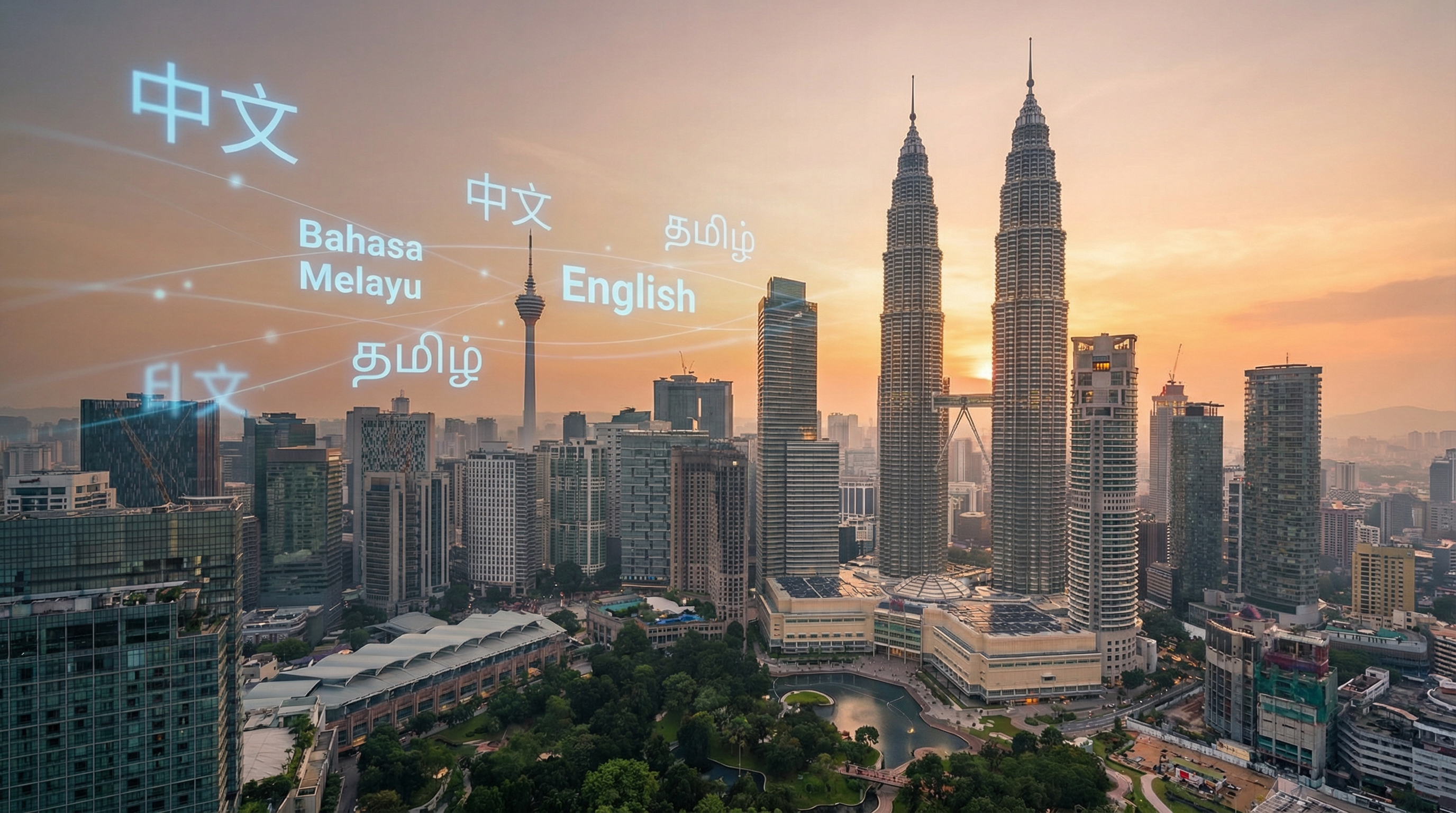
Malaysia stands at the crossroads of Southeast Asian commerce, where Malay, English, Mandarin, and Tamil interweave in a complex tapestry of daily communication. This linguistic diversity has spawned a translation industry valued between RM500 million and RM1 billion, growing at an impressive 10-15% annually. In this comprehensive analysis, we examine the structure, challenges, opportunities, and future trajectory of Malaysia's language services market.
Executive Summary
Malaysia's translation industry occupies a unique position in the global language services ecosystem. As a multilingual nation with a complex constitutional framework governing language use, Malaysia has developed one of Southeast Asia's most sophisticated translation markets. The industry serves not only domestic needs but also functions as a regional hub for ASEAN language services.
The Malaysian translation market demonstrates robust growth driven by several converging factors: increasing foreign direct investment, digital transformation initiatives under Malaysia Digital Economy Blueprint (MyDigital), the rise of e-commerce requiring multilingual content, and growing medical tourism necessitating healthcare communication services. Post-pandemic recovery has accelerated demand, with remote interpretation and AI-assisted translation experiencing particularly strong growth.
Key findings from this analysis reveal that legal and corporate translation represent the largest market segments, collectively accounting for approximately 45% of industry revenue. The healthcare sector shows the fastest growth trajectory at 18% annually, driven by Malaysia's position as a leading medical tourism destination in Asia. Technology adoption varies significantly across the industry, with larger agencies embracing CAT tools and translation management systems while freelancers often rely on basic tools.
Challenges facing the industry include persistent quality inconsistency, a talent shortage exacerbated by brain drain to Singapore and Western markets, and increasing price pressure from commoditized translation services. However, opportunities abound in Islamic finance translation, halal certification documentation, and the expanding creative content localization market for streaming platforms and gaming.
Key Market Indicators at a Glance
Malaysia's Multilingual Tapestry: Constitutional Framework and Language Policy
Understanding Malaysia's translation industry requires deep appreciation of the nation's linguistic complexity. Malaysia operates under a constitutional framework that establishes Bahasa Melayu (Malay language) as the national language while preserving the right of communities to use, teach, and learn other languages. This delicate balance, enshrined in Article 152 of the Federal Constitution and the National Language Act 1963/1967, creates a unique environment where translation services become essential for daily commerce, governance, and social interaction.
Constitutional Framework: Article 152 and the National Language Act
Article 152 of the Malaysian Constitution establishes Bahasa Melayu as the national language, but crucially includes provisions protecting other languages. The clause stating that no person shall be prohibited or prevented from using, teaching, or learning any other language has enabled the flourishing of Chinese and Tamil vernacular schools, as well as the continued use of English in commercial and professional contexts. The National Language Act 1963/1967 further delineates language requirements, mandating Malay for official government purposes while allowing English for business and legal contexts.
This dual-language framework creates significant translation demand. Government agencies must produce documents in Malay, requiring translation of English source materials. Courts operate primarily in Malay but must accommodate English proceedings when parties request it. Educational institutions produce materials in multiple languages. The result is a constant flow of translation work between Malay and English, with additional demand for Chinese and Tamil translations to serve community needs.
Bahasa Melayu: National Language and Official Business Language
Bahasa Melayu serves dual functions in Malaysia: as the national language representing national identity and as the official language of government. The Dewan Bahasa dan Pustaka (DBP, Institute of Language and Literature) standardizes Malay terminology, creating a continuous stream of neologisms to accommodate technological and scientific advancement. This standardization work directly impacts translation practice, as translators must stay current with official terminology while serving clients who may use colloquial or industry-specific variants.
The evolution of Bahasa Melayu into Bahasa Malaysia and subsequently Bahasa Melayu reflects broader national identity discussions, but for translators, practical considerations dominate. Legal documents require formal register with precise terminology. Marketing materials may employ more conversational tones. Technical documentation demands specialized vocabulary approved by relevant professional bodies. The distinction between formal and informal Malay, regional variations, and code-switching (Manglish) present ongoing challenges for translation professionals.
Government policy increasingly emphasizes Malay in official contexts, with the "Kempen Cintailah Bahasa Kebangsaan" (Love the National Language Campaign) reinforcing usage requirements. This policy direction sustains demand for Malay translation services, particularly for companies seeking government contracts, licenses, or regulatory approval. Foreign companies entering the Malaysian market must navigate these requirements, often engaging translation services for business proposals, compliance documentation, and communication with government agencies.
English in Business and Legal Contexts
Despite Malay's constitutional status, English maintains a dominant position in Malaysian business, legal, and professional contexts. The legal system operates primarily in English for commercial law, with common law precedents from British tradition requiring English proficiency for legal practitioners. Corporate Malaysia conducts business predominantly in English, with multinational corporations, financial institutions, and professional services firms using English as their operating language.
The Malaysian government's policy on English has evolved significantly. Following the 1970s implementation of the National Language Policy in education, concerns about declining English proficiency led to the "PPSMI" (Teaching of Mathematics and Science in English) policy introduced in 2003, subsequently reversed and then partially reinstated through the Dual Language Programme (DLP). These policy oscillations reflect ongoing tensions between national language promotion and economic competitiveness concerns.
For the translation industry, English dominance creates substantial demand for Malay-to-English and English-to-Malay services. Legal translation requires particular expertise, as Malaysian law incorporates English common law, Islamic law (Syariah), and customary law (Adat), necessitating specialized terminology and conceptual translation. Corporate documents, financial reports, IPO prospectuses, and commercial contracts all require professional translation services that bridge the gap between Malay official requirements and English business practice.
Mandarin and Chinese Dialects in Business and Community
Malaysia's ethnic Chinese community, comprising approximately 23% of the population, maintains a complex linguistic landscape. Mandarin (Putonghua) serves as the lingua franca among different Chinese dialect groups, but Hokkien, Cantonese, Hakka, Teochew, and Hainanese continue to be spoken within families and community contexts. The Chinese vernacular school system (Sekolah Jenis Kebangsaan Cina, SJKC) uses Mandarin as the medium of instruction, producing generations fluent in both Mandarin and Malay, with English increasingly prevalent among younger demographics.
Chinese language proficiency correlates strongly with business opportunities in Malaysia. Chinese-owned businesses, which dominate certain sectors including retail, manufacturing, and property development, often conduct internal communications in Mandarin or dialects. The ability to translate between Malay, English, and Chinese creates significant business advantages, particularly in negotiation, contract preparation, and relationship building with Chinese Malaysian business leaders.
The rise of China as an economic superpower has intensified demand for Mandarin translation services in Malaysia. Malaysian companies seeking to enter Chinese markets, attract Chinese investment, or participate in Belt and Road Initiative projects require professional translation of business proposals, technical documentation, legal contracts, and marketing materials. Similarly, Chinese companies investing in Malaysia need localization services for their Malaysian operations, product documentation, and communication with local partners.
Tamil and Indian Languages
The Malaysian Indian community, representing approximately 7% of the population, primarily speaks Tamil, with smaller communities speaking Malayalam, Telugu, Punjabi, and other Indian languages. Tamil vernacular schools (Sekolah Jenis Kebangsaan Tamil, SJKT) preserve Tamil language and culture, though enrollment has declined in recent decades due to urbanization and perceived economic advantages of national-type schools.
Tamil translation services serve specific niche markets in Malaysia. Legal aid services require Tamil interpreters for court proceedings involving Tamil-speaking defendants or witnesses. Healthcare providers need Tamil translation for patient communication in areas with significant Indian populations. Religious institutions translate Hindu religious texts and teachings. Indian-owned businesses, particularly in food services, retail, and small manufacturing, occasionally require Tamil translation for community marketing and internal communications.
The Indian diaspora's global connections create additional translation demand. Malaysian Indians maintaining family, business, or cultural ties with India require translation services for documents, correspondence, and media. Indian professionals and students coming to Malaysia need visa documentation, educational credentials, and employment contracts translated. While smaller in volume than Malay-English or Chinese translation markets, Tamil translation maintains steady demand supported by community institutions and government social services.
Indigenous Languages of Sabah and Sarawak
East Malaysia presents a distinct linguistic landscape with over 50 indigenous languages spoken across Sabah and Sarawak. In Sarawak, Iban constitutes the largest indigenous language group, while Kadazan-Dusun and Bajau languages predominate in Sabah. The complexity of these linguistic ecosystems creates unique translation challenges, as many indigenous languages lack standardized writing systems, technical vocabularies, or trained translators.
Government and NGO initiatives in indigenous areas require specialized interpretation and translation services. Rural development programs, healthcare outreach, legal aid services, and educational initiatives all encounter language barriers. The Malaysian government's efforts to incorporate indigenous perspectives into policy-making, including the requirement for free, prior, and informed consent (FPIC) for development projects affecting indigenous lands, necessitates professional interpretation services that can bridge between indigenous languages, Malay, and English.
Translation demand for indigenous languages remains relatively small in commercial terms but carries significant social importance. Academic researchers studying indigenous cultures require transcription and translation services. Cultural preservation projects document oral traditions and create written records. Legal proceedings involving indigenous parties require court interpreters. While the market size is modest, specialized translators serving these languages command premium rates due to scarcity of qualified practitioners.
Language Proficiency Statistics and Demographics
Language proficiency patterns in Malaysia reflect both official policy and demographic realities. According to the Department of Statistics Malaysia and various academic studies, Malay language proficiency approaches universal levels among ethnic Malays and near-universal among other ethnic groups for basic communication. However, proficiency levels vary significantly by domain—conversational Malay, formal Malay, and technical Malay represent distinct competency tiers.
English proficiency in Malaysia has been a subject of ongoing concern and policy debate. The EF English Proficiency Index typically ranks Malaysia in the "moderate" to "high" proficiency band among Asian nations, with significant urban-rural and socioeconomic disparities. Professional and managerial classes demonstrate high English proficiency, while working-class and rural populations may have limited English skills. This proficiency gradient drives translation demand, as businesses must communicate across English-proficiency boundaries within their own workforce and customer base.
Multilingualism represents the norm rather than exception among educated Malaysians. Many professionals operate comfortably in three or more languages—typically Malay, English, and a mother tongue (Mandarin, Tamil, or indigenous language). This multilingual capability creates a robust talent pool for translation services, though true professional translation competence requires training beyond conversational multilingualism. The gap between fluent bilingual speakers and qualified translators remains a persistent industry challenge.
Historical Evolution of Language Policy
Malaysia's language policy has evolved through distinct historical phases. The colonial era (British rule) privileged English in administration, education, and commerce while allowing vernacular education for Chinese and Tamil communities. Independence in 1957 and the formation of Malaysia in 1963 initiated a gradual shift toward Malay language promotion, culminating in the 1970s implementation of the National Language Policy that established Malay as the medium of instruction in national schools and universities.
The post-1970 period saw significant translation industry development as government, businesses, and institutions adapted to Malay language requirements. The 1980s and 1990s witnessed translation service expansion driven by privatization, industrialization, and increasing international trade. The 2000s brought technology adoption, with CAT tools and machine translation entering the Malaysian market. The 2010s and 2020s have seen digital transformation accelerate, with e-commerce, streaming media, and mobile applications creating new translation demand patterns.
Current language policy debates center on balancing national language promotion with economic competitiveness. The Malaysia Education Blueprint 2013-2025 emphasizes proficiency in both Malay and English, while the Malaysia Digital Economy Blueprint (MyDigital) acknowledges English's dominance in technology and digital commerce. Translation services mediate these policy tensions, enabling compliance with Malay language requirements while facilitating English-based international business.
Market Size and Economic Impact
Quantifying Malaysia's translation industry presents methodological challenges due to the sector's fragmentation across formal agencies, freelance practitioners, and informal service providers. Based on industry estimates, professional association data, and analysis of related sectors, the Malaysian translation market is valued between RM500 million and RM1 billion annually, with consistent growth of 10-15% CAGR over the past five years.
Industry Valuation and Market Segments
The translation industry encompasses multiple service categories, each with distinct market dynamics. Written translation services represent the largest segment, accounting for approximately 60% of industry revenue. Interpretation services, including simultaneous and consecutive interpretation for conferences, meetings, and events, comprise roughly 20% of the market. Localization services—adapting software, websites, and digital content for Malaysian audiences—represent the fastest-growing segment at approximately 15% of revenue. Ancillary services including transcription, subtitling, and language training account for the remaining 5%.
Geographically, the Klang Valley (Kuala Lumpur and Selangor) dominates the translation market, capturing approximately 70% of industry revenue. Penang, as Malaysia's secondary business hub and technology center, accounts for roughly 15% of market activity. Johor Bahru, benefiting from proximity to Singapore and Iskandar Malaysia development, represents approximately 8% of the market. East Malaysia (Sabah and Sarawak) constitutes the remaining 7%, with unique characteristics reflecting local linguistic diversity and economic patterns.
| Market Segment | Revenue Share | Growth Rate | Key Drivers |
|---|---|---|---|
| Written Translation | 60% | 10% | Legal, corporate, government |
| Interpretation | 20% | 12% | Conferences, events, meetings |
| Localization | 15% | 18% | E-commerce, apps, gaming |
| Ancillary Services | 5% | 8% | Transcription, subtitling |
Growth Trajectory and Market Dynamics
The Malaysian translation market demonstrates robust growth driven by structural economic factors. Foreign direct investment (FDI) inflows, which reached RM61.3 billion in 2024 according to the Malaysian Investment Development Authority (MIDA), create sustained demand for translation services as international companies establish Malaysian operations. These companies require localization of corporate materials, translation of legal and compliance documents, and interpretation services for management communication with global headquarters.
Digital transformation initiatives amplify translation demand across sectors. The Malaysia Digital Economy Blueprint (MyDigital) targets digital economy contribution to GDP reaching 22.6% by 2025, up from 19.1% in 2020. This digital shift requires multilingual content for e-commerce platforms, government digital services, mobile applications, and digital marketing campaigns. The COVID-19 pandemic accelerated digital adoption, permanently shifting consumer behaviors toward online channels that require localized content.
Post-pandemic recovery has revealed lasting changes in translation demand patterns. Remote interpretation, which emerged as a necessity during lockdown periods, has become standard practice for many organizations, reducing travel costs while maintaining communication effectiveness. Virtual events and webinars requiring simultaneous interpretation have proliferated. Documentation translation has increased as companies digitize paper-based processes. These shifts suggest sustained demand growth even as pandemic conditions normalize.
Regional Comparison: Singapore, Indonesia, and Thailand
Malaysia's translation industry exists within a competitive regional landscape. Singapore, with its status as a global financial center and higher GDP per capita, maintains a more mature translation market valued at approximately SGD 400-600 million. Singaporean translation services command higher rates due to operating costs, but Malaysia benefits from cost advantages for regional operations, with many Singapore-based clients outsourcing to Malaysian translation providers.
Indonesia represents a significantly larger but less developed translation market. With a population exceeding 270 million and the fourth-largest nation by population, Indonesia's translation industry is valued at approximately USD 300-500 million, growing rapidly but from a lower base of professionalization. The Indonesian market remains more fragmented, with informal translation services playing a larger role. Malaysia benefits from higher professional standards and bilingual education, positioning itself as a quality alternative for ASEAN-wide projects.
Thailand's translation market, valued at approximately THB 8-12 billion, shares characteristics with Malaysia in terms of development level and growth trajectory. Both countries balance national language promotion with international business needs, creating similar demand patterns. However, Thailand's tourism focus generates proportionally more interpretation demand for hospitality and tourism services, while Malaysia's financial services and Islamic finance sectors create distinctive specialization opportunities.
Government Spending on Translation and Interpretation
Malaysian government expenditure on translation services represents a significant market segment. Federal and state government agencies require translation for parliamentary proceedings, official documents, public communications, and international correspondence. The Dewan Bahasa dan Pustaka receives substantial funding for terminology development and standardization work. Government-linked companies (GLCs) and public universities maintain ongoing translation requirements for research publications, corporate communications, and international engagement.
Court interpretation services represent a specific government-funded segment with constitutional significance. The Malaysian court system provides interpretation services as a right for defendants and parties who do not understand the proceedings language. This creates steady demand for court interpreters, particularly for Tamil, Mandarin, and indigenous languages in criminal proceedings. The Judicial Department's investment in interpretation infrastructure, including equipment for simultaneous interpretation in appellate courts, reflects ongoing commitment to language access.
E-government initiatives have expanded government translation demand significantly. The Malaysia Government Enterprise Architecture (MyGEA) framework requires government digital services to be accessible in multiple languages. Government websites, mobile applications, and online service portals require ongoing translation and localization. Public awareness campaigns on health, safety, and government programs must reach multilingual audiences. These requirements sustain substantial government translation expenditure annually.
Sector Analysis: Industry-Specific Translation Requirements
The Malaysian translation market serves diverse industry verticals, each presenting unique requirements, regulatory frameworks, and quality standards. Understanding these sector-specific dynamics is essential for translation providers seeking to develop expertise and for clients seeking appropriate language services.
Legal and Judicial Translation
Legal translation constitutes one of Malaysia's most demanding and highest-value market segments. The Malaysian legal system's complexity—incorporating common law, Islamic law (Syariah), and customary law (Adat)—requires translators with specialized expertise in multiple legal traditions. Court proceedings, contracts, legislation, and legal opinions demand precision that leaves no room for error, with translation accuracy potentially affecting case outcomes and contractual obligations.
The Malaysian court system operates primarily in Malay at the lower courts and increasingly in English at higher courts, creating continuous translation demand. Court interpreters must provide simultaneous interpretation for proceedings, requiring specialized training and certification. The Judicial Department maintains a registry of qualified court interpreters, though demand frequently exceeds supply, particularly for less common language pairs and specialized proceedings.
Syariah law translation presents unique challenges. Islamic legal terminology, derived from Arabic and adapted into Malay jurisprudence, requires translators with expertise in both Islamic law and Malaysian legal practice. Family law matters including marriage, divorce, inheritance, and child custody involve sensitive terminology where cultural and religious nuances affect translation choices. The dual court system (civil and Syariah) necessitates translation services that understand jurisdictional boundaries and applicable legal frameworks.
Corporate legal translation serves multinational corporations, financial institutions, and law firms. IPO prospectuses, merger and acquisition documents, regulatory filings, and commercial contracts require translation that maintains legal force across languages. Major law firms in Kuala Lumpur maintain in-house translation capabilities or preferred vendor relationships with specialized legal translation providers. International arbitration proceedings involving Malaysian parties generate significant interpretation and document translation demand.
Medical and Healthcare Translation
Malaysia's position as a leading medical tourism destination in Asia drives substantial healthcare translation demand. The Malaysia Healthcare Travel Council (MHTC) reports that medical tourism contributed RM1.7 billion to the economy in 2019, with the sector recovering strongly post-pandemic. International patients from Indonesia, Bangladesh, China, India, and the Middle East require comprehensive translation services for medical history, consent forms, treatment plans, and discharge instructions.
Healthcare interpretation presents life-critical communication requirements. Patient-doctor consultations, emergency department interactions, and surgical consent procedures demand accurate interpretation where misunderstanding could have serious consequences. Major Malaysian hospitals including IHH Healthcare, KPJ Healthcare, and Prince Court Medical Centre employ in-house interpreters or maintain contracts with medical interpretation services. Telemedicine expansion has increased demand for remote interpretation services.
Pharmaceutical and medical device documentation translation serves Malaysia's growing life sciences industry. Product registration with the National Pharmaceutical Regulatory Agency (NPRA) requires translation of clinical trial data, product labeling, and regulatory submissions. Medical device manufacturers must provide instruction manuals in Malay and English. The growing complexity of biologics and specialized therapeutics requires translators with advanced scientific backgrounds.
Business and Corporate Translation
Corporate translation represents the largest segment of Malaysia's translation market by revenue. Multinational corporations operating in Malaysia require translation services for internal communications, HR documentation, training materials, and compliance reporting. Malaysian companies expanding regionally or globally need translation of business proposals, marketing materials, and legal documents for international markets.
Initial Public Offering (IPO) translation constitutes a high-value niche within corporate translation. Companies listing on Bursa Malaysia must provide prospectuses in both Malay and English, requiring translation of complex financial and legal disclosures. The translation must meet securities regulatory standards while accurately conveying risk factors, financial statements, and governance structures. IPO translation projects involve significant volumes with tight deadlines, commanding premium rates.
Marketing localization extends beyond literal translation to cultural adaptation. Malaysian consumers, comprising multiple ethnic communities with distinct cultural references, require messaging that resonates appropriately. FMCG companies, automotive brands, and financial services providers invest in localized marketing campaigns using dialect-appropriate language, culturally relevant imagery, and community-specific channels. Transcreation—the creative adaptation of marketing content—commands higher rates than standard translation.
Government and Public Sector
Government translation requirements reflect Malaysia's constitutional commitment to Malay as the national language while serving multilingual populations. Parliamentary proceedings are recorded in both Malay and English, with Hansard requiring accurate transcription and translation. Government gazettes, circulars, and policy documents must be published in Malay, with English versions for international reference. Ministries and agencies maintain translation units or outsource to approved vendors.
E-government initiatives have transformed public sector translation demand. The Malaysia Government Enterprise Architecture (MyGEA) requires digital services to be accessible in multiple languages. The MyGovernment Portal (MyGP) and mobile applications must support Malay, English, and increasingly Chinese interfaces for key services. Public health communications, including COVID-19 pandemic messaging, demonstrated the importance of rapid, accurate translation for public safety.
International diplomacy and ASEAN engagement generate specialized translation requirements. Malaysia's Ministry of Foreign Affairs (Wisma Putra) requires translation for diplomatic correspondence, treaty negotiations, and international conference participation. As an ASEAN member, Malaysia participates in regional initiatives requiring translation between Malay and other ASEAN languages, particularly for technical working groups and sectoral cooperation frameworks.
Technical and Engineering Translation
Malaysia's industrial base, spanning oil and gas, manufacturing, electronics, and construction, generates substantial technical translation demand. The oil and gas sector, concentrated in East Malaysia and offshore operations, requires translation of technical specifications, safety manuals, environmental impact assessments, and operational procedures. Major operators including Petronas and Shell maintain exacting standards for technical documentation.
Manufacturing and electronics industries in Penang, Selangor, and Johor require translation for supplier documentation, quality control procedures, and equipment manuals. Malaysia's role in global supply chains, particularly for semiconductor manufacturing, necessitates translation between English and Asian languages for technical specifications and quality certifications. Industry 4.0 transformation has increased demand for translation of automation system documentation and digital twin specifications.
Engineering, procurement, and construction (EPC) projects generate substantial document translation volumes. Major infrastructure projects including MRT expansion, Pan Borneo Highway, and renewable energy installations involve international contractors requiring translation of construction drawings, technical specifications, and safety protocols. These projects typically require fast-turnaround translation services to maintain project schedules.
Education and Academic Translation
Malaysia's higher education internationalization drives academic translation demand. Public and private universities recruiting international students must translate prospectuses, program descriptions, and admission materials. Academic credential evaluation for international applicants requires certified translation of transcripts, certificates, and supporting documents. Major institutions including University of Malaya, UKM, and Monash University Malaysia maintain ongoing translation requirements.
Research publication support represents a growing academic translation segment. Malaysian researchers seeking publication in international journals often require editing and translation of manuscripts from Malay or Chinese into English. The Ministry of Higher Education's research assessment frameworks incentivize international publication, driving demand for academic English editing and translation services. Predatory publishing concerns have increased emphasis on quality translation that preserves research integrity.
Textbook and educational material translation serves Malaysia's multilingual education system. While the medium of instruction in national schools is Malay, vernacular schools require Chinese and Tamil translations. Private international schools use English-language materials but may require translation for parent communication. The Ministry of Education's curriculum development generates translation demand for syllabus documents, examination papers, and teaching guides.
Technology and Innovation in Translation
Technology adoption in Malaysia's translation industry has accelerated significantly, driven by global trends, competitive pressure, and the COVID-19 pandemic's digital acceleration. Understanding the current state and trajectory of translation technology is essential for industry participants and clients seeking efficient language services.
Computer-Assisted Translation (CAT) Tools Adoption
CAT tool adoption in Malaysia varies significantly by organization size and service type. Large translation agencies and multinational corporate translation departments have widely adopted industry-standard tools including SDL Trados, MemoQ, and Phrase (formerly Memsource). These platforms enable translation memory management, terminology consistency, and project workflow automation. Investment in CAT infrastructure distinguishes professional agencies from informal providers.
Freelance translator adoption of CAT tools is mixed. Experienced professionals recognize productivity benefits and client requirements for CAT-compatible workflows. However, licensing costs present barriers for freelancers operating on thin margins. Cloud-based CAT solutions with subscription pricing have lowered entry barriers, enabling more freelancers to access professional-grade tools. Training and support resources in Malay and English support adoption.
Translation memory assets accumulated over years of practice represent significant competitive advantages for established Malaysian agencies. Specialized memories for legal, financial, technical, and medical domains enable efficient handling of repetitive content while maintaining consistency. Agencies increasingly monetize these assets through translation memory leasing and shared resource arrangements.
Machine Translation (MT) and Post-Editing
Machine translation has transformed the economics of translation services in Malaysia. Neural machine translation (NMT) engines from Google, Microsoft, and DeepL provide increasingly usable output for many language pairs, though Malay presents unique challenges due to limited training data compared to major European and Asian languages. English-Malay MT output requires significant post-editing for professional use.
Machine translation post-editing (MTPE) has emerged as a distinct service category. Rather than translating from scratch, linguists edit and refine MT output, achieving cost savings of 30-50% compared to human translation while maintaining acceptable quality for appropriate content types. Internal communications, large-volume documentation, and time-sensitive projects particularly benefit from MTPE workflows. Malaysian agencies have developed MTPE expertise and quality assessment frameworks.
Custom machine translation engines represent the next technology frontier. Enterprises with large, specialized translation volumes—including government agencies, GLCs, and multinational corporations—are investing in domain-specific MT engines trained on proprietary translation memories. These custom engines deliver superior output quality for specialized terminology, justifying investment through reduced post-editing effort.
AI-Powered Translation Services
Large language models (LLMs) including GPT-4, Claude, and Gemini have entered the translation landscape with significant implications. These models demonstrate impressive zero-shot translation capabilities across many language pairs, including Malay, Chinese, and Tamil. Malaysian translation providers are exploring LLM integration for specific use cases while managing quality concerns and cost considerations.
AI-powered translation management platforms automate project workflows previously requiring manual coordination. These systems handle project intake, translator assignment, quality assurance checking, and client delivery with minimal human intervention. Malaysian agencies adopting these platforms achieve scalability and 24/7 service capabilities previously accessible only to global language service providers.
Quality estimation (QE) technology uses AI to assess translation quality without full human review. QE scores help prioritize human review resources, identify problematic segments, and route content to appropriate quality tiers. Malaysian agencies implementing QE workflows optimize quality assurance investment, applying intensive review to high-risk content while managing costs for routine material.
Remote Interpretation Technology
The COVID-19 pandemic fundamentally transformed interpretation service delivery in Malaysia. Remote simultaneous interpretation (RSI) platforms including Interprefy, KUDO, and Zoom's interpretation feature enabled conferences and events to continue despite travel restrictions. Post-pandemic, RSI has become standard practice, with many clients preferring the cost savings and logistical simplicity of remote interpretation over on-site services.
Over-the-phone interpretation (OPI) and video remote interpretation (VRI) serve healthcare, legal aid, and customer service applications. Malaysian hospitals deploy VRI for patient communication with interpreters in centralized language centers. Legal aid services use remote interpretation for lawyer-client consultations and court proceedings. The technology infrastructure supporting remote interpretation has improved significantly, with latency and audio quality approaching on-site standards.
Industry Structure and Key Players
Malaysia's translation industry comprises a diverse ecosystem of providers, from individual freelancers to multinational language service companies. Understanding this structure helps clients navigate provider selection and helps industry participants identify competitive positioning opportunities.
Freelance Translators: The Backbone of the Industry
Freelance translators represent the largest employment category in Malaysia's translation industry, with estimates suggesting 5,000-10,000 active practitioners. These independent professionals serve direct clients and work through agencies, offering specialized expertise in specific domains and language pairs. Many Malaysian freelancers combine translation with other professional activities including teaching, writing, and subject-matter expertise.
The freelance market exhibits significant segmentation. Elite translators with rare specializations—legal, medical, technical—command premium rates and maintain waiting lists for their services. Mid-market freelancers provide general business translation for standard rates. Entry-level translators compete on price, often working through online platforms where global competition pressures rates downward. This segmentation creates distinct market tiers with limited mobility between them.
Freelancer professionalization varies widely. Some maintain professional credentials including MTA membership, ISO certification, and specialized training. Others operate informally without formal credentials, relying on language ability alone. Quality variance among freelancers presents ongoing challenges for clients seeking reliable translation services. Reputation systems, portfolio review, and test translations help clients assess freelancer capabilities.
Translation Agencies: Market Organization
Translation agencies serve as market intermediaries, aggregating freelancer capacity and providing clients with project management, quality assurance, and service reliability. Malaysian agencies range from one-person operations to established firms with 20+ employees and extensive freelancer networks. Major local players include Translife, GTC, Eluneva, and Asia Translate, alongside Malaysian operations of global agencies including TransPerfect, Lionbridge, and RWS.
Agency differentiation strategies vary. Some focus on specific verticals such as legal, medical, or technical translation, developing deep expertise and specialized terminology resources. Others emphasize technology capabilities including CAT tools, MT integration, and workflow automation. Price-competitive agencies leverage offshore translator networks and MTPE workflows to offer low-cost solutions. Boutique agencies emphasize premium quality, personalized service, and high-touch client relationships.
International agencies with Malaysian operations compete aggressively for multinational corporate clients, offering global scale, 24/7 operations, and standardized quality processes. Local agencies compete on local market knowledge, Malay language expertise, and relationship networks within Malaysia. Mid-market competition is intense, with agencies seeking differentiation through specialization, technology, or service models.
Professional Associations and Certification
The Malaysian Translators Association (MTA, Persatuan Penterjemah Malaysia) serves as the primary professional body for translators and interpreters. Founded in 1974, MTA promotes professional standards, organizes continuing education, and advocates for translator interests. MTA membership, while not legally required for practice, signals professional commitment and provides networking and development opportunities.
The Institute of Translation and Books (ITBM, Institut Terjemahan dan Buku Malaysia), a government agency under the Ministry of Education, supports translation of academic and literary works into Malay. ITBM provides translation grants, organizes training, and maintains translator databases. While focused on literary and academic translation rather than commercial services, ITBM contributes to translator professionalization and Malay language development.
Certification and credentialing in Malaysia's translation industry remains fragmented. Unlike some jurisdictions with government-regulated certification systems, Malaysia relies primarily on professional association membership, academic qualifications, and vendor certification programs. ISO 17100 certification for translation service providers has gained traction among established agencies seeking to demonstrate quality management systems. Individual translator certification from international bodies including ATA (American Translators Association) and NAATI (National Accreditation Authority for Translators and Interpreters, Australia) holds prestige in the Malaysian market.
Challenges and Pain Points
Malaysia's translation industry, despite its growth and importance, faces significant challenges that affect service quality, professional sustainability, and industry development. Understanding these challenges helps stakeholders navigate the market and identifies areas for improvement.
Quality Inconsistency and Client Uncertainty
Quality inconsistency represents the translation industry's most persistent challenge. Unlike regulated professions where credentials guarantee minimum competence, translation quality varies dramatically across providers. Clients frequently receive substandard translations from uncredentialed providers, undermining trust in professional translation services. The absence of a regulatory framework allowing clients to verify translator qualifications exacerbates this problem.
Quality assessment itself presents challenges. Non-bilingual clients cannot easily evaluate translation accuracy, creating information asymmetry where providers may deliver poor quality undetected. Revision and proofreading services provide quality assurance but add cost. Industry-standard quality metrics including the LISA QA Model and MQM (Multidimensional Quality Metrics) framework offer objective assessment tools, though adoption remains limited outside professional agencies.
Talent Shortage and Brain Drain
The translation industry faces significant talent pipeline challenges. University translation programs produce graduates whose practical skills often do not meet industry requirements, creating a gap between academic preparation and professional practice. Graduate employment in translation is uncertain, with many qualified translators leaving the profession for more stable careers in teaching, government, or corporate roles.
Brain drain to Singapore and Western markets affects the Malaysian translation talent pool. Experienced translators with international credentials and specialized expertise often relocate for better compensation, career advancement, and lifestyle opportunities. This outflow particularly impacts specialized fields including legal, medical, and technical translation where expertise takes years to develop.
Price Competition and Race to the Bottom
Price competition in Malaysia's translation market has intensified through several mechanisms. Global translation platforms including Upwork, Fiverr, and ProZ connect Malaysian freelancers with international clients at rates depressed by global competition. Clients seeking lowest-cost options drive rates downward without understanding quality implications. Aggressive agency competition for corporate contracts squeezes margins throughout the supply chain.
The commoditization of general translation particularly affects market economics. For routine content without specialized terminology, MTPE and low-cost human translation provide acceptable quality at prices professional translators cannot match. This commoditization pressures translators to either accept unsustainable rates or develop specializations that justify premium pricing.
Technology Adoption Barriers
Technology adoption gaps create market inefficiencies. Freelancers without CAT tools cannot participate in large agency workflows. Agencies without MT integration lose competitive position to technology-enabled competitors. Clients unfamiliar with translation technology cannot effectively specify requirements or evaluate technology-enabled solutions. These gaps slow industry modernization and perpetuate manual processes that could be automated.
Intellectual Property and Confidentiality Concerns
Translation involves handling sensitive client information, creating IP and confidentiality concerns. Leakage of confidential information through insecure workflows or unprofessional freelancers damages client trust. Machine translation raises additional concerns as content may be processed on external servers outside client control. Legal frameworks for translator confidentiality in Malaysia remain less developed than in some jurisdictions.
Opportunities and Future Trends
Despite challenges, Malaysia's translation industry presents substantial opportunities for growth, specialization, and innovation. Identifying and capitalizing on these opportunities enables industry participants to build sustainable, competitive businesses.
ASEAN Integration Benefits
Malaysia's position as a multilingual ASEAN member creates regional translation opportunities. The ASEAN Economic Community's deepening integration increases cross-border business requiring translation between Malay, Thai, Indonesian, Vietnamese, and other Southeast Asian languages. Malaysian agencies with Malay expertise and English proficiency are well-positioned to serve as regional translation hubs, particularly for Islamic finance and halal industry content.
Islamic Finance Translation Boom
Malaysia's status as a global Islamic finance center generates specialized translation demand. Sukuk (Islamic bond) issuance, Shariah compliance documentation, and Islamic banking products require translation of Arabic terminology into Malay and English. The complexity of Islamic financial concepts and the requirement for Shariah board approval create barriers to entry that protect specialist translators. Malaysia's dual-language Islamic finance framework—Arabic-Malay-English—requires sophisticated translation capabilities.
Halal Certification Documentation
Global halal market expansion, projected to reach USD 3 trillion, drives demand for halal certification translation. Malaysia's JAKIM (Department of Islamic Development Malaysia) is a recognized global halal certification authority, and Malaysian companies seeking halal export certification require translation of manufacturing processes, ingredient lists, and compliance documentation. The technical and religious complexity of halal standards creates specialized translation opportunities.
Creative Content Localization
Streaming platforms including Netflix, Disney+, and Viu have expanded Malaysian content libraries, requiring extensive subtitling and dubbing services. The Malaysian gaming industry, while nascent, shows growth potential requiring localization for international distribution. Social media content localization for Malaysian influencers and brands entering regional markets presents ongoing demand. Transcreation—the creative adaptation of marketing and entertainment content— commands premium rates compared to technical translation.
AI-Human Hybrid Workflows
Rather than viewing AI as a threat, forward-looking translation providers are developing hybrid workflows that combine AI efficiency with human expertise. MTPE represents an early form of this hybrid approach. Emerging models include AI drafting with human editing, human translation with AI quality checking, and AI terminology assistance for human translators. These workflows optimize cost-quality tradeoffs and enable service providers to serve broader market segments.
Regional Deep Dive: Geographic Variations in the Malaysian Market
Malaysia's translation market exhibits significant geographic variation reflecting regional economic patterns, demographic composition, and industry concentration. Understanding these variations helps service providers optimize geographic positioning and helps clients access appropriate local resources.
Kuala Lumpur and Selangor: The National Hub
The Klang Valley dominates Malaysia's translation market, concentrating approximately 70% of industry revenue and the majority of established agencies. Kuala Lumpur's status as the capital, financial center, and primary business hub creates sustained demand for corporate, legal, and government translation services. The presence of international law firms, accounting firms, and multinational headquarters generates high-value translation projects requiring premium service levels.
KL-based agencies benefit from proximity to clients, enabling face-to-face consultation and relationship building. The concentration of freelance talent in the Klang Valley supports agency capacity scaling. Infrastructure including high-speed internet, meeting facilities, and interpretation equipment rental supports service delivery. Competition is intense, with agencies competing on specialization, technology, and service quality rather than geography.
Penang: Technology and Manufacturing Focus
Penang's translation market reflects its industrial character. As Malaysia's manufacturing hub, particularly for electronics and semiconductors, Penang generates substantial technical translation demand for product documentation, quality specifications, and supply chain communications. The state's Free Industrial Zone companies, including Intel, AMD, and Broadcom, maintain ongoing translation requirements for global operations.
George Town's UNESCO World Heritage status supports tourism interpretation and cultural translation services. The state's growing startup ecosystem, supported by Penang Digital and related initiatives, creates demand for app localization, website translation, and digital content adaptation. Penang agencies typically combine technical specialization with competitive pricing compared to KL providers.
Johor: The Southern Gateway
Johor Bahru's proximity to Singapore and Iskandar Malaysia development create distinctive translation market dynamics. The state serves as an extension of Singapore's business ecosystem, with many Singaporean companies establishing back-office operations and manufacturing facilities in Johor. This cross-border integration generates translation demand for business documentation, regulatory compliance, and workforce communication.
The Iskandar Malaysia special economic zone attracts international investment requiring comprehensive localization services. Port of Tanjung Pelepas activities generate logistics and shipping documentation translation. The state's position as a logistics hub for southern Malaysia creates sustained demand for business translation services. Johor agencies often serve as lower-cost alternatives to Singapore providers while maintaining quality standards.
Sabah and Sarawak: East Malaysian Dynamics
East Malaysia presents a distinct translation market shaped by indigenous language diversity, resource extraction industries, and geographic isolation. Oil and gas operations in Miri, Bintulu, and offshore fields generate technical translation demand. Palm oil plantation operations require communication with indigenous communities, creating interpretation needs for Iban, Kadazan-Dusun, and other languages. Government rural development programs require translation of agricultural extension materials.
Infrastructure limitations affect service delivery. Internet connectivity, while improving, remains less reliable than in Peninsular Malaysia, complicating remote interpretation and digital workflows. The limited local translator pool necessitates engagement of Peninsular-based providers, increasing costs and turnaround times. However, East Malaysia's growing urban centers including Kota Kinabalu and Kuching are developing local translation capabilities.
Strategic Recommendations
Based on this comprehensive analysis, we offer strategic recommendations for different stakeholders in Malaysia's translation ecosystem.
For Businesses Seeking Translation Services
- 1.Assess quality requirements rigorously. Match translation investment to content criticality. Legal contracts, medical documentation, and regulatory submissions warrant premium translation services with full quality assurance. Internal communications may be suitable for MTPE or standard translation.
- 2.Verify translator qualifications. Request evidence of professional credentials, subject matter expertise, and relevant experience. Test translations provide objective quality assessment before committing to large projects.
- 3.Build long-term translator relationships. Ongoing collaboration with trusted translators builds institutional knowledge, improves consistency, and often yields preferential pricing for retained work.
- 4.Invest in translation technology. CAT tools, translation memories, and terminology management systems improve efficiency and consistency while reducing long-term costs.
For Translators Entering the Market
- 1.Develop specialization early. General translation faces intense price competition. Legal, medical, technical, or financial specialization enables premium pricing and protects against commoditization.
- 2.Invest in professional credentials. MTA membership, ISO 17100 certification, and specialized training signal professionalism and open doors to quality-conscious clients.
- 3.Master translation technology. CAT tools, terminology management, and MT post-editing capabilities are essential for competitive positioning in the modern market.
- 4.Build direct client relationships. While agencies provide volume, direct clients typically pay better rates and offer more stable work. Marketing, networking, and specialization support direct client acquisition.
For Policy Makers
- 1.Consider translator certification framework. A standardized certification system would help clients identify qualified translators and improve overall industry quality standards.
- 2.Support professional association development. Increased funding for MTA and related organizations would support training, standardization, and professional development initiatives.
- 3.Address brain drain through incentives. Tax incentives, professional development support, and quality of life improvements could retain translation talent in Malaysia.
- 4.Promote Malaysia as a regional translation hub. Leveraging multilingual capabilities for ASEAN services could create economic opportunities and strengthen Malaysia's service sector.
For Education Institutions
- 1.Align curricula with industry needs. Translation programs should incorporate CAT tools, MT post-editing, and practical industry skills alongside traditional translation theory.
- 2.Develop specialized tracks. Legal, medical, technical, and financial translation specializations prepare graduates for high-demand, premium-rate market segments.
- 3.Strengthen industry partnerships. Internships, guest lectures, and collaborative projects bridge the gap between academic preparation and professional practice.
Conclusion: The Future of Malaysia's Translation Industry
Malaysia's translation industry stands at an inflection point. The convergence of digital transformation, ASEAN integration, and Malaysia's unique multilingual heritage creates unprecedented opportunities for growth and specialization. The industry, valued between RM500 million and RM1 billion with 10-15% annual growth, demonstrates resilience and adaptability in a changing global landscape.
Key takeaways from this analysis illuminate both opportunities and imperatives. First, specialization emerges as the critical success factor—general translation faces commoditization while legal, medical, technical, and emerging fields including Islamic finance and halal certification command premium pricing. Second, technology adoption separates market leaders from laggards, with CAT tools, MT integration, and AI workflows becoming standard requirements rather than competitive advantages. Third, professionalization through credentials, standards, and quality processes builds client trust and sustainable business models.
The outlook for 2025-2030 remains broadly positive despite challenges. Quality inconsistency, talent shortages, and price competition will persist, but these market pressures also reward providers who invest in quality, specialization, and technology. Malaysia's strategic position as a multilingual ASEAN hub, combined with its Islamic finance leadership and halal certification authority, creates differentiated opportunities unavailable to monolingual competitors.
For industry participants—translators, agencies, and technology providers—the path forward requires strategic clarity. Freelancers must choose between competing on price in commoditized markets or investing in specialization for premium positioning. Agencies need technology-enabled scale or boutique expertise to avoid the middle-market squeeze. All participants must navigate AI's transformative impact, neither ignoring its efficiency potential nor overestimating its ability to replace human expertise.
At Translife, we observe these market dynamics daily as we serve clients across Malaysia and the region. The translation industry's evolution reflects Malaysia's broader economic transformation—from a resource-based economy to a services-led, knowledge-intensive, digitally-enabled marketplace. Language services facilitate this transition, enabling communication across linguistic boundaries that would otherwise fragment Malaysia's diverse society and economy. The translation industry's future is inseparable from Malaysia's future, and both remain bright.
About Translife Translation Services
Translife is a leading Malaysian translation agency serving clients across legal, medical, corporate, and technical domains. With offices in Kuala Lumpur, Penang, and Johor Bahru, we provide comprehensive language services including translation, interpretation, localization, and certified document services.