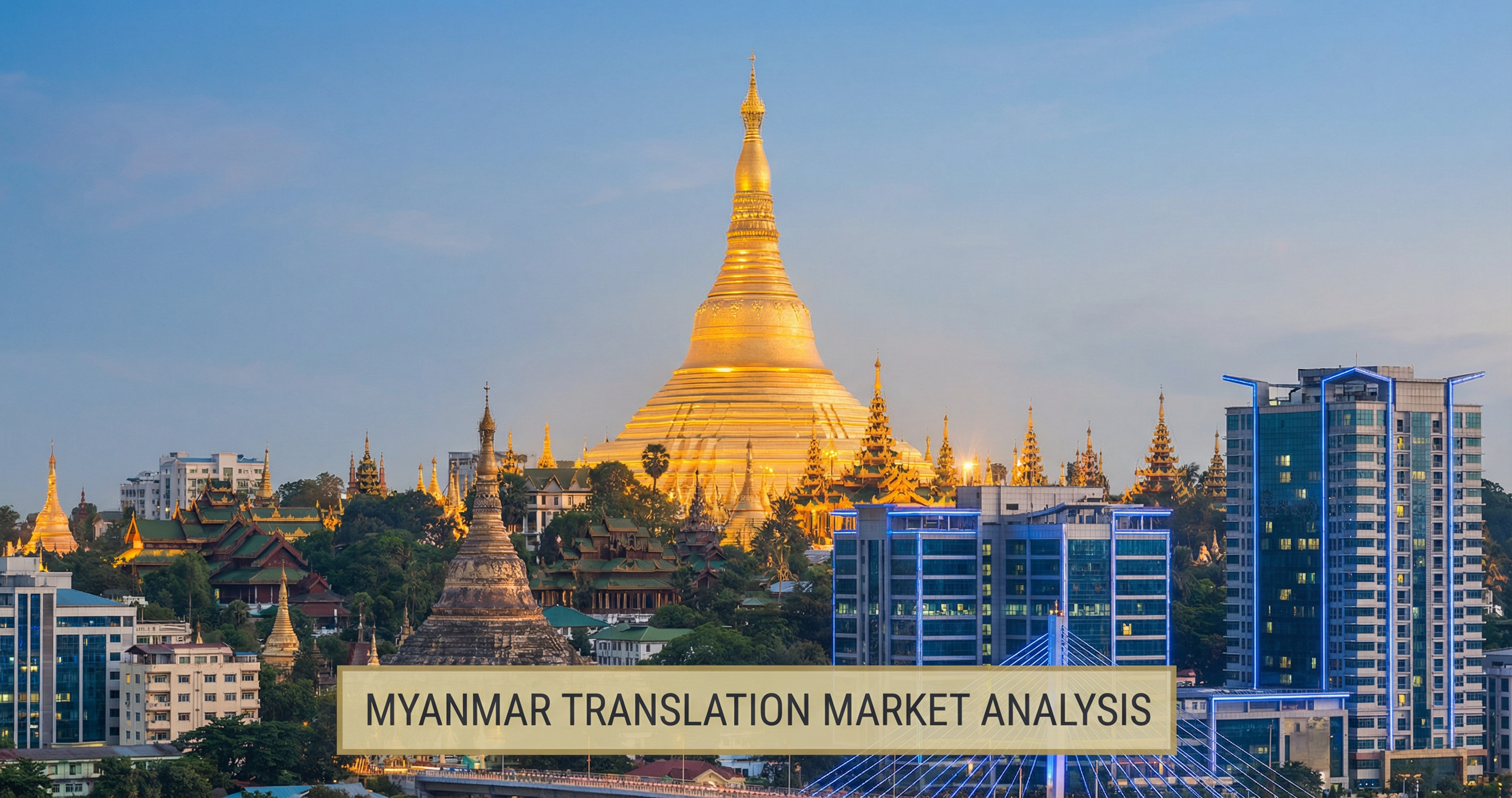
Myanmar represents one of Southeast Asia's most linguistically complex and politically challenging translation markets. With over 54 million people speaking more than 100 languages across a nation emerging from decades of isolation, the translation industry navigates a landscape shaped by British colonial legacy, ethnic diversity, and ongoing political turbulence. This comprehensive analysis examines a market valued at MMK 15-25 billion (USD 7-12 million), dominated by international development organizations and constrained by sanctions, infrastructure deficits, and the complex aftermath of the 2021 military coup.
Executive Summary: Myanmar's Unique Translation Market Context
Myanmar's translation industry operates within a context unlike any other in Southeast Asia. The nation's 54 million people speak over 100 distinct languages, with Burmese serving as the lingua franca for approximately two-thirds of the population while seven major ethnic languages—Shan, Karen, Rakhine, Chin, Kachin, Mon, and Kayah—maintain significant speaker communities. This extraordinary linguistic diversity, combined with Myanmar's complex political history and challenging business environment, creates a translation market defined by humanitarian need, development priorities, and the practical requirements of international engagement in a fractured society.
The market valuation of MMK 15-25 billion (approximately USD 7-12 million) reflects both the modest scale of formal economic activity and the substantial translation needs generated by Myanmar's development sector. Unlike the commercial-driven translation markets of Singapore, Thailand, or Vietnam, Myanmar's language services industry remains overwhelmingly oriented toward international non-governmental organizations (INGOs), United Nations agencies, and bilateral development programs. Commercial translation represents a minority share, concentrated in extractive industries, manufacturing, and the limited tourism sector that operated prior to COVID-19 and the 2021 political crisis.
The post-2011 reform period, which began with the military's gradual liberalization of the political and economic system, generated unprecedented translation demand as international organizations returned following decades of isolation. This expansion created an informal but substantial translation workforce—estimated at 2,000-3,000 professional translators and interpreters—before the 2021 coup triggered an industry contraction. Current market conditions remain volatile, with operations complicated by international sanctions, banking restrictions, currency instability, and the security concerns affecting large portions of the country.
Key findings from this analysis reveal that the development and INGO sector dominates market demand, accounting for approximately 60-70% of translation volume. Legal and justice sector translation, supported by the British common law legacy and international rule-of-law programs, represents the second-largest segment. Natural resources—particularly mining and energy extraction—generate specialized technical translation needs despite ongoing debates about responsible investment. Manufacturing, primarily in the garment sector, creates steady demand for compliance and operational documentation. Healthcare translation has grown significantly through pandemic response and ongoing humanitarian health programs.
Technology adoption in Myanmar's translation sector faces fundamental constraints. Internet penetration remains limited outside urban centers, with connectivity further disrupted since 2021. The long-delayed migration from Zawgyi (a non-standard font encoding that dominated for two decades) to Unicode standard Burmese script continues to create compatibility challenges. Machine translation development for Burmese lags behind major Southeast Asian languages, reflecting both the technical complexity of Myanmar's script and the limited commercial incentive for technology investment in a sanctioned, politically unstable market.
Myanmar Translation Market at a Glance
Myanmar's Linguistic Complexity: A Nation of Languages
Myanmar's translation market cannot be understood without deep appreciation of the nation's extraordinary linguistic diversity. The country's 54 million people speak more than 100 distinct languages, representing four major language families—Sino-Tibetan, Tai-Kadai, Austroasiatic, and Austronesian—creating a translation landscape of exceptional complexity. This diversity reflects both Myanmar's position as a historical crossroads between South Asia, East Asia, and Southeast Asia, and the mountainous geography that has preserved distinct linguistic communities across millennia.
The Burmese Language: Characteristics and National Role
Burmese (also called Myanmar language) serves as the official language and primary lingua franca, spoken as a first language by approximately 33-35 million people and as a second language by millions more across ethnic communities. As a member of the Sino-Tibetan language family, specifically the Tibeto-Burman branch, Burmese shares ancestry with Tibetan and numerous Himalayan languages while maintaining distinctive characteristics shaped by centuries of cultural development in the Irrawaddy River basin.
The Burmese writing system presents unique challenges for translation technology and non-native practitioners. Derived from the Burmese script, which evolved from the Old Mon script in the 11th century, the writing system is an abugida (segmental writing system) where consonant-vowel sequences are written as a unit. The script consists of 33 consonants and 12 vowel symbols that combine to form syllabic characters. This orthographic complexity, combined with the tonal nature of the language (Burmese has three tones), creates significant challenges for optical character recognition, text encoding, and machine translation systems.
Burmese grammar operates on principles distinct from Indo-European languages. The language employs extensive particle systems—post-positional markers that indicate grammatical relationships, tense, aspect, and modality. Honorifics play a crucial role, with elaborate systems of linguistic politeness reflecting Myanmar's hierarchical social structures. Pali loanwords, introduced through Theravada Buddhist religious traditions, dominate philosophical, religious, and formal vocabulary. This grammatical and lexical complexity requires translators to navigate not merely linguistic conversion but cultural and social nuance embedded in language choice.
The digital evolution of Burmese has been complicated by the Zawgyi-Unicode schism. Zawgyi, a non-standard font encoding system that became dominant in the early 2000s, uses incorrect character ordering that creates compatibility problems with international standards. While Unicode adoption has accelerated since 2019, Zawgyi remains prevalent in legacy systems, government documents, and among less technically sophisticated users. This encoding divide creates practical translation challenges: content may need conversion between systems, and search functionality often fails to find text encoded in the "wrong" system. Professional translators must navigate both encoding systems, adding technical overhead to linguistic work.
Major Ethnic Languages: Shan, Karen, Rakhine, Chin, and Kachin
Beyond Burmese, seven major ethnic languages maintain substantial speaker communities and create distinct translation needs. Shan, a Tai-Kadai language closely related to Thai and Lao, is spoken by approximately 3.3 million people primarily in Shan State. The language uses the Shan script, derived from Burmese but with distinct letterforms, and shares many cultural and linguistic characteristics with neighboring Thai. Translation between Shan and Burmese is complicated by differing political contexts—Shan State has experienced prolonged armed conflict, and language policy has been a flashpoint in ethnic relations.
Karen languages (also called Kayin) represent a complex of related languages spoken by approximately 4-5 million people across multiple dialects including S'gaw Karen, Pwo Karen, and Pa'O. The Karen communities, concentrated in Kayin State and the Irrawaddy Delta, have been deeply affected by decades of conflict, resulting in significant refugee populations in Thailand. Karen translation needs are substantial in humanitarian contexts—health education, refugee documentation, and resettlement materials—but professional Karen translators remain scarce relative to demand. The languages use scripts derived from Burmese but with modifications, creating additional technical complexity.
Rakhine (also called Arakanese), spoken by approximately 2-3 million people in Rakhine State and Bangladesh refugee camps, shares significant mutual intelligibility with Burmese but maintains distinct identity markers. The Rohingya crisis has generated unprecedented translation demands—humanitarian organizations require Rakhine translation for conflict documentation, aid delivery, and refugee services. Chin languages, comprising over 40 distinct varieties spoken in Chin State and neighboring regions, present particular challenges due to their diversity and limited standardization. Kachin (Jinghpaw), spoken in Kachin State and parts of China, has become increasingly important as conflict in the region has displaced populations and drawn international attention.
Mon, the language of the historic Mon Kingdom that once dominated much of mainland Southeast Asia, maintains cultural significance beyond its current speaker population of approximately 800,000. As the source of the Burmese script and a major conduit for Indian cultural and religious influence, Mon occupies a special position in Myanmar's linguistic heritage. Kayah (Karenni) languages, spoken in Kayah State, have gained translation importance due to conflict-related displacement and humanitarian programming in the region.
British Colonial Linguistic Legacy
Myanmar's colonial history under British rule (1824-1948) has left indelible marks on the translation landscape. Unlike neighboring Thailand, which maintained independence, Myanmar experienced direct colonial administration that established English as the language of government, law, and higher education. This colonial linguistic legacy created patterns of bilingualism among elite populations and established English as the primary foreign language for official translation—patterns that persist, albeit diminished by decades of post-independence isolation.
The British legal system imposed common law traditions that continue to shape Myanmar's judicial framework. Court procedures, legal terminology, and legislative drafting all reflect this British inheritance, creating ongoing demand for legal translation that bridges Myanmar's statutory law with international legal standards. British colonial documentation practices—maintaining records in English while administering in Burmese—established institutional translation needs that subsequent Burmese governments continued, albeit with varying degrees of competence and resource commitment.
Post-independence language policy reversed many colonial linguistic patterns. The military governments that ruled from 1962 emphasized Burmese as the national language, promoting monolingual policies that disadvantaged ethnic minority languages. English proficiency declined significantly during the isolation period, creating the current situation where qualified English-Myanmar translators are scarce relative to demand. The post-2011 opening reversed some of these trends, with renewed emphasis on English education and international engagement, but the 2021 coup has again disrupted language education and international academic exchange.
Language Policy and Ethnic Relations
Language policy in Myanmar has been deeply intertwined with ethnic politics and conflict. Successive governments have promoted Burmese as the sole national language, framing multilingual policies as threats to national unity. Ethnic minority communities, conversely, have often viewed their languages as markers of identity and resistance to centralization. This political dimension of language creates translation contexts where linguistic choices carry political weight—decisions about which languages to translate into, which scripts to use, and which dialects to privilege can signal political alignment or opposition.
The 2008 Constitution nominally recognizes "the languages of the national races" as subjects to be developed, but practical support for minority language education and media remains limited. INGOs and development organizations navigating this landscape must make strategic decisions about translation priorities—focusing on Burmese maximizes reach but may be perceived as neglecting ethnic communities, while investing in ethnic language translation requires substantial resources for languages with limited written traditions and professional translator pools.
Script Complexities and Digital Challenges
The Burmese script's digital representation presents ongoing technical challenges. Unicode implementation for Myanmar was finalized in Unicode 5.1 (2008), but adoption was slow due to the dominance of Zawgyi, which achieved market presence before standardization. The result has been a fragmented digital ecosystem where the same Burmese text may render as gibberish or display inconsistently depending on the font and encoding used. For translation work, this creates quality assurance challenges—translators must verify that deliverables display correctly across different systems and user contexts.
Rendering complexity stems from the script's visual characteristics. Burmese characters combine consonants, vowel marks, tone marks, and other diacritics into stacked arrangements that can extend vertically and horizontally. Line breaking—determining where text can wrap to the next line—is particularly challenging because breaks must occur at syllable boundaries rather than word boundaries. These rendering issues affect translation deliverables in digital formats, requiring specialized knowledge to produce professional documents, websites, and mobile applications that display correctly for Myanmar users.
English Proficiency Variations
English proficiency in Myanmar varies dramatically by region, education level, and age cohort. The elderly population, educated during the colonial period or early independence, often retains English skills from an era when English-medium education was more prevalent. The middle generation, educated during the isolation period (1962-2011), generally shows lower English proficiency due to reduced international engagement and educational resources. Younger populations, particularly in urban centers and from privileged backgrounds, often demonstrate improved English following post-2011 educational reforms and digital access to English content.
This proficiency variation creates translation demand segmentation. High-stakes materials—legal documents, medical information, technical specifications—require professional translation regardless of target audience English proficiency. Consumer-facing materials, however, must consider whether English-proficient segments represent sufficient market share to justify English-only content or whether Burmese translation is essential for reach. Urban, educated populations may engage with English content, while rural and less-educated audiences require Burmese or ethnic language materials.
Historical Context and Development
Myanmar's translation industry has evolved through distinct historical phases, each shaping the current market structure and professional practice. Understanding this historical trajectory is essential for comprehending why Myanmar's translation landscape differs so significantly from neighboring markets and why the industry remains heavily oriented toward development and humanitarian applications rather than commercial activity.
Pre-Colonial Translation Traditions
Translation has deep roots in Myanmar's cultural history. Buddhist textual traditions required extensive translation efforts as Pali canonical texts were rendered into Burmese, Mon, and other local languages. Royal courts maintained scribes and translators for diplomatic correspondence with neighboring kingdoms—Ayutthaya, Lan Na, and later the British East India Company. These pre-colonial translation traditions established the cultural importance of linguistic mediation and created institutional precedents for professional translation that would later influence colonial and post-colonial practice.
British Colonial Period (1824-1948)
British colonial rule transformed Myanmar's translation landscape through systematic institutionalization of English-Burmese translation. The colonial government required translation of administrative, legal, and educational materials to govern a population where English proficiency was limited to elite strata. Courts operated with interpretation services. Legislative drafting involved translation between English source materials and Burmese implementation texts. Educational institutions, particularly missionary schools, produced bilingual graduates who formed the nucleus of a professional translation class.
The colonial period also established patterns of asymmetrical bilingualism that persist today. English was the language of power, administration, and opportunity; Burmese was the language of the populace. This hierarchy created translation demand that flowed primarily from English to Burmese—for documents, policies, and communications intended for mass audiences—while Burmese-to-English translation served narrower purposes of colonial intelligence, ethnographic documentation, and limited local voice in colonial administration.
Post-Independence Isolation (1948-2011)
Independence in 1948 initially maintained colonial-era translation infrastructure, but the trajectory shifted dramatically following the 1962 military coup. The Revolutionary Council and subsequent military governments pursued policies of autarky and isolation that systematically reduced international engagement. English education declined; international organizations were expelled or restricted; economic self-sufficiency policies limited foreign trade and the translation needs it generates.
During the isolation period, translation activity concentrated in government media (translating international news for domestic consumption), technical fields where Soviet and Chinese aid required translation from Russian and Chinese, and limited diplomatic correspondence. The translation profession withered as a formal occupation—few young people pursued translation careers in an economy with minimal international private sector activity. Those translators who maintained professional practice often worked in state media, government ministries, or academic institutions with limited resources and technological support.
The Reform Period and Opening (2011-2021)
The political and economic reforms initiated in 2011 triggered an unprecedented expansion of Myanmar's translation industry. The transition from military rule to quasi-civilian government under President Thein Sein, followed by the National League for Democracy government elected in 2015, opened the country to international investment, development programming, and civil society engagement on a scale not seen since the colonial era.
International organizations returned in force—UN agencies, international NGOs, bilateral development programs, and international businesses established operations requiring extensive translation services. The development sector alone generated translation demand for project documentation, monitoring and evaluation materials, community engagement content, and capacity building resources. The influx of foreign direct investment created commercial translation needs for manufacturing, energy, and mining sectors. Tourism development required hospitality and cultural translation.
This expansion created the foundation of the contemporary translation industry. A generation of translators entered the profession, developing expertise in development, humanitarian, and commercial contexts. Translation quality standards, professional networks, and training opportunities emerged— though formal professionalization remained limited compared to mature translation markets. The Myanmar Translation Association was established, and international translation companies began exploring the market. By 2020, the industry had achieved a level of capacity and sophistication unthinkable a decade prior.
The 2021 Coup and Industry Impact
The military coup of February 1, 2021, fundamentally disrupted Myanmar's translation industry. International sanctions, operational restrictions, and security concerns forced many international organizations to reduce or suspend operations. The banking crisis triggered by sanctions and civil disobedience movements made international payments difficult, affecting translation vendors who worked with foreign clients. Currency instability—with the kyat losing approximately 60% of its value against the dollar—created pricing and contract challenges.
The political crisis generated new translation needs even as it disrupted existing operations. Human rights documentation, humanitarian programming for conflict-affected populations, and international advocacy required extensive translation services. However, security concerns complicated translator safety—translators working on sensitive political materials faced risks in a context of surveillance and arbitrary detention. The "brain drain" of educated professionals leaving Myanmar included experienced translators, reducing industry capacity at a time when humanitarian translation needs were expanding.
Current operations continue under severe constraints. Many INGOs have shifted to remote management from regional hubs in Bangkok, Singapore, or Yangon itself. Translation work increasingly relies on diaspora networks—Myanmar translators who have relocated abroad but maintain language skills and cultural knowledge. The industry has bifurcated: development and humanitarian translation continues through adapted operational models, while commercial translation has contracted significantly as foreign investment has declined and domestic economic activity has stagnated.
Sanctions and Business Environment
International sanctions targeting Myanmar's military regime have created a complex operating environment for translation service providers. While translation services themselves are generally not sanctioned, financial transactions face significant obstacles. International banks often refuse to process payments to Myanmar, fearing inadvertent sanctions violations. Correspondent banking relationships have been severed, making dollar transactions extremely difficult. Remaining payment channels often involve high fees, delays, and uncertainty.
These financial constraints affect translation operations in several ways. International clients struggle to pay Myanmar translators; payment delays of weeks or months are common. Myanmar translators working with international clients face currency conversion challenges, receiving payment in Thai baht, Singapore dollars, or other regional currencies rather than kyat. Translation companies have developed creative payment mechanisms—working through third-country entities, using informal remittance channels, or requiring advance payment—but these add cost, complexity, and risk to operations.
Market Structure and Size
Myanmar's translation market, estimated at MMK 15-25 billion (USD 7-12 million), represents one of Southeast Asia's smallest formal language services markets by absolute value. However, this modest valuation reflects market structure rather than translation need—Myanmar has substantial linguistic diversity and international engagement requirements, but the formal translation economy is constrained by economic underdevelopment, operational challenges, and the informal nature of much translation activity.
Industry Valuation and Growth Patterns
The MMK 15-25 billion estimate encompasses formal translation services—registered businesses, documented INGO contracts, and trackable professional activity. The informal translation economy, including individual translators working without business registration, government translators in official capacities, and volunteer/community translation, likely adds substantial unmeasured volume. During the reform period (2011-2021), the formal market experienced rapid growth, expanding from perhaps MMK 3-5 billion to the current level. Post-coup contraction has likely reduced market value by 20-30%, though humanitarian translation demand has partially offset commercial declines.
Growth patterns in Myanmar's translation market have been exceptionally volatile compared to regional peers. The 2011-2016 period saw explosive growth as international organizations established operations. Growth moderated but continued through 2020, followed by sharp contraction in 2021-2022. Current projections suggest continued volatility—humanitarian needs sustain baseline demand, but commercial recovery depends on political developments that remain highly uncertain.
Formal vs. Informal Sectors
Myanmar's translation economy is characterized by a large informal sector relative to formal business activity. While international organizations typically contract with registered translation companies for compliance and audit purposes, much translation work—particularly for smaller INGOs, community organizations, and individual clients—occurs through informal arrangements with individual translators. These informal arrangements may offer lower costs but present quality, accountability, and payment risk challenges.
The formal translation sector includes several domestically registered language service providers, international translation companies with Myanmar operations or partnerships, and specialized boutiques serving specific sectors (legal, medical, technical). The formal sector has been more severely affected by post-coup disruptions—registered businesses face banking restrictions, compliance challenges, and the departure of international clients. Informal translators, operating through personal networks and alternative payment channels, have shown greater operational flexibility.
Foreign Investment Impact
Foreign direct investment (FDI) patterns have directly shaped Myanmar's translation demand. During the reform period, manufacturing investment—particularly from China, Japan, South Korea, and ASEAN countries—created sustained translation needs for factory documentation, compliance materials, and operational communications. Energy and mining investments generated technical translation requirements. International hotel chains, financial services, and retail entrants required marketing and customer service localization.
Post-coup FDI collapse has eliminated much of this demand. Manufacturing operations that continue often do so at reduced scale with limited new translation needs. Energy projects face ongoing operational translation requirements but limited expansion. The withdrawal of international retail, hospitality, and financial services has removed entire translation demand categories. Recovery of commercial translation depends on FDI returning, which in turn depends on political stabilization that remains distant.
INGO and Development Sector Demand
International development spending constitutes the dominant source of translation demand in Myanmar. The country received substantial Official Development Assistance (ODA) during the reform period—peaking at approximately USD 1.5 billion annually—generating translation needs across program design, implementation, monitoring, evaluation, and reporting. UN agencies, bilateral donors (USAID, JICA, DFAT, GIZ), and international NGOs have historically accounted for 60-70% of formal translation market value.
Development sector translation spans diverse content types: policy and strategy documents, technical guidelines and manuals, training materials, community mobilization content, research instruments and reports, and communications products. This content often requires translation into multiple languages—English-Burmese for national-level work, plus ethnic language translation for community engagement in diverse regions. The development sector's preference for professional translation over informal arrangements has supported the formal translation sector's growth and professionalization.
Post-coup, humanitarian funding has partially offset declines in development assistance. The 2021 coup and subsequent conflict generated humanitarian needs—including displacement, protection concerns, and service disruption—that sustain translation demand for aid delivery. Humanitarian translation tends to emphasize speed and reach over the quality refinement typical of development programming, creating different service requirements and pricing structures.
Sector Analysis: Where Translation Demand Concentrates
Myanmar's translation demand concentrates in distinct sectors, each with unique characteristics, quality requirements, and market dynamics. Understanding sector-specific translation needs is essential for service providers, translators, and clients navigating this complex market.
Development & INGO Sector: The Market Backbone
The development and humanitarian sector dominates Myanmar's translation market, accounting for an estimated 60-70% of formal translation value. This dominance reflects the structure of Myanmar's international engagement—heavy reliance on aid and development programming rather than commercial trade and investment. Translation within this sector serves diverse programmatic needs across health, education, governance, agriculture, economic development, and humanitarian response.
Aid documentation represents a major translation category. Development organizations produce extensive materials—project proposals, implementation plans, budget documents, logical frameworks, and donor reports—that require translation for coordination with government counterparts, partner organizations, and increasingly, for transparency and accountability to Myanmar civil society. These materials often involve technical terminology specific to development practice, requiring translators familiar with sector jargon and donor requirements.
Health education materials constitute another significant translation segment. Myanmar's health sector, supported extensively by international partners, requires translation of public health messaging, clinical guidelines, training materials for community health workers, and patient education resources. The COVID-19 pandemic generated unprecedented health translation demand—vaccine information, prevention messaging, and treatment protocols required rapid, accurate translation into Burmese and ethnic languages for nationwide dissemination.
Governance support programming creates translation needs in democratic institution building, legal reform, and civic education. Materials supporting the 2015 elections, voter education campaigns, parliamentary strengthening, and civil society development all required extensive translation. Post-coup, governance-related translation has shifted toward human rights documentation, international advocacy, and support for civil disobedience movements— content types that present security considerations for translators and organizations alike.
Legal & Justice Sector: Common Law Legacy
Myanmar's legal system, built upon British common law foundations substantially modified by subsequent statutory development, generates consistent translation demand. The legal sector requires translation of legislation (both historic and new), court judgments, legal pleadings, contracts, corporate documentation, and international legal instruments. The common law heritage means that much legal translation involves rendering English legal concepts into Burmese, often requiring explanatory adaptation rather than direct equivalence.
Court interpretation represents a specialized and high-stakes translation sub-sector. Myanmar's courts conduct proceedings primarily in Burmese, but cases involving foreign parties, international commercial disputes, or human rights matters may require English interpretation. The quality of court interpretation has been a persistent concern—interpreters may lack legal training, leading to errors that affect judicial outcomes. International rule-of-law programs have supported interpreter training, but capacity remains limited relative to need.
Rule-of-law and access-to-justice programming by INGOs and development agencies has generated substantial legal translation. Legal aid organizations require translation of statutes, procedure guides, and rights information for public distribution. Legislative reform projects require comparative translation—rendering foreign legal models into Burmese for adaptation consideration. Post-coup, legal translation has expanded to document human rights violations, support accountability initiatives, and enable international legal advocacy.
Natural Resources: Mining and Energy
Myanmar's natural resource sectors—extractive industries, mining, and energy—generate specialized technical translation demand. While controversial due to governance and human rights concerns, these sectors have historically represented significant translation market segments. Mining operations, particularly in jade, gems, and metals, require translation of geological reports, environmental impact assessments, safety protocols, and equipment documentation.
The energy sector, including oil and gas exploration and hydropower development, creates translation needs for technical specifications, environmental compliance, community consultation materials, and operational documentation. Major energy projects often involve consortia of international companies requiring multilingual documentation—English, Chinese, Thai, and Burmese translation may all be required for single projects.
Natural resource translation operates within a charged political context. Projects in ethnic minority regions have been particularly controversial, generating community opposition and international criticism. Translation for community consultation in these contexts requires not merely technical accuracy but cultural sensitivity and awareness of political dynamics. Translators working on natural resource projects may face community scrutiny and security concerns in conflict-affected areas.
Manufacturing: The Garment Industry
Manufacturing translation demand in Myanmar has concentrated heavily in the garment sector, which emerged as a significant industry during the reform period. Garment factories, operated by investors from China, South Korea, Japan, and other Asian economies, require translation of standard operating procedures, quality control documentation, worker safety materials, and compliance documentation for international buyers.
The garment sector's translation needs are shaped by international buyer requirements. Major apparel brands sourcing from Myanmar require suppliers to maintain documentation in English for audit and compliance purposes. Factory management systems, quality manuals, and training materials require English-Burmese translation. Worker-facing materials— safety instructions, rights information, and operational guidance—require clear, accessible Burmese translation given limited English proficiency among factory workers.
Post-coup, garment sector translation demand has contracted substantially. International brand sourcing from Myanmar has declined due to reputational risks and operational challenges. Factory closures and production reductions have eliminated translation needs at affected operations. Some translation activity continues for factories serving regional markets or operating through adapted business models, but the sector no longer represents the growth segment it was during the reform period.
Tourism: Pre-COVID Potential and Current Collapse
Tourism represented an emerging translation sector during the reform period, with Myanmar's cultural heritage, Buddhist sites, and natural attractions drawing rapidly growing visitor numbers. Tourism translation encompassed hospitality services—hotel websites, booking systems, guest services—cultural interpretation—guide materials, site signage, museum content—and transportation services—airlines, railways, and tourism transport providers.
The sector's development was truncated by COVID-19 and subsequently devastated by the 2021 coup. International tourism to Myanmar has collapsed to negligible levels. Hotels, tour operators, and related services that generated translation demand have closed or operate at minimal scale. The tourism sector exemplifies the compounding challenges facing Myanmar's translation market—external shocks (pandemic) and internal political crisis (coup) creating sectoral collapse that eliminates translation demand.
Recovery prospects for tourism translation remain highly uncertain. Even if political stabilization occurs, Myanmar's reputation damage will take years to repair. Tourism infrastructure has deteriorated; skilled hospitality staff have left the country. Should tourism eventually recover, translation demand would follow, but this appears to be a long-term prospect at best.
Healthcare: Expanding Needs Amid Crisis
Healthcare translation in Myanmar serves multiple constituencies: public health programming by government and international partners, private medical services for international patients, and humanitarian health response to conflict and displacement. The sector has grown substantially, driven by pandemic response, conflict health impacts, and persistent health system challenges.
Public health translation encompasses disease surveillance reporting, clinical guidelines, health worker training, and community health education. Myanmar's health system, weak even before recent crises, relies heavily on international technical support that requires translation for implementation. Maternal and child health, malaria, tuberculosis, HIV/AIDS, and emerging infectious diseases all generate specialized translation needs.
Humanitarian health translation has expanded dramatically. Conflict-affected populations require health information, medical records translation for cross-border referral, and interpretation for mobile clinic services. Mental health and psychosocial support (MHPSS) programs require careful translation of culturally sensitive content. Health translation in humanitarian contexts often operates under time pressure and security constraints that complicate quality assurance.
Challenges: Operating in a Fractured Environment
Myanmar's translation industry faces extraordinary challenges that distinguish it from regional peers. These challenges stem from the country's political situation, economic constraints, infrastructure deficits, and social complexities. Understanding these obstacles is essential for any organization seeking translation services in Myanmar or any translator considering work in this market.
Political Instability and Operational Risk
The ongoing political crisis fundamentally constrains translation operations. Active conflict affects large portions of the country, making physical presence dangerous or impossible in many areas. Checkpoints, curfews, and arbitrary detention create security risks for translators, particularly those working on politically sensitive content. The unpredictability of political developments makes planning and commitment difficult—contracts may become impossible to fulfill if conditions deteriorate.
Political polarization affects the translator pool itself. The 2021 coup divided Myanmar society, including professional communities. Some translators have aligned with resistance movements; others have maintained working relationships with military-affiliated entities. International organizations must navigate these political dynamics carefully, as translator choices may carry political significance and affect access, security, and community trust.
Sanctions Complexity
International sanctions targeting the Myanmar military create a complex compliance environment. While translation services are not themselves sanctioned, the financial infrastructure for paying Myanmar translators has been severely disrupted. International banks' de-risking practices—exiting relationships with Myanmar institutions to avoid potential sanctions violations—have made legitimate business payments extremely difficult.
Translation companies and clients have developed workarounds: payment through third-country entities, use of informal remittance channels, cryptocurrency payments, and payment to translators who have relocated abroad. Each workaround introduces cost, delay, and risk. Compliance officers at international organizations may reject proposed payment mechanisms, leaving translation needs unmet despite available budget and willing providers.
Infrastructure Deficits
Myanmar's underdeveloped infrastructure constrains translation operations. Internet connectivity, while improving in the reform period, remains limited outside major urban centers. Electricity supply is unreliable, affecting the continuous power required for computer-assisted translation and communication. The 2021 coup damaged infrastructure development trajectories, with maintenance and expansion investments declining.
Remote translation work, which expanded globally during the COVID-19 pandemic, faces particular challenges in Myanmar. Translators outside Yangon and Mandalay may lack reliable connectivity for video calls, large file transfers, and real-time collaboration platforms. This infrastructure gap concentrates professional translation capacity in urban centers while limiting development of a distributed translator workforce that could serve ethnic language needs in peripheral regions.
Quality Assurance Limitations
Myanmar's translation market lacks mature quality assurance infrastructure. Professional translation associations exist but have limited capacity for standardized testing, certification, or continuing education. There is no widely recognized Burmese translation certification equivalent to credentials available in more developed markets. Clients must rely on reputation, references, and sample testing rather than standardized quality indicators.
Quality challenges are compounded for ethnic language translation. With limited standardization of written forms, dictionary resources, and professional training, quality varies substantially. Clients requiring ethnic language translation often struggle to assess quality given limited capacity to review translations. INGOs have developed internal quality assurance processes, but these add cost and delay to translation workflows.
Talent Retention and Brain Drain
The post-coup exodus of educated professionals has significantly affected the translation sector. Experienced translators with established international client relationships, sectoral expertise, and quality reputations have relocated to Thailand, Singapore, Western countries, and elsewhere. While some continue serving Myanmar clients remotely, capacity has been reduced and costs increased.
Remaining translators face intense pressure. Those continuing to work in Myanmar face economic hardship as the kyat collapses, inflation rises, and banking restrictions limit access to international earnings. Security concerns affect willingness to work on sensitive topics. The pipeline of new translators has been disrupted— educational institutions are affected by conflict and civil disobedience, while young professionals seek to emigrate rather than build careers in an unstable environment.
Digital Divide
Myanmar's digital divide—between urban and rural, educated and uneducated, connected and unconnected—affects translation in multiple ways. Digital translation tools, including computer-assisted translation (CAT) platforms, terminology management systems, and machine translation, remain inaccessible to many translators who lack reliable connectivity, hardware, or technical skills.
The Zawgyi-Unicode divide represents a specific digital challenge for Burmese translation. Translators must manage content in both encoding systems, ensure compatibility with client systems, and often convert between encodings. This adds technical overhead and creates quality risks when conversions are performed incorrectly. International clients often require Unicode but receive content in Zawgyi from Myanmar-based translators, creating friction in translation workflows.
Ethnic Conflict Impact
Long-standing ethnic conflicts, intensified post-coup, create translation challenges beyond the immediate security concerns. Translators working in ethnic minority areas or on ethnic-related content must navigate complex political sensitivities. Language choice itself can be politically charged—translating into particular ethnic languages may signal alignment with specific political actors or positions.
Conflict has displaced translators and disrupted translation capacity in affected regions. Translators from conflict zones have joined the broader refugee and internally displaced population. The concentration of translation capacity in Yangon and, to a lesser extent, Mandalay means that conflict affecting peripheral areas may not directly affect translation supply, but it creates demand for translation services that the industry struggles to meet—ethnic language translation for affected communities, documentation of human rights violations, and humanitarian communications.
Technology Landscape: Digital Constraints and Adaptations
Myanmar's translation technology landscape reflects both the country's broader digital development constraints and the specific technical challenges of the Burmese script. While major translation technology providers have added Burmese support in recent years, adoption and effectiveness remain limited compared to major Southeast Asian languages.
Internet Penetration and Connectivity
Internet penetration in Myanmar, while growing during the reform period, remains limited relative to regional peers. Estimates suggest approximately 40-50% of the population has internet access, concentrated in urban areas. Mobile internet is the primary access mode, with smartphones serving as the main computing device for many users.
The 2021 coup disrupted internet infrastructure development and at times imposed deliberate connectivity restrictions. The military has periodically cut internet access in conflict-affected areas and imposed broader restrictions on social media and communication platforms. These disruptions affect translators who rely on internet connectivity for research, communication with clients, and access to translation tools.
Mobile-First Solutions
Myanmar's digital environment is characteristically mobile-first. Smartphone penetration exceeds computer ownership, and mobile applications dominate digital service delivery. This mobile-first pattern affects translation needs—content must be adapted for mobile consumption, user interfaces require Burmese localization, and translation workflows may need to accommodate mobile input and review processes.
Mobile-first translation consumption creates specific quality considerations. Small screen sizes affect how translated content displays; Burmese text rendering on mobile devices has historically had bugs and inconsistencies. Translation for mobile applications, SMS messaging, and social media platforms requires awareness of character limits, truncation issues, and the informal language patterns of mobile communication.
Unicode Migration Challenges
The long-delayed migration from Zawgyi to Unicode encoding for Burmese script has created persistent technical challenges for translation technology. Zawgyi, a non-standard encoding that became dominant before Unicode standardization, uses visual order rather than logical order for character storage. This creates fundamental incompatibility with international systems that assume Unicode compliance.
Translation technology—including CAT tools, machine translation systems, and terminology databases—must handle both encodings or risk losing substantial user bases. Many professional translation tools have added Unicode support, but Zawgyi persistence means translators often need to work with or convert legacy content. The encoding issue exemplifies how Myanmar's unique digital history creates translation technology challenges not faced in markets that adopted Unicode standardization earlier.
Limited Machine Translation Development
Machine translation (MT) for Burmese lags significantly behind major Southeast Asian languages. Google Translate and other major platforms support Burmese, but quality is generally poor compared to languages like Thai, Vietnamese, or Indonesian. The reasons include technical complexity—Burmese script processing is challenging—and limited commercial incentive for technology investment in a small, difficult market.
MT limitations affect translation workflows. Unlike in markets where MT post-editing (MTPE) is standard practice, Myanmar translation relies primarily on human translation with limited MT assistance. Some specialized MT systems have been developed for specific purposes— humanitarian organizations have experimented with domain-specific MT for crisis translation—but general-purpose MT remains insufficient for professional use.
The lack of mature MT for Burmese means higher costs and longer timelines for translation projects. Clients cannot rely on MTPE to reduce costs for large-volume content. Translators work without the productivity aids that MT integration provides in other markets. This MT gap may eventually close as neural machine translation technology improves and training data becomes more available, but progress has been slow.
Industry Structure: Who Provides Translation
Myanmar's translation provider landscape comprises diverse actors, each with distinct capabilities, limitations, and market positioning. Understanding the provider ecosystem helps clients navigate sourcing decisions and quality management challenges.
Local Translators and Small Providers
The backbone of Myanmar's translation industry consists of individual translators and small local providers. These practitioners range from highly experienced professionals with decades of development sector experience to recent entrants building portfolios. Local translators offer the advantages of cultural fluency, understanding of context, and often lower costs than international alternatives.
Individual translators often work through personal networks and word- of-mouth referrals rather than formal marketing. INGOs maintain roster systems of vetted translators for recurring work. Quality varies substantially—some individual translators produce excellent work while others lack professional training or quality discipline. Client due diligence is essential when engaging individual providers.
INGO-Employed Linguists
International organizations employ substantial in-house translation capacity. Large UN agencies maintain language teams for Burmese and sometimes ethnic languages. Major INGOs employ staff translators or interpretation coordinators who manage translation needs across programs. These in-house linguists provide quality assurance, consistency, and institutional memory that external providers cannot match.
Regional LSPs and International Companies
Regional language service providers (LSPs), particularly those based in Thailand and Singapore, serve Myanmar clients through remote delivery models. These companies offer project management, quality assurance infrastructure, and established workflows that local providers may lack. However, Myanmar-specific expertise varies— some regional LSPs have developed strong Myanmar capabilities while others rely on limited local subcontractor relationships.
International translation companies with global networks have generally limited Myanmar operations due to market size and operational challenges. Some maintain Myanmar as a supported language through regional hubs, but direct investment in Myanmar-based operations has been rare and, post-coup, has contracted further. Clients seeking international-standard quality assurance and project management often work with regional rather than Myanmar-based LSPs.
Professional Development Gaps
Myanmar's translation profession lacks mature training and development infrastructure. University programs in translation are limited; most translators enter the field through language studies (English, Burmese literature) or domain expertise (law, medicine, engineering) with translation skills developed on the job. Continuing professional development opportunities—workshops, certification programs, conferences— are scarce.
International organizations have partially filled this gap through training programs, translator networks, and quality mentoring. Some INGOs invest substantially in translator capacity building, recognizing that translation quality directly affects program effectiveness. However, these training efforts remain fragmented and lack coordination across organizations. Professional development for ethnic language translation is particularly underdeveloped given the diversity of languages and limited institutional capacity.
Regional Considerations: Geography Matters
Myanmar's geography and regional diversity create distinct translation considerations. The country's seven states, seven regions, and various self-administered zones present different operational environments that affect translation planning and execution.
Yangon: The Commercial Hub
Yangon, Myanmar's largest city and commercial center, concentrates the majority of translation capacity. International organization headquarters, major INGO offices, and the largest domestic translation providers operate from Yangon. The city offers the best infrastructure, international connectivity, and professional networks for translation services.
However, Yangon-centric operations face limitations. Post-coup, the city's security environment has deteriorated, with periodic explosions, protests, and military operations affecting operations. The concentration of capacity in Yangon means limited access to translators with deep knowledge of ethnic minority languages and contexts. Remote work from Yangon to conflict-affected areas is feasible but misses the cultural nuance that local translators provide.
Mandalay and Upper Myanmar
Mandalay, the historic royal capital, serves as an alternative hub with significant but smaller translation capacity. Upper Myanmar presents distinct linguistic characteristics— regional Burmese dialects and closer proximity to Chinese linguistic influence create translation considerations different from Yangon. Some organizations have shifted operations toward Mandalay post-coup, seeking distance from Yangon's political intensity.
Ethnic States: Complexities and Constraints
Myanmar's ethnic states—Kachin, Kayah, Kayin, Chin, Mon, Rakhine, and Shan— present the most complex translation environments. These states are linguistically diverse, with ethnic languages predominating in many areas. Translation for community engagement in these states often requires working in ethnic languages rather than or alongside Burmese.
Security conditions in ethnic states vary dramatically. Some areas experience active armed conflict; others are relatively stable but affected by political tensions. Translator safety is a paramount concern in many ethnic state operations. Access for international staff, including translation supervisors and quality reviewers, may be restricted or impossible.
Ethnic state translation capacity is limited. Professional translators with formal training in ethnic languages are scarce. Community interpreters and translators may have strong language skills but limited exposure to formal translation practice, quality standards, or professional ethics. INGOs working in these areas often invest heavily in translator capacity building as a necessary component of program implementation.
Border Areas: Cross-Border Dynamics
Myanmar's extensive borders with China, Thailand, India, and Bangladesh create cross-border translation dynamics. Border communities often have cross-border ethnic affiliations and language use patterns. Thai-Burmese translation serves refugees and migrant populations in Thailand. Chinese-Myanmar translation supports border trade and Chinese investment projects. Translation for refugee populations in Bangladesh involves Rohingya language considerations.
Cross-border translation often operates outside formal Myanmar market structures. Translators based in Thailand may serve Myanmar clients; diaspora communities provide translation capacity that supplements or replaces in-country resources. International organizations increasingly rely on cross-border translation arrangements as in-country operations become more difficult post-coup.
Opportunities and Future Outlook
Despite extraordinary challenges, Myanmar's translation market presents opportunities for those able to navigate its complexities. Understanding potential positive trajectories helps stakeholders prepare for possible futures while maintaining realistic expectations about near-term constraints.
ASEAN Integration Potential
Myanmar's membership in ASEAN creates long-term integration opportunities that could eventually reshape translation demand. The ASEAN Economic Community agenda envisions increased regional trade, investment, and labor mobility. Should Myanmar stabilize politically, regional economic integration could generate sustained translation demand for business documentation, cross-border commerce, and regional compliance.
ASEAN integration also presents opportunities for Myanmar translators. Regional mobility allows Myanmar linguists to work from Thailand, Singapore, or other ASEAN bases while serving Myanmar language needs. This diaspora-based service model, already emerging post-coup, could become a permanent feature of the market, with Myanmar language expertise maintained by professionals based abroad.
Post-Conflict Reconstruction
Should Myanmar eventually achieve political resolution and transition toward stability, the reconstruction period would generate substantial translation demand. Post-conflict scenarios typically require massive international assistance for governance restoration, economic rebuilding, social reconciliation, and infrastructure rehabilitation—all activities requiring extensive translation.
Reconstruction translation would differ from current humanitarian translation in significant ways. Longer timelines would allow quality-focused processes rather than rapid crisis response. Institutional rebuilding would create demand for training materials, curriculum development, and capacity building content. Economic recovery would eventually regenerate commercial translation demand alongside development sector needs.
Border Trade and Regional Investment
Myanmar's geographic position— between China, India, and ASEAN— creates enduring economic potential that will eventually drive translation demand. Border trade, even during the current crisis, continues at significant volumes. Cross-border investment, particularly Chinese infrastructure projects, maintains translation needs despite political complications.
Regional investment corridors, including the China-Myanmar Economic Corridor and potential India-Myanmar-Thailand connectivity initiatives, will require sustained translation support when conditions permit. These large-scale infrastructure and development programs generate translation needs that span years and involve substantial professional resources.
Investment in Language Technology
The current crisis may eventually create opportunities for language technology investment. Myanmar's linguistic diversity, combined with humanitarian needs, could attract philanthropic and development funding for language technology initiatives. Machine translation development, speech recognition for ethnic languages, and digital language resources could advance significantly with appropriate investment.
The diaspora of Myanmar language professionals, including technologists and linguists, represents a resource for such development. Myanmar technology professionals now working abroad could contribute to language technology initiatives with applications for the domestic market. International organizations with ongoing Myanmar programming may invest in translation technology to improve efficiency and quality.
Recommendations: Navigating Myanmar's Translation Landscape
Based on this analysis, we offer targeted recommendations for different stakeholders in Myanmar's translation ecosystem. These suggestions acknowledge current constraints while positioning for potential future developments.
For Humanitarian Actors
Humanitarian organizations working in Myanmar should invest in translator relationships and capacity building as a core operational requirement. Given the scarcity of qualified translators, maintaining stable partnerships with vetted providers is essential. Budget appropriately for translation quality assurance—review and back-translation processes add cost but are necessary given quality variability.
Prioritize ethical engagement with Myanmar translators. The profession is under severe stress; fair compensation, reasonable timelines, and sensitivity to security concerns are professional obligations. Consider remote engagement models that enable Myanmar translators to work from safer locations, whether elsewhere in the country or abroad. Support translator professional development even in crisis contexts—training investments maintain capacity for current and future needs.
For Businesses
Commercial entities considering Myanmar translation should conduct thorough due diligence on the political and operational risks. Current conditions present substantial challenges for commercial translation procurement. Consider whether deferring Myanmar market entry until stabilization occurs may be prudent for non-essential commercial activities.
Businesses with essential Myanmar translation needs should work through established regional LSPs with Myanmar capabilities rather than attempting direct engagement with local providers. Regional providers can manage payment, quality assurance, and risk mitigation challenges that direct engagement would impose. Budget for higher costs reflecting Myanmar operational complexity and limited provider competition.
For Translators
Myanmar translators should prioritize professional resilience and safety. Maintain international client relationships that provide hard currency income and professional development opportunities. Invest in specialized domain expertise— legal, medical, technical— that differentiates your services in a competitive market. Consider relocation options if security conditions deteriorate; the diaspora translation market offers viable professional alternatives.
Develop technical skills beyond translation itself. CAT tool proficiency, quality assurance techniques, and project management capabilities enhance value to clients. Consider ethnic language specialization where you have heritage or access— demand for ethnic language translation exceeds supply, and this gap may persist. Maintain professional ethics and quality standards even under pressure; reputation is the foundation of sustainable translation careers.
Conclusion: Resilience Amid Uncertainty
Myanmar's translation market exemplifies resilience under extraordinary pressure. Despite political crisis, economic collapse, and operational challenges that would destroy less essential industries, translation services continue to support the humanitarian response, documentation efforts, and international engagement that Myanmar's situation demands.
The market's current state— dominated by development and humanitarian demand, constrained by sanctions and infrastructure deficits, supported by a diminished but determined translator workforce—reflects Myanmar's broader condition. Translation professionals operate as linguistic first responders, enabling communication across languages and cultures in a context where such communication can be literally lifesaving.
Looking forward, the Myanmar translation market's trajectory is inseparable from the country's political future. Stabilization and recovery would enable market expansion, professional development, and technology adoption that would bring Myanmar's translation industry closer to regional standards. Continued conflict and isolation would maintain the current crisis-driven model, with translation remaining a humanitarian support function rather than a developed professional sector.
For international stakeholders, Myanmar's translation market requires patience, flexibility, and ethical engagement. Quality translation in Myanmar is achievable but demands investment, relationship building, and realistic expectations about timelines and costs. The translators who continue serving this market under difficult conditions deserve support, fair treatment, and recognition of their professional contributions to Myanmar's international connectivity even in its darkest hours.
Key Takeaways
- Myanmar's translation market (~MMK 15-25B / USD 7-12M) is overwhelmingly development and humanitarian-focused, with INGOs accounting for 60-70% of demand
- Extraordinary linguistic complexity—100+ languages across four major language families—creates unique translation challenges
- The 2021 coup fundamentally disrupted the industry, triggering brain drain, financial constraints, and operational difficulties
- Technology adoption is limited by infrastructure deficits, the Zawgyi-Unicode divide, and slow machine translation development for Burmese
- Humanitarian translation needs remain substantial despite—or because of—ongoing crisis conditions
- The diaspora translator model is emerging as a sustainable adaptation to in-country constraints