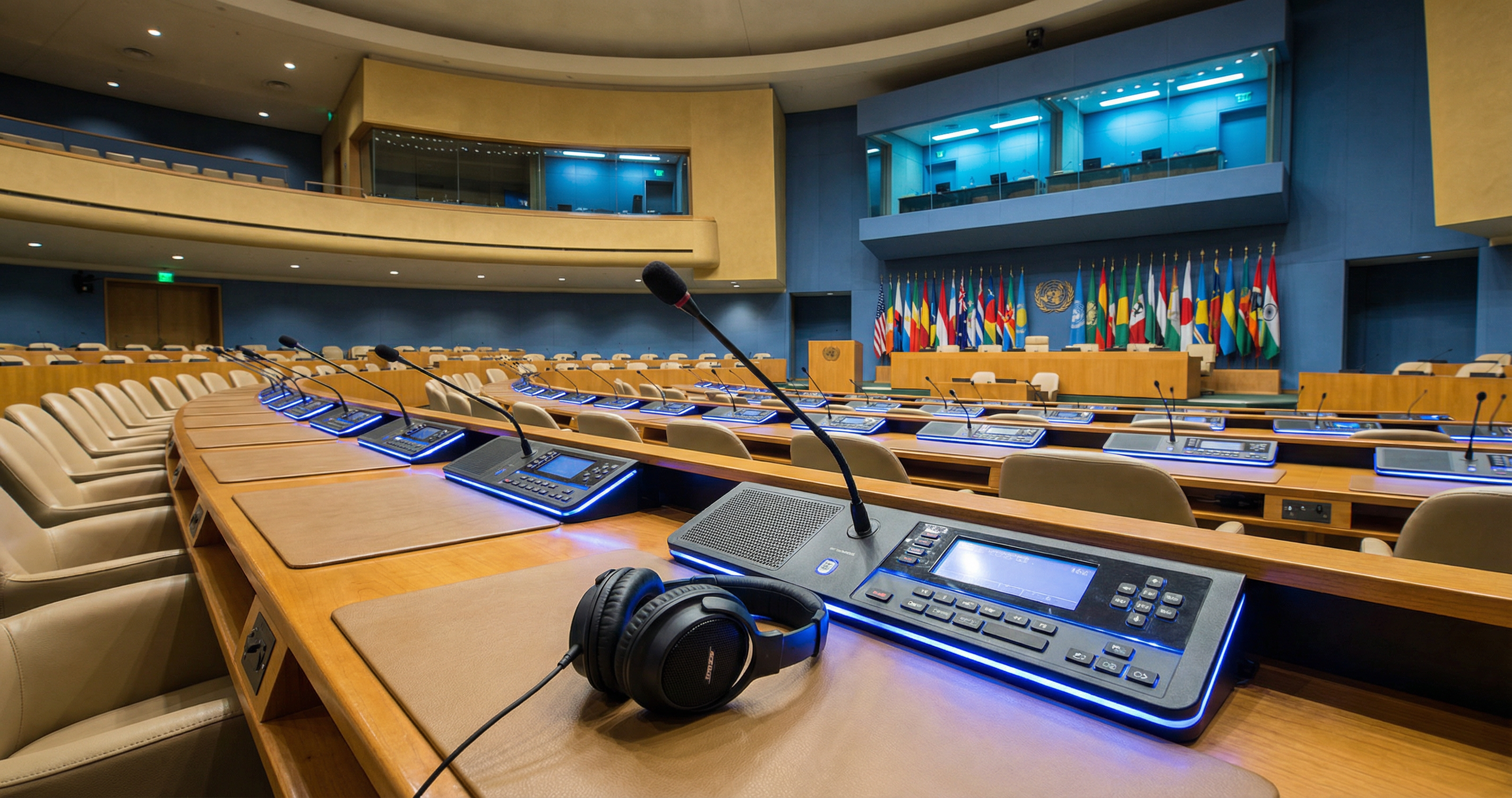
United Nations conference interpreters represent the pinnacle of the interpretation profession—a career that combines extraordinary linguistic mastery, intellectual rigor, and the opportunity to facilitate diplomacy among the world's nations. This comprehensive guide examines the complete pathway to becoming a UN certified conference interpreter, from educational foundations through retirement, offering aspiring professionals a detailed roadmap to one of the most prestigious and demanding careers in the language services industry.
Executive Summary: The UN Interpreter Profession
UN conference interpreters serve as the linguistic backbone of the world's premier international organization, enabling communication across six official languages among delegates from 193 member states. This profession represents the highest echelon of interpretation excellence, requiring not merely bilingual proficiency but complete mastery of multiple languages at a near-native or native level, combined with deep knowledge of international affairs, economics, law, and diplomacy.
The career offers exceptional rewards: competitive tax-free salaries, comprehensive benefits including education grants for children and generous home leave, diplomatic status, the intellectual stimulation of working on the world's most pressing issues, and the prestige of contributing directly to international peace and security. Interpreters witness history as it unfolds, from Security Council deliberations on conflicts to General Assembly debates on climate change, human rights, and global development.
However, the pathway to this career is extraordinarily demanding. The selection process through the Language Competitive Examination (LCE) sees pass rates of only 5-15%, with many candidates requiring multiple attempts over several years. The educational foundation requires a master's degree from one of a handful of internationally recognized interpretation schools—institutions like the University of Geneva (FTI), Paris ESIT, or Monterey Institute—that themselves have highly competitive admissions processes.
Success requires a unique combination of cognitive abilities: exceptional working memory, the capacity for split-second decision-making under pressure, simultaneous listening and speaking capabilities, and the intellectual flexibility to navigate complex subject matter ranging from nuclear non-proliferation to sustainable development goals. Beyond these technical skills, UN interpreters must embody diplomatic discretion, political neutrality, and cultural sensitivity while working in high-stakes environments where their words can influence international relations.
This guide provides a comprehensive examination of every aspect of this career path: the UN language regime and interpretation types, educational requirements, language proficiency standards, the competitive examination process, career progression, professional development, working conditions, ethical standards, and the substantial rewards and challenges that define this extraordinary profession.
Understanding UN Interpretation
The UN Language Regime
The United Nations operates with six official languages: Arabic, Chinese, English, French, Russian, and Spanish. These languages have equal status, and all official UN documents, debates, and proceedings are conducted in these languages with full interpretation provided. This language regime reflects both historical considerations—the major powers at the UN's founding—and the organization's commitment to multilingualism as a fundamental principle of inclusive international cooperation.
For interpreters, this regime creates a complex matrix of language combinations and interpretation directions. Unlike many interpretation settings where bidirectional work between two languages is sufficient, UN interpretation often involves relay interpretation: when a delegate speaks in a language not known by all interpreters in a given booth, their speech is first interpreted into a "pivot" language (typically English or French), and then other interpreters render it from that pivot into their target languages. This creates a fascinating linguistic ecosystem where interpreters must be acutely aware of not just their direct language pairs but the broader interpretation matrix in play.
The mother tongue principle is fundamental to UN interpretation quality. Interpreters work primarily into their mother tongue (retour interpretation into a non-mother tongue is rare and subject to strict limitations). This means an interpreter with English as their A language (mother tongue) would typically interpret from French, Spanish, Russian, Arabic, and/or Chinese into English. The concept of "passive" versus "active" languages is crucial: passive languages (also called B or C languages) are those the interpreter understands completely but does not work into; active languages are the mother tongue and any retour languages.
Types of UN Interpretation
Simultaneous interpretation constitutes the vast majority of UN interpretation work. In soundproof booths overlooking the meeting room, interpreters listen through headphones to the floor language and speak simultaneously into microphones, with delegates listening through earpieces to their selected language channel. This requires extraordinary cognitive processing: the interpreter hears the source language while producing the target language, managing a lag of approximately 2-4 seconds between hearing and speaking. The UN's simultaneous interpretation system, developed during the Nuremberg Trials and refined over decades, remains the gold standard for multilingual conference interpretation.
Consecutive interpretation, where the interpreter waits for the speaker to pause before delivering the interpretation, is rare at the UN for formal meetings but occasionally used for bilateral discussions, press conferences, or working groups where the technical infrastructure for simultaneous interpretation is unavailable. UN interpreters are trained in consecutive techniques but rarely practice them in the formal meeting rooms of the General Assembly or Security Council.
Whispered interpretation (chuchotage) involves the interpreter whispering simultaneously to a small group of delegates without technical equipment. While not standard for UN proceedings, it may be used in informal consultations or corridor discussions among diplomats.
Relay interpretation is a crucial technique in the multilingual UN environment. When a delegate speaks Arabic and the Spanish interpreter does not have Arabic in their combination, the Arabic interpreter renders the speech into English (or French), and the Spanish interpreter then interprets from that relay. While this introduces an additional processing step, skilled interpreters manage relay with minimal latency and maximum accuracy. The UN's language services carefully plan relay chains to ensure complete coverage of all six languages.
UN Bodies Requiring Interpretation
The General Assembly, the UN's principal deliberative body where all 193 member states have equal representation, represents the most visible interpretation setting. During the annual General Debate in September, interpreters handle dozens of head-of-state speeches covering the full spectrum of international issues. The sheer volume, diversity of accents, and range of topics—from domestic political controversies to existential threats like climate change—make this the most demanding interpretation environment in the world.
The Security Council carries particular weight. Here, interpreters facilitate discussions that directly impact international peace and security, from authorizing peacekeeping missions to imposing sanctions. The stakes are highest, the language most carefully calibrated, and the pressure greatest. Security Council interpreters must navigate highly sensitive diplomatic terrain, understanding not just the words but the nuanced positions of permanent and rotating members. The formal and informal consultations of the Security Council demand the highest levels of professional discretion.
The Economic and Social Council (ECOSOC) and its subsidiary bodies, the Human Rights Council, the specialized agencies, and the numerous treaty bodies and working groups create year-round demand for interpretation services. Geneva hosts the largest concentration of UN interpretation outside New York, with the UN Office at Geneva (UNOG) serving as a major hub for humanitarian, human rights, and disarmament discussions. The Vienna International Centre and the UN Office at Nairobi also maintain significant interpretation services.
The Role of a UN Interpreter
UN interpreters function as far more than linguistic converters. They are cultural mediators who bridge not just language barriers but conceptual and contextual differences between diplomatic traditions. When a Russian delegate employs a classic Soviet-era diplomatic formulation or an Arab representative uses elaborate rhetorical structures rooted in classical Arabic traditions, the interpreter must convey not just the words but the diplomatic intent, the cultural nuance, and the political significance embedded in the communication.
Diplomatic sensitivity is paramount. Interpreters must remain scrupulously neutral while conveying positions they may personally find objectionable. They must handle emotionally charged debates—on war crimes, human rights violations, or territorial disputes—without allowing their own reactions to color their interpretation. The interpreter's voice must remain steady, professional, and neutral even when the content is disturbing or highly controversial.
The ethical dimensions of the role are extensive. Confidentiality is absolute: interpreters witness sensitive negotiations, informal consultations, and strategic discussions that never become public. They must maintain this confidentiality even after retirement. Accuracy is non-negotiable: a misinterpreted statement could cause diplomatic incidents, misrepresent a country's position, or derail delicate negotiations. The burden of this responsibility shapes every aspect of a UN interpreter's professional life.
Educational Pathway
Undergraduate Foundation
The pathway to UN interpretation typically begins with a strong undergraduate education that develops both linguistic proficiency and substantive knowledge of international affairs. While there is no single required undergraduate major, certain fields provide particularly strong foundations: International Relations, Political Science, Economics, Law, Area Studies (particularly for Arabic, Chinese, or Russian), and Language and Linguistics.
Language proficiency requirements at the undergraduate stage are rigorous. By the time they apply to interpretation programs, successful candidates typically possess near-native command of their target languages. This often requires extended periods of immersion study: a year abroad in a French-speaking country for those pursuing French, intensive Arabic programs in the Middle East, or Chinese language study at institutions in China. Many successful UN interpreters spent significant portions of their undergraduate years living in countries where their working languages are spoken, developing not just linguistic fluency but deep cultural understanding.
International relations background proves particularly valuable for UN interpretation. Understanding the UN system, international law, diplomatic protocol, and the historical contexts of current international issues enables interpreters to anticipate content, understand references, and navigate the complex subject matter they encounter daily. Economics coursework prepares interpreters for the extensive development and financial discussions at the UN, while legal studies provide essential foundations for understanding human rights instruments, international treaties, and Security Council resolutions.
Master's Programs in Conference Interpretation
The gold standard for UN interpretation training is the Master of Arts in Conference Interpretation from the University of Geneva's Faculty of Translation and Interpreting (FTI, formerly ETI). This two-year program offers comprehensive training in simultaneous and consecutive interpretation, with particular strengths in the UN's six official languages. Located in the heart of international Geneva, the FTI provides unparalleled access to practicing UN interpreters, regular practice in simulated UN settings, and strong connections to the UNOG interpretation service. The program's proximity to the Palais des Nations means students regularly observe working interpreters and develop professional networks.
Paris ESIT (École Supérieure d'Interprètes et de Traducteurs), part of Université Paris Cité, is another prestigious program with a long history of training UN interpreters. ESIT's rigorous selection process, comprehensive curriculum, and location in a major diplomatic hub make it highly respected. The program emphasizes consecutive interpretation in the first year before progressing to simultaneous, and maintains strong relationships with international organizations throughout Paris.
Monterey Institute of International Studies (MIIS) at Middlebury College offers the premier conference interpretation program in the United States. The MA in Conference Interpretation provides excellent training across multiple language combinations, with particular strength in English-Spanish and English-Chinese. MIIS benefits from its location in the diplomatically significant Monterey area and maintains connections with UN missions in New York. The program emphasizes technology in interpretation and prepares students for both UN and private market work.
Other recognized programs include: Université libre de Bruxelles (ULB/ISTI) in Brussels, strategically located near EU institutions but with UN connections; University of Westminster in London, offering strong programs in European languages; Beijing Foreign Studies University (BFSU) for Chinese A interpreters; and several other EU and North American programs that meet AIIC (International Association of Conference Interpreters) training standards.
Program Admission Requirements
Admission to top interpretation programs is highly competitive, with acceptance rates often below 20%. The entrance examination typically includes: rigorous language proficiency testing (often including tests from source language into mother tongue and vice versa); a consecutive interpretation test to assess aptitude; general knowledge questions on international affairs, economics, and politics; and a personal interview evaluating motivation, communication skills, and professional demeanor.
Language proficiency tests assess not just fluency but register flexibility—the ability to work with formal diplomatic language, technical terminology, and various regional accents and speaking styles. Candidates must demonstrate that they can understand speakers from different countries speaking the same language with varying accents and idiosyncrasies. The entrance exam often includes surprise elements: unexpected topics, rapid-fire delivery, or deliberately difficult passages to test grace under pressure.
The competitive selection serves an important purpose: interpretation training is resource-intensive, and programs must identify candidates with genuine aptitude. Not all multilingual individuals can become interpreters; the cognitive demands require specific abilities that testing helps identify. Many successful UN interpreters failed entrance exams on their first attempts, returning after additional language study and preparation.
Curriculum Components
Master's programs in conference interpretation combine intensive practical training with substantial knowledge-building. The core curriculum emphasizes simultaneous technique: students begin with controlled exercises—slow, clear speeches on familiar topics—progressing gradually to faster delivery, technical content, and multiple source languages. The technique involves learning to listen and speak simultaneously while maintaining lag, managing terminology, and preserving accuracy. Students typically log hundreds of hours of booth practice during their programs.
Consecutive interpretation training, while less emphasized for UN work, remains important for developing memory techniques, note-taking systems, and the ability to analyze discourse structure. Students learn to listen for meaning rather than words, to identify logical relationships between ideas, and to reconstruct speeches coherently rather than translating sequentially.
Sight translation—rendering written text orally into another language in real-time—is another essential skill. UN interpreters frequently encounter written statements read aloud by delegates, and must be able to sight translate resolutions, amendments, and other documents. Programs dedicate significant time to this skill, which bridges translation and interpretation competencies.
Knowledge components cover international relations theory, UN system structures, economics and development studies, international law and human rights, and specialized terminology across these fields. Programs often include courses on public speaking, voice training, stress management, and professional ethics. Many programs incorporate mock UN sessions, where students interpret simulated Security Council meetings or General Assembly debates in realistic conditions.
Language Requirements and Proficiency
UN Language Proficiency Standards
The United Nations maintains exacting language standards for interpretation. "Near-native command" is the baseline requirement, meaning interpreters must function at a level indistinguishable from educated native speakers in professional contexts. This encompasses not just vocabulary and grammar but register flexibility, idiomatic mastery, and the ability to handle the full range of discourse from highly formal diplomatic language to colloquial expressions that may emerge in informal consultations.
Active versus passive language levels reflect different requirements. For passive languages (those interpreted from), complete comprehension is essential: interpreters must understand every nuance, cultural reference, and rhetorical device, regardless of accent, speed, or complexity. For active languages (those interpreted into), the standard is even higher: production must be flawless, natural, and appropriate to the diplomatic context. A single awkward phrasing or grammatical error could undermine the credibility of the interpretation.
Testing and assessment for UN accreditation involves multiple layers. Educational programs provide initial certification of language competence. The UN's own competitive examination then tests language skills under professional conditions. After recruitment, interpreters undergo regular quality assessments and peer feedback processes. The bar for maintaining active language status requires ongoing professional development and regular exposure to the languages in professional and cultural contexts.
Ideal Language Combinations
The most in-demand language combination features English A (mother tongue) with French and/or Spanish B (active second languages) plus additional passive languages. This combination serves the vast majority of UN meetings, given the predominance of English and French as working languages and the growing importance of Spanish as the number of Latin American Spanish-speaking member states increases.
Arabic A interpreters—those with Arabic as their mother tongue—face exceptional demand and short supply. The complexity of Arabic, with its many dialects, classical foundations, and the specific demands of UN Arabic (which incorporates elements of Modern Standard Arabic while accommodating diverse national speaking styles), creates a significant bottleneck. Arabic A interpreters with English and French in their combinations are among the most sought-after professionals in UN interpretation services.
Chinese A interpreters have seen demand increase substantially as China's role in the UN expands. The Chinese interpretation booth at major UN meetings handles not just Chinese delegate interventions but interpretation for the growing number of Chinese-speaking participants in UN activities. The written nature of Chinese, the gap between spoken Mandarin and written characters, and the specific terminology of UN Chinese make this a highly specialized field.
Russian A interpreters remain essential despite the reduction in Russian-speaking member states, given Russia's permanent membership in the Security Council and the continued importance of Russian in disarmament and security contexts. The revival of Cold War tensions and ongoing Russia-related Security Council activity has maintained steady demand.
Building Your Language Skills
Developing the language proficiency required for UN interpretation demands sustained, intensive effort over many years. Immersion strategies are essential: extended periods living in countries where target languages are spoken, professional work in those languages, and continuous exposure to media, literature, and cultural production. Many successful interpreters maintain residences in multiple countries, creating ongoing immersion opportunities throughout their careers.
Country-specific training addresses the particular challenges of UN interpretation. For French, this means exposure not just to metropolitan French but to African French, Canadian French, and various international diplomatic French registers. For English, interpreters must navigate British, American, Indian, African, and Caribbean English varieties, each with distinct accents, idioms, and rhetorical patterns. Spanish requires familiarity with Castilian, Mexican, various South American dialects, and Caribbean Spanish.
Maintaining proficiency is an ongoing challenge. Languages evolve, new terminology emerges (particularly in technical fields like climate science, cybersecurity, or international finance), and unused languages atrophy. UN interpreters must dedicate substantial time to maintaining their language portfolios: reading extensively, watching media, engaging in conversation, and staying current with linguistic developments across all their working languages.
Expanding language repertoire during one's career is possible but demanding. Adding a new passive language requires significant study and practice, followed by rigorous testing to demonstrate competence. Some interpreters expand their combinations strategically to increase their value and flexibility. This expansion typically happens early in careers, before the demands of full-time UN interpretation limit study time.
The UN Competitive Examination
Exam Structure
The Language Competitive Examination (LCE) serves as the gateway to UN interpretation careers. This rigorous multi-day examination assesses whether candidates meet the professional standards required for UN work. The written examination serves as an elimination round, testing general knowledge of international affairs, UN system knowledge, and language proficiency through translation exercises and comprehension questions. Candidates who fail the written exam do not proceed to interpretation testing.
The simultaneous interpretation test forms the core of the examination. Candidates interpret several speeches of increasing difficulty across their language combinations. Examiners—senior UN interpreters and language service chiefs—assess accuracy, completeness, delivery quality, terminology management, and stress management. The test includes diverse content: political statements, economic analyses, legal texts, and technical discussions. Speed, accent difficulty, and rhetorical complexity increase throughout the examination.
Consecutive interpretation may be tested depending on the language combination and specific requirements. Sight translation tests assess the ability to render written documents orally with accuracy and appropriate delivery. Some examinations include specialized tests for particular skills: whispered interpretation, relay interpretation techniques, or performance under specific technical constraints.
Preparation Strategies
Successful LCE preparation typically spans years, not months. Study materials and resources include: UN document repositories (UN Digital Library, Official Document System), UN webcasts providing authentic meeting recordings, UN terminology databases (UNTERM), previous examination reports when available, and extensive practice materials from interpretation schools. Candidates often form study groups with peers preparing for the same examination, creating practice opportunities and mutual support.
Practice techniques emphasize simulation of examination conditions. Candidates use UN webcasts to interpret authentic speeches, record their performance, and critically analyze their output. They practice with speeches delivered at challenging speeds, with difficult accents, and on unfamiliar technical topics. Building stamina is crucial: the examination requires sustained high-level performance over multiple days.
Mock examination participation provides invaluable experience. Some interpretation schools offer formal mock UN exams; professional associations organize practice examinations; and informal networks of candidates create examination simulations. Professional coaching from practicing UN interpreters—sometimes available through professional associations or private arrangements—offers expert feedback on performance and specific improvement strategies.
Success Rates and Competition
The LCE maintains low pass rates by design: typically 5-15% depending on the language combination and the specific needs of the UN at the time of examination. The UN only recruits when vacancies exist, so examination frequency and pass rates fluctuate based on retirement patterns and service expansion or contraction. Some language combinations see examinations only once every several years, creating intense competition when opportunities arise.
Multiple attempts are common and expected. Many successful UN interpreters failed the LCE on their first, second, or even third attempts, using each experience to identify weaknesses and strengthen preparation. The examination provides feedback that helps candidates understand where they fell short. Taking the examination multiple times demonstrates commitment and allows candidates to develop the maturity and stamina that come with repeated high-stakes performance.
Recent examination statistics reflect the UN's evolving language needs. Demand for Arabic and Chinese interpreters has increased, while some European language combinations face more limited recruitment. However, even historically "easier" combinations remain highly competitive due to the exceptional quality of candidates attracted to UN careers. The examination's reputation as one of the most demanding professional tests in the language services industry ensures that only the most qualified candidates succeed.
Application Process
The Young Professionals Programme (YPP) provides an alternative entry path for candidates under 32, including language examination tracks. The YPP examination includes a written general assessment followed by specialized testing for interpretation candidates who pass the initial stage. Successful YPP candidates enter the UN as junior professionals with structured career development programs.
Direct application to the Language Competitive Examination requires meeting specific prerequisites: typically a master's degree from a recognized interpretation program, demonstrated professional experience (sometimes required, sometimes preferred), and citizenship of a UN member state. The UN announces examination opportunities through its careers portal, and candidates must submit detailed applications including educational credentials, language proficiency documentation, and professional references.
Timing and frequency of examinations vary by language combination. The UN publishes examination schedules annually, but these are subject to change based on organizational needs. Some examinations occur annually; others only when sufficient vacancies accumulate. Candidates must monitor UN employment announcements closely and be prepared to apply quickly when their language combination opens. Documentation requirements are extensive, and incomplete applications result in disqualification.
Career Progression at the UN
Staff Categories
UN interpreters follow the Professional (P) category career track. Entry typically occurs at the P-2 level (Associate Interpreter), though some candidates with exceptional qualifications may enter at P-3 (Interpreter). The P-2 level involves supervised work, structured professional development, and progressive assumption of responsibility. New hires typically spend their first years in supportive roles, building experience across different meeting types and developing their skills under the guidance of senior colleagues.
P-3 represents the fully qualified professional level, where interpreters handle the full range of UN meetings independently. At this level, interpreters work across all bodies, from routine committee sessions to high-stakes Security Council meetings. P-3 interpreters may take on specialized assignments, develop expertise in particular subject areas, and begin mentoring more junior colleagues. This level typically spans the core professional years of an interpreter's career.
P-4 and P-5 levels (Senior Interpreter and Chief Interpreter or equivalent) recognize extensive experience and additional responsibilities. Senior interpreters handle the most challenging assignments, serve as quality leaders, and may supervise teams. P-5 positions involve managerial responsibilities: overseeing interpretation services for major conferences, coordinating teams of interpreters, and contributing to language service management. These levels require not just interpretation excellence but leadership, judgment, and organizational skills.
D-1 and D-2 levels represent senior leadership: Chiefs of Interpretation Services for major duty stations or across the UN system. These positions involve strategic management, policy development, resource allocation, and representation of interpretation services at the highest organizational levels. Chiefs of Service balance operational management with advocacy for interpretation services within the UN's bureaucratic structure. Only a small percentage of interpreters reach these senior leadership positions.
Salary and Benefits
UN salaries for professional staff are competitive and tax-exempt for non-US citizens (US citizens must pay taxes on UN income). Base salaries follow established scales based on grade level. As of recent scales, entry-level P-2 interpreters might expect base salaries in the range of $60,000-75,000 annually, progressing to $100,000+ at P-4 level and significantly higher at D-level positions. These figures are approximate and subject to regular adjustment by the UN General Assembly.
Post adjustment represents a significant component of UN compensation. Because UN duty stations have vastly different costs of living, the organization applies post adjustment multipliers to base salaries. Working in Geneva or New York, with high living costs, generates substantially higher post adjustments than positions in Nairobi or other lower-cost locations. This system ensures that UN staff maintain consistent purchasing power regardless of assignment location.
Education grants for children constitute a major benefit, particularly for international staff whose children may not speak the local language of their duty station. The UN provides substantial annual grants toward international school tuition, making this career path particularly attractive for parents. Healthcare coverage is comprehensive, including international medical evacuation if necessary. Pension benefits through the UN Joint Staff Pension Fund provide retirement security after minimum years of service.
Home leave provisions allow internationally recruited staff to return to their home countries periodically at UN expense, maintaining family connections and preventing the isolation that can accompany long-term expatriate life. Travel benefits extend to official travel for conferences and training. The cumulative benefits package makes UN interpretation careers financially attractive despite the demanding entry requirements.
Duty Stations
New York serves as the UN Headquarters and hosts the largest concentration of interpretation staff. The General Assembly, Security Council, and Economic and Social Council all meet primarily in New York, creating year-round demand. The New York duty station offers the most diverse meeting exposure but also the highest cost of living and competitive housing market. Many UN interpreters consider New York the pinnacle assignment given its centrality to UN activities.
Geneva (UNOG) represents the second major interpretation hub. The UN Office at Geneva hosts extensive human rights, humanitarian, and disarmament activities, with interpretation services supporting year-round meetings. Geneva offers an exceptional quality of life, international atmosphere, and proximity to other international organizations. Many interpreters consider Geneva the most attractive duty station for work-life balance and professional environment.
Vienna (UNOV) and Nairobi (UNON) maintain smaller but significant interpretation services. Vienna hosts drug control, crime prevention, and nuclear energy activities. Nairobi serves as the UN's African headquarters with growing meeting volumes. These duty stations offer different lifestyle profiles and career opportunities. Staff may rotate between duty stations during their careers, gaining diverse experiences.
Rotation policies vary by contract type and organizational needs. Staff members may request transfers between duty stations, subject to vacancy availability and organizational requirements. Some interpreters spend their entire careers at one duty station; others rotate to gain diverse experience. The UN's mobility requirements for certain career advancement paths may encourage or require duty station changes.
Freelance vs Staff Positions
The LCE roster provides an alternative to permanent staff appointment. Successful LCE candidates may be placed on freelance rosters, available for short-term contracts when the UN requires additional interpretation capacity. Freelance interpreters work on a contract basis for specific conferences or periods, without the benefits and job security of staff positions but with greater flexibility and the potential to combine UN work with private market interpretation.
Staff appointments offer comprehensive benefits, job security, and career progression within the UN system. Fixed-term appointments provide employment for specified periods (typically one to two years, renewable), while continuing appointments offer permanent status after a probationary period. Staff interpreters are fully integrated into the UN system, participating in professional development, staff associations, and organizational life.
Contract types vary based on funding availability and organizational needs. Some interpretation services rely heavily on freelancers to manage fluctuating meeting volumes; others maintain larger permanent staffs. Career paths can move between categories: freelancers may eventually obtain staff positions; staff members sometimes transition to freelance status for lifestyle reasons while maintaining UN accreditation.
Professional Skills Development
Core Competencies
Simultaneous technique mastery requires ongoing refinement throughout an interpreter's career. Even after formal training, professional interpreters continuously work on specific technical elements: lag management (the delay between hearing and speaking), voice quality and projection, breathing techniques for sustained speaking, and coordination with booth partners. Senior interpreters often report that their technique continued developing for a decade or more after entering the profession.
Anticipation and prediction abilities separate adequate interpreters from exceptional ones. Experienced UN interpreters learn to anticipate diplomatic formulations, standard treaty language, and common rhetorical structures. They recognize when a delegate is reading from a prepared text versus speaking extemporaneously, adjusting their approach accordingly. This predictive capacity allows interpreters to manage difficult passages more smoothly and maintain output quality during challenging speeches.
Number and name handling represents a particular challenge requiring specific techniques. Delegates rattle off statistics, financial figures, dates, and proper names at speeds that challenge memory and processing. Interpreters develop systems for capturing this information: noting numbers immediately, breaking complex figures into manageable units, and using their booth partner for verification. The consequences of errors in this domain—misstating a financial commitment or misidentifying a country—can be serious.
Accent adaptation is a constant requirement. UN delegates represent 193 countries, and English, French, Spanish, and Arabic are spoken with countless regional accents and varying proficiency levels. Interpreters must quickly attune their ears to unfamiliar accents, understanding heavily accented speech that might challenge native speakers. This requires not just linguistic flexibility but cultural exposure and experience with the full diversity of global language use.
Specialization Areas
Legal interpretation encompasses Security Council proceedings, treaty negotiations, International Court of Justice activities, and the work of legal committees. This specialization requires deep familiarity with international law, UN Charter provisions, treaty terminology, and the specific formulations of diplomatic language. Legal interpretation demands exceptional precision: ambiguous wording in legal contexts can have significant consequences.
Economic and financial interpretation covers the Bretton Woods institutions' relationships with the UN, ECOSOC discussions, development financing, trade negotiations, and the Sustainable Development Goals implementation. Specialized knowledge of macroeconomics, development theory, international financial institutions, and statistical terminology supports this work. The technical density of economic discourse—packed with acronyms, specialized metrics, and policy references—requires sustained study.
Human rights interpretation involves the Human Rights Council, treaty bodies, commissions of inquiry, and special procedures. This work requires familiarity with international human rights law, humanitarian law, specific country situations, and the sensitive dynamics of rights discourse. Human rights interpretation often involves traumatic content: war crimes testimony, descriptions of torture, or accounts of atrocities. Interpreters in this domain develop particular resilience and professional distance techniques.
Scientific and technical interpretation covers environmental negotiations, climate change conferences, disarmament technical discussions, health policy debates, and specialized agency work. The terminology density in these areas is extreme: climate interpreters must command the vocabulary of atmospheric science, carbon accounting, and renewable energy technology; disarmament interpreters handle nuclear physics terminology, weapons systems nomenclature, and verification protocols. Continuous study of evolving technical fields is essential.
General political interpretation remains the bread-and-butter of UN work: General Assembly debates, committee discussions, and political consultations. While perhaps less technically dense than specialized domains, political interpretation requires comprehensive knowledge of international relations, current events, and the positions and concerns of member states. The breadth of knowledge required makes this challenging in its own way.
Continuing Education
In-house training programs provide structured professional development opportunities. The UN's interpretation services organize workshops, seminars, and training sessions on specific skills, new subject areas, and professional issues. New technologies, changing meeting formats, and evolving subject matter all generate training needs. Senior interpreters often lead these sessions, sharing expertise with colleagues.
Professional development extends beyond technical skills. Leadership training prepares interpreters for managerial roles. Language maintenance courses help interpreters expand or refresh their language combinations. Stress management, professional ethics, and career planning workshops address the broader dimensions of professional life. The UN invests substantially in interpreter development, recognizing that maintaining excellence requires continuous learning.
Retraining opportunities allow interpreters to add new specializations or refresh existing skills. Sabbatical arrangements may support intensive language study or subject-matter deep dives. Some interpreters pursue advanced degrees in international relations, law, or economics while continuing their careers. The UN's educational benefits support these professional development activities.
New language acquisition during one's career is challenging but possible. Some interpreters strategically add languages to increase their value and flexibility. This typically requires extended study, immersion experiences, and rigorous testing before the new language can be deployed professionally. The investment is substantial, but the career benefits can be significant, particularly for languages in short supply.
Day-in-the-Life and Working Conditions
Typical Work Day
A typical day for a UN interpreter begins with preparation. Before each meeting, interpreters review agendas, study background documents, research terminology, and familiarize themselves with the specific issues under discussion. This preparation time—often several hours per day—is essential for quality interpretation but invisible to meeting participants. For major conferences, preparation may extend over weeks, involving extensive document review and terminology building.
Booth assignments follow careful scheduling protocols. Interpreters typically work in teams of two or three per booth, rotating every 20-30 minutes to maintain quality. The demanding cognitive load of simultaneous interpretation requires these regular breaks; research has demonstrated significant quality degradation beyond 30-40 minutes of continuous interpretation. Scheduling ensures that interpreters with appropriate language combinations cover all required meetings.
Meeting schedules vary enormously. Normal sessions run 3-4 hours with breaks, but intense negotiations may extend much longer. During the General Assembly's high-level week or major conference finales, interpreters may work extended hours under considerable pressure. The annual calendar includes intense periods (September General Debate, year-end budget negotiations) and lighter periods when fewer bodies are in session.
Break rotations during meetings allow recovery. When not actively interpreting, booth partners monitor the meeting, assist with terminology and numbers, and prepare to take over. The booth becomes a small team environment where colleagues support each other through difficult passages. The relationship between booth partners is professionally intimate—they hear each other's voices continuously, provide real-time assistance, and share the pressures of demanding assignments.
Physical and Mental Demands
Concentration requirements are extreme. Simultaneous interpretation demands sustained focused attention while performing multiple cognitive tasks: listening in one language, analyzing content, finding equivalents, speaking in another language, and monitoring one's own output for quality. This multi-tasking under time pressure creates significant mental load. Interpreters describe the experience as intensely focused mental exercise—comparable to playing simultaneous chess while solving puzzles.
Stress management is essential professional competence. UN meetings can be extraordinarily stressful: high-stakes negotiations, heated exchanges between member states, technical failures, or simply the volume and density of content. Interpreters develop personal strategies for managing this stress: breathing techniques, mental preparation rituals, physical exercise routines, and psychological distance techniques. Professional associations and the UN provide resources for stress management and mental health support.
Booth ergonomics affect long-term health. Interpreters spend thousands of hours annually in soundproof booths, wearing headsets, maintaining speaking postures, and working under artificial lighting. The UN has invested in ergonomic booth design, quality equipment, and proper ventilation. Interpreters must also attend to their vocal health: hydration, vocal warm-ups, and techniques for maintaining voice quality during long sessions.
Hearing protection is a long-term concern. Despite quality equipment, years of headphone use at volume levels sufficient to hear speakers clearly creates risk. Interpreters monitor their hearing health and use optimal equipment settings. The profession has raised awareness about occupational hearing risks, and modern UN interpretation systems incorporate features to minimize exposure while maintaining clarity.
Team Dynamics
Booth partner collaboration defines the immediate working environment. Partners develop默契—unspoken coordination around handovers, assistance with difficult passages, and mutual support. Experienced partners anticipate each other's needs: passing notes with terminology, flagging important developments, or simply providing encouraging presence during stressful moments. The quality of booth partnership significantly affects job satisfaction and interpretation quality.
Handover protocols ensure seamless transitions. When one interpreter finishes their rotation and hands over to their partner, the transition must be invisible to listeners. This requires coordination around the specific moment of handover, careful briefing on current discussion context, and smooth assumption of the microphone. Poor handovers disrupt delegate attention; excellent handovers maintain flow.
The broader interpretation service creates a supportive professional community. Colleagues share terminology resources, discuss challenging assignments, and provide peer feedback. The collective expertise of an interpretation service represents an invaluable resource—interpreters consult colleagues on technical questions, unfamiliar accents, or subject matter expertise. This collegiality helps manage the isolation that can come from working in soundproof booths.
Meeting Preparation
Document review consumes significant preparation time. Interpreters examine draft resolutions, agenda items, background papers, and previous meeting records. For recurring agenda items, they maintain terminology files and subject-matter resources. For new topics, they may need to conduct substantial background reading to understand technical issues. The UN's document distribution systems make materials available in advance, and preparation time is built into professional schedules.
Terminology research addresses the specific language of each meeting. UN documents have their own terminology conventions, and specialized topics bring their own vocabulary. Interpreters consult UNTERM (the UN terminology database), previous documents on similar topics, and subject- matter resources. They build personal glossaries and share terminology with colleagues. For major conferences, terminology coordination across language services ensures consistency.
Country knowledge updates help interpreters understand delegate positions. Knowing a country's history with a particular issue, their standard diplomatic formulations, and their current political context helps interpreters anticipate content and navigate references. For ongoing negotiations, understanding the bloc positions and alliance structures informs interpretation. Interpreters follow international news and maintain awareness of geopolitical developments.
Ethics and Professional Standards
AIIC Code of Ethics
The International Association of Conference Interpreters (AIIC) maintains the profession's ethical framework. While not all UN interpreters are AIIC members, the association's Code of Professional Ethics shapes industry standards. Confidentiality stands as the paramount obligation: interpreters must never disclose information obtained in the course of their work. This includes not just the content of interpretation but the fact that particular meetings occurred, the positions taken by delegates, and any non-public information encountered.
Neutrality requires interpreters to convey messages faithfully regardless of their personal views. An interpreter may find a delegate's position objectionable, but must interpret it with the same professionalism as positions they support. This extends to body language, tone, and emphasis: the interpretation should not signal the interpreter's views through subtle cues. Maintaining this neutrality during politically charged debates requires genuine professional discipline.
Professional conduct encompasses punctuality, preparation, appropriate dress, respectful interaction with colleagues and clients, and commitment to quality. AIIC standards address working conditions, fair remuneration, and professional solidarity. Collegiality—the obligation to support fellow interpreters and maintain professional community—counters the isolation of booth work and ensures collective standards.
UN Specific Ethics
Diplomatic sensitivity goes beyond standard professional ethics. UN interpreters must understand the implications of their work for international relations. A misinterpretation could cause offense, misstate a country's position, or undermine delicate negotiations. Interpreters must be aware of the political context surrounding their words and ensure their interpretation supports rather than impedes diplomatic processes. This requires not just linguistic but political awareness.
Non-disclosure requirements are particularly stringent at the UN. Interpreters witness informal consultations, corridor conversations, and strategic discussions that never become public. The obligation to maintain confidentiality extends indefinitely—retired interpreters must still protect information learned during their service. The UN's status as an international organization with special privileges and immunities creates additional confidentiality obligations.
Conflict of interest must be carefully managed. Interpreters cannot work for private clients whose interests might conflict with their UN role, nor can they accept gifts or favors from member states. Political activity may be restricted to preserve perceived neutrality. Even after leaving UN service, former interpreters must be careful about exploiting insider knowledge or relationships acquired during their careers.
Political neutrality requires careful attention to personal activities and associations. While UN staff have personal political views, they must not allow these to affect their professional work or create perceptions of bias. Public political activity may be restricted. Social media requires particular care—interpreters must not post content that could undermine their professional neutrality or the UN's reputation.
Professional Liability
Error consequences can be significant. A serious misinterpretation could mislead delegates about a country's position, alter the meaning of a negotiated text, or create diplomatic incidents. While the UN system has mechanisms for correcting interpretation errors when identified, the potential impact creates substantial professional pressure. Interpreters must balance speed and accuracy, knowing that both matter but that serious errors have greater consequences than minor delays.
Quality standards are maintained through multiple mechanisms: self- monitoring during interpretation, peer feedback, quality assessment programs, and professional development. Interpreters are expected to recognize their own errors and limitations, seeking assistance when necessary. The professional culture emphasizes continuous improvement rather than blame—errors are treated as learning opportunities within a framework of accountability.
Continuous improvement is both an individual obligation and a collective professional value. Interpreters should analyze their performance, seek feedback, address weaknesses, and refine their skills throughout their careers. Professional associations and the UN support this through peer review processes, training opportunities, and quality assurance mechanisms. The commitment to excellence sustains the profession's standards and reputation.
Challenges and Rewards
Professional Challenges
The high-stress environment of UN interpretation affects virtually every aspect of professional life. Security Council meetings during active conflicts, budget negotiations with hundreds of millions of dollars at stake, or human rights debates addressing atrocities create psychological pressure. Interpreters must perform flawlessly while conscious that their words matter in concrete ways. This stress accumulates over careers, requiring active management strategies.
Complex subject matter constantly challenges interpreters. One meeting may cover climate science, international finance, humanitarian law, and diplomatic protocol. No interpreter can be an expert in all these domains, yet all require accurate interpretation. The cognitive load of processing unfamiliar technical content in real-time, with no opportunity for research or consultation, represents a fundamental professional challenge. Preparation helps, but the breadth of UN activities ensures constant encounters with new material.
Rapid speech rates test the limits of human cognitive processing. Delegates may speak at 150-180 words per minute or faster, leaving minimal time for analysis and reformulation. Some speakers accelerate when passionate or when time-limited. Interpreters must develop strategies for managing speed: anticipation, strategic compression, and working with booth partners to capture content that exceeds individual processing capacity.
Technical difficulties occasionally disrupt work. Equipment failures, acoustical problems, or software issues can compromise interpretation quality. Interpreters must maintain composure while technical staff address problems, sometimes improvising solutions. The COVID-19 pandemic introduced remote interpretation, with all its technical complexities. While the UN has invested in robust systems, technical challenges remain an occupational reality.
Personal Rewards
Prestige and recognition come with the territory. UN interpreters are recognized within the language services industry as having reached the pinnacle of their profession. The title "UN interpreter" carries weight in professional contexts and opens doors to teaching positions, consultancy opportunities, and leadership roles in professional associations. This professional standing represents a significant non-material reward.
Contributing to world peace and international cooperation provides deep meaning. Interpreters facilitate the dialogue that prevents conflicts, builds consensus on climate action, advances human rights, and coordinates humanitarian responses. While interpreters maintain professional distance, many find profound satisfaction in knowing their work serves these larger purposes. The privilege of witnessing history and enabling diplomacy creates professional fulfillment beyond salary and benefits.
Intellectual stimulation attracts many to this career. No two days are alike; the subject matter constantly evolves with world events. Interpreters must stay informed about international affairs, understand new technical fields, and navigate diverse cultural contexts. This continuous learning keeps the work engaging even after decades of practice. For intellectually curious individuals, the career offers sustained mental challenge.
Global professional networks develop over careers. UN interpreters form connections with colleagues from around the world, with diplomats and international civil servants, and with professionals in related fields. These networks provide career opportunities, intellectual exchange, and personal friendships across borders. The international lifestyle—living abroad, working with global colleagues, traveling for conferences—appeals to those with internationalist orientations.
Job security distinguishes UN interpretation from freelance conference interpretation. While not absolute (organizational changes can affect staffing), staff interpreter positions offer more stability than the unpredictable private market. Benefits like health insurance, pensions, and education grants provide security that supports long-term planning. For those prioritizing stability alongside professional excellence, UN careers offer an attractive combination.
Work-Life Balance
Meeting schedules create intense periods and lighter periods. During September's General Debate or major conference climaxes, interpreters may work long hours with limited breaks. Conversely, holiday periods and between major meetings offer lighter schedules. The cyclical nature of UN work means some months are highly demanding while others allow recovery and personal time. Understanding and planning for these rhythms helps maintain balance.
Travel opportunities extend beyond the duty station. Interpreters may travel to support conferences in other locations, from climate COPs to regional commissions to special sessions. This travel can be exciting and enriching but also disrupts personal routines. Some interpreters embrace the travel opportunities; others prefer the stability of their home duty station. Professional seniority often brings more control over travel assignments.
Time off between sessions allows recovery. The UN system provides generous annual leave, home leave for internationally recruited staff, and holidays. Many interpreters find that the intensity of meeting work is offset by substantial time off. However, preparation requirements mean that "off" time often includes document review and professional development. True disconnection is possible but requires conscious boundaries.
Alternative International Organization Careers
EU Institutions
The European Commission's Directorate-General for Interpretation (SCIC) represents the largest interpretation service after the UN. SCIC interpreters work in Brussels and Luxembourg, supporting EU institutions including the Commission, Council, and Parliament. The EU operates with 24 official languages, creating enormous interpretation demand and diverse career opportunities. EU interpretation careers parallel UN careers in many respects: competitive entry examinations, structured career progression, and excellent benefits.
The European Parliament maintains its own interpretation service with specific demands related to parliamentary procedure and political dynamics. European Court of Justice interpretation involves the highest legal precision, with interpreters supporting landmark EU legal decisions. These EU institutions offer alternatives for those drawn to European integration rather than global multilateralism.
Other International Organizations
NATO maintains interpretation services supporting alliance diplomacy and military cooperation. NATO interpretation operates primarily in English and French, with different security requirements and subject matter (defense, security, collective action). Career paths exist both as staff and as contractors for NATO interpretation services.
The OECD (Organisation for Economic Co-operation and Development)in Paris employs interpreters for its meetings on economic policy, development, and international cooperation. OECD interpretation focuses heavily on economics, with smaller scale than the UN but high technical demands. The organization's prestige and location in Paris make it an attractive alternative.
The World Bank and International Monetary Fund (IMF) in Washington, D.C. employ interpreters for their governance meetings and operational activities. These institutions focus on development finance, macroeconomics, and poverty reduction. Interpretation careers here combine international organization benefits with private sector compensation structures.
The International Criminal Court (ICC) in The Hague and other international tribunals require interpretation services with specific expertise in international criminal law. Court interpretation involves simultaneous and consecutive modes, with particular attention to accuracy given legal consequences. The gravity of ICC subject matter (war crimes, crimes against humanity) creates distinctive professional demands.
The World Trade Organization (WTO) in Geneva employs interpreters for trade negotiations, dispute settlement proceedings, and governance meetings. WTO interpretation involves highly technical trade policy content, legal precision, and the high stakes of international trade disputes. Located in Geneva, WTO careers offer similar lifestyle benefits to UN Geneva.
Comparison with UN
Salary differences vary by organization. The EU often offers higher base salaries than the UN, though the UN's post adjustment system and benefits can equalize total compensation. NATO and OECD positions may offer different compensation structures. Private sector interpretation (freelance or in-house for corporations) can exceed international organization salaries for senior interpreters but lacks benefits and job security.
Work environments differ in scale and scope. The UN offers the broadest range of subject matter and the most global perspective. EU institutions provide deep engagement with European integration. Specialized organizations (OECD, WTO, World Bank) offer focus on specific domains. Some interpreters prefer the UN's diversity; others appreciate the depth possible in specialized settings. Career mobility between these organizations is possible, with UN experience highly valued elsewhere.
Mobility patterns vary. The UN system offers more duty station options globally, while EU institutions are concentrated in Brussels, Luxembourg, and Strasbourg. Some professionals value the opportunity to work in New York, Geneva, Vienna, and Nairobi; others prefer the stability of a single European location. Family considerations, language preferences, and lifestyle priorities influence these choices.
Preparation Resources and Timeline
Five-Year Preparation Plan
Years 1-2 (Undergraduate Foundation): Focus on building language proficiency through intensive study and immersion. Choose a major that develops substantive knowledge (international relations, economics, law, area studies). Study abroad in countries where your target languages are spoken. Begin following UN proceedings and international news to build knowledge foundations. Join interpretation student associations or clubs if available.
Years 3-4 (Master's Program): Gain admission to a recognized interpretation program. Immerse fully in training, logging maximum booth time and practice. Build terminology resources and subject- matter knowledge. Attend professional conferences and AIIC events to network with practicing interpreters. Observe UN interpretation whenever possible. Begin preparing for the LCE even during training, using mock exams and practice materials.
Year 5 (First Exam Attempt and Beyond): Apply for the LCE when your language combination opens. If successful, begin your UN career. If unsuccessful, analyze feedback, strengthen weaknesses, and prepare for the next examination. Continue professional development through private market work if possible. Many successful UN interpreters required multiple attempts; persistence and continuous improvement matter more than initial success.
Study Resources
UN document repositories provide authentic study materials. The UN Digital Library, Official Document System (ODS), and treaty databases contain millions of documents representing the full range of UN activities. Practice interpreting speeches from the General Assembly, Security Council, and other bodies using these authentic materials. Focus on recent documents to build current terminology.
UN webcasts offer invaluable practice material. The UN webcast portal provides live and archived meeting recordings in all official languages. Practice interpreting recorded speeches, then compare your interpretation with the official interpretation (when available) to assess accuracy and style. This authentic practice material cannot be replicated through artificial exercises.
UNTERM, the UN terminology database, provides authoritative terminology across all six official languages. Study UNTERM entries to learn standard diplomatic formulations, technical vocabulary, and proper names. Build personal glossaries based on UNTERM entries and your own research. Terminology consistency is essential for UN interpretation quality.
Professional networks offer peer support and guidance. AIIC (International Association of Conference Interpreters) provides resources, training, and networking for aspiring and practicing interpreters. National interpretation associations offer local support. Social media groups and online forums connect candidates preparing for the LCE, enabling study partnerships and information sharing.
Mentorship and Guidance
Connecting with practicing UN interpreters provides invaluable insight. Interpretation schools often facilitate connections between students and alumni working at the UN. Professional associations like AIIC offer mentorship programs. Reaching out respectfully to practicing interpreters—requesting brief informational interviews rather than demanding ongoing mentorship—can yield career-changing guidance.
Training program alumni networks represent a crucial resource. Graduates of FTI Geneva, ESIT Paris, Monterey, and other programs maintain connections and support newer graduates. These networks provide practical advice on examination preparation, career decisions, and professional development. The shared experience of rigorous training creates lasting professional bonds.
Professional coaching from experienced interpreters can accelerate development. Some senior interpreters offer private coaching for LCE candidates, providing expert feedback on practice examinations and targeted improvement strategies. While coaching involves expense, the investment may significantly improve examination prospects. Group coaching or peer study circles offer more affordable alternatives.
Financial Investment and ROI
Education Costs
Master's program tuition varies significantly by institution and country. European programs (Geneva, ESIT, Brussels) may cost €1,000-15,000 per year depending on national education policies and student status. US programs (Monterey) typically cost $40,000-60,000 for the full program. Living expenses during study add substantial costs, particularly in expensive cities like Geneva, Paris, or Monterey. Total educational investment often ranges from $30,000 to $100,000+.
Undergraduate education costs must also be considered. While not strictly required for UN interpretation (the master's degree matters most), bachelor's degrees from reputable institutions provide necessary foundations. International study experiences, which are highly valuable for language development, add cost but significant professional value. Scholarship opportunities exist at both undergraduate and graduate levels.
Exam Preparation Expenses
LCE preparation involves significant costs beyond formal education. Practice materials, study resources, professional association memberships, and potential coaching all require investment. Travel to examination centers (which may be in different countries) adds costs. Multiple examination attempts multiply these expenses. Candidates should budget for sustained investment in examination preparation.
Time investment represents the largest cost. Years of language study, master's program completion, and examination preparation represent opportunity costs compared to other career paths. The delayed entry into full professional earnings (often age 25-30 or later) affects lifetime earnings calculations. However, the career longevity and earning trajectory of UN interpretation generally justify this investment.
Career Earnings
Starting salaries for entry-level UN interpreters (P-2 level) typically range from $60,000-75,000 annually base, plus post adjustment depending on duty station. This represents strong starting compensation for language professionals, particularly considering tax exemptions for non-US citizens and comprehensive benefits. With career progression to P-4 and beyond, salaries increase substantially, with senior interpreters earning $100,000-150,000+ annually.
Long-term career earnings over 30-40 year careers can reach $3-5 million+ in total compensation, considering salary progression, post adjustments, benefits value, and pension. This compares favorably to private sector freelance interpretation, where earnings may be higher in peak years but unpredictable and without benefits. The stability and benefits of UN careers provide financial security that many freelancers lack.
Private sector comparison reveals trade-offs. Senior freelance interpreters in major markets (New York, Geneva, Brussels) may earn higher hourly rates than UN salaries, potentially exceeding $150,000- 200,000 in good years. However, freelance income is unpredictable, benefits must be self-funded, and career longevity may be shorter due to the physical and mental demands of intensive freelance work. The UN offers a sustainable, secure alternative to the higher-risk, higher- reward freelance path.
Conclusion
The pathway to becoming a UN certified conference interpreter represents one of the most demanding career journeys in the language services profession. From undergraduate language study through master's level training, competitive examination, and continuous professional development, this career requires sustained commitment over many years. The investment is substantial—financially, temporally, and intellectually—but the rewards match the challenge.
Success factors are clear, if not easily achieved: genuine linguistic excellence across multiple languages, acquired through immersion and intensive study; professional training from recognized interpretation programs; comprehensive knowledge of international affairs, economics, and law; exceptional cognitive abilities including memory, processing speed, and stress management; diplomatic sensitivity and unwavering professional ethics; and the persistence to attempt the LCE multiple times if necessary.
For aspirants considering this career, the path begins with honest assessment of linguistic aptitude and commitment level. Those with the necessary gifts and determination should pursue the structured pathway outlined in this guide: undergraduate foundation, master's training, examination preparation, and professional development. Each stage builds upon the previous, creating the foundation for eventual success.
The profession of UN conference interpreter offers a rare combination of intellectual challenge, meaningful contribution to international cooperation, professional prestige, and financial security. Interpreters serve as the voice of diplomacy, enabling communication that prevents conflicts, builds understanding, and advances human welfare. Those who succeed in joining their ranks find not just a job but a calling—one that rewards their extraordinary skills with the privilege of contributing to the world's most important conversations.
For those with the languages, the intellect, the resilience, and the commitment, the UN interpretation booth awaits. The journey is long, the competition fierce, and the demands unrelenting. But for those who succeed, no more rewarding career exists in the language services profession. The privilege of interpreting for the United Nations—of being present at the creation of international agreements, of witnessing history, of serving as the bridge between nations—repays every hour of preparation, every examination attempt, and every moment of professional dedication.
Ready to Begin Your Journey?
Translife provides conference interpretation services for international organizations, corporations, and diplomatic events. Our team includes interpreters experienced in UN-level work. Contact us for professional interpretation services or career guidance.
Explore Our Interpretation Services →