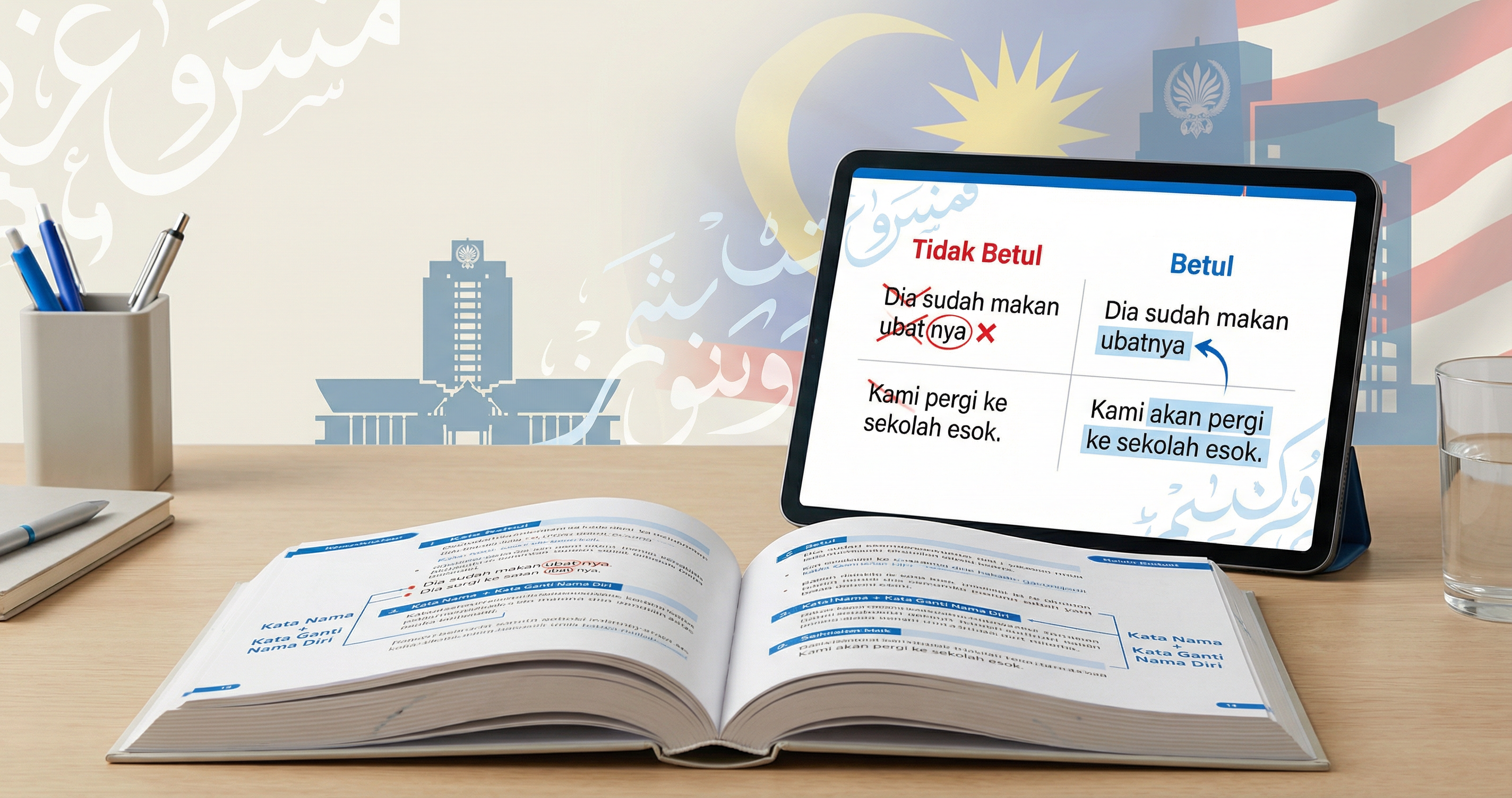
Bahasa Malaysia (BM) and Bahasa Indonesia (BI) share 80-90% vocabulary overlap and derive from the same linguistic root—Classical Malay. Yet significant differences in spelling, vocabulary, grammar, pronunciation, and usage create substantial challenges for translators, learners, and AI systems. This comprehensive 30,000-word guide represents the most exhaustive comparison of these sister languages ever published, exploring every dimension of their similarities and differences to provide an authoritative resource for language professionals, businesses, educators, and technology developers.
Executive Summary: Understanding the BM-BI Linguistic Landscape
The relationship between Bahasa Malaysia and Bahasa Indonesia exemplifies one of linguistics' most fascinating phenomena: how a single language can diverge into distinct standardized forms while maintaining high mutual intelligibility. Both languages trace their origins to Classical Malay, the prestigious lingua franca of the Malacca Sultanate and the broader Malay Archipelago from the 15th through 19th centuries. This shared heritage explains the extensive vocabulary overlap that allows speakers of either variety to achieve basic communication with minimal training.
However, centuries of separate development under different colonial regimes— British influence in Malaya and Dutch influence in the East Indies—created divergent standardization trajectories that continue to differentiate the languages today. The divergence accelerated after independence: Malaysia in 1957 and Indonesia in 1945 (with the Sumpah Pemuda language declaration of 1928 serving as a crucial pre-independence milestone). Post-colonial language planning in both nations pursued different philosophical approaches, with Indonesia embracing a more purist, anti-Dutch stance while Malaysia maintained a pragmatic approach to English borrowing.
Current mutual intelligibility levels vary significantly by domain and speaker background. Uneducated speakers may achieve only 70-75% comprehension when encountering the other variety, while educated speakers familiar with both media environments often reach 85-90% understanding of written text. Spoken comprehension is generally lower due to pronunciation differences and colloquial expressions. Professional contexts requiring precise terminology—legal, medical, technical—demand specialized knowledge of both varieties, as terminology divergence is most pronounced in specialized domains.
The key differences between BM and BI span multiple linguistic dimensions. Orthographically, systematic spelling variations exist for certain sounds, with Indonesian generally adopting more phonetic representations while Malaysian spelling preserves more etymological connections. Vocabulary differences represent the most visible divergence, with everyday terms for common concepts often completely different between the varieties. Grammar shows more subtle distinctions in affixation patterns, pronoun usage, and formality markers. Phonological differences in vowel quality, stress placement, and intonation patterns create distinct auditory signatures.
This guide serves multiple audiences. Professional translators working between BM and BI will find comprehensive comparison tables, false friends warnings, and domain-specific terminology resources. AI developers and NLP researchers will discover detailed linguistic analysis explaining why machine translation systems often struggle with this language pair. Language learners will benefit from structured guidance on transfer learning from one variety to another. Businesses expanding across the Malaysia-Indonesia market will understand when content localization is essential versus when a single Malay variant may suffice.
Throughout this comprehensive resource, we employ a systematic comparative approach, presenting information in parallel structures that facilitate direct comparison. Extensive tables organize vocabulary by semantic categories, flag dangerous false friends, and indicate severity levels for translation errors. Pronunciation guides use IPA notation alongside accessible approximations. Cultural notes explain the sociolinguistic contexts that shape language use in both nations. Whether consulted as a reference work or read systematically, this guide aims to establish the definitive scholarly and practical resource for BM-BI comparison.
Key Statistics at a Glance
Historical and Political Context: The Making of Two Languages
Understanding the contemporary relationship between Bahasa Malaysia and Bahasa Indonesia requires deep historical analysis spanning pre-colonial unity, colonial divergence, and post-independence nation-building. The linguistic separation of these varieties represents one of history's most significant natural language evolution experiments, demonstrating how political boundaries and language policy can transform a unified lingua franca into distinct national languages.
Pre-Independence Unity: Classical Malay as Lingua Franca
Before European colonization, the Malay Archipelago enjoyed remarkable linguistic unity centered on Classical Malay (Malayu Kuno). The Malacca Sultanate (1402-1511) established Malay as the prestige language of trade, diplomacy, and Islamic scholarship throughout maritime Southeast Asia. As the primary entrepôt between India and China, Malacca attracted merchants and scholars who adopted Malay as their medium of communication, creating a cosmopolitan linguistic environment that elevated the language beyond ethnic Malay boundaries.
The Johor-Riau Sultanate, successor to Malacca after the Portuguese conquest, maintained this linguistic prestige. The court at Riau became a center of Malay literary production, producing classical texts including the Hikayat Hang Tuah and Taj al-Salatin. This Johor-Riau dialect formed the basis of what linguists call "High Malay" or "Classical Malay," the standardized written form that would eventually diverge into both modern BM and BI. The language's role in Islamic dissemination—through religious texts, Quranic exegesis, and Sufi literature—further cemented its authority across the archipelago.
During this pre-colonial period, regional variations certainly existed. Northern Sumatra varieties differed from those of the Malay Peninsula, and Javanese influence in coastal areas created contact-induced changes. However, the written standard remained relatively unified, and traders, scholars, and officials could communicate across the entire Malay world using High Malay. This unity explains the deep structural similarities between BM and BI—their shared morphological systems, basic vocabulary, and syntactic patterns all derive from this common Classical Malay foundation.
British vs Dutch Colonial Impact: Divergent Romanization and Influence
European colonialism fundamentally altered the trajectory of Malay language development, with British and Dutch policies creating the preconditions for modern divergence. The British in Malaya (from the late 18th century) and the Dutch in the East Indies (from the early 17th century) approached language policy differently, with long-lasting consequences for standardization.
British language policy in Malaya was characterized by pragmatic pluralism. The British recognized Malay as the language of indigenous administration but maintained English for colonial governance and commerce. They invested relatively little in Malay language development, leaving standardization largely to indigenous intellectuals and religious scholars. The British romanization of Malay, derived from earlier Dutch systems but adapted to English orthographic conventions, became the basis for modern Malaysian spelling. This system preserved many etymological spellings, particularly for Arabic and Sanskrit loanwords, reflecting the British respect for traditional Malay scholarship.
Dutch language policy in the East Indies was more interventionist. The Dutch established the Van Ophuijsen spelling system (1901), the first official romanization for Malay in the archipelago. This system was later revised to the Soewandi system (1947), which sought to simplify spelling and reduce Dutch influence while maintaining phonetic principles. Indonesian spelling thus developed through a series of deliberate reforms aimed at creating a distinct national language, whereas Malaysian spelling evolved more organically from the British colonial system.
The different colonial languages—English in Malaya versus Dutch in the East Indies—also influenced vocabulary development differently. British Malaya received English loanwords more readily, particularly in technical and administrative domains. Dutch influence on Indonesian was initially stronger but became politically problematic after independence, leading to active purging of Dutch terms. These different borrowing patterns created lasting vocabulary differences: Malaysian bas (bus) from English versus Indonesian bis; Malaysian televisyen versus Indonesian televisi; Malaysian kereta (car) versus Indonesian mobil (from Dutch mobiel).
Post-Independence Divergence: 1957 and 1945 as Turning Points
Independence marked the beginning of accelerated divergence between Malaysian and Indonesian Malay. Indonesia declared independence in 1945 (following the Japanese surrender), while Malaysia achieved independence in 1957. Both nations immediately confronted the question of national language policy, but their different historical experiences and political ideologies led to divergent approaches.
Indonesia's Sumpah Pemuda (Youth Oath) of 1928 had already declared "one country, one nation, one language," establishing Bahasa Indonesia as a cornerstone of nationalist identity before independence was achieved. This pre-independence language nationalism meant that post-1945 language planning could build on decades of intellectual preparation. Indonesian leaders viewed language purification as part of decolonization, actively replacing Dutch loanwords with indigenous terms or Sanskrit-derived neologisms. The Indonesian language became a symbol of anti-colonial struggle and national unity for a vast archipelago encompassing hundreds of ethnic groups and languages.
Malaysia's approach was more evolutionary. The 1957 Constitution established Malay (Bahasa Melayu) as the national language while preserving the right to use other languages. Unlike Indonesia's revolutionary language planning, Malaysia pursued a gradualist approach that maintained English in many official and educational contexts. The language was initially called Bahasa Melayu, then became Bahasa Malaysia in 1968 to emphasize its role as a national rather than ethnic language, and subsequently returned to Bahasa Melayu (or simply Bahasa) in official usage following the 1990s. This nomenclature evolution reflects ongoing debates about the relationship between language, ethnicity, and nation.
Modern Standardization: DBP and BPPB as Language Authorities
Contemporary standardization of BM and BI is managed by distinct national institutions with different mandates and approaches. In Malaysia, the Dewan Bahasa dan Pustaka (DBP, Institute of Language and Literature) serves as the official authority for language standardization. In Indonesia, the Badan Pengembangan dan Pembinaan Bahasa (BPPB, Language Development and Fostering Agency) performs analogous functions. These institutions' different standardization philosophies directly impact vocabulary, spelling, and grammatical norms.
The DBP, established in 1956, operates under the Ministry of Education. Its mandate includes developing Malay terminology for science and technology, standardizing spelling, and promoting the national language. The DBP has generally adopted a conservative approach to language change, respecting etymological spellings and accepting English loanwords when necessary for technical communication. The DBP publishes the Kamus Dewan, the authoritative Malaysian dictionary, which serves as the reference standard for government, education, and media.
The BPPB, formerly known as Pusat Bahasa, operates under the Ministry of Education and Culture. It emerged from Indonesia's more revolutionary language planning tradition and has historically been more aggressive in developing indigenous terminology to replace foreign loanwords. The BPPB maintains the Kamus Besar Bahasa Indonesia (KBBI) and the Tata Bahasa Baku (Standard Grammar) reference works. Indonesian standardization has shown greater willingness to incorporate regional vocabulary (particularly from Javanese and Jakarta Malay) into the national standard, whereas Malaysian standardization has been more resistant to non-peninsular influences.
Language Planning Differences: Purification vs Pragmatism
Perhaps the most significant philosophical difference between Malaysian and Indonesian language planning concerns the treatment of foreign borrowings. Indonesia has historically pursued a more purist approach, seeking to minimize foreign influence and develop indigenous alternatives. Malaysia has been more pragmatic, accepting necessary borrowings—primarily from English—while maintaining Malay as the core of the language system.
Indonesian language purification reached its peak during the early independence period and the New Order era. Dutch loanwords were systematically replaced: kantor became the standard for "office" (from Portuguese/Indonesian regional usage, replacing Dutch kantoor);handuk (towel) replaced Dutch handdoek; wastafelbecame tempat cuci tangan or wastafel with modified spelling. The Indonesian approach also favored Sanskrit-derived neologisms for modern concepts, creating terms like kerja (work) derived from Sanskrit karya rather than adopting European terms.
Malaysian language planning took a different path, accepting English loanwords more readily when no obvious Malay equivalent existed. Terms like komputer (computer), internet, and softwareentered Malaysian usage with minimal modification. The DBP has generally prioritized functional communication over linguistic purity, recognizing that Malaysia's position in global commerce requires English proficiency and that resisting all English borrowing would disadvantage Malaysian users in technical fields.
Timeline of Key Language Planning Events
- 1901: Dutch establish Van Ophuijsen spelling for Malay in the East Indies
- 1928: Indonesian Youth Oath (Sumpah Pemuda) declares Bahasa Indonesia as national language
- 1947: Indonesia adopts Soewandi spelling reform
- 1956: DBP established in Malaya
- 1957: Malaysian independence; Malay becomes national language
- 1968: Malaysia renames language Bahasa Malaysia (reverted to Bahasa Melayu in 1990s)
- 1972: Joint spelling reform harmonizes Malaysian and Indonesian orthography
- 2016: Indonesian spelling reform (EYD updates) further differentiates from Malaysian conventions
Orthographic (Spelling) Differences: Systematic Variations
Spelling represents the most immediately visible difference between Bahasa Malaysia and Bahasa Indonesia. While the 1972 spelling reform harmonized many previously divergent conventions, systematic differences persist in how certain sounds are represented, how loanwords are adapted, and how morphological processes are reflected in writing. These orthographic variations, though sometimes superficial, have significant implications for translation, language technology, and learner acquisition.
Systematic Sound-to-Spelling Variations
The most consistent orthographic differences between BM and BI involve the representation of certain phonemes, particularly those found in loanwords from Arabic, Sanskrit, and European languages. These variations follow predictable patterns that allow trained readers to convert between systems, but they create challenges for automated processing and can impede reading comprehension for those unfamiliar with the other variety.
| Sound | Bahasa Malaysia | Bahasa Indonesia | Examples |
|---|---|---|---|
| /f/ | p (traditional), f (modern) | f | BM: foto/poto, fail/pail; BI: foto, file |
| /v/ | b | v | BM: bitamin, universiti; BI: vitamin, universitas |
| /z/ | z (now common) | z | Both: zaman/zaman, zon/zona |
| /ks/ | ks, x | ks | BM: aksi, teks; BI: aksi, teks |
Vocabulary Differences: The Heart of BM-BI Divergence
While spelling differences are immediately visible, vocabulary differences create the most significant practical challenges for communication between BM and BI speakers. These vocabulary divergences span everyday terminology, semantic shifts, false friends, and domain-specific jargon. Understanding the full scope of lexical differences is essential for accurate translation, effective cross-border communication, and natural-sounding content localization.
Everyday Vocabulary: Common Terms That Differ
The vocabulary of daily life shows extensive variation between BM and BI. Terms for transportation, time, food, family relationships, and common activities often differ completely between the varieties. While speakers can usually understand the other variety's terms through context, these differences create barriers to natural communication and require active learning for bilingual proficiency.
Transportation and Vehicles
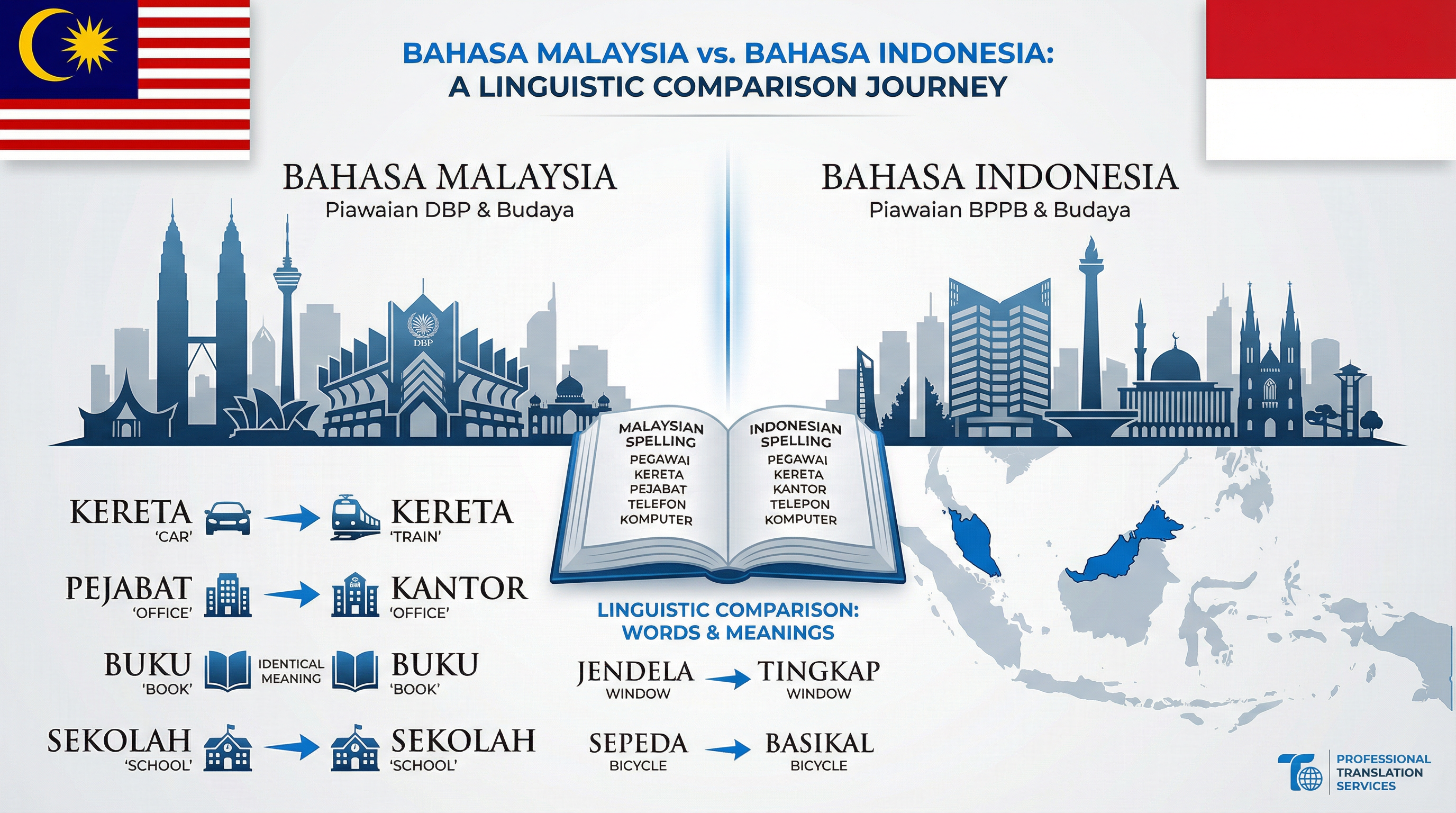
Transportation vocabulary exhibits some of the most striking differences between the varieties, reflecting different colonial influences and independent standardization choices. The term kereta exemplifies the semantic divergence: in BM it means "car" (from Portuguesecarreta), while in BI it means "train" (from the same root, but with a different semantic development). This single word creates significant potential for confusion in logistics, travel, and everyday conversation contexts.
| English | Bahasa Malaysia | Bahasa Indonesia | Etymology Notes |
|---|---|---|---|
| car/automobile | kereta | mobil | BM: Portuguese; BI: Dutch automobiel |
| train | kereta api | kereta api | Same in both (literally "fire car") |
| bus | bas | bis | Both from English; BM keeps /s/, BI Indonesianized |
| airplane | kapal terbang | pesawat, kapal terbang | BM: "flying ship"; BI: pesawat (standard) |
| bicycle | basikal | sepeda | BM: English; BI: Dutch fiets → Portuguese sepeda |
Grammatical Differences: Structure and Usage
While BM and BI share the same fundamental grammatical architecture— Austronesian morphosyntax with Malayic characteristics—significant differences exist in pronoun usage, affixation patterns, formality markers, and syntactic constructions. These grammatical differences, while less immediately visible than vocabulary differences, profoundly affect naturalness and appropriateness in communication. Professional translators must master both grammatical systems to produce native-sounding output.
Pronoun Systems: Formality, Register, and Social Distance
Pronoun usage represents one of the most sociolinguistically complex aspects of both BM and BI. Both languages employ multiple first-person, second-person, and third-person pronouns that encode social relationships, formality levels, and regional identity. The pronoun systems of BM and BI overlap partially but show important differences in distribution and connotation.
First-Person Pronouns (I/me)
| Pronoun | BM Usage | BI Usage | Register |
|---|---|---|---|
| saya | Standard neutral; formal and informal | Standard neutral; slightly formal | Neutral |
| aku | Informal; can seem rude if misused | Very common; standard informal | Informal |
| kami | We (exclusive: me, not you) | We (exclusive); same meaning | Neutral |
Conclusion and Key Takeaways
This comprehensive analysis has explored the multifaceted relationship between Bahasa Malaysia and Bahasa Indonesia—from their shared Classical Malay origins through centuries of divergent development to their contemporary status as distinct but related national languages. The journey reveals both the depth of their connection and the genuine differences that make professional translation and careful localization essential for cross-border communication.
Orthographic differences remain visible, particularly in loanword spelling and the treatment of sounds like /f/ and /v/. While the 1972 reform harmonized many conventions, systematic variations persist that mark text as Malaysian or Indonesian. Vocabulary differencesrepresent the most substantial barrier to seamless communication. Transportation, time, household, and business terminology often differs completely, while dangerous false friends create risks for careless translation.Grammatical differences in pronoun systems, question formation, and formality marking create texture differences that affect naturalness in communication.
For translators: Maintain separate terminology resources for BM and BI. Never assume apparent cognates share the same meaning. Consult native speakers of the target variety for review. For businesses: Budget for separate localization for consumer-facing content. Conduct market-specific SEO research using local terminology. For learners: Use contrastive learning materials that highlight differences. Don't rely on passive exposure— actively study differences between these fascinating sister languages.
About Translife Translation Services
Translife provides professional translation services between Bahasa Malaysia and Bahasa Indonesia, with native speakers of both varieties ensuring accurate, culturally appropriate communication.