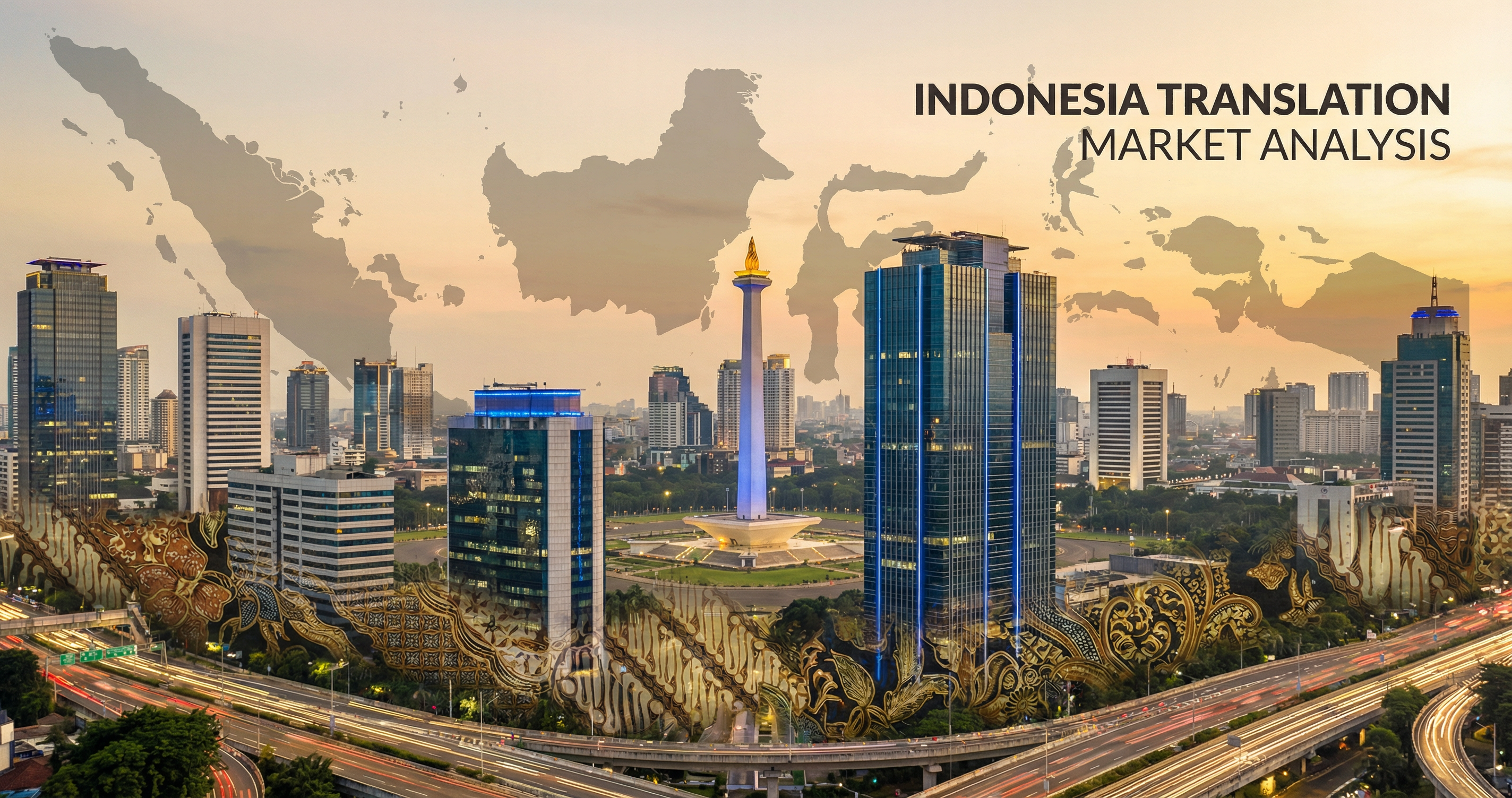
Indonesia, the world's fourth most populous nation with over 275 million people speaking more than 700 languages, represents one of the most linguistically complex and economically significant translation markets in Southeast Asia. As the largest economy in ASEAN undergoes rapid digital transformation, its translation industry has emerged as a critical enabler of commerce, governance, and cultural exchange. In this comprehensive analysis, we examine the structure, dynamics, and future trajectory of Indonesia's burgeoning language services market, valued at approximately IDR 2-4 trillion (USD 130-260 million) and growing at an exceptional 12-18% annually.
Executive Summary
Indonesia's translation market represents one of the most dynamic and rapidly evolving language services ecosystems globally. The nation's extraordinary linguistic diversity—with over 700 living languages distributed across 17,000 islands—creates both extraordinary challenges and unprecedented opportunities for translation professionals, language service providers (LSPs), and technology developers.
The market's estimated valuation of IDR 2-4 trillion (USD 130-260 million) reflects sustained growth driven by Indonesia's digital economy explosion, cross-border e-commerce expansion, and increasing integration with ASEAN and global markets. With a compound annual growth rate (CAGR) of 12-18%, Indonesia's translation market outpaces regional peers and positions the nation as potentially the fastest-growing language services market in Southeast Asia.
Key market drivers include: the explosive growth of e-commerce platforms requiring multilingual product listings and customer support; the rapid expansion of fintech and digital banking services needing localized interfaces and compliance documentation; government initiatives promoting digital literacy and online services; tourism recovery generating demand for hospitality and travel content localization; and the emergence of Indonesia's content creator economy requiring subtitling, dubbing, and transcreation services.
However, the industry faces significant challenges: quality inconsistency across a fragmented provider landscape; limited technology adoption among smaller providers; price competition from informal translation services; declining proficiency in regional languages among younger generations; and the ongoing struggle to balance Bahasa Indonesia's national role with regional language preservation. Addressing these challenges while capitalizing on growth opportunities will define the industry's trajectory through 2030.
Key Market Indicators at a Glance
Indonesia's Linguistic Landscape: The World's Most Complex Language Ecosystem
Understanding Indonesia's translation market requires deep appreciation of the nation's extraordinary linguistic diversity. Indonesia ranks among the world's most linguistically diverse nations, surpassed only by Papua New Guinea, India, and Nigeria. This diversity is not merely statistical—it fundamentally shapes communication patterns, economic development, and the structure of the translation industry itself.
Bahasa Indonesia: The National Lingua Franca
Bahasa Indonesia, the standardized register of Malay that serves as Indonesia's national language, represents one of the great success stories of language planning in the developing world. Adopted as the national language upon independence in 1945, Bahasa Indonesia has achieved near-universal adoption as a second language across the archipelago, enabling communication across ethnic and linguistic boundaries that would otherwise fragment the nation.
The language's success stems from several factors: its linguistic simplicity compared to many regional languages; its historical role as a trade language throughout the Malay Archipelago; its lack of association with any single dominant ethnic group (unlike Javanese, which might have alienated other communities); and sustained government investment in language education and standardization. Today, Bahasa Indonesia is spoken by over 270 million people, making it one of the world's most widely spoken languages.
For the translation industry, Bahasa Indonesia serves as the primary pivot language—the bridge connecting Indonesia to global commerce. Most translation work flows into or out of Bahasa Indonesia rather than directly between regional languages and foreign languages. This centrality creates demand for translators with exceptional Bahasa Indonesia proficiency, including mastery of both formal registers required for legal and government translation and informal registers used in marketing and digital content.
Major Regional Languages: Javanese, Sundanese, and Beyond
Despite Bahasa Indonesia's dominance, major regional languages maintain significant speaker populations and cultural importance. Javanese, spoken by approximately 82 million people primarily in Central and East Java, represents the most widely spoken regional language. Its complex system of speech levels (krama, madya, ngoko) reflecting social hierarchy creates unique translation challenges when rendering content for Javanese-speaking audiences.
Sundanese, spoken by approximately 39 million people in West Java, maintains strong cultural identity and active literary production. The language's distinct phonology and vocabulary, influenced by different historical developments than Javanese, requires specialized translator expertise. Other significant regional languages include: Madurese (13 million speakers); Minangkabau (6 million); Bugis (5 million); and Banjarese (4 million).
Translation demand for regional languages primarily serves three functions: government communication and public service announcements targeting specific regions; marketing campaigns seeking cultural resonance with local audiences; and cultural preservation initiatives including traditional literature translation and media production. While the volume of regional language translation is smaller than Bahasa Indonesia work, specialized regional language translators command premium rates due to limited supply.
Ethnologue Statistics: Quantifying Indonesia's Language Diversity
According to Ethnologue, the comprehensive reference work cataloging the world's living languages, Indonesia hosts 719 distinct languages—a figure that represents approximately 10% of global linguistic diversity. Of these, approximately 400 are spoken in Papua alone, reflecting the island's extreme linguistic fragmentation resulting from geographic isolation and traditional small-scale societies.
The vitality of Indonesia's languages varies dramatically. While Bahasa Indonesia and major regional languages show strong intergenerational transmission, many smaller languages face endangerment. Ethnologue classifies 139 Indonesian languages as threatened, shifting, moribund, or nearly extinct. The translation industry plays an increasingly important role in language documentation and preservation, with academic and government initiatives supporting translation of traditional oral literature into written form and Bahasa Indonesia.
Translation volume correlates roughly with speaker population and economic activity, creating a hierarchy of language pairs. Bahasa Indonesia-English dominates commercial translation, followed by Javanese-Indonesian and Sundanese-Indonesian for regional government and marketing work. Beyond these major pairs, translation demand becomes increasingly specialized, serving academic research, government programs in remote areas, and cultural preservation initiatives.
Language Policy and Constitutional Framework
Indonesia's language policy is anchored in Article 36 of the 1945 Constitution, which establishes Bahasa Indonesia as the national language while affirming the rights of ethnic groups to preserve and develop their languages. This framework has enabled the successful promotion of Bahasa Indonesia as a unifying national language while protecting linguistic diversity—a balance that many linguistically diverse nations have struggled to achieve.
The 2009 Law on National Language, Flag, Emblem, and Anthem reinforced Bahasa Indonesia's position in government, education, and national development. The law requires government agencies to use Bahasa Indonesia in official communications, mandates Bahasa Indonesia as the medium of instruction in schools (with provisions for regional language education), and establishes requirements for foreign companies operating in Indonesia.
For the translation industry, legal requirements create sustained demand for Bahasa Indonesia translation services. Government agencies must translate international agreements, technical documentation, and foreign correspondence into Bahasa Indonesia. Private companies must localize products, services, and documentation to comply with consumer protection regulations. Legal proceedings require interpretation and document translation to ensure fair access to justice for all citizens.
The Indonesian Language Agency (Badan Bahasa): Standardization and Development
The Badan Bahasa (Indonesian Language Agency), operating under the Ministry of Education, Culture, Research, and Technology, serves as the primary institution for Bahasa Indonesia standardization and development. The agency maintains the Great Dictionary of the Indonesian Language (Kamus Besar Bahasa Indonesia), the authoritative reference for vocabulary, spelling, and usage. This dictionary, now in its fourth edition, represents the culmination of decades of lexicographic work.
Beyond dictionary compilation, Badan Bahasa plays a crucial role in terminology development across technical and professional domains. As Indonesia develops expertise in fields ranging from aerospace to biotechnology, the agency creates standardized Indonesian terms for concepts previously expressed only in foreign languages. This terminology work directly impacts translation practice, as translators must navigate between established foreign terms and newly standardized Indonesian equivalents.
The agency also supports regional language preservation through documentation projects, educational materials development, and research initiatives. Collaboration between Badan Bahasa and translation professionals ensures that standardized terminology propagates through translated materials, contributing to linguistic development while serving practical communication needs.
Regional Identity vs. National Unity: The Translation Challenge
Indonesia's translation industry operates within a complex tension between national unity and regional identity. The successful promotion of Bahasa Indonesia as a national language has enabled communication across the archipelago, facilitating commerce, governance, and national identity formation. However, this success has come at some cost to regional language vitality, as younger generations increasingly prefer Bahasa Indonesia for most purposes.
Translation services navigate this tension daily. Marketing campaigns targeting specific regions often employ regional languages or dialects to achieve cultural resonance, requiring translators who understand both the linguistic nuances and cultural connotations of regional varieties. Government communications may require translation into regional languages for effective public service delivery in areas where Bahasa Indonesia proficiency is limited among older populations.
The translation industry also contributes to language preservation through documentation and educational translation. Translators working with indigenous communities help document oral traditions, create educational materials supporting regional language instruction, and enable access to global knowledge resources through translation into regional languages. These activities, while economically modest, carry significant cultural importance.
Code-Mixing Phenomena: Bahasa Gaul, Jakartan Slang, and Digital Communication
Indonesian digital communication has developed distinctive code-mixing patterns that present unique challenges for translation. Bahasa Gaul (Indonesian slang) combines elements of Bahasa Indonesia, regional languages, English, Dutch colonial vocabulary, and creative neologisms to form a dynamic linguistic system particularly prevalent among urban youth and in social media contexts.
Jakartan slang (Bahasa Jakarta) represents the most influential code-mixing variety, originating in Indonesia's capital and spreading through national media, entertainment, and social networks. Terms like "gue" and "lu" (I/you, from Hokkien), "mantap" (excellent), and "sok" (pretentious) demonstrate the hybrid nature of urban Indonesian communication. This slang evolves rapidly, with new terms emerging and spreading through social media platforms.
For translation professionals, code-mixing presents both challenges and opportunities. Marketing translation targeting young urban demographics requires understanding of current slang and cultural references to achieve authentic communication. Social media content translation must capture the informal register and emotional nuance of Indonesian digital communication. However, code-mixing also creates quality risks when translators unfamiliar with formal registers produce materials requiring standard Bahasa Indonesia.
Market Size and Economic Analysis
Quantifying Indonesia's translation market presents significant methodological challenges due to the industry's fragmentation across formal agencies, freelance practitioners, informal providers, and in-house corporate translation functions. However, based on industry surveys, economic modeling, and analysis of related sectors, the Indonesian translation market is estimated at IDR 2-4 trillion (approximately USD 130-260 million) annually, with consistent growth of 12-18% CAGR—among the highest rates in Southeast Asia.
Industry Valuation Methodology
Market valuation combines multiple data sources: revenue reporting from major language service providers; freelance translator income surveys conducted by professional associations; government procurement data for translation services; and economic modeling based on translation intensity (translation volume relative to economic activity) observed in comparable markets. This multi-method approach addresses data limitations while providing reasonable market size estimates.
The formal translation agency market—including established LSPs serving corporate clients—is estimated at IDR 800 billion to 1.2 trillion annually. The freelance market, comprising individual practitioners serving direct clients and agency subcontractors, contributes an additional IDR 600-900 billion. In-house corporate translation functions, particularly in multinational corporations and government agencies, represent approximately IDR 400-600 billion in equivalent value. Informal translation services, difficult to quantify but significant in volume, account for the remaining market segment.
Growth Trajectory: 12-18% CAGR Driving ASEAN's Fastest-Growing Market
Indonesia's translation market growth significantly outpaces regional peers, driven by structural factors unique to the Indonesian economy. The 12-18% annual growth rate compares favorably to: Malaysia (10-15%), Thailand (8-12%), Philippines (8-10%), and Singapore (6-8%). This outperformance reflects Indonesia's larger population base, faster digital adoption, and the relative underdevelopment of professional translation services creating catch-up growth dynamics.
Growth drivers include Indonesia's digital economy expansion, with e-commerce growing 30%+ annually and requiring massive localization of product listings, customer support content, and marketing materials. Fintech proliferation—Indonesia hosts Southeast Asia's largest fintech ecosystem with over 300 registered fintech companies—drives demand for localized financial interfaces, compliance documentation, and user agreements. Government digital transformation initiatives, including the 100 Smart Cities movement and e-government service expansion, generate sustained translation demand.
The COVID-19 pandemic, while disrupting traditional translation workflows, ultimately accelerated digital adoption and remote service delivery. Post-pandemic, remote interpretation has become standard practice, enabling Indonesian interpreters to serve international clients without travel costs. E-learning content localization surged during lockdowns and remains elevated. These structural shifts suggest that growth rates may sustain rather than revert to pre-pandemic levels.
Contribution to the Creative Economy
Indonesia's creative economy, targeted to contribute 8% of GDP by 2025 under the Ekonomi Kreatif roadmap, relies heavily on translation services. The content creation sector—encompassing film, television, music, gaming, and digital content—requires extensive subtitling, dubbing, and transcreation services for both domestic distribution and international export.
Streaming platform expansion has been particularly significant for translation demand. Netflix, Disney+, Amazon Prime Video, Viu, and local platforms Iflix and Vidio all require Indonesian content localization, creating demand for professional subtitling, creative translation, and quality assurance. The quality requirements for streaming content—demanding cultural adaptation, timing precision, and register appropriateness—support premium pricing compared to traditional translation work.
Indonesia's emerging gaming industry also generates translation demand. Local game developers targeting international markets require localization of in-game text, marketing materials, and user documentation. International game publishers entering the Indonesian market must localize content for Indonesia's massive gamer population (over 100 million). These creative industry applications demonstrate translation's role as an enabling infrastructure for Indonesia's cultural and economic soft power.
Regional Distribution: Jakarta's Dominance vs. Emerging Secondary Markets
Indonesia's translation market exhibits extreme geographic concentration, with the Greater Jakarta area (Jabodetabek) capturing approximately 55-60% of industry revenue. Jakarta's dominance reflects its position as Indonesia's political capital, financial center, and headquarters location for most multinational corporations. The city's concentration of educated professionals, technology infrastructure, and client proximity creates self-reinforcing market dynamics.
Secondary markets are emerging as Indonesia's economy decentralizes. Surabaya, as East Java's capital and Indonesia's second-largest city, hosts a growing translation market serving manufacturing, shipping, and regional corporate clients. Bandung, with its strong educational institutions and emerging startup ecosystem, generates translation demand for technology companies and creative industries. Bali's tourism focus drives hospitality and travel content localization, while Medan serves as a hub for Sumatra-focused business activities.
The emergence of remote work and cloud-based translation workflows is gradually reducing geographic advantages for Jakarta-based providers. Skilled translators in secondary cities can now serve Jakarta clients remotely, potentially redistributing market activity. However, relationship networks, face-to-face client interaction preferences, and concentration of high-value clients sustain Jakarta's market dominance in the near term.
E-Commerce Explosion Driving Localization Demand
Indonesia's e-commerce sector, valued at over USD 40 billion and growing 20-30% annually, represents the single largest driver of translation and localization demand. Platforms including Tokopedia, Shopee, Bukalapak, Lazada, and TikTok Shop require massive multilingual content to serve Indonesia's diverse consumer base and expanding cross-border trade.
Product listing translation—converting millions of product descriptions, specifications, and marketing content into Bahasa Indonesia—represents a substantial translation volume. E-commerce platforms employ in-house localization teams, engage translation agencies, and leverage machine translation with human post-editing to manage scale. The quality requirements vary by product category: consumer electronics and health products require accurate technical translation, while fashion and home goods may accept more creative adaptation.
Cross-border e-commerce creates bidirectional translation demand. Indonesian sellers on international platforms (Amazon, eBay, Alibaba) require translation of product information into English and other target languages. International sellers targeting Indonesian consumers must localize product listings, customer support, and marketing materials into Bahasa Indonesia. This two-way flow generates sustained demand for e-commerce specialized translation services.
Sector Analysis: Industry-Specific Translation Requirements
Indonesia's translation market serves diverse industry verticals, each presenting unique requirements, regulatory frameworks, and quality standards. Understanding these sector-specific dynamics enables translation providers to develop expertise and helps clients identify appropriate language services for their needs.
E-Commerce and Digital Economy
The e-commerce sector drives unprecedented translation volume in Indonesia, with localization requirements spanning multiple content types and quality levels. Major platforms maintain extensive localization operations: Tokopedia (now part of GoTo Group) operates large in-house localization teams; Shopee (Sea Limited) maintains translation infrastructure serving multiple Southeast Asian markets including Indonesia; Bukalapak engages translation agencies for specialized content and crowdsourced translation for user-generated content.
Cross-border e-commerce amplifies translation complexity. Indonesian sellers accessing international markets through platforms like Amazon Global Selling, eBay, and Alibaba require translation of product catalogs, customer service templates, and compliance documentation into English, Chinese, Japanese, and other target languages. The quality of this translation directly impacts sales conversion, making professional e-commerce translation a high-value service segment.
Digital payment and fintech localization represents a specialized sub-segment. GoPay, OVO, Dana, LinkAja, and bank-backed e-wallets require localization of mobile interfaces, user agreements, error messages, and help documentation. The terminology precision required for financial content—where ambiguous translation could cause user confusion or compliance issues—demands specialized translator expertise in fintech localization.
Tourism and Hospitality
Indonesia's tourism sector, recovering strongly post-pandemic with visitor numbers approaching pre-COVID levels, generates substantial translation demand. Bali remains the epicenter of tourism translation, requiring multilingual content for hotels, restaurants, attractions, and tourism services. However, tourism translation extends across Indonesia's 17,000 islands, from Lombok's emerging resort destinations to Raja Ampat's diving tourism to Yogyakarta's cultural tourism.
Bali's international visitor profile—encompassing Australian holidaymakers, Chinese group tourists, European backpackers, Indian wedding parties, and Japanese luxury travelers—creates complex multilingual requirements. Tourism businesses must maintain content in English (the primary tourism lingua franca), Chinese, Japanese, Korean, and increasingly Arabic for Middle Eastern visitors. The cultural adaptation required for tourism content—capturing the experiential essence of Indonesian destinations— favors transcreation over literal translation.
Halal tourism represents a growing specialized segment. As Indonesia promotes itself as a Muslim-friendly destination and develops halal tourism infrastructure, translation of halal certification documentation, prayer facility information, and halal food guides becomes essential. The technical and religious specificity of halal standards requires translators with both language skills and Islamic knowledge to accurately convey compliance requirements.
Energy and Natural Resources
Indonesia's natural resource sector—encompassing oil and gas, mining, palm oil, and renewable energy—generates substantial technical translation demand. The sector's international character, with foreign investment and technology transfer playing major roles, creates continuous requirements for translation of technical specifications, environmental impact assessments, safety documentation, and regulatory compliance materials.
Mining documentation translation serves both operational and compliance functions. International mining companies operating in Indonesia—particularly in coal, nickel, copper, and gold—must translate Indonesian mining regulations, community agreements, and environmental permits into English for international headquarters review. Technical mining documentation from international equipment suppliers requires translation into Bahasa Indonesia for Indonesian operations teams.
Environmental compliance documentation has gained importance as Indonesia strengthens environmental regulations and seeks international green financing. Environmental Impact Assessments (AMDAL), sustainability reports, and carbon accounting documentation require accurate technical translation for international verification and reporting. This segment demands translators with environmental science backgrounds combined with translation expertise.
Manufacturing and Automotive
Indonesia's manufacturing sector, including automotive, electronics, textiles, and food processing, generates technical translation demand driven by international supply chain integration. Indonesia's position as a major automotive production hub in Southeast Asia—with Toyota, Honda, Daihatsu, Mitsubishi, and increasingly Chinese EV manufacturers operating large production facilities—creates sustained demand for automotive documentation translation.
Safety manuals and Standard Operating Procedures (SOPs) represent critical manufacturing translation content. Occupational safety documentation must be accurately translated to protect Indonesian workers and comply with labor regulations. Poorly translated safety instructions can lead to accidents, regulatory penalties, and legal liability. This criticality supports premium pricing for manufacturing safety translation services.
The automotive industry's shift toward electric vehicles creates emerging translation requirements. EV technology documentation, charging infrastructure specifications, and battery management system materials require translation as Indonesia positions itself as a regional EV hub. Technical accuracy is paramount, as errors in EV system documentation could have safety implications. This emerging segment offers opportunities for translators with automotive and electronics technical backgrounds.
Financial Services
Indonesia's financial services sector, encompassing traditional banking, Islamic finance, fintech, insurance, and capital markets, generates high-value translation work demanding precision and regulatory awareness. The sector's regulated nature means that translation errors can have legal and compliance consequences, supporting premium pricing for financial translation services.
Fintech localization has emerged as a major growth segment as Indonesia's fintech ecosystem expands. Digital banking platforms (Jago, Blu, SeaBank), peer-to-peer lending platforms, insurance tech companies, and payment systems all require extensive localization of user interfaces, terms of service, privacy policies, and customer communications. The rapid iteration cycles of fintech products create ongoing translation demand rather than one-time projects.
Islamic banking and finance represent a specialized segment reflecting Indonesia's position as the world's largest Muslim-majority nation. Shariah-compliant financial products—ranging from savings accounts to sukuk (Islamic bonds) to takaful (Islamic insurance)—require translation of Arabic terminology and Islamic financial concepts. The religious and legal complexity of Islamic finance documentation demands specialized translator expertise and often involves Shariah board review of translated materials.
Government and Legal
Government translation requirements in Indonesia reflect the constitutional status of Bahasa Indonesia as the national language while accommodating international engagement needs. Government agencies must translate legislation, regulations, official communications, and public services content into Bahasa Indonesia, while also translating Indonesian materials into English for international audiences.
Regulation translation represents a critical function as Indonesia develops its legal and regulatory framework. New laws and regulations in areas including data protection (PDP Law), investment, employment, and environmental protection require accurate translation for international businesses seeking compliance. The authoritative nature of government translation means that errors can have significant legal consequences, supporting requirements for sworn/certified translators in this segment.
Court interpretation services ensure access to justice for non-Indonesian speakers and Indonesians with limited Bahasa Indonesia proficiency. The Indonesian court system provides interpreters for criminal proceedings, civil litigation, and administrative hearings. Court interpreting demands specialized training beyond general interpreting competence, including knowledge of legal terminology and courtroom procedure. The judicial system maintains registries of qualified court interpreters while facing ongoing challenges in meeting demand for less common languages.
Technology and Digital Transformation
Technology adoption in Indonesia's translation industry has accelerated dramatically, driven by the nation's digital transformation agenda, smartphone penetration exceeding 70%, and the need to serve a massive, geographically dispersed market. The intersection of translation and technology presents both opportunities for efficiency gains and challenges around quality management and professional adaptation.
Mobile-First Translation Solutions
Indonesia's mobile-first digital ecosystem—where smartphones serve as the primary internet access device for millions—has driven development of mobile-optimized translation tools. Consumer translation apps including Google Translate, Microsoft's Translator, and local alternatives like Kata.ai serve Indonesian users with varying degrees of accuracy. For professional translation, mobile-accessible cloud platforms enable translators to work from anywhere, supporting Indonesia's distributed translator workforce across the archipelago.
Mobile-first design considerations affect translation work itself. User interface translation for Indonesian mobile apps must account for screen size constraints, touch interaction patterns, and the reading habits of Indonesian mobile users. Push notifications, SMS content, and app store descriptions all require translation optimized for mobile consumption. This mobile context has influenced Indonesian translation style toward brevity and clarity that works across device types.
Social Media Content Localization
Indonesia ranks among the world's most active social media markets, with over 167 million social media users spending an average of 3.5 hours daily on platforms. This social media saturation creates enormous demand for content localization—translating and culturally adapting brand content for Indonesian audiences across platforms including Instagram, TikTok, Facebook, Twitter, and LinkedIn.
Social media localization extends beyond literal translation to encompass cultural adaptation, trend awareness, and platform-specific optimization. Indonesian social media users respond to content that reflects local cultural references, current slang, and trending topics. Transcreation— the creative adaptation of marketing content—often serves social media better than direct translation. Influencer marketing content requires particularly nuanced localization to maintain authenticity while adapting brand messaging.
The rapid content cycles of social media create operational challenges for translation providers. Brand content calendars require quick-turnaround translation to maintain posting schedules. User-generated content and community management require real-time or near-real-time translation capabilities. These requirements have driven adoption of machine translation with human post-editing workflows for social media content, balancing speed and quality needs.
Machine Translation Adoption Among SMEs
Small and medium enterprises (SMEs) form the backbone of Indonesia's economy, comprising 99% of businesses and employing 97% of the workforce. These SMEs increasingly access translation through machine translation tools, fundamentally democratizing access to multilingual communication. Google Translate serves as the entry point for many Indonesian SMEs, providing free, instant translation for basic business needs including email communication, simple website content, and customer inquiries.
However, raw machine translation quality for Bahasa Indonesia presents limitations that create opportunities for human translators. NMT (Neural Machine Translation) engines perform reasonably well for English-Indonesian translation of general content but struggle with specialized terminology, formal register, and nuanced cultural adaptation. Machine translation post-editing (MTPE) services—where translators edit and refine MT output— offer a middle ground that many Indonesian SMEs find cost-effective.
Enterprise-grade MT solutions are gaining traction among larger Indonesian companies with substantial translation volumes. Custom MT engines trained on company-specific terminology and previous translations improve output quality for specialized domains. The decision to invest in MT depends on translation volume, content type, and quality requirements. Indonesian language service providers are developing MTPE expertise and quality assessment frameworks to serve this growing market segment.
Local Startup Ecosystem: Language Technology Innovation
Indonesia's vibrant startup ecosystem has produced language technology ventures addressing specific Indonesian market needs. Kata.ai, a Jakarta-based conversational AI company, develops Bahasa Indonesia natural language processing capabilities for chatbots and virtual assistants. Prosa.ai focuses on Indonesian speech recognition and text-to-speech technology, enabling voice-based applications in Bahasa Indonesia. These local language technology companies create both competition and collaboration opportunities for traditional translation services.
The Indonesian language technology sector has attracted significant venture capital investment as investors recognize the commercial potential of Indonesia-first AI solutions. Language-specific models trained on Indonesian data often outperform general-purpose international models for Bahasa Indonesia tasks. This specialization trend suggests that the future of Indonesian translation technology may involve a mix of international platforms and local solutions optimized for Indonesian linguistic and cultural context.
Government Digital Initiatives and Translation
Indonesia's government digital transformation, led by the Ministry of Communication and Information Technology and coordinated through the National Digital Transformation Roadmap, creates sustained translation demand. E-government services must be accessible in Bahasa Indonesia, requiring localization of international platforms and translation of government content for citizen consumption.
The 100 Smart Cities movement—aiming to digitally transform 100 Indonesian cities—generates localization requirements for smart city platforms, citizen service applications, and public information systems. These smart city initiatives often involve international technology partnerships, requiring translation of technical documentation, training materials, and interface content into Bahasa Indonesia for local government adoption.
Industry Structure and Professional Landscape
Indonesia's translation industry comprises a diverse ecosystem of providers, ranging from individual freelancers operating from home offices to established agencies serving multinational corporate clients. Understanding this structure helps clients navigate provider selection and helps industry participants identify competitive positioning opportunities.
Freelance Translator Communities
Freelance translators represent the largest employment category in Indonesia's translation industry, with estimates suggesting 8,000-15,000 active practitioners across the archipelago. These independent professionals serve direct clients and work through agencies, offering specialized expertise in specific domains and language pairs. Many Indonesian translators combine translation with other professional activities including teaching, writing, and subject-matter expertise work.
Online communities play a crucial role in Indonesia's freelance translation ecosystem. Facebook groups including "Translators Indonesia," "Penerjemah Indonesia," and specialized groups for legal/medical translation serve as hubs for knowledge sharing, job postings, and professional networking. These communities enable freelancers to learn about opportunities, share resources, and develop professional relationships without geographic constraints.
The freelance market exhibits significant segmentation. Elite translators with rare specializations—legal, medical, technical—command premium rates and maintain waiting lists for their services. Mid-market freelancers provide general business translation at standard market rates. Entry-level translators compete on price, often working through online platforms where global competition pressures rates downward. This segmentation creates distinct market tiers with varying quality expectations and pricing levels.
Local Language Service Providers: Major Players
Established Indonesian translation agencies serve as market organizers, aggregating freelance capacity and providing clients with project management, quality assurance, and service reliability. Major local players include: Translife, providing comprehensive language services across Indonesia; Language Network Services Indonesia; Elitra Indonesia; and numerous regional agencies serving specific geographic markets.
Agency differentiation strategies vary across the Indonesian market. Some focus on specific verticals such as legal, medical, or technical translation, developing deep expertise and specialized terminology resources. Others emphasize technology capabilities including CAT tools, MT integration, and workflow automation. Price-competitive agencies leverage networks of junior translators and MTPE workflows to offer lower-cost solutions. Boutique agencies emphasize premium quality and personalized client relationships.
Agency business models are evolving in response to technology disruption. Traditional agency models based on markup between client rates and translator payments face pressure from direct freelancer platforms and technology-enabled solutions. Forward-thinking agencies are developing value-added services including transcreation, multilingual content strategy, and translation technology consulting to differentiate from commodity translation providers.
International Agency Presence
Global language service providers including TransPerfect, Lionbridge, RWS, and SDL maintain operations or partnerships in Indonesia, serving multinational corporate clients with Indonesian language needs. These international agencies compete aggressively for large corporate accounts, offering global scale, standardized quality processes, and integration with global translation management systems.
The relationship between international and local agencies in Indonesia involves both competition and collaboration. International agencies often partner with Indonesian LSPs as subcontractors for local market expertise and capacity scaling. Local agencies leverage international partnerships to access global clients and technology platforms. This ecosystem enables Indonesian translation services to participate in global value chains while maintaining local market presence.
Professional Associations and Certification
Himpunan Penerjemah Indonesia (HPI, Indonesian Translators Association) serves as the primary professional body for translators and interpreters. Founded in 1976, HPI promotes professional standards, organizes continuing education, and advocates for translator interests. HPI membership, while not legally required for practice, signals professional commitment and provides access to networking, training, and professional development opportunities.
The sworn translator (penerjemah tersumpah) system provides official recognition for translators qualified to produce legally certified translations. Sworn translators are appointed by the Governor after examination, with their official stamp carrying legal weight for document certification purposes. The sworn translator system creates a formal credentialing pathway for legal and official document translation, though the number of sworn translators remains limited relative to market demand.
Professional certification in Indonesia remains less developed than in some jurisdictions. Unlike Australia (NAATI) or the United States (ATA), Indonesia lacks a comprehensive national certification system for translators. This gap creates challenges for quality assurance, as clients cannot easily verify translator qualifications beyond academic credentials and experience claims. Some Indonesian translators pursue international certifications to differentiate themselves in the market.
Training and Certification Landscape
University translation programs in Indonesia produce graduates who typically require additional practical training before meeting industry requirements. Major universities offering translation/interpretation programs include: Universitas Indonesia, Universitas Gadjah Mada, Universitas Padjadjaran, and numerous other institutions. These programs provide foundational language skills and translation theory but often lack practical training in CAT tools, specialized domains, and professional workflow management.
The gap between academic preparation and industry needs creates opportunities for professional training providers. Short courses, workshops, and online training programs address practical skills including CAT tool proficiency, specialized domain knowledge, and business skills for freelance translators. Professional associations, translation agencies, and individual practitioners offer training that supplements university education.
Regional Analysis: Geographic Market Dynamics
Indonesia's translation market exhibits significant geographic variation reflecting the nation's economic geography, population distribution, and regional development patterns. Understanding these variations helps service providers optimize geographic positioning and helps clients access appropriate local resources.
Jakarta: The Dominant Market
The Greater Jakarta area (Jabodetabek—Jakarta, Bogor, Depok, Tangerang, Bekasi) dominates Indonesia's translation market, capturing approximately 55-60% of industry revenue. Jakarta's supremacy reflects its position as Indonesia's political capital, financial center, and headquarters location for over 80% of multinational corporations operating in Indonesia. The city's concentration of educated professionals, technology infrastructure, and client proximity creates self-reinforcing market dynamics.
Jakarta-based translation agencies benefit from face-to-face client relationships, proximity to corporate decision-makers, and access to the deepest talent pool of professional translators. The city hosts the headquarters of most major Indonesian LSPs and serves as the hub for international agency operations. Translation rates in Jakarta typically exceed those in secondary markets by 20-40%, reflecting higher operating costs and client willingness to pay for proximity and perceived quality.
Competition in Jakarta's translation market is intense, with agencies competing on specialization, technology capabilities, and service quality rather than geography. The market supports diverse business models, from premium boutique agencies serving luxury brands to high-volume providers leveraging MTPE for e-commerce localization. Market sophistication in Jakarta leads national trends, with new technologies and service models typically adopted in Jakarta before spreading to secondary markets.
Surabaya, Bandung, and Medan: Secondary Market Dynamics
Surabaya, as East Java's capital and Indonesia's second-largest city, hosts a growing translation market estimated at 10-12% of national revenue. The city's industrial base—encompassing manufacturing, shipping, and agribusiness—generates translation demand for technical documentation, export documentation, and international business communication. Surabaya agencies typically serve regional corporate clients and function as capacity providers for Jakarta-based agencies.
Bandung, located in West Java, leverages its strong educational institutions and emerging startup ecosystem to develop a distinctive translation market. The city's numerous universities produce translation graduates who increasingly find local opportunities rather than migrating to Jakarta. Bandung's creative industries—including fashion, design, and digital content—generate demand for transcreation and creative localization services.
Medan serves as the hub for translation services in Sumatra, Indonesia's largest island. The city's position as a trading and logistics center creates demand for business translation, while plantation agriculture and natural resource industries generate technical translation requirements. Medan agencies often serve clients across Sumatra, including Palembang, Pekanbaru, and smaller regional centers, functioning as the primary translation service provider for western Indonesia outside Jakarta.
Bali: Tourism-Focused Translation Services
Bali's translation market is uniquely shaped by the island's tourism economy. While representing a smaller share of overall national translation revenue (approximately 3-5%), Bali's market demonstrates distinctive characteristics reflecting the hospitality industry's multilingual requirements. Translation services in Bali focus heavily on tourism content—hotel websites, restaurant menus, tour descriptions, and cultural interpretation materials.
Bali's expatriate community includes a significant number of foreign translators and language professionals who have established practices serving both local Indonesian clients and international businesses operating in Bali. This expatriate presence creates a unique market where native English, French, Japanese, and other language speakers provide translation services, sometimes competing with Indonesian translators and sometimes complementing them through collaborative arrangements.
The digital nomad phenomenon—remote workers choosing Bali as a base—has introduced new dynamics to the local translation market. Some digital nomads offer translation services as part of their remote work portfolio, while others create demand for Indonesian translation as they navigate local business requirements, visa applications, and property arrangements. This intersection of local and global remote work trends shapes Bali's distinctive translation ecosystem.
Emerging Second-Tier Cities: Market Expansion
Beyond the established secondary markets, translation demand is emerging in Indonesia's rapidly growing second-tier cities. Makassar (South Sulawesi), Semarang (Central Java), Denpasar (Bali), and Yogyakarta each host growing translation markets driven by local economic development, university expansion, and increasing business internationalization. These markets typically support 2-5 established agencies alongside numerous freelancers.
The emergence of remote work and cloud-based translation workflows is accelerating market development outside Jakarta. Skilled translators in second-tier cities can serve Jakarta and international clients remotely, bypassing traditional geographic constraints. This decentralization trend benefits second-tier city translators through access to higher-rate markets while reducing cost pressures on Jakarta-based providers facing high local operating costs.
Challenges Facing Indonesia's Translation Industry
Despite robust growth and significant opportunities, Indonesia's translation industry faces substantial challenges that affect service quality, professional sustainability, and industry development. Understanding these challenges helps stakeholders navigate the market and identifies areas requiring intervention.
Quality Consistency Issues
Quality inconsistency represents the translation industry's most persistent challenge in Indonesia. The absence of comprehensive certification systems means that clients cannot easily verify translator qualifications. Quality varies dramatically across providers, from professional translators with specialized expertise to unqualified practitioners who simply happen to be bilingual. This inconsistency undermines client trust in translation services and creates market inefficiencies.
The information asymmetry problem is acute—clients without Indonesian language skills cannot independently assess translation quality. Poor translations may go undetected until they cause business problems, legal complications, or reputational damage. While professional agencies implement quality assurance processes including editing, proofreading, and review workflows, these processes add cost that price-sensitive clients may resist.
Low Barriers to Entry and Market Fragmentation
The translation profession in Indonesia lacks formal barriers to entry. Unlike law, medicine, or accounting, translation does not require licenses, formal qualifications, or professional registration for practice. Anyone claiming bilingual proficiency can offer translation services, leading to market fragmentation and quality dilution. This low-barrier environment attracts entrants who may lack the skills, training, or professional standards that quality translation demands.
Market fragmentation creates challenges for both clients and professional translators. Clients struggle to identify qualified providers among numerous options with varying quality levels. Professional translators compete against low-cost providers whose pricing reflects neither qualification investment nor quality commitment. The resulting price pressure affects professional sustainability and discourages investment in skills development and technology.
Price Competition and Commoditization Pressure
Intense price competition characterizes Indonesia's translation market, particularly for general translation services without specialized requirements. Online platforms connecting clients with translators globally—including Upwork, Fiverr, and ProZ—expose Indonesian translators to international rate competition. Clients seeking lowest-cost options drive rates downward, often without understanding quality implications.
The commoditization of general translation affects market economics throughout the industry. Routine content without specialized terminology can increasingly be handled by machine translation with light post-editing, at costs human translators cannot match. This commoditization pressures translators to either accept unsustainable rates or develop specializations that justify premium pricing through differentiated value.
Technology Adoption Gaps
Technology adoption in Indonesia's translation industry is unevenly distributed. Large agencies and tech-savvy freelancers have adopted CAT tools, translation management systems, and MT post-editing workflows. However, many smaller providers continue operating without productivity tools, limiting their capacity and competitive positioning. These technology gaps create market segmentation between tech-enabled and traditional providers.
Internet connectivity disparities across Indonesia's archipelago affect technology adoption. While Jakarta and major cities enjoy reliable high-speed internet, many regions experience intermittent connectivity that complicates cloud-based translation workflows. Translators in remote areas may be unable to access online resources, collaborative platforms, or CAT tool cloud features, creating geographic barriers to technology adoption.
Regional Language Decline and Specialized Translator Scarcity
While Bahasa Indonesia strengthens as Indonesia's national lingua franca, many regional languages face declining intergenerational transmission. Young Indonesians increasingly use Bahasa Indonesia as their primary language, limiting proficiency in ancestral languages. This shift affects the translation industry through declining availability of qualified translators for regional language pairs.
The scarcity of regional language translators creates supply constraints for specialized translation needs. Government programs in regional languages, indigenous community development projects, and cultural preservation initiatives all require translators with regional language skills. As these skills become scarcer, the cost of regional language translation increases, potentially limiting the viability of programs depending on such services.
Opportunities and Future Growth Areas
Indonesia's translation industry presents substantial opportunities for growth, specialization, and innovation. Forward-looking translation providers and professionals who capitalize on these opportunities can build sustainable, competitive businesses in Indonesia's dynamic language services market.
Indonesia Emas 2045: The Golden Indonesia Vision
Indonesia's Vision 2045 (Indonesia Emas or "Golden Indonesia") targets Indonesia becoming one of the world's top five economies by the nation's centennial in 2045. This ambitious development roadmap includes substantial investment in education, digital infrastructure, and international engagement—all creating translation demand. The vision's emphasis on knowledge economy development suggests sustained growth in academic, technical, and business translation requirements.
The 2045 Vision's human capital development pillar includes improving English proficiency and multilingual capabilities across the Indonesian workforce. Translation services will play an enabling role in this development, making international knowledge resources accessible in Bahasa Indonesia while supporting Indonesians' access to global opportunities through English translation. The interplay between translation services and national development objectives creates alignment for sustained industry growth.
ASEAN Economic Community Integration
Deeper integration within the ASEAN Economic Community creates regional translation opportunities for Indonesian language service providers. As ASEAN nations reduce trade barriers and increase economic integration, cross-border business requires translation between Bahasa Indonesia and other Southeast Asian languages including Thai, Vietnamese, Tagalog, and Burmese. Indonesian agencies with multilingual capabilities can position as regional hubs for ASEAN language services.
Indonesia's position as ASEAN's largest economy and population center provides strategic advantages for regional translation services. Foreign companies entering ASEAN markets often prioritize Indonesia, requiring Indonesian localization as a foundation for regional operations. Indonesian translation providers who develop capabilities serving these entrants can expand relationships as companies grow across ASEAN.
Content Creator Economy Expansion
Indonesia's booming content creator economy presents translation opportunities across multiple content types. YouTube creators, Instagram influencers, and TikTok personalities increasingly require subtitling, dubbing, and content localization to reach international audiences. The internationalization of Indonesian content—taking local creator content global—requires translation services that preserve cultural authenticity while enabling cross-cultural understanding.
International content entering Indonesia also requires localization. Streaming platforms, gaming companies, and social media platforms all invest in Indonesian content adaptation to capture market share among Indonesia's massive youth population. This bidirectional content flow creates sustained demand for creative translation, transcreation, and multimedia localization services.
Gaming and Entertainment Localization
Indonesia's gaming market, with over 100 million gamers representing one of the world's largest gaming populations, drives substantial localization demand. International game publishers must localize content for Indonesian audiences, including in-game text, dialogue, marketing materials, and community management content. The technical and creative complexity of game localization—requiring both linguistic accuracy and cultural appropriateness—supports premium service pricing.
Indonesia's emerging game development industry creates outbound translation requirements. Indonesian game studios developing content for international markets require localization services to translate games into English, Japanese, Chinese, and other target languages. As the Indonesian game industry matures, the volume of localization work for Indonesian-developed games will increase, supporting specialized game localization service providers.
Halal Industry Documentation
Indonesia's position as the world's largest Muslim-majority nation and a major halal market creates specialized translation opportunities. The halal industry—encompassing food, pharmaceuticals, cosmetics, tourism, and finance—requires extensive documentation translation for compliance, certification, and market access. The technical and religious specificity of halal standards creates barriers to entry that protect specialized translators from commoditization pressure.
The global halal market, projected to exceed USD 3 trillion, creates export opportunities for Indonesian halal-certified products. Exporting companies require translation of halal certification documentation, ingredient lists, manufacturing process descriptions, and compliance materials for target markets. Indonesian translation providers with halal industry expertise can serve both domestic halal compliance needs and international halal export documentation requirements.
Talent and Education: Building Indonesia's Translation Workforce
The quality and sustainability of Indonesia's translation industry depends on talent development through education, training, and professional development. Current capacity and quality gaps present both challenges and opportunities for strengthening the industry's human capital foundation.
University Translation Programs
Indonesian universities have expanded translation and interpretation program offerings over the past two decades, producing increasing numbers of translation graduates annually. Major programs operate at Universitas Indonesia (Jakarta), Universitas Gadjah Mada (Yogyakarta), Universitas Padjadjaran (Bandung), and numerous other institutions across the archipelago. These programs typically offer four-year degree programs combining language training, translation theory, and practical translation practice.
Despite expansion, university translation programs face several challenges. Curriculum relevance varies, with some programs emphasizing theoretical approaches while industry needs increasingly favor practical skills. Technology training often lags industry adoption, with graduates entering the market unfamiliar with CAT tools, translation management systems, and MT post-editing workflows. Specialized domain training in legal, medical, and technical translation is limited, requiring graduates to develop expertise through on-the-job learning.
English Proficiency Challenges
Indonesia's English proficiency, as measured by EF English Proficiency Index, ranks in the "moderate" band globally—lower than Singapore, Malaysia, and the Philippines among ASEAN peers. This moderate proficiency creates challenges for translation quality, as Bahasa Indonesia-English translation demands high-level command of both languages. Many translation graduates possess strong Bahasa Indonesia skills but limited English proficiency for professional translation work.
The English proficiency gap particularly affects outbound translation (Indonesian to English), which demands native or near-native English capability. Clients requiring high-quality English translation—particularly for international publication, marketing, or legal purposes—may prefer native English speakers or translators with extensive international experience. This proficiency asymmetry supports higher rates for qualified Indonesian-to-English translators relative to English-to- Indonesian work.
Skills Development and Continuing Education
The gap between academic preparation and industry requirements creates demand for professional training beyond university programs. Short courses, workshops, and online training programs address practical skills including: CAT tool proficiency (SDL Trados, MemoQ, Phrase); specialized domain knowledge (legal, medical, technical); MT post-editing techniques; business skills for freelance translators (pricing, client management, contracts); and professional ethics and quality standards.
Professional associations including HPI (Himpunan Penerjemah Indonesia) organize training programs, workshops, and conferences supporting continuing education. These events serve both knowledge transfer and networking functions, helping translators develop professional relationships and stay current with industry developments. International training providers increasingly offer Indonesian-language training materials and online courses accessible to Indonesian translators.
Strategic Recommendations
Based on this comprehensive analysis of Indonesia's translation market, we offer strategic recommendations for businesses, translators, and policymakers seeking to navigate and strengthen this dynamic industry.
For Businesses Seeking Translation Services
- 1.Invest in quality for critical content. Legal contracts, compliance documentation, and customer-facing marketing materials warrant professional translation with quality assurance. Cutting costs on critical translation creates risks that far exceed any savings.
- 2.Build long-term translator relationships. Ongoing collaboration with trusted translators builds institutional knowledge, improves consistency, and often yields preferential pricing for retained work. Long-term relationships enable translators to develop deep understanding of your business and terminology.
- 3.Leverage technology appropriately. For high-volume, routine content, machine translation with human post-editing can achieve substantial cost savings. Reserve full human translation for creative, critical, or specialized content where quality demands justify the investment.
- 4.Consider regional expertise. For content targeting specific Indonesian regions, translators with regional language skills or cultural knowledge can enhance relevance and resonance. Jakarta-centric translation may not optimize communication for audiences in Surabaya, Medan, or Bali.
For Translators Entering the Market
- 1.Develop specialization early. General translation faces intense price competition. Legal, medical, technical, or financial specialization enables premium pricing and protects against commoditization. Specialization justifies higher rates through differentiated expertise that clients cannot find in generalist markets.
- 2.Invest in technology proficiency. CAT tools, terminology management systems, and MT post-editing capabilities are increasingly standard requirements. Technology proficiency enables participation in large-scale projects and agency workflows while improving productivity and earning potential.
- 3.Build direct client relationships. While agencies provide volume, direct clients typically pay better rates and offer more stable work. Marketing, networking, and specialization support direct client acquisition. Professional online presence and portfolio development attract direct clients seeking specific expertise.
- 4.Pursue professional credentials. Sworn translator certification, professional association membership, and international certifications signal professionalism and open doors to quality-conscious clients. Credentials help differentiate qualified professionals in a market with low barriers to entry.
For Policymakers and Industry Development
- 1.Develop translator certification framework. A standardized certification system would help clients identify qualified translators and improve overall industry quality standards. Certification could be developed in partnership with professional associations and international certification bodies.
- 2.Strengthen university-industry collaboration. Translation curricula should align with industry needs through advisory boards, internships, and collaborative projects. Practical skills including technology proficiency, domain knowledge, and business acumen should complement theoretical foundations.
- 3.Support professional association development. Increased recognition and support for HPI and regional translator associations would strengthen professional standards, training programs, and advocacy for translator interests. Government recognition of professional association standards could improve industry quality.
- 4.Promote Indonesia as an ASEAN language hub. Indonesia's linguistic diversity, large population, and growing economy position the nation as a potential regional center for language services. Strategic investment in translation infrastructure, education, and technology could capture ASEAN market opportunities.
Conclusion: Indonesia as ASEAN's Rising Language Services Power
Indonesia's translation market stands at a transformative juncture. With a population exceeding 275 million people speaking over 700 languages, sustained economic growth, and rapid digital adoption, Indonesia offers exceptional opportunities for language services development. The market's estimated value of IDR 2-4 trillion (USD 130-260 million), growing at 12-18% annually, positions Indonesia as potentially ASEAN's fastest-growing translation market and a rising global player in language services.
The outlook for 2025-2030 remains broadly positive, driven by structural factors including: continued digital economy expansion requiring massive content localization; Indonesia's increasing integration with ASEAN and global markets generating cross-border translation demand; government digital transformation initiatives requiring multilingual e-government services; creative industry growth demanding subtitling, dubbing, and transcreation services; and fintech proliferation requiring financial localization.
Key success factors for industry participants include specialization, technology adoption, and professionalization. General translation faces intensifying commoditization from machine translation and global competition. Translators and agencies who develop expertise in high-value domains—legal, medical, technical, creative—can command premium pricing and build sustainable businesses. Technology proficiency enables productivity and participation in modern translation workflows. Professional credentials and quality processes build client trust in a market challenged by quality inconsistency.
Indonesia's potential to emerge as an ASEAN language hub reflects the nation's unique combination of linguistic diversity, population scale, and economic dynamism. As Indonesia's economy grows toward the Indonesia Emas 2045 vision, the translation industry serves as critical infrastructure enabling communication across linguistic boundaries, international business engagement, and knowledge access for Indonesian development. The translation industry's future is inseparable from Indonesia's national development trajectory—and both point toward sustained growth and increasing importance in the years ahead.
About Translife Translation Services
Translife is a leading Southeast Asian translation agency serving clients across Indonesia, Malaysia, Singapore, and the broader ASEAN region. With expertise in Bahasa Indonesia and comprehensive language services, we support businesses, institutions, and individuals navigating Indonesia's complex linguistic landscape.