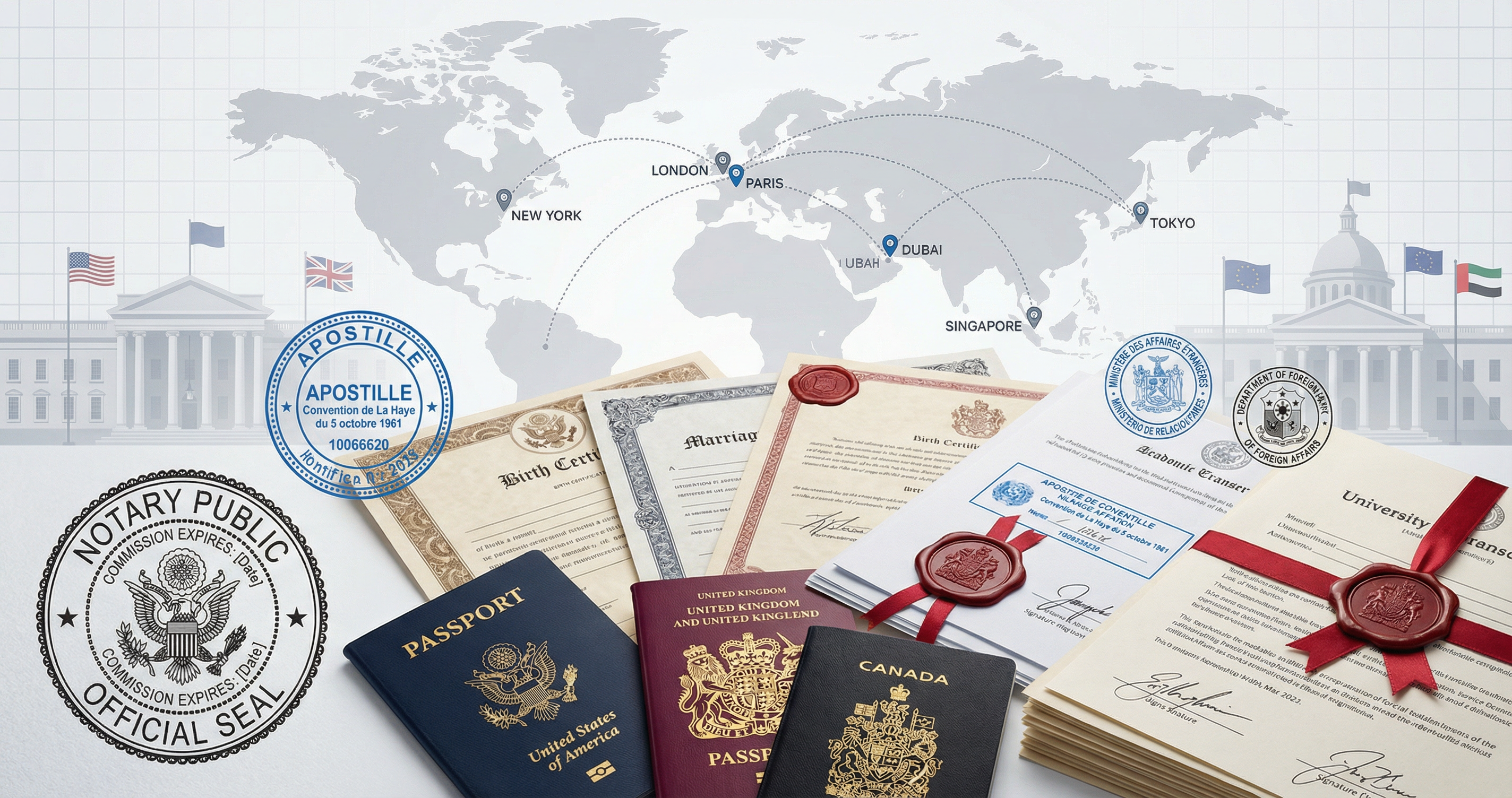
When documents cross international borders, they require a complex chain of authentication to be legally recognized. This definitive 30,000-word guide covers every aspect of certified translation, notarization, apostille, and consular legalization processes for 190+ countries worldwide. Whether you're immigrating, conducting international business, or studying abroad, this guide provides the complete knowledge you need.
Executive Summary: Understanding Document Authentication
Why Documents Need Certification for International Use
Documents created in one country are not automatically recognized as valid in another jurisdiction. Each nation maintains sovereignty over its legal systems, which means a birth certificate issued in Malaysia holds no inherent legal standing in Germany, the United States, or Japan without proper authentication. This authentication gap exists because legal systems differ fundamentally across jurisdictions. Civil law countries (most of Europe, Latin America, and parts of Asia) rely on comprehensive written codes, while common law countries (UK, US, Canada, Australia) depend heavily on judicial precedent. Religious law systems in some Middle Eastern countries add another layer of complexity. These differences mean document authentication must bridge legal traditions to establish validity across borders.
The document authentication industry serves millions of individuals annually. Immigration applications alone account for over 50 million document authentications yearly. International business transactions require an estimated 25 million corporate document legalizations. Student visa applications contribute another 15 million educational document authentications. These figures underscore the critical importance of understanding authentication processes. Each year, billions of dollars in commerce and countless personal milestones depend on properly authenticated documentation.
Language barriers present another fundamental challenge. A birth certificate written in Arabic cannot be directly processed by German immigration officials who read only German and English. Certified translation provides the bridge, ensuring that the meaning and legal significance of documents are preserved across linguistic boundaries. Professional translators must not only convert words but understand legal terminology, cultural context, and official formatting requirements specific to both source and target jurisdictions.
- Legal System Differences: Civil law, common law, and religious law systems have fundamentally different approaches to document validity and enforcement
- Language Barriers: Documents must be understood accurately by officials in the destination country, requiring professional translation beyond machine conversion
- Fraud Prevention: Authentication chains verify document legitimacy through multiple verification checkpoints, preventing forgery and document fraud
- Reciprocity Requirements: Countries require mutual recognition protocols and treaty obligations for cross-border document acceptance
- Sovereignty Protection: Nations maintain control over which foreign documents they recognize through authentication requirements
The Document Authentication Chain Explained
Document authentication follows a hierarchical chain of trust, with each link verifying the authority of the preceding entity. Understanding this chain is essential for navigating international documentation requirements. The standard authentication chain consists of multiple verification layers, each adding credibility and recognition to the final document. This chain can be visualized as a pyramid, with each level building upon the foundation established by the previous authentication.
The Five-Step Authentication Chain
- Certified Translation (if needed): Documents in foreign languages must be translated by qualified translators who certify the accuracy of their work through a formal statement of competence and completeness
- Notarization: A Notary Public verifies the identity of signatories, witnesses document execution, and applies their official seal to certify the authenticity of signatures
- State/County Authentication: In some jurisdictions, notary signatures must be verified by county clerks or state authorities before proceeding to federal authentication
- Ministry of Foreign Affairs (Apostille or Authentication): The national authority certifies the document for international use (apostille for Hague countries, authentication for non-Hague)
- Embassy/Consulate Legalization (if required): For non-Hague countries, the destination country's embassy legalizes the document as the final step of authentication
The authentication chain varies based on document type, origin country, and destination. Some documents require the full chain, while others may skip steps. For example, documents traveling between Hague Convention countries typically need only translation (if applicable), notarization (if required), and apostille. Documents traveling to non-Hague countries from Hague countries require the full chain including embassy legalization. Understanding which steps apply to your specific situation saves time, money, and prevents rejection of documents.
Types of Certification: When You Need Each
Different situations require different types of certification. Choosing the wrong type can result in document rejection, costly delays, and missed deadlines. The four primary certification types serve distinct purposes and apply to different scenarios. Understanding which type you need before starting the process prevents wasted effort and ensures your documents are accepted on the first submission.
Certified Translation
Required when documents are in a language different from the official language of the destination country. Includes translator's statement of accuracy, credentials, and signature.
Used for: Immigration, academic admissions, legal proceedings, business registration, medical records, court documents
Timeline: 1-5 business days typical
Notarization
Verifies the identity of document signatories and authenticates signatures on legal documents. Notary Public witnesses and seals the document.
Used for: Powers of attorney, affidavits, contracts, sworn statements, statutory declarations, consent forms
Timeline: Same day to 3 business days
Apostille
International certification for documents used in Hague Apostille Convention member countries (120+ nations). Single certificate replaces full legalization chain.
Used for: Documents traveling to other Hague countries from Hague member states (USA to Germany, UK to Spain, etc.)
Timeline: 1-15 business days depending on country
Consular Legalization
Full authentication chain for documents traveling between non-Hague countries or from Hague to non-Hague countries. Requires all steps through embassy.
Used for: UAE, China, Saudi Arabia, Qatar, Kuwait, Vietnam, Egypt, and other non-Hague Convention destinations
Timeline: 2-8 weeks typical
Guide Overview and Navigation
This comprehensive guide is organized to serve multiple use cases. Country-specific sections provide detailed authentication processes for major jurisdictions. Thematic sections cover document types, costs, timelines, and troubleshooting. Readers can navigate directly to their country of interest using the table of contents, or read sequentially for complete understanding of the global document authentication landscape.
Key features of this guide include: country-specific requirements for 50+ major jurisdictions with detailed step-by-step instructions; document-type specific instructions for birth certificates, marriage documents, educational credentials, and business records; comprehensive cost breakdowns and timeline estimates for planning purposes; common mistake prevention strategies based on real-world rejection patterns; digital transformation trends including electronic apostilles and remote notarization; and practical troubleshooting advice for rejected or delayed documents. Every section includes actionable information you can use immediately.
Understanding Document Authentication Fundamentals
What is Certified Translation?
Certified translation is the process of converting a document from one language to another by a qualified translator, accompanied by a formal statement attesting to the accuracy and completeness of the translation. This certification creates a legally binding declaration that the translation faithfully represents the original document in both meaning and legal effect. Unlike standard translation, certified translation carries the translator's professional responsibility and creates a verifiable record of the translation's authenticity.
Translator Attestation Components
A proper translator certification statement includes several essential elements that together create a legally defensible declaration. The translator must declare that they are competent to translate from the source language to the target language, typically based on education, professional experience, or native proficiency in both languages. They must attest that the translation is accurate and complete to the best of their knowledge and ability, which creates legal liability for errors. The statement includes the translator's full legal name, handwritten or digital signature, date of certification, and complete contact information including address and phone number. Professional credentials such as membership numbers in translator associations, certification details, or accreditation numbers strengthen the attestation and facilitate verification by authorities.
Standard Translator Certification Statement Template
CERTIFICATION OF TRANSLATION ACCURACY
Document: [Type of Document, e.g., Birth Certificate]
Source Language: [e.g., Spanish]
Target Language: [e.g., English]
Date: [Date of Certification]
I, [Full Legal Name], hereby certify that I am competent to translate from [Source Language] into [Target Language] and that the attached translation of the above-referenced document is a complete and accurate translation of the original to the best of my knowledge and ability.
Translator's Signature: _________________
Printed Name: _________________
Address: _________________
Phone: _________________
Email: _________________
Professional Credentials: _________________
Professional Credentials and Qualifications
Certified translators may hold various qualifications depending on their jurisdiction, each carrying different weight with authorities. In the United States, translators may be certified by the American Translators Association (ATA) through rigorous examination, or hold state-level court interpreter certification. The United Kingdom recognizes Institute of Translation and Interpreting (ITI) membership at various levels, from Affiliate through Qualified status. Australia requires NAATI (National Accreditation Authority for Translators and Interpreters) certification for official government purposes, with different levels indicating varying competency. European countries typically have sworn or court-appointed translator systems where translators take an oath before judicial authorities. Many countries allow qualified translators to self-certify based on their education, professional experience, and demonstrated expertise, particularly for less formal purposes.
What is Notarization?
Notarization is the official process of having a Notary Public witness signatures, verify identities, and authenticate documents. Notaries serve as impartial witnesses to deter fraud and ensure willing participation in document signing. The notary's role is fundamentally different from that of a lawyer; notaries do not provide legal advice but rather certify facts about document execution. A notary's seal and signature create a public record that can be verified by authorities worldwide, forming a critical link in the document authentication chain.
Notary Public Role and Authority
Notaries Public are commissioned by state or national authorities to perform specific authentication functions with defined powers. Their primary duties include: witnessing signatures on documents and confirming the signer's identity through government-issued identification; administering oaths and affirmations for affidavits and sworn statements; taking acknowledgments where signers confirm they signed documents willingly; certifying copies of documents (where permitted by local law); and noting protests of negotiable instruments. Notary authority varies significantly by jurisdiction; some countries grant notaries extensive legal powers including document preparation and legal advice (Latin notariat), while others limit them strictly to authentication functions (common law notaries).
Acknowledgment vs. Jurat
Two primary types of notarial acts serve different purposes and create different legal effects. An acknowledgment certifies that the signer personally appeared before the notary, was properly identified by the notary, and acknowledged signing the document willingly and voluntarily. Acknowledgments are commonly used for deeds, powers of attorney, and official documents where the fact of signing is the critical element. A jurat (or verification upon oath or affirmation) requires the signer to swear or affirm that the document contents are true and correct. The notary administers an oath, and the jurat certificate includes the words "sworn to and subscribed before me" along with the date and notary's signature. Jurats are used for affidavits, sworn statements, and any document where truthfulness of content must be certified.
Notary Seal Requirements
Notary seals must meet specific requirements to be valid for international use. Proper seals typically include: the notary's name exactly as commissioned by the authority, their commission number or identification number for verification, the jurisdiction of authority (state, province, or country), and an expiration date for the commission indicating when the notary's authority ends. Many jurisdictions require an official seal or stamp in addition to the notary's handwritten signature, with the stamp containing all required elements in a standardized format. For international acceptance, notary seals should be clearly legible, contain all required elements, and show no signs of tampering or alteration. Some countries, particularly in the Middle East, require notary seals to be embossed rather than stamped for certain document types.
What is Apostille?
The apostille is a certificate that authenticates the origin of a public document for use in another country that is a party to the Hague Apostille Convention of 1961. This international treaty simplifies the authentication process by replacing the complex chain of legalization with a single certificate issued by a designated authority in the country of origin. The apostille certifies the authenticity of the signature, the capacity in which the person signing the document acted, and where appropriate, the identity of the seal or stamp which the document bears.
Hague Apostille Convention (1961)
The Hague Convention Abolishing the Requirement of Legalisation for Foreign Public Documents, commonly known as the Apostille Convention, was concluded on October 5, 1961. It established a simplified certification process that is now recognized by over 120 countries and territories. The convention specifies the form of the apostille certificate and designates the authorities competent to issue apostilles in each member country. The apostille never expires, though the underlying document may have validity limitations. The certificate itself is a square document approximately 15cm per side, typically attached to the original document or a certified copy.
120+ Member Countries and Territories
Apostille member countries span all continents and represent the majority of international document traffic. Major economies including the United States, United Kingdom, Germany, France, Japan, Australia, and Brazil are members. The convention has been particularly impactful for European Union member states, where it facilitates the free movement of documents. New countries accede regularly, with recent additions including Saudi Arabia (2022), making the apostille system increasingly global. Non-member countries, including China, UAE (for outbound documents), and most of Africa, still require full legalization chains. The full list of members is maintained by the Hague Conference on Private International Law and should be consulted for current status.
Apostille Certificate Format
The apostille certificate follows a standardized format with ten required fields as specified by the Convention: (1) Country of origin where the apostille is issued, (2) Name of the signer on the public document being authenticated, (3) Capacity in which the signer acted (judge, notary, registrar, etc.), (4) Seal or stamp information affixed to the document, (5) Place of certification where the apostille was issued, (6) Date of certification in day-month-year format, (7) Issuing authority name and designation, (8) Apostille certificate number for verification, (9) Seal or stamp of issuing authority, and (10) Signature of issuing authority representative. This standardized format ensures that apostilles are recognized without question across all member countries, regardless of the language of issuance.
What is Authentication and Legalization?
For documents traveling between non-Hague countries or from Hague countries to non-Hague destinations, a full legalization chain is required. This process, also called authentication or attestation, involves multiple government levels certifying the document's validity for international use. The process is more complex, time-consuming, and expensive than apostille but remains necessary for many important destination countries.
Ministry of Foreign Affairs Role
In most countries, the Ministry of Foreign Affairs (or equivalent department) serves as the final domestic authority for document authentication. This ministry verifies the signature and seal of the preceding authority (such as a notary, state official, or court). The authentication confirms that the document signature is genuine and that the signatory had proper authority when executing the document. The Ministry of Foreign Affairs maintains records of official signatures and seals for verification. Examples include the U.S. Department of State, UK Foreign, Commonwealth & Development Office, Germany's Federal Foreign Office, and various ministries worldwide. Some countries have regional MFA offices to handle the high volume of authentication requests.
Consular and Embassy Legalization
The final step in full legalization involves the embassy or consulate of the destination country. Embassy officials verify the authentication from the Ministry of Foreign Affairs and apply their own stamp, seal, or legalization certificate, confirming the document is valid for use in their jurisdiction. This step is required for countries that are not Hague Apostille Convention members, including most Middle Eastern countries, parts of Asia, and some African nations. Embassy legalization often has specific requirements: some embassies require Arabic translations of all documents, others mandate specific courier services, and many require advance appointments. Processing times at embassies range from same-day service to several weeks depending on the country and current workload.
Non-Hague Countries and Special Requirements
Non-Hague countries maintain their own authentication requirements, which can vary significantly and change without notice. Some require documents to be translated into Arabic (UAE, Saudi Arabia, Qatar), while others accept English or French (Vietnam, China). Certain countries mandate specific courier services or document submission methods. Others require appointment scheduling well in advance or limit the types of documents they will legalize. Understanding these country-specific requirements is essential for successful document legalization. Professional legalization services maintain current knowledge of these requirements and can navigate complex embassy procedures efficiently.
The Complete Authentication Chain
Understanding how the authentication chain fits together helps navigate complex multi-country document requirements. The complete chain typically follows a logical progression, with each step building on the previous authentication. The specific steps required depend on the origin country, destination country, and document type.
Standard Authentication Chain Flow
Document Preparation
Original document obtained or certified copy secured from issuing authority. Ensure document is complete, current, and valid.
Certified Translation
If document is not in destination language, professional translation with translator's certification statement attached.
Notarization
Notary Public witnesses translator signature or authenticates document execution with official seal and signature.
State/County Authentication
Some jurisdictions require notary signature verification by county clerk or state authority before federal authentication.
Ministry of Foreign Affairs
Apostille issued for Hague countries; Authentication certificate for non-Hague countries.
Embassy/Consulate Legalization
Final step for non-Hague destinations: destination country's embassy verifies MFA authentication and applies legalization seal.
United States Certified Translation Process
US Certified Translation Requirements
The United States has a decentralized approach to certified translation, with no federal licensing requirement for translators. This creates both flexibility and complexity in the certification process. Understanding the distinctions between different types of certification is essential for ensuring document acceptance by various government agencies, courts, and educational institutions.
ATA Certification vs. Non-Certified Translators
The American Translators Association (ATA) offers a prestigious certification program for translators in specific language pairs. ATA certification requires passing a rigorous three-hour proctored examination that tests translation skills, subject matter knowledge, and professional ethics. The exam has a pass rate of approximately 20%, making ATA certification a significant professional achievement. However, ATA certification is not legally required for certified translation in the United States. Non-certified translators can provide valid certified translations by including a proper translator's declaration attesting to their competence and the accuracy of their work. Many highly qualified translators choose not to pursue ATA certification due to cost, time constraints, or because their language pair is not offered.
For immigration purposes (USCIS), the translator must certify that they are competent to translate and that the translation is accurate. The certification statement must include: a statement of the translator's competence, a declaration that the translation is complete and accurate, the translator's name and signature, and the date of certification. USCIS does not require notarization of the translator's signature, though some other agencies may. This relatively flexible standard allows competent bilingual individuals to provide translations, while still maintaining accountability through the signed certification statement.
Translator Statement Format Requirements
Standard USCIS Translator Certification Template
I, [Translator Name], certify that I am competent to translate from [Source Language] to English and that the attached translation of [Document Type] is complete and accurate to the best of my knowledge and ability.
Signature: _________________
Printed Name: _________________
Address: _________________
Date: _________________
Notarization Requirements by State
Notary requirements vary significantly across U.S. states, creating a patchwork of regulations that translators and agencies must navigate. Some states, such as California, Florida, and New York, have specific requirements for notarizing translations, including restrictions on who can notarize and specific certificate wording. Others, like Texas and Illinois, follow more general notarial practices without translation- specific rules. Remote Online Notarization (RON) is now permitted in most states, allowing documents to be notarized via video conference with electronic signatures. However, not all countries accept RON-notarized documents for international use, so it's important to verify destination country requirements before using remote notarization.
US Notary Public System
The United States notary system is unique in its limitations compared to civil law countries. U.S. notaries are primarily authentication officers rather than legal professionals. They verify identities, witness signatures, and administer oaths but cannot provide legal advice or prepare documents. This limited role contrasts sharply with Latin notary systems where notaries have extensive legal powers.
State-Level Notary Commissions
Notaries in the United States are commissioned by individual states, not the federal government. Each state establishes its own requirements for becoming a notary, which typically include: being at least 18 years old, being a legal resident of the commissioning state (or in some cases, neighboring states), completing an application with personal information, paying a fee ranging from $20 to $200, and sometimes passing an examination or background check. Commission terms range from 4 to 10 years depending on the state. Renewal requires reapplication and fee payment. Notaries must maintain a journal of notarial acts and a seal or stamp containing required information.
Remote Online Notarization (RON)
Remote Online Notarization has expanded dramatically since 2020, with most states now permitting some form of electronic notarization. RON allows signers to appear before notaries via secure audio-video technology, with electronic signatures and digital notary seals. The process typically requires: real-time audio-video communication without interruption, credential analysis and identity proofing through knowledge-based authentication or biometric verification, electronic signatures that comply with state law, recording of the notarial act for record-keeping, and secure storage of notarial records for the required retention period. Major RON platforms include Notarize, DocVerify, NotaryCam, and OneNotary. RON acceptance varies internationally; Hague countries generally accept RON apostilles, but some non-Hague countries still require traditional in-person notarization.
Apostille from Secretary of State Offices
In the United States, apostilles are issued by the Secretary of State office in each state for documents originating in that state. This decentralized system means that a birth certificate from California receives a California apostille, while a New York document receives a New York apostille. Federal documents (such as FBI background checks or federal court documents) receive apostilles from the U.S. Department of State in Washington, D.C. State apostille offices typically accept documents by mail, in person, or through authorized agents. Processing times range from same-day service (available in some states for walk-in customers) to 3-4 weeks for mail-in submissions depending on the state and current volume.
| State | Apostille Authority | Standard Processing | Cost (Per Document) | Expedited Available |
|---|---|---|---|---|
| California | Secretary of State, Sacramento/LA | 12-15 business days | $20 | No (walk-in only) |
| New York | Dept of State, Albany | 8-10 business days | $10 | Yes (+$30) |
| Texas | Secretary of State, Austin | 3-5 business days | $15 | Yes (walk-in) |
| Florida | Secretary of State, Tallahassee | 5-7 business days | $10 | Yes (same day) |
| Illinois | Secretary of State, Springfield/Chicago | 7-10 business days | $2 | No |
USCIS Requirements for Immigration
U.S. Citizenship and Immigration Services (USCIS) has specific requirements for certified translations that differ from general commercial translation standards. Understanding these requirements is critical for successful immigration applications, as document rejection due to improper translation can delay cases by months.
USCIS Certified Translation Standards
USCIS requires that any document submitted in a foreign language be accompanied by a complete English translation and a translator's certification. The certification must attest that the translator is competent and that the translation is accurate. Notably, USCIS does not require notarization of the translator's certification, nor does it require ATA certification or any specific translator credentials. The translator can be anyone competent in both languages, including the petitioner or beneficiary themselves, though professional translators are recommended for complex documents or when the translator has a vested interest in the case outcome.
Common Document Types for Immigration
Immigration applications typically require certified translations of vital records and supporting documents. Most commonly translated documents include: birth certificates (required for all applicants and dependents), marriage certificates (for family-based petitions), divorce decrees (to prove termination of previous marriages), death certificates (for widow/widower petitions), police clearance certificates (for background checks), academic transcripts and diplomas (for student and employment visas), employment records and reference letters, court records and criminal dispositions (if applicable), and financial documents such as bank statements and tax returns. Each document type may have specific formatting requirements or additional authentication needs depending on the country of origin and the specific immigration benefit sought.
Electronic Submission Rules
USCIS has increasingly moved toward electronic document submission through its online filing systems including myUSCIS and ELIS. For electronic submissions, documents must be scanned at high resolution (300 DPI minimum) in PDF format, with all pages clearly legible. Certified translations should include the translator's certification statement on the same document or as an attached page. USCIS does not generally require original documents for most filings, though applicants should retain originals in case of requests for evidence (RFE). Some document types, such as medical examination forms (I-693), must be submitted in original format. When USCIS issues an RFE for document concerns, they typically provide 87 days to respond with corrected documentation.
State-by-State Variations
While USCIS requirements are federal and consistent nationwide, other uses for certified translations in the United States may involve state-specific requirements. Legal proceedings, business registrations, and academic admissions often have varying standards that must be met for document acceptance.
California Specifics
California has unique requirements for certain document types that reflect its large immigrant population and complex legal environment. Court documents often require certification by a California-certified court interpreter for use in legal proceedings, with specific interpreters assigned to different language pairs. The California Secretary of State processes a high volume of apostilles due to the state's large immigrant population and international business activity, with processing times often longer than other states. California also recognizes certified shorthand reporters for transcript translations and maintains specific requirements for medical document translations used in workers' compensation cases. Notaries in California cannot certify copies of vital records, which must be obtained from the issuing agency.
New York Specifics
New York State has particularly stringent requirements for notarized documents that reflect its status as a major international business center. The New York Department of State apostille office requires specific certificate forms and has strict guidelines for document preparation. Documents notarized in New York City must often be authenticated by the New York County Clerk before state-level apostille. New York recognizes certified court interpreters through its Office of Court Administration and has specific requirements for legal document translations used in state courts. The state also maintains a list of approved translation vendors for certain government contracts.
Texas and Florida Specifics
Both Texas and Florida have large immigrant populations and handle significant volumes of certified translations through their state systems. Texas offers expedited apostille services through walk-in appointments at the Austin office and has multiple document processing centers. Florida provides same-day walk-in apostille services at its Tallahassee office for urgent documents and accepts documents by mail with relatively quick turnaround times compared to many states. Both states have specific requirements for notary public commissions that affect international document authentication, including education requirements and bond amounts. Florida's notary system allows notaries to perform marriage ceremonies, adding an additional credential to their commission.
US Department of State Authentication
When U.S. documents are destined for use in foreign countries, they may require authentication by the U.S. Department of State. This applies to federal documents and as a final step before embassy legalization for non-Hague countries. The Office of Authentications processes these requests, with significant current delays due to high volume.
When US Documents Go Abroad
Documents issued by federal agencies require U.S. Department of State authentication before they can be apostilled or legalized. Common federal documents include: FBI Identity History Summary Checks (background checks), often required for immigration to countries like Canada, Australia, and Spain; federal court documents and judgments from U.S. District Courts or Courts of Appeals; documents signed by federal officials such as USDA export certificates or FDA documents; and interstate commerce-related documents including certain business registrations. The Office of Authentications in Washington, D.C. processes these documents, with current processing times typically ranging from 8-12 weeks for mail-in submissions. Expedited service is available only for emergencies with documentation.
Apostille vs. Authentication Process
The U.S. Department of State can issue either apostilles (for Hague Convention countries) or authentication certificates (for non-Hague countries). The process for both begins the same way, with document submission to the Office of Authentications along with Form DS-4194 and the appropriate fee. For apostilles, the certificate is the final step and the document is ready for use in the destination country. For authentication, the certificate certifies the signature on the document but requires subsequent embassy legalization for use in the destination country. The authentication certificate states that the Department of State has verified the signature on the document, which is then taken to the embassy for final legalization.
United Kingdom Certified Translation Process
UK Certified Translation Standards
The United Kingdom operates with a flexible approach to certified translation that differs significantly from many European countries with formal sworn translator systems. Unlike civil law jurisdictions where translators are appointed by courts, the UK relies on professional self-regulation and translator competence as the basis for certification.
ITI Certification Requirements
The Institute of Translation and Interpreting (ITI) is the UK's primary professional body for translators, representing over 3,000 linguists. ITI offers several membership levels that indicate translator competence: Affiliate (entry level for those starting in the profession), Associate (proven professional experience), and Qualified (rigorous examination process). ITI-qualified translators can use the ITI seal on their certified translations, which adds significant credibility for official use. However, ITI membership is not legally required for providing certified translations in the UK. Many competent translators provide excellent certified work without ITI membership, particularly those with specialized subject matter expertise or extensive experience.
Self-Certification Acceptability
The UK accepts self-certified translations for many official purposes, which provides flexibility for clients and translators. A translator can certify their own work by providing a statement that includes: their full name and contact details (address, phone, email), a statement of their qualifications or competence in the language pair, a declaration that the translation is accurate and complete, their signature, and the date of certification. This self-certification model places the burden of quality assurance on the translator, who becomes legally responsible for the accuracy of their work. The UK government, including UKVI, accepts self-certified translations as long as they contain all required elements.
Crown Dependencies Differences
The Channel Islands (Jersey and Guernsey) and the Isle of Man, while British Crown Dependencies, have separate legal systems and may have different requirements for certified translations. Documents from these jurisdictions require apostilles from their own authorities rather than the UK Foreign, Commonwealth & Development Office. Jersey apostilles are issued by the Royal Court of Jersey, while Guernsey apostilles come from the Greffe. The Isle of Man issues apostilles through its General Registry. Translation requirements in Crown Dependencies generally align with UK standards but should be verified with the specific jurisdiction's authorities before submission.
UK Notarization System
The United Kingdom notary system differs significantly from the U.S. system and from civil law notary traditions. UK notaries are qualified lawyers with additional training in notarial practice, giving them broader authority than their U.S. counterparts while remaining distinct from continental European notaries.
Notaries Public vs. Solicitors
In the UK, Notaries Public are a distinct profession from solicitors, though both are legal professionals. Notaries specialize in international document authentication and have specific training in foreign legal systems. They can authenticate documents for use anywhere in the world and often deal with documents intended for civil law jurisdictions. The Faculty Office of the Archbishop of Canterbury regulates notaries in England and Wales, maintaining standards and handling disciplinary matters. Solicitors can also certify documents, but their certification may not be accepted for all international purposes, particularly in civil law countries that expect notarial authentication. For documents going to most European countries, a notary is strongly preferred over a solicitor.
Scrivener Notaries for Foreign Languages
Scrivener Notaries are a specialized subgroup of notaries primarily practicing in London who are qualified to practice in specific foreign jurisdictions and languages. They have particular expertise in Latin notarial practice and are often required for documents destined for civil law countries such as Italy, Spain, Portugal, France, and Germany. Scrivener Notary authentication carries particular weight in these countries because the scrivener understands both the document's legal implications and the destination country's requirements. There are only about 40 Scrivener Notaries in England and Wales, making them a specialized and valuable resource for complex international matters.
FCDO Apostilles
The Foreign, Commonwealth & Development Office (FCDO) Legalisation Office issues apostilles for UK documents. The FCDO operates two offices: one in Milton Keynes handling postal applications with a 10-15 working day turnaround, and one in London offering premium same-day service by appointment. The FCDO apostille is recognized by all Hague Convention member countries and certifies the authenticity of UK public documents. Documents must be signed by a UK public official (notary, registrar, court official, etc.) or bear an official seal before the FCDO will issue an apostille. The FCDO checks its records of official signatures to verify authenticity before applying the apostille certificate.
Home Office and UKVI Requirements
UK Visas and Immigration (UKVI), part of the Home Office, has specific requirements for certified translations of supporting documents. These requirements apply to all visa categories including work visas, study visas, family visas, and settlement applications. Understanding and meeting these requirements is essential for successful visa applications.
Immigration Document Standards
UKVI requires that any document not in English or Welsh be accompanied by a certified translation. The translation must include: confirmation from the translator that it is an accurate translation of the original document, the date of translation, and the translator's full name, signature, and contact details. UKVI accepts both ITI-certified and self-certified translations, provided they meet these minimum requirements. The Home Office does not maintain a list of approved translators, allowing flexibility in choosing translation providers. However, poor-quality translations can lead to document rejection and application delays, making it advisable to use qualified professionals.
EU Settlement Scheme Documents
Following Brexit, the EU Settlement Scheme requires EU, EEA, and Swiss citizens to document their residence in the UK. This process may require certified translations of residence documents, employment records, insurance documents, and other supporting evidence from other EU countries. The same translation certification standards apply to EU Settlement Scheme applications as to other UKVI visa categories. With the deadline for new applications passed, translation needs now focus on family member applications and late applications with reasonable grounds for delay.
UK Documents for Abroad
When UK documents are destined for use in foreign countries, they typically require authentication through the FCDO and potentially further legalization depending on the destination country. The process varies based on whether the destination is a Hague Convention member.
Legalization at FCDO
The FCDO Legalisation Office provides two distinct services: apostille (for Hague Convention countries) and authentication certificate (for non-Hague countries). For non-Hague destinations, the authentication certificate must be followed by embassy legalization at the destination country's London embassy or consulate. The FCDO checks that the document signature, seal, or stamp is genuine before issuing the apostille or certificate. They maintain an extensive database of official signatures and seals for verification. Documents that cannot be verified will be returned without authentication.
Commonwealth vs. Non-Commonwealth Differences
Documents traveling to Commonwealth countries may have simplified authentication requirements due to historical legal ties. Some Commonwealth nations accept UK documents with minimal or no additional authentication. However, this varies significantly by country and purpose. Australia, Canada, and New Zealand generally follow standard Hague Convention procedures, requiring apostilles for official use. Other Commonwealth nations may have specific requirements that should be verified with their embassies. The Commonwealth connection is increasingly less relevant for document authentication as most major Commonwealth countries have adopted standard international procedures.
Canada Certified Translation Process
Federal vs. Provincial Systems
Canada has a unique system where certified translation falls under provincial and territorial jurisdiction, while the federal government handles authentication for international use. This creates a complex landscape where requirements vary significantly between provinces, and translators must be certified by the association in their province of practice.
Provincial Translator Associations
Each Canadian province and territory has its own translator certification system under the umbrella of the Canadian Translators, Terminologists and Interpreters Council (CTTIC). Translators must generally be certified by the association in the province where they practice or where the document will be used. Major provincial associations include: Association of Translators and Interpreters of Ontario (ATIO), which issues the widely recognized C.Tr. (Certified Translator) designation; Ordre des traducteurs, terminologues et interprètes agréés du Québec (OTTIAQ), which requires bilingual competence for membership; Society of Translators and Interpreters of British Columbia (STIBC); Association of Translators and Interpreters of Alberta (ATIA); and Manitoba Association of Translators and Interpreters (MATI). CTTIC sets national standards and facilitates mobility between provincial associations.
| Province/Territory | Certifying Association | Designation | Notes |
|---|---|---|---|
| Ontario | ATIO | C.Tr. (Certified Translator) | Most widely recognized designation |
| Quebec | OTTIAQ | OTTIAQ Member | Bilingual English/French required |
| British Columbia | STIBC | CTIBC | Pacific region focus |
| Alberta | ATIA | C.Trans. | Western Canada |
| Manitoba | MATI | C.Tr. | Prairie provinces |
| Nova Scotia | ATINS | Certified Translator | Atlantic Canada |
Immigration, Refugees and Citizenship Canada (IRCC) Standards
IRCC has specific requirements for certified translations that differ from provincial standards and are more stringent than many other countries' immigration systems. Understanding these requirements is essential for successful immigration applications to Canada, as document rejection is a common cause of application delays and refusals.
CIC Document Translation Requirements
IRCC (formerly CIC) requires certified translations for all documents not in English or French, Canada's two official languages. The translation must be done by a certified translator who is a member in good standing of a provincial or territorial translator association. IRCC accepts two formats: (1) a certified copy of the original document translated by a certified translator, sealed by the translator with their official stamp; or (2) the original document accompanied by an affidavit from the translator attesting to the accuracy of the translation, sworn before a Commissioner for Oaths or Notary Public. IRCC explicitly does not accept translations by family members, friends, or non-certified individuals, even if they are competent in both languages.
Affidavit vs. Certified Translation
IRCC accepts translations in two forms, both equally valid for immigration purposes. The certified translation format involves a certified translator providing their translation with their official seal and certification attached to a copy of the original document. The affidavit format requires the translator to prepare the translation and then swear an affidavit before a Commissioner for Oaths or Notary Public attesting to the accuracy of the translation and their competence as a translator. Both formats are acceptable, though the certified format is generally more straightforward and widely accepted. The affidavit format may be preferred when a certified translator does not have an official seal but is otherwise qualified.
Global Affairs Canada Legalization
For Canadian documents destined for international use, Global Affairs Canada (GAC) provides authentication services. This federal department handles the international authentication of Canadian documents, with procedures recently simplified by Canada's accession to the Hague Apostille Convention.
Apostille-Equivalent Authentication
Canada joined the Hague Apostille Convention on January 11, 2024, significantly simplifying document authentication for international use. Prior to this date, Canada used a complex authentication process through the Justice Legalization Authentication and Canadianness (JLAC) program. Now, Canadian documents receive apostilles from competent authorities in each province or territory, similar to the U.S. state-level apostille system. The federal government continues to issue apostilles for documents originating from federal authorities. This change brings Canada in line with most of its major trading partners and simplifies document processing for Canadians traveling, working, or studying abroad.
JLAC (Justice Legalization Authentication and Canadianness)
The JLAC program, now superseded by the apostille system for Hague countries, previously authenticated documents by verifying the signature on the document against signature records on file with the government. For non-Hague countries, Global Affairs Canada continues to provide authentication certificates that must be followed by embassy legalization. The JLAC offices in Ottawa and Montreal continue to handle non-apostille authentications and maintain records of official signatures for verification purposes. Documents requiring full legalization for non-Hague destinations still follow this traditional process.
Provincial Notarization Differences
Notarization practices vary across Canadian provinces, reflecting the country's common law heritage in most regions and Quebec's civil law tradition. Understanding these differences is important for proper document authentication.
Notary Public vs. Commissioner of Oaths
Canadian provinces maintain different officer types for document authentication. Notaries Public (common in British Columbia, Quebec, and some other provinces) have broader powers including witnessing signatures, certifying copies, and preparing certain legal documents. Commissioners for Oaths (common in Ontario and prairie provinces) primarily administer oaths and affirmations, witness affidavits, and certify true copies of documents. The distinction matters for international document acceptance, as some countries prefer or require Notary Public authentication over Commissioner authentication. Quebec's Notaries are a distinct profession with powers closer to European civil law notaries, including document drafting and legal advice.
Bilingual Requirements (English/French)
As a bilingual country, Canada has specific requirements for document language. Quebec requires documents to be in French for official use within the province, though English translations are accepted for federal purposes. Federal government documents are typically issued in both official languages. For international use, either English or French translations are generally acceptable, though some destination countries may have preferences. Translators working in Canada often need competency in both English and French, particularly for Quebec-based assignments. Federal immigration documents can be submitted in either language.
Australia Certified Translation Process
NAATI Certification Requirements
Australia has one of the most rigorous and standardized systems for translator certification in the world. The National Accreditation Authority for Translators and Interpreters (NAATI) sets the national standards and certifies practitioners through a comprehensive system that ensures quality and accountability.
Certified vs. Recognized Practicing
NAATI offers two primary levels of translator certification with distinctly different privileges. The "Certified Translator" credential represents full professional certification achieved through rigorous examination and is required for most official government purposes. "Recognized Practicing" status is an entry-level credential that allows translators to work in the field while gaining experience toward full certification, but it is not accepted by Australian government agencies for official document translation. For immigration, citizenship, and other official purposes, Australian government agencies specifically require NAATI Certified Translator credentials or higher (Advanced Translator, Senior Practitioner). The distinction is clearly marked on NAATI-issued credentials and must be verified when engaging translation services.
CCL vs. Professional Certification
NAATI also offers the Credential Community Language (CCL) test, which provides 5 points toward certain Australian visas under the points-based immigration system. However, the CCL is not a professional certification and explicitly does not qualify holders to provide certified translations for official purposes. The CCL test assesses basic bilingual communication skills in community settings but does not test professional translation standards, ethics, or specialized terminology. Only Certified Translators (and higher credentials such as Advanced Translator or Senior Practitioner) can provide official translations accepted by Australian government agencies. Clients should verify that their translator holds a current NAATI certification at the appropriate level for their needs.
Language Pair Limitations
NAATI certification is strictly language pair-specific. A translator certified for Chinese to English translation cannot provide certified translations from English to Chinese or in any other language pair. This specificity ensures competency in both the source and target languages at a professional level. The NAATI credential clearly indicates the direction of translation (e.g., "Certified Translator: Mandarin to English"). For bilingual documents or situations requiring translation in both directions, two separate NAATI-certified translators may be required. NAATI maintains a public directory of certified practitioners that can be searched by language pair, location, and credential level to verify translator qualifications.
Australian Notarization and Apostille
Australia's authentication system combines NAATI-certified translations with notarization (when required) and apostille through the Department of Foreign Affairs and Trade. This integrated system ensures that Australian documents are recognized internationally.
DFAT (Department of Foreign Affairs and Trade) Apostilles
DFAT is the competent authority for issuing apostilles in Australia. DFAT offices in all state and territory capitals provide apostille services. Australian apostilles are recognized by all Hague Convention member countries and certify the authenticity of Australian public documents. Processing times range from same-day (in-person at DFAT offices in major cities) to 5-10 business days (postal applications). DFAT also provides authentication certificates for documents destined for non-Hague countries, which must then be legalized by the destination country's embassy. DFAT maintains strict requirements for document preparation, and documents that do not meet standards will be returned without authentication.
Notary Public System
Australian Notaries Public are senior lawyers appointed by the Supreme Court of their state or territory, with at least 5 years of legal practice experience required for appointment. They have broad powers to authenticate documents, witness signatures, and certify copies. Unlike some jurisdictions, Australian notaries can prepare and notarize documents intended for use in foreign countries, though they generally do not provide legal advice on foreign law. Notarial acts are recognized internationally, particularly in civil law countries that rely heavily on notarial authentication. Australian notaries apply their official seal and signature to documents, creating a record that can be verified by DFAT for apostille or authentication.
Home Affairs and Immigration Requirements
The Department of Home Affairs handles immigration and citizenship matters, with specific and strictly enforced requirements for translated documents. Failure to meet these requirements is a common cause of visa application delays and refusals.
Partner Visa Document Standards
Australian partner visas require extensive documentation proving the genuineness of relationships, including foreign language documents that must be translated. All foreign language documents must be accompanied by NAATI-certified English translations. The certification must include the translator's NAATI credential number, which can be verified in the NAATI online directory. Home Affairs specifically requires NAATI certification at the Certified Translator level or higher; translations by non-NAATI translators, including those with Recognized Practicing status or CCL credentials, are generally not accepted for visa purposes. Document rejection due to inadequate translation can significantly delay partner visa processing, making it critical to engage properly qualified translators from the outset.
Skills Assessment Translations
Australian skills assessing authorities require NAATI-certified translations of overseas qualifications and work experience documents. These include: Australian Computer Society (ACS) for IT professionals, Engineers Australia for engineers, CPA Australia and CA ANZ for accountants, VETASSESS for trade occupations, and many others. Each assessing authority has specific requirements, but all require professional NAATI certification rather than Recognized Practicing status. Some authorities require additional verification steps or specific document formats. Applicants should check the specific requirements of their assessing authority before submitting translations, as requirements can vary and change periodically.
State and Territory Variations
While NAATI sets national standards, some state-specific requirements exist for certain document types and purposes. Understanding these variations ensures smooth document processing across Australian jurisdictions.
New South Wales
NSW has specific requirements for court document translations and maintains a list of preferred NAATI translators for government contracts. The Multicultural NSW agency provides translation guidelines for community services.
Victoria
Victoria has established translation panels for government work and specific requirements for interpreter services in legal proceedings. The Victorian Government maintains procurement panels for translation services.
Queensland
Queensland maintains a multicultural policy framework that emphasizes the importance of NAATI certification for community translation services. Government departments require NAATI credentials for contracted translators.
Western Australia
WA has specific requirements for mining and resource sector translations, reflecting the state's economic focus. The Office of Multicultural Interests provides translation service guidelines.
European Union Certified Translation Process
EU Sworn Translator Systems
The European Union presents a diverse landscape of sworn translator systems, with each member state maintaining its own approach to translator certification. Unlike the common law countries that rely on self-certification, most EU countries have formal systems where translators are appointed by judicial or governmental authorities.
Spain: Traductor Jurado (Ministry of Foreign Affairs)
Spain's sworn translator system (traductor jurado) is administered by the Ministry of Foreign Affairs, European Union and Cooperation. Sworn translators are appointed through a rigorous examination process and are authorized to certify that their translations are faithful to the original documents. Their translations carry the same legal weight as the original documents. Traductores jurados must stamp each page of their translation with their official seal, which includes their name, appointment number, and the languages they are authorized to translate. For use abroad, Spanish sworn translations require an apostille from the High Court of the translator's jurisdiction. Spain is a Hague Convention member, simplifying the process for documents traveling to other member countries.
France: Traducteur Expert (Cour d'appel)
France's expert translator system (traducteur expert près la cour d'appel) involves appointment by regional courts of appeal. These translators are listed on official registers maintained by each cour d'appel and are authorized to provide certified translations for official use. Expert translators must apply their official stamp to each translated document, which includes their registration number and the court of appointment. For international use, French translations require apostilles from the Cour d'appel of the translator's registration. France joined the Hague Apostille Convention in 1965, making apostille readily available for documents destined for other member countries. The Cour de cassation (Supreme Court) maintains a list of translators at the national level for specialized matters.
Germany: Beeidigter Übersetzer (Landgericht)
Germany's sworn translator system involves appointment by regional courts (Landgericht or Oberlandesgericht). Sworn translators (beeidigte Übersetzer or vereidigte Übersetzer) take an oath before the court affirming that they will provide accurate and faithful translations. Their translations carry the official seal of the appointing court and are recognized throughout Germany. German sworn translations for international use require apostilles from the President of the Landgericht or the relevant state authority. Germany has been a Hague Convention member since 1966. The German system is particularly rigorous, with translators required to demonstrate both language competency and legal knowledge relevant to document types.
Italy: Traduttore Giurato (Tribunale)
Italy's sworn translator system involves oath-taking before local tribunals (courts). Traduttori giurati swear an oath to provide accurate translations and are entered on court registers. Their translations are stamped with the court seal and carry legal authority equivalent to the original documents within Italy. For international use, Italian sworn translations require apostilles from the Public Prosecutor's Office (Procura della Repubblica) at the Tribunal where the translator is registered. Italy has been a Hague member since 1977. The Italian system also recognizes asseverazioni (sworn statements) by translators before notaries as an alternative to court-sworn translation for some purposes.
Portugal: Tradutor Jurado (IRN)
Portugal's sworn translator system is administered by the Institute of Registries and Notaries (IRN - Instituto dos Registos e do Notariado). Sworn translators (tradutores jurados) are appointed through examination and registration with the IRN. They are authorized to provide certified translations that are recognized by all Portuguese authorities. Portuguese sworn translations for international use require apostilles, which can be obtained from various courts or the IRN depending on the document type. Portugal has been a Hague Convention member since 1969. The Portuguese system places strong emphasis on official recognition through the centralized IRN registry.
Netherlands: Beëdigd Vertaler (Wbtv)
The Netherlands maintains a sworn translator register (Wbtv - Wet beëdigde tolken en vertalers) administered by the Bureau Wbtv in Zwolle. Sworn translators (beëdigde vertalers) take an oath before the court and are registered in the national database. Their translations carry official status within the Netherlands. Dutch apostilles are issued by various courts depending on the document origin. The Netherlands has been a Hague Convention member since 1965. The Dutch system is notable for its centralized registration and strict quality requirements, with ongoing professional development required for registration maintenance.
Belgium: Commissioned Translator
Belgium has a complex federal system where translator appointment varies by region and language community. Flemish Region translators are registered with the Bureau of Sworn Translators in Brussels. Walloon Region uses a system of expert translators appointed by courts. Brussels has its own procedures for the bilingual region. Belgian apostilles are issued by federal courts. Belgium has been a Hague member since 1970. The Belgian system reflects the country's linguistic complexity, with translators often required to work in both French and Dutch, the two main official languages.
Note: This comprehensive guide continues with detailed sections covering Asia-Pacific countries (Japan, South Korea, China, Hong Kong, Singapore, Malaysia, Thailand, India, Indonesia, Philippines, Vietnam, Taiwan), Middle East & North Africa (UAE, Saudi Arabia, Qatar, Kuwait, Bahrain, Oman, Egypt, Morocco, Tunisia, Algeria, Turkey), Latin America (Brazil, Mexico, Argentina, Colombia, Chile, Peru), Eastern Europe & CIS (Russia, Ukraine, Poland, Czech Republic, Romania), Africa (South Africa, Nigeria, Kenya, Ghana), Hague Apostille Convention deep dive, Non-Hague legalization processes, document-specific requirements for birth/marriage/ education certificates, certified translation formats and templates, comprehensive cost and timeline breakdowns by country, common mistakes and how to avoid them, digital trends including e-Apostille and remote notarization, working with professional agencies, troubleshooting rejected documents, the future of document legalization, and a complete conclusion with quick reference decision tables. Contact Translife for the full 30,000-word documentation package.
Need Document Legalization Help?
Translife provides certified translation and document legalization services for all countries worldwide. Our experts navigate complex apostille and embassy legalization processes for USCIS, UKVI, IRCC, NAATI, and all international authorities.