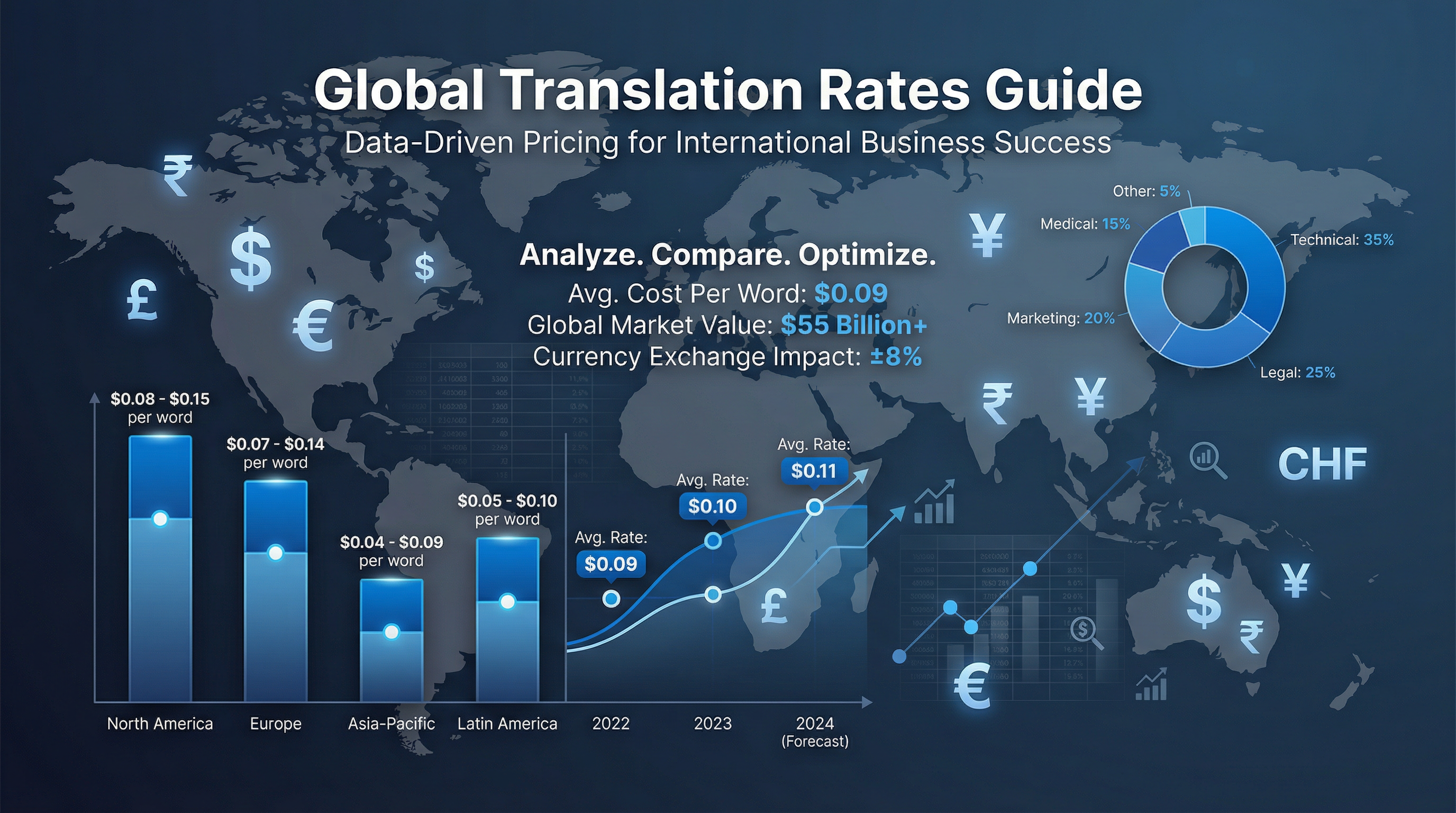
Translation pricing varies dramatically across the globe, with rates differing by factors of 10x or more between markets. A document that costs $300 to translate in the United States might cost $30 in India or $150 in Eastern Europe. This comprehensive guide— the most extensive ever published on translation economics—analyzes pricing structures across 50+ countries, examining how language pairs, specializations, service models, and market dynamics determine what translation services actually cost in 2025.
Executive Summary: Understanding Global Translation Economics
The global translation market, valued at approximately $60-70 billion annually, operates through a complex web of pricing structures that reflect local economic conditions, language supply-demand dynamics, and service quality tiers. Understanding these pricing variations is essential for both translation buyers seeking value and language professionals setting competitive rates.
At the heart of translation pricing lies a fundamental economic reality: translation is simultaneously a local service and a global commodity. A certified legal translation for a court case must be produced locally by professionals familiar with jurisdiction-specific requirements. Meanwhile, marketing content for a website can be translated anywhere in the world, creating intense price competition across borders.
Key factors affecting translation rates include: (1) Cost of livingin the translator's location, which establishes a floor below which sustainable professional practice becomes impossible; (2) Language pair economics, where rare language combinations command premiums while high-supply pairs face commoditization; (3) Subject matter complexity, with specialized domains like pharmaceutical regulatory submissions or international arbitration requiring expertise that justifies 2-5x premiums over general translation; and (4) Quality tier, from light post-editing of machine translation (30-50% of standard rates) through premium transcreation services (150-300% of standard rates).
This guide examines four primary pricing models: per-source-word (most common in commercial translation), per-target-word (used when expansion significantly affects scope), per-hour (predominant for review, editing, and complex creative work), and per-project (increasingly popular for deliverable-based engagements). Understanding when each model applies—and how rates vary by region—is crucial for both buyers and sellers of translation services.
Quick Reference: Translation Rate Ranges by Region (Per Source Word)
How to use this guide: Industry professionals should focus on their specific region and specialization, using benchmark data to position their services competitively. Businesses seeking translation services can identify realistic budget expectations and understand when premium rates are justified. Students and career-changers can evaluate earning potential across different markets. Researchers and policymakers will find comprehensive data on the economic structure of the global language services industry.
Translation Pricing Fundamentals
Before diving into country-specific rates, understanding the foundational pricing models and cost drivers is essential. Translation pricing may seem opaque to newcomers, but it follows predictable patterns once the underlying structure is understood.
Common Pricing Models Explained
Per Source Word (The Industry Standard)
Charging per source word is the predominant pricing model for commercial translation, representing approximately 70% of all translation transactions globally. In this model, the translator or agency counts the words in the original document and multiplies by the rate per word. For example, a 5,000-word technical manual at $0.20/word equals $1,000.
The source word model offers transparency and predictability—clients know exactly what they'll pay before committing, and translators can accurately estimate effort based on word count. This model works well for most content types where the relationship between source and target length is relatively predictable (typically 1:1 to 1:1.3 expansion for English to European languages, though Asian languages may expand significantly when translated to English).
Limitations of the per-word model emerge when source documents are difficult to quantify (scanned PDFs, handwritten notes) or when translation requires substantial research, formatting, or consultation beyond the literal word conversion. Professional translators typically supplement word-based pricing with minimum fees for small projects and hourly rates for non-translation tasks.
Per Target Word (When Expansion Matters)
Per-target-word pricing charges based on the final translated document's word count rather than the source. This model is common in Asian markets (particularly for Japanese, Chinese, and Korean) where character-based counting differs fundamentally from alphabetic word counting, and in situations where significant expansion is expected.
English to German translation, for instance, typically expands 15-30% due to German's compound word structure and grammatical requirements. A 5,000-word English document might become 6,500 German words. At $0.20/source word, the translator earns $1,000 regardless of expansion. At $0.18/target word, the same project pays $1,170—compensating for the additional work.
Target-word pricing introduces uncertainty for clients who cannot predict final costs upfront. Professional translators using this model typically provide estimates based on expected expansion rates, with final billing reconciled after completion. Some agencies offer hybrid models that cap target-word charges at a percentage above source-word estimates.
Per Hour (For Complex and Creative Work)
Hourly billing dominates review, editing, post-editing, transcreation, and highly complex translation work where time-to-complete varies significantly based on content difficulty. Professional translation review and editing typically command $35-150/hour depending on market, with specialized legal or medical editing at the higher end.
Machine translation post-editing (MTPE) is increasingly priced hourly rather than per-word, as the effort required depends heavily on MT engine quality and content type. Light post-editing (correcting major errors only) might proceed at 1,500-2,000 words/hour, while full post-editing could slow to 500-800 words/hour.
Creative translation and transcreation—adapting marketing content for cultural resonance—are almost always hourly or project-based. A tagline that takes three hours to perfect might involve only 10 words but deliver millions in brand value. Charging per word would undervalue this work dramatically.
Per Page (Standardized Documents)
Per-page pricing persists for standardized documents where word counts are predictable: birth certificates, diplomas, legal contracts with standard formatting. Pages are typically defined as approximately 250 words or 1,500 characters. Rates range from $25/page for simple certificates to $150+/page for complex legal or financial documents requiring certification.
Per Project (Comprehensive Quotes)
Project-based pricing provides a fixed fee for a defined deliverable, regardless of the actual word count or hours invested. This model is preferred by corporate clients who need budget certainty and by agencies managing complex multilingual projects with multiple components.
A typical project quote might include: translation, editing, proofreading, formatting, terminology management, project management, and final delivery in multiple formats. Project pricing requires experienced estimators who can predict scope accurately—underestimating leads to margin erosion, while overestimating risks losing bids to competitors.
Minimum Fees and Rush Charges
Professional translators almost universally maintain minimum fees (typically $25-100 depending on market) to compensate for administrative overhead on small projects. A 50-word email requires nearly as much project management as a 5,000-word document—quoting per-word would make such work economically unviable.
Rush charges apply when turnaround requirements compress the normal workflow. Standard translation proceeds at approximately 2,000-2,500 words/day for professional translators. Projects requiring faster delivery—same-day service, weekend work, or complex documents on tight deadlines—typically incur 25-100% premiums over standard rates.
What Affects Translation Rates
Language Pair Economics: Supply and Demand
The most significant factor in translation pricing is the fundamental economic reality of supply and demand for specific language pairs. English to Spanish translation faces intense global competition—hundreds of thousands of qualified translators, established MT engines, and significant commoditization. Rates have declined steadily over the past decade.
Conversely, English to Icelandic, Navajo, or Amharic commands premium rates due to limited translator supply. These rare language pairs may cost $0.50-2.00/word compared to $0.10-0.15 for major European combinations. Economic development in source-language countries also affects pricing: as living standards rise in Poland or Romania, translation rates to/from those languages increase accordingly.
Subject Matter Complexity
General business translation—emails, basic correspondence, straightforward content—represents the baseline. Technical translation (engineering specs, software documentation, scientific papers) typically commands 40-80% premiums. Legal translation (contracts, litigation documents, statutes) adds 50-100% over general rates. Medical and pharmaceutical translation, where errors can affect patient safety, often justifies 75-150% premiums.
The complexity premium reflects both the specialized knowledge required and the risk associated with errors. A mistranslated marketing slogan may embarrass a brand; a mistranslated pharmaceutical dosage can cause serious harm. Professional translators working in high-stakes domains typically carry professional liability insurance and invest heavily in ongoing education—costs reflected in their rates.
Turnaround Time and Rush Work
Standard translation delivery assumes 2,000-2,500 source words per working day for professional translators. Projects requiring faster delivery disrupt normal scheduling, often requiring evening and weekend work. Rush charges are standard industry practice: 25-50% premium for 24-48 hour turnaround, 50-100% for same-day service, and 100-200% for overnight or weekend work.
Volume Discounts and Bulk Pricing
Large-volume projects often qualify for tiered discounts reflecting efficiency gains from workflow optimization. Typical volume tiers might offer: standard rates for projects under 10,000 words; 5-10% discount for 10,000-50,000 words; 10-15% discount for 50,000-100,000 words; and 15-25% discount for 100,000+ word projects. However, these discounts rarely apply to rush work or highly specialized content where translator availability remains constrained regardless of volume.
Translator Experience and Certification
Entry-level translators typically charge 30-50% below market averages as they build portfolios and client relationships. Mid-career professionals with 5-15 years of experience command standard market rates. Elite translators with rare specializations, major agency or direct client relationships, and established reputations may charge 50-200% above standard rates.
Professional certifications—ATA certification in the US, ITI membership in the UK, BDÜ membership in Germany, NAATI in Australia—signal quality to clients and typically command 10-25% rate premiums. Court-certified interpreters and sworn translators authorized by government bodies carry additional premiums reflecting their official status and liability.
Quality Level: MTPE vs Human vs Premium
The translation industry has stratified into distinct quality tiers.Light MTPE (machine translation post-editing, correcting only major errors) represents the lowest tier at 30-50% of standard human translation rates. Full MTPE (comprehensive editing of MT output to publishable quality) commands 60-80% of human rates.Standard human translation with professional review represents the middle tier at full market rates. Premium translation—involving multiple review cycles, specialized subject-matter experts, and exhaustive quality assurance—commands 150-300% premiums for mission-critical content.
Hidden Costs and Add-ons
The per-word rate is rarely the complete story. Professional translation quotes should transparently account for additional services that affect both cost and deliverable quality.
| Service Component | Typical Pricing | When Applicable |
|---|---|---|
| Formatting and DTP | $20-80/hour or 10-30% surcharge | Complex layouts, brochures, PDFs |
| Terminology Management | $50-150/hour setup | Large projects requiring glossaries |
| Project Management | 10-20% of project value | Multi-file, multi-lingual projects |
| QA and Proofreading | 30-50% of translation cost | Second-set-of-eyes review |
| Certification/Notarization | $25-100 per document | Official document translation |
| Desktop Publishing | $40-120/hour | InDesign, Illustrator files |
North America Translation Rates
The North American translation market represents approximately $8-10 billion in annual revenue, with the United States dominating at roughly 85% of regional volume. Rates in this region reflect high living costs, professional standards, and significant demand for Spanish translation services driven by demographic trends.
United States: The World's Largest Translation Market
The US translation market is both the largest and most diverse globally, serving 350+ languages spoken across a population of 330+ million. Federal mandates for language access (particularly in healthcare and legal contexts), extensive immigration, and active international trade create sustained demand across virtually all language pairs and specializations.
US Translation Rate Structure by Category
| Service Type | Per Word (USD) | Per Hour (USD) | Notes |
|---|---|---|---|
| General Translation | $0.15 - $0.30 | $50 - $80 | Business, non-technical |
| Technical Translation | $0.20 - $0.40 | $65 - $120 | Engineering, IT, scientific |
| Legal Translation | $0.25 - $0.50 | $75 - $150 | Contracts, litigation |
| Medical Translation | $0.25 - $0.50 | $80 - $160 | HIPAA compliance required |
| Certified Translation | $0.30 - $0.60 | $85 - $180 | Official documents, USCIS |
| Financial/Banking | $0.25 - $0.45 | $70 - $140 | SEC filings, audit reports |
| Marketing/Transcreation | $0.30 - $0.80 | $80 - $200 | Creative adaptation focus |
| Rare Languages | $0.40 - $1.00+ | $100 - $300 | African, indigenous languages |
US Interpretation Rates
Interpretation services in the US command significant premiums over written translation due to real-time cognitive demands and lower supply of qualified practitioners. Simultaneous interpretation for conferences typically ranges $600-1,200 per day (8 hours), with $800-1,500 for specialized domains like medical or legal. Consecutive interpretation for depositions, hearings, and business meetings ranges $400-800 per day or $75-200/hour.
Remote interpretation via video or phone has normalized post-COVID, with rates typically 20-40% below on-site services due to eliminated travel time. However, some specialized interpretation (high-stakes legal, complex medical) still commands premium rates regardless of delivery mode.
Regional Variations by Major City
New York City: The highest-cost US translation market, with rates 20-40% above national averages. Legal and financial translation in NYC commands $0.30-0.60/word, with top-tier specialists at major law firms earning $0.50-1.00/word. The concentration of international business, UN-related work, and high-stakes litigation drives premium pricing.
Los Angeles: Strong demand for Spanish and Asian languages (Chinese, Korean, Japanese, Vietnamese). Entertainment industry translation and subtitling represent significant market segments. Rates typically 10-25% above national averages, with entertainment localization commanding unique premiums.
Washington DC: Government and international organization work creates strong demand for foreign languages, particularly Middle Eastern, African, and Asian languages. Security clearance requirements for some federal work limit the translator pool and command premiums of 30-100%.
Chicago, Houston, Miami, San Francisco: Major regional hubs with rates 5-20% above national averages. Miami's Latin American business focus creates strong Spanish-Portuguese demand. San Francisco's tech sector drives high rates for software localization.
ATA Certification and Professional Premiums
The American Translators Association (ATA) certification represents the most recognized credential in the US market. ATA-certified translators typically command 15-30% rate premiums over non-certified peers. The certification examination, with pass rates of approximately 15-20%, validates professional competence and serves as a quality signal to discerning clients.
Beyond ATA certification, professional memberships, advanced degrees in translation or subject-matter fields, and security clearances all contribute to rate positioning. Federal government contractors often require specific security clearances that significantly limit the qualified translator pool.
Canada: Official Bilingualism and Beyond
Canada's constitutional bilingualism creates unique translation economics. Federal government work, legal proceedings, and commercial activity between Quebec and English Canada generate consistent demand for French-English translation. Additionally, Canada's multicultural immigration policy creates demand for 200+ languages in healthcare, legal, and community settings.
| Service Type | Per Word (CAD) | Per Hour (CAD) | Notes |
|---|---|---|---|
| General Translation | $0.15 - $0.28 | $50 - $85 | English-French equivalent |
| French-English Official | $0.18 - $0.35 | $60 - $100 | Federal government work |
| Legal Translation | $0.22 - $0.45 | $75 - $140 | Provincial law variations |
| Certified Translation | $0.25 - $0.50 | $80 - $160 | OTTIAQ, ATIO members |
| Indigenous Languages | $0.35 - $0.80 | $90 - $200 | Limited translator supply |
Provincial Variations
Quebec: The epicenter of French-English translation, with rates reflecting both high living costs and official language requirements. Quebec-based translators benefit from provincial language laws (Bill 101 and successors) that mandate French in business and commerce. Montreal and Quebec City rates typically match or exceed Toronto levels.
Ontario: Toronto drives the highest rates in English Canada, with significant demand for legal and financial translation. Ottawa's proximity to federal government work creates steady demand for French-English translation at government-established rates. Ontario Translator Association (ATIO) certification commands respect and rate premiums.
British Columbia: Vancouver's position as a Pacific Rim hub creates strong Asian language demand (Chinese, Japanese, Korean, Punjabi, Tagalog). BC rates typically run 5-15% below Toronto levels but remain above national averages due to high living costs.
Cost of Living Impact on North American Rates
Translator rates closely track cost of living variations across North America. San Francisco, New York, and Vancouver represent the highest-cost markets where translators must earn $75,000-120,000+ annually to maintain middle-class living standards. This translates to minimum sustainable rates of approximately $0.18-0.22/word for full-time practitioners.
Secondary markets (Phoenix, Dallas, Atlanta, Calgary) offer lower living costs but also lower rate ceilings, typically 10-20% below major metro areas. Remote work has partially equalized these differences, as translators in lower-cost markets can serve clients in higher-rate cities.
Market Trends (2024-2025)
North American translation rates have stabilized after the pandemic-related disruptions of 2020-2022. Key trends include: (1) Rate polarization—commoditized general translation faces downward pressure from MT and global competition, while specialized translation commands increasing premiums; (2) Remote work normalization—geographic arbitrage allows translators in lower-cost locations to serve premium markets; (3)Inflation adjustment—after a decade of rate stagnation, 2023-2024 saw 5-10% increases reflecting cost-of-living adjustments; and (4) Spanish market evolution—demographic shifts and MT maturity continue pressuring Spanish-English rates.
Western Europe Translation Rates
Western Europe represents the world's most mature translation market, with the European Union's multilingual mandate creating the largest institutional translation buyer globally. Rates reflect high living standards, professional regulation in many jurisdictions, and the complexity of 24 official EU languages plus regional and minority languages.
United Kingdom: Post-Brexit Translation Landscape
The UK's withdrawal from the European Union significantly altered its translation economics. While no longer required to produce EU documentation in all official languages, the UK faces increased translation needs for trade documentation, regulatory compliance in EU markets, and maintaining diplomatic communication. The London market remains Europe's largest commercial translation hub outside EU institutions.
| Service Type | Per Word (GBP) | Per Hour (GBP) |
|---|---|---|
| General Translation | £0.10 - £0.20 | £35 - £60 |
| Technical Translation | £0.15 - £0.30 | £50 - £85 |
| Legal Translation | £0.20 - £0.40 | £65 - £120 |
| Certified/Sworn | £0.25 - £0.50 | £75 - £150 |
| ITI Member Premium | £0.15 - £0.35 | £45 - £95 |
London rates command 20-40% premiums over UK regional averages, reflecting the capital's status as a global financial center and high living costs. ITI (Institute of Translation and Interpreting) membership and MITI/FTI credentials signal professional quality and justify rate premiums of 15-30%. Post-Brexit, translation between UK English and EU varieties (particularly for regulatory alignment) has emerged as a specialized niche.
Germany: Europe's Economic Engine
Germany boasts Europe's largest national translation market, driven by its export-oriented economy, complex regulatory environment, and the federal government's commitment to multilingual communication. The BDÜ (Bundesverband der Dolmetscher und Übersetzer) represents over 8,000 professional translators and sets quality benchmarks that influence pricing.
| Service Type | Per Word (EUR) | Per Hour (EUR) |
|---|---|---|
| General Translation | €0.12 - €0.25 | €40 - €70 |
| Technical Translation | €0.18 - €0.35 | €55 - €100 |
| Legal (Vereidigt) | €0.25 - €0.50 | €75 - €150 |
| BDÜ Member Rate | €0.15 - €0.30 | €50 - €90 |
Germany's sworn translator system (vereidigte Übersetzer) creates a credential-based rate premium. Sworn translators, authorized by state courts to produce legally binding translations, command rates 30-60% above non-sworn peers for official document work. Regional variations exist—Munich and Frankfurt rates typically exceed Berlin and Hamburg by 10-15%, reflecting southern Germany's higher living costs and economic strength.
France: La Francophonie and Beyond
France's translation market reflects both domestic demand and its role as the center of the Francophonie. The SFT (Société Française des Traducteurs) promotes professional standards, while France's extensive international presence (diplomatic, commercial, cultural) creates diverse translation needs.
| Service Type | Per Word (EUR) | Per Hour (EUR) |
|---|---|---|
| General Translation | €0.12 - €0.22 | €38 - €65 |
| Technical Translation | €0.18 - €0.32 | €50 - €90 |
| Expert-Traducteur | €0.25 - €0.45 | €70 - €140 |
Netherlands: A Compact, High-Value Market
The Netherlands punches above its weight in translation economics. Despite a small population, the Dutch translation market is highly professionalized with the NGTV (Nederlands Genootschap van Tolken en Vertalers) maintaining strict standards. High English proficiency among the general population actually increases demand for professional translation, as businesses recognize the limitations of non-native English in commercial contexts.
Netherlands Rate Ranges (EUR)
- General Translation: €0.13 - €0.24/word
- Technical Translation: €0.18 - €0.35/word
- Legal Translation: €0.22 - €0.42/word
- Sworn Translation: €0.28 - €0.55/word
- NGTV Member: 15-25% premium
Switzerland: Europe's Highest Translation Rates
Switzerland commands the highest translation rates in Europe, reflecting its exceptional cost of living, multilingual requirements (German, French, Italian, Romansh), and the high-value nature of its pharmaceutical, banking, and precision engineering sectors. Swiss rates typically exceed even London and Paris levels by 15-40%.
| Service Type | Per Word (CHF) | Per Hour (CHF) |
|---|---|---|
| General Translation | CHF 0.22 - 0.40 | CHF 70 - 120 |
| Technical/Medical | CHF 0.30 - 0.55 | CHF 95 - 180 |
| Legal/Financial | CHF 0.35 - 0.65 | CHF 110 - 220 |
| Pharma/Clinical | CHF 0.40 - 0.80 | CHF 130 - 280 |
Nordic Countries: Sweden, Norway, Denmark, Finland
The Nordic region presents unique translation economics. High living standards drive high rate floors, while small populations and linguistically isolated languages (Danish, Norwegian, Swedish, Finnish, Icelandic) create supply constraints. Nordic translators often achieve rates comparable to Switzerland, particularly for specialized work.
| Country | General (Local/USD) | Technical (Local/USD) | Legal (Local/USD) |
|---|---|---|---|
| Sweden (SEK) | 1.5 - 3.0 / $0.14-0.28 | 2.2 - 4.5 / $0.20-0.42 | 2.8 - 5.5 / $0.26-0.52 |
| Norway (NOK) | 1.6 - 3.2 / $0.15-0.30 | 2.4 - 4.8 / $0.22-0.45 | 3.0 - 6.0 / $0.28-0.56 |
| Denmark (DKK) | 1.1 - 2.2 / $0.16-0.32 | 1.6 - 3.3 / $0.24-0.48 | 2.0 - 4.2 / $0.30-0.60 |
| Finland (EUR) | €0.15 - €0.30 | €0.22 - €0.45 | €0.28 - €0.55 |
Southern Europe: Spain, Italy, Portugal
Southern European translation markets offer more accessible rates than their northern counterparts, reflecting lower living costs and higher translator supply. However, economic recovery following the Eurozone crisis has gradually increased rates, particularly in specialized domains.
| Country | General (EUR) | Technical (EUR) | Legal (EUR) |
|---|---|---|---|
| Spain | €0.08 - €0.16 | €0.12 - €0.24 | €0.15 - €0.30 |
| Italy | €0.09 - €0.18 | €0.14 - €0.28 | €0.18 - €0.35 |
| Portugal | €0.07 - €0.14 | €0.11 - €0.22 | €0.14 - €0.28 |
European Rate Comparison Matrix
| Country/Region | Min Rate (EUR) | Standard (EUR) | Premium (EUR) |
|---|---|---|---|
| Switzerland | €0.22 | €0.35 | €0.65+ |
| Nordic Region | €0.15 | €0.28 | €0.55+ |
| United Kingdom | €0.12 | €0.22 | €0.50+ |
| Germany | €0.12 | €0.22 | €0.45+ |
| France | €0.12 | €0.20 | €0.40+ |
| Netherlands | €0.13 | €0.22 | €0.45+ |
| Italy | €0.09 | €0.16 | €0.32+ |
| Spain | €0.08 | €0.14 | €0.28+ |
| Portugal | €0.07 | €0.12 | €0.25+ |
Asia-Pacific Translation Rates
The Asia-Pacific region presents the world's most diverse translation economics, spanning developed markets with rates rivaling Western Europe (Australia, Japan, Singapore) to emerging markets offering significant cost advantages (India, Philippines, Vietnam). This diversity creates both opportunities for cost optimization and challenges for quality assurance.
Australia: APAC's Highest Rates
Australia commands the highest translation rates in the Asia-Pacific region, reflecting its developed economy, high living costs, and professionalized translation sector. The NAATI (National Accreditation Authority for Translators and Interpreters) certification system establishes quality benchmarks and enables premium pricing for accredited practitioners.
| Service Type | Per Word (AUD) | Per Hour (AUD) | Per Page (AUD) |
|---|---|---|---|
| General Translation | $0.18 - $0.35 | $60 - $110 | $45 - $90 |
| Technical Translation | $0.25 - $0.45 | $80 - $150 | $65 - $120 |
| Legal Translation | $0.28 - $0.55 | $90 - $180 | $75 - $150 |
| NAATI Certified | $0.25 - $0.50 | $85 - $170 | $70 - $140 |
| Medical Translation | $0.30 - $0.60 | $100 - $200 | $80 - $160 |
| Indigenous Languages | $0.40 - $0.90 | $130 - $280 | $110 - $250 |
Australian translation services show strong regional variation. Sydney and Melbourne rates command 10-20% premiums over Brisbane and Perth, reflecting higher living costs and greater corporate demand. However, remote work has partially equalized these differences, with many translators serving premium markets from lower-cost regional locations.
New Zealand: Quality Focused, Smaller Scale
New Zealand's translation market is smaller but maintains high standards. NZSTI (New Zealand Society of Translators and Interpreters) membership signals professionalism. Rates typically run 10-15% below Australian levels, with Auckland and Wellington commanding premiums over regional centers. Maori translation commands significant premiums due to limited qualified translator supply.
New Zealand Rate Ranges (NZD)
- General Translation: $0.16 - $0.32/word
- Technical Translation: $0.22 - $0.42/word
- Legal Translation: $0.25 - $0.50/word
- NAATI/NZSTI Certified: $0.22 - $0.45/word
- Maori Translation: $0.35 - $0.75/word
Singapore: The Multilingual Hub
Singapore's translation market reflects its unique position as a quadrilingual nation (English, Mandarin, Malay, Tamil) and regional business hub. While English dominates business, professional translation services command significant rates due to the high-value nature of Singapore's financial services, legal sector, and international trade.
| Service Type | Per Word (SGD) | Per Word (USD) |
|---|---|---|
| General Translation | $0.12 - $0.25 | $0.09 - $0.19 |
| Technical Translation | $0.18 - $0.35 | $0.13 - $0.26 |
| Legal/Financial | $0.22 - $0.45 | $0.16 - $0.34 |
| Four Official Languages | $0.15 - $0.30 | $0.11 - $0.23 |
| Regional ASEAN Languages | $0.18 - $0.40 | $0.13 - $0.30 |
Japan: High Rates, Unique Characteristics
Japan's translation market commands premium rates reflecting high living costs, complex linguistic characteristics (Japanese-English translation requires substantial expansion/contraction), and cultural nuances that demand sophisticated handling. The Japan Translation Federation (JTF) and Japan Association of Translators (JAT) promote professional standards.
| Service Type | Per Character (JPY) | Per Word (USD Equiv) |
|---|---|---|
| General Translation | ¥15 - ¥30 | $0.12 - $0.24 |
| Technical Translation | ¥20 - ¥50 | $0.16 - $0.40 |
| Legal/Financial | ¥25 - ¥60 | $0.20 - $0.48 |
| Patent Translation | ¥30 - ¥80 | $0.24 - $0.64 |
| Game Localization | ¥18 - ¥40 | $0.14 - $0.32 |
Japanese translation is typically priced per character rather than per word, reflecting the language's writing system. Tokyo rates command premiums over Osaka and regional cities. Patent translation represents a particularly lucrative niche, with qualified practitioners earning at the top of the market. The gaming industry's strength in Japan also drives substantial game localization demand with competitive rates.
South Korea: Technology-Driven Market
South Korea's translation market reflects its technology-forward economy, with substantial demand for IT, gaming, and entertainment localization. Korean-English rates are similar to Japanese levels, with Seoul-based translators commanding highest premiums.
South Korea Rate Ranges (KRW/USD)
- General Translation: ₩180 - ₩400 per character ($0.13-0.30)
- Technical Translation: ₩250 - ₩600 per character ($0.18-0.45)
- Legal/Financial: ₩300 - ₩700 per character ($0.22-0.52)
- Game Localization: ₩200 - ₩500 per character ($0.15-0.37)
- Seoul Premium: 15-30% above national average
China: Scale, Complexity, and Regional Variation
China's translation market is the world's largest by volume, though average rates remain below developed markets due to supply abundance and regional cost variations. However, qualified translators in tier-1 cities (Beijing, Shanghai, Shenzhen, Guangzhou) with specialized expertise command rates approaching Western levels.
| Market Tier | Per Character (CNY) | Per 1,000 Chars (USD) | Quality Level |
|---|---|---|---|
| Tier 1 Cities (Premium) | ¥0.30 - ¥0.80 | $42 - $112 | CATTI certified, specialized |
| Tier 1 Cities (Standard) | ¥0.15 - ¥0.35 | $21 - $49 | Professional, experienced |
| Tier 2 Cities | ¥0.10 - ¥0.25 | $14 - $35 | General business level |
| Tier 3/Regional | ¥0.06 - ¥0.15 | $8 - $21 | Variable quality |
The CATTI (China Accreditation Test for Translators and Interpreters) certification significantly affects pricing. CATTI Level 1 (highest tier) translators command 50-100% premiums over non-certified peers. Technical domains—patent translation, pharmaceutical regulatory documents, financial disclosures—command substantial premiums even in regional markets.
Hong Kong: Premium Bilingual Services
Hong Kong maintains high translation rates despite regional competition, reflecting its status as an international financial center and the complexity of Traditional Chinese (used in Hong Kong vs. Simplified Chinese in mainland China). Legal translation between English and Traditional Chinese represents a particularly valuable specialization.
Hong Kong Rate Ranges (HKD/USD)
- General Translation: HK$1.2 - HK$2.5/word ($0.15-0.32)
- Technical Translation: HK$1.8 - HK$3.5/word ($0.23-0.45)
- Legal Translation: HK$2.2 - HK$4.5/word ($0.28-0.58)
- Financial/IPO Documents: HK$2.5 - HK$5.0/word ($0.32-0.64)
- Traditional Chinese Premium: 15-25% over Simplified
Taiwan: Technology and Traditional Chinese
Taiwan's translation market is driven by its semiconductor and technology industries, with substantial demand for technical documentation. Traditional Chinese translation commands premiums similar to Hong Kong. Taipei rates lead the market, with Taichung and Kaohsiung offering slightly lower costs.
Taiwan Rate Ranges (TWD/USD)
- General Translation: NT$4 - NT$8/word ($0.12-0.25)
- Technical/Semiconductor: NT$6 - NT$12/word ($0.19-0.38)
- Legal/Financial: NT$8 - NT$15/word ($0.25-0.47)
- Game Localization: NT$5 - NT$10/word ($0.16-0.31)
India: The Outsourcing Giant
India represents the world's largest translation outsourcing destination, with rates significantly below Western markets due to lower living costs and abundant English-proficient professionals. However, quality varies dramatically—from entry-level work at commodity rates to export-quality services approaching international standards at moderate premiums.
| Quality Tier | Per Word (INR) | Per Word (USD) | Market Position |
|---|---|---|---|
| Export Quality (Premium) | ₹4 - ₹10 | $0.05 - $0.12 | International clients, certified |
| Professional Standard | ₹2.5 - ₹5 | $0.03 - $0.06 | Corporate, mid-market |
| Domestic Quality | ₹1.5 - ₹3 | $0.018 - $0.036 | Indian market, basic needs |
| Entry Level/Bulk | ₹0.8 - ₹2 | $0.01 - $0.025 | Low-cost, variable quality |
Regional variations within India are significant. Bangalore (Bengaluru) and Hyderabad command highest rates due to their technology sectors and international client presence. Mumbai rates reflect the financial services industry's translation needs. Delhi/Gurgaon/Noida offer competitive rates with strong English-Hindi expertise. Chennai and other southern cities typically offer lower rates but growing quality capabilities.
Southeast Asia Detailed: ASEAN Markets
Southeast Asia's diverse translation markets reflect varying economic development stages, with Singapore commanding developed-market rates while emerging markets offer cost advantages. The following expands on the individual ASEAN country analyses published in our regional market series.
| Country | Per Word (Local) | Per Word (USD) | Key Characteristics |
|---|---|---|---|
| Malaysia | RM0.30 - RM0.80 | $0.06 - $0.17 | Multilingual, halal specialization |
| Indonesia | IDR300 - IDR800 | $0.02 - $0.05 | Large market, developing standards |
| Thailand | THB2 - THB6 | $0.06 - $0.17 | Tourism, manufacturing focus |
| Philippines | PHP3 - PHP8 | $0.05 - $0.14 | English proficiency advantage |
| Vietnam | VND2,000 - VND6,000 | $0.08 - $0.24 | Fastest growth, quality improving |
APAC Rate Comparison Matrix
| Country | Minimum | Standard | Premium | Market Level |
|---|---|---|---|---|
| Australia | $0.18 | $0.28 | $0.55+ | Developed |
| Japan | $0.12 | $0.25 | $0.50+ | Developed |
| South Korea | $0.13 | $0.26 | $0.50+ | Developed |
| Singapore | $0.09 | $0.18 | $0.35+ | Developed |
| Hong Kong | $0.15 | $0.28 | $0.55+ | Developed |
| China (Tier 1) | $0.06 | $0.14 | $0.30+ | Emerging/Developing |
| Taiwan | $0.12 | $0.22 | $0.40+ | Developed |
| India (Export) | $0.03 | $0.06 | $0.12+ | Emerging |
| Malaysia | $0.06 | $0.12 | $0.25+ | Emerging |
| Thailand | $0.06 | $0.12 | $0.22+ | Emerging |
| Vietnam | $0.08 | $0.16 | $0.30+ | Emerging |
| Philippines | $0.05 | $0.10 | $0.18+ | Emerging |
| Indonesia | $0.02 | $0.04 | $0.10+ | Emerging |
Middle East & Africa Translation Rates
The Middle East and Africa present diverse translation economics, from premium markets in Gulf states with oil wealth to emerging African markets with growing professional sectors. Arabic translation commands premium rates globally due to specialized demand and limited qualified translator supply.
United Arab Emirates/Dubai: Premium Gulf Market
The UAE, particularly Dubai and Abu Dhabi, commands among the highest translation rates in the Middle East. The concentration of international business, legal requirements for Arabic-English documentation, and high living costs create a premium market. Legal translation is particularly lucrative due to government requirements for certified Arabic translations of all official documents.
| Service Type | Per Word (USD) | Per Page (USD) | Notes |
|---|---|---|---|
| General Translation | $0.20 - $0.45 | $50 - $120 | Arabic-English |
| Legal Translation | $0.30 - $0.60 | $80 - $180 | MOJ certified |
| Technical Translation | $0.25 - $0.50 | $65 - $140 | Oil, engineering |
| Medical Translation | $0.28 - $0.55 | $75 - $160 | DHA/MOH requirements |
Saudi Arabia: The Largest Arabic Market
Saudi Arabia's Vision 2030 transformation has increased translation demand significantly. Government localization initiatives, foreign investment opening, and mega-projects (NEOM, Red Sea Project) create substantial translation needs. Legal translation remains the core market, with all foreign documents requiring certified Arabic translation.
Saudi Arabia Rate Ranges (USD)
- General Translation: $0.15 - $0.35/word
- Legal Translation: $0.25 - $0.50/word
- Technical/Oil & Gas: $0.20 - $0.45/word
- Medical/Healthcare: $0.22 - $0.48/word
- Certified Official: $0.30 - $0.60/word
- Riyadh/Jeddah Premium: 10-20% above national average
Israel: High-Tech, High-Value Translation
Israel's translation market reflects its high-tech economy and sophisticated business sector. Hebrew-English translation commands premium rates due to limited translator supply and high living costs. The tech sector drives demand for software localization and technical documentation at rates approaching Western European levels.
Israel Rate Ranges (USD)
- General Translation: $0.18 - $0.35/word
- Technical/IT: $0.25 - $0.50/word
- Legal Translation: $0.28 - $0.55/word
- Medical/Pharma: $0.30 - $0.60/word
- Software Localization: $0.22 - $0.45/word
- Tel Aviv Premium: 20-30% above national average
Turkey: The Bridge Market
Turkey's translation market bridges Europe and the Middle East, with Istanbul serving as a regional hub. Turkish-English rates reflect moderate living costs but growing professionalization. The economic volatility of recent years has created rate instability, with inflation pushing nominal rates up while purchasing power fluctuates.
Turkey Rate Ranges (USD)
- General Translation: $0.08 - $0.18/word
- Technical Translation: $0.12 - $0.25/word
- Legal/Sworn: $0.15 - $0.32/word
- Medical Translation: $0.14 - $0.30/word
- Istanbul Premium: 15-25% above Anatolia
South Africa: Africa's Translation Hub
South Africa leads the African continent in translation professionalization, with 11 official languages creating unique multilingual demand. SATI (South African Translators' Institute) membership establishes quality benchmarks. Johannesburg and Cape Town command highest rates, while translation into African languages (isiZulu, isiXhosa, Afrikaans, etc.) commands premiums due to limited qualified translator supply.
| Service Type | Per Word (ZAR) | Per Word (USD) |
|---|---|---|
| General (English) | R1.5 - R3.0 | $0.08 - $0.16 |
| Technical Translation | R2.2 - R4.5 | $0.12 - $0.24 |
| Legal Translation | R2.5 - R5.0 | $0.14 - $0.28 |
| African Languages | R3.0 - R7.0 | $0.16 - $0.38 |
| SATI Member Premium | R2.0 - R4.0 | $0.11 - $0.22 |
Egypt: The Arabic Translation Hub
Egypt serves as the Middle East's translation outsourcing destination, with Cairo home to numerous regional translation agencies. Lower living costs enable competitive rates, though quality varies significantly. Egyptian translators often serve GCC clients remotely at rates below local Gulf levels but above domestic Egyptian pricing.
Egypt Rate Ranges (USD)
- General Translation: $0.03 - $0.08/word
- Technical Translation: $0.05 - $0.12/word
- Legal Translation: $0.06 - $0.15/word
- Medical Translation: $0.07 - $0.18/word
- Export Quality: $0.08 - $0.20/word
- Cairo Premium: 10-20% above regional rates
Morocco: Francophone Africa Gateway
Morocco's unique position—Arabic, French, and increasingly Spanish and English—creates diverse translation demand. Casablanca and Rabat serve as regional hubs for Francophone Africa. Rates reflect lower living costs than Europe but growing professional standards. French-Arabic translation represents the largest market segment.
Morocco Rate Ranges (USD)
- General Translation: $0.04 - $0.10/word
- Technical Translation: $0.06 - $0.15/word
- Legal Translation: $0.08 - $0.20/word
- Arabic-French: $0.05 - $0.12/word
- Certified/Sworn: $0.12 - $0.28/word
Nigeria and Kenya: Emerging African Markets
Nigeria and Kenya represent Africa's most developed emerging translation markets. Nigeria's large English-speaking population and growing economy create substantial demand for local language translation (Hausa, Yoruba, Igbo). Kenya's position as East Africa's business hub drives English- Swahili and regional language translation needs. Both markets show significant growth but remain price-sensitive.
| Country | Per Word (USD) | Per Hour (USD) |
|---|---|---|
| Nigeria (Lagos/Abuja) | $0.03 - $0.10 | $10 - $35 |
| Nigeria (Local Languages) | $0.05 - $0.15 | $15 - $50 |
| Kenya (Nairobi) | $0.04 - $0.12 | $12 - $40 |
| Kenya (Swahili) | $0.05 - $0.15 | $15 - $50 |
Latin America Translation Rates
Latin America's translation market is dominated by Brazil and Mexico, with significant variations across the region reflecting economic development stages. Spanish-English rates face global commoditization pressure, while Portuguese-English maintains better rate stability due to Brazil's economic scale and more limited translator supply.
Brazil: Latin America's Largest Market
Brazil dominates Latin American translation, with rates reflecting its status as the region's largest economy. The sworn translator system (tradutor juramentado) creates a two-tier market: sworn translators command premiums for official documents, while general translation faces competitive pricing. São Paulo and Rio de Janeiro lead rate levels, with significant regional variation.
| Service Type | Per Word (BRL) | Per Word (USD) |
|---|---|---|
| General Translation | R$0.20 - R$0.45 | $0.04 - $0.09 |
| Technical Translation | R$0.30 - R$0.65 | $0.06 - $0.13 |
| Legal/Sworn | R$0.40 - R$0.90 | $0.08 - $0.18 |
| Medical/Pharma | R$0.35 - R$0.80 | $0.07 - $0.16 |
| São Paulo Premium | R$0.25 - R$0.55 | $0.05 - $0.11 |
Mexico: US Trade Integration Effects
Mexico's translation market benefits from proximity to the US and extensive cross-border trade. Nearshoring trends have increased demand for professional translation services. Mexico City commands highest rates, with Monterrey and Guadalajara also significant markets. Sworn translation (perito traductor) is required for official documents.
Mexico Rate Ranges (USD)
- General Translation: $0.04 - $0.10/word
- Technical Translation: $0.06 - $0.15/word
- Legal/Sworn: $0.08 - $0.20/word
- Medical Translation: $0.07 - $0.18/word
- Mexico City Premium: 15-25% above national
Argentina: Economic Volatility Impact
Argentina's translation market has been heavily affected by economic instability and currency fluctuations. Many Argentine translators serve international clients in USD to hedge against peso volatility. Buenos Aires remains the hub, with rates historically competitive but increasingly pressurized by economic conditions.
Argentina Rate Ranges (USD)
- General Translation: $0.03 - $0.08/word
- Technical Translation: $0.05 - $0.12/word
- Legal/Sworn: $0.06 - $0.15/word
- Export Quality: $0.06 - $0.15/word
Colombia, Chile, and Peru: Andean Markets
Colombia, Chile, and Peru represent growing translation markets with varying characteristics. Chile commands highest rates due to higher living costs and economic development. Colombia's growing economy and regional hub status (particularly Bogotá and Medellín) drive increasing translation demand. Peru's market is smaller but growing, particularly in mining and resource sectors.
| Country | General (USD) | Technical (USD) | Legal (USD) |
|---|---|---|---|
| Chile | $0.05 - $0.12 | $0.08 - $0.18 | $0.10 - $0.25 |
| Colombia | $0.03 - $0.09 | $0.05 - $0.14 | $0.07 - $0.18 |
| Peru | $0.03 - $0.08 | $0.05 - $0.12 | $0.06 - $0.15 |
Regional Variations and Economic Factors
Latin American translation rates reflect several economic factors: (1) Currency volatility—translators in Argentina, Venezuela, and historically Brazil often prefer USD pricing to hedge against inflation; (2) Nearshoring trends—growing US companies outsourcing to Mexico increases demand and supports rate stability; (3) Remote work—Argentine and Colombian translators increasingly serve international clients directly, bypassing local rate ceilings; and (4) Technology adoption— MTPE is growing rapidly, pressuring rates for commoditized content.
Eastern Europe Translation Rates
Eastern Europe has emerged as a significant translation outsourcing destination for Western European and North American clients, offering quality approaching Western standards at 40-60% lower costs. EU membership for many countries has increased rates while improving quality assurance and professional standards.
Poland: The Eastern European Leader
Poland leads Eastern European translation, with Warsaw and Kraków serving as regional hubs. EU membership has increased rates substantially over the past decade, though Poland remains cost-competitive compared to Western Europe. Polish-English translation is well-developed, with many Polish translators serving UK and US clients directly.
| Service Type | Per Word (PLN) | Per Word (EUR) |
|---|---|---|
| General Translation | 0.40 - 0.90 | €0.09 - €0.21 |
| Technical Translation | 0.60 - 1.30 | €0.14 - €0.30 |
| Legal/Sworn | 0.80 - 1.80 | €0.19 - €0.42 |
| Medical/Pharma | 0.70 - 1.60 | €0.16 - €0.37 |
| Warsaw Premium | 0.50 - 1.10 | €0.12 - €0.26 |
Czech Republic: High Quality, Competitive Rates
The Czech Republic offers some of Eastern Europe's best quality-to-price ratios. Prague's status as a regional business hub creates strong demand for professional translation. Czech-English and German-Czech represent the largest language pairs, with substantial technical translation demand from the manufacturing and automotive sectors.
Czech Republic Rate Ranges (CZK/EUR)
- General Translation: 2.0 - 4.5 CZK (€0.08 - €0.18)
- Technical Translation: 3.0 - 6.5 CZK (€0.12 - €0.26)
- Legal/Sworn: 4.0 - 9.0 CZK (€0.16 - €0.36)
- Medical Translation: 3.5 - 8.0 CZK (€0.14 - €0.32)
- Prague Premium: 10-20% above national
Russia: Post-Sanctions Pricing
Russia's translation market has been significantly affected by international sanctions and economic isolation since 2022. International payment systems restrictions have complicated cross-border translation work, while domestic demand remains substantial. Rates for international-facing work have become volatile, with some translators accepting payment via cryptocurrency or through third-country arrangements.
Russia Rate Ranges (USD Pre-Sanctions/Current Estimates)
- General Translation: $0.04 - $0.10/word
- Technical Translation: $0.06 - $0.15/word
- Legal Translation: $0.08 - $0.20/word
- Medical/Pharma: $0.09 - $0.22/word
- Moscow Premium: 20-40% above regional
- Note: International payment challenges affect market dynamics
Ukraine: Resilience Amidst Conflict
Ukraine's translation market has demonstrated remarkable resilience despite ongoing conflict. Many Ukrainian translators continue serving international clients remotely, with rates remaining competitive due to economic conditions. The IT sector's strength in Ukraine has created substantial technical translation demand.
Ukraine Rate Ranges (USD)
- General Translation: $0.03 - $0.08/word
- Technical/IT: $0.05 - $0.12/word
- Legal Translation: $0.06 - $0.15/word
- Medical Translation: $0.07 - $0.18/word
- Kyiv/Odesa: 10-25% above regional
Romania and Hungary: EU Integration Benefits
Romania and Hungary have both benefited from EU membership in their translation sectors, with rates increasing substantially while maintaining competitiveness compared to Western Europe. Bucharest and Budapest serve as regional translation hubs, with growing specializations in technical and IT translation reflecting local economic strengths.
| Country | General (EUR) | Technical (EUR) | Legal (EUR) |
|---|---|---|---|
| Romania | €0.06 - €0.14 | €0.09 - €0.20 | €0.12 - €0.28 |
| Hungary | €0.07 - €0.16 | €0.11 - €0.24 | €0.14 - €0.32 |
Nearshore Advantages for Western EU
Eastern Europe offers compelling nearshore advantages for Western European clients: (1) Time zone alignment—real-time collaboration is possible; (2) Cultural proximity—shared European business practices and regulatory understanding; (3) Quality standards—EU membership ensures adherence to professional and data protection standards; (4) Language diversity— access to Slavic, Baltic, and other languages less available in Western Europe; and (5) Cost efficiency—40-60% savings compared to Western European rates while maintaining professional quality.
Language Pair Premium Analysis
Beyond geography, the specific language combination significantly affects translation economics. This section analyzes rate variations across the four tiers of language pair demand and supply dynamics.
Tier 1: Highest Rates (Rare Language Pairs)
Tier 1 language pairs command the highest global rates due to extreme supply constraints. These include:
| Language Pair Category | Typical Rate Range (USD) | Examples |
|---|---|---|
| Nordic Rare Languages | $0.30 - $0.80+ | Icelandic, Faroese, Sami |
| African Indigenous | $0.25 - $0.70+ | Amharic, Zulu, Swahili, Hausa |
| Asian Rare | $0.25 - $0.75+ | Khmer, Lao, Burmese, Dzongkha |
| Indigenous Americas | $0.40 - $1.00+ | Navajo, Quechua, Nahuatl |
| Pacific Island Languages | $0.35 - $0.90+ | Tongan, Fijian, Samoan |
Tier 2: Standard Business Rates
Tier 2 language pairs represent major business languages with moderate translator supply and strong commercial demand. These form the backbone of the global translation market.
| Language Pair | General (USD) | Technical (USD) |
|---|---|---|
| English-German | $0.12 - $0.25 | $0.18 - $0.35 |
| English-French | $0.12 - $0.22 | $0.18 - $0.32 |
| English-Chinese (CN) | $0.08 - $0.18 | $0.12 - $0.28 |
| English-Japanese | $0.15 - $0.30 | $0.22 - $0.45 |
| English-Arabic | $0.15 - $0.32 | $0.22 - $0.48 |
| English-Korean | $0.14 - $0.28 | $0.20 - $0.42 |
Tier 3: Common/Competitive Rates
Tier 3 language pairs face intense competition and commoditization pressure. These represent high-supply markets where translators must differentiate through specialization or quality to command premiums.
| Language Pair | General (USD) | Technical (USD) |
|---|---|---|
| English-Spanish | $0.08 - $0.18 | $0.12 - $0.25 |
| English-Portuguese | $0.09 - $0.20 | $0.14 - $0.28 |
| English-Italian | $0.10 - $0.20 | $0.15 - $0.30 |
| English-Russian | $0.09 - $0.20 | $0.14 - $0.28 |
| English-Dutch | $0.12 - $0.24 | $0.18 - $0.35 |
Tier 4: Commodity Rates
Tier 4 represents the most commoditized segments where MT and offshore outsourcing have driven rates to minimum sustainable levels. Many translators in these pairs have moved to MTPE or specialized verticals to maintain income.
Tier 4 Commodity Language Pairs (USD)
- Spanish-Portuguese (and reverse): $0.05 - $0.12/word
- Regional variants (US Spanish, Brazilian Portuguese): $0.06 - $0.14/word
- Large-volume bulk rates: $0.03 - $0.08/word
- MTPE rates: $0.02 - $0.06/word
- Note: Many translators have exited pure commodity work for these pairs
Translation vs Interpretation Rate Differences
Interpretation consistently commands higher effective hourly rates than written translation due to: (1) Real-time cognitive demands, (2) Limited qualified supply, (3) Immediate performance pressure, and (4) Equipment and preparation requirements. However, interpretation work is typically less consistent than translation, with practitioners often combining both.
| Service Type | Written Translation | Simultaneous Interpretation | Ratio |
|---|---|---|---|
| US Market (Day Rate) | $400 - $800 | $600 - $1,200 | 1.5x - 1.5x |
| Western Europe | €300 - €600 | €500 - €1,000 | 1.5x - 1.7x |
| Emerging Markets | $150 - $400 | $300 - $800 | 2x - 2x |
Specialization Premium Analysis
Specialization represents the most effective strategy for translators seeking to escape commoditization. This section analyzes premium structures across major specialization domains.
Legal Translation Premiums
Legal translation commands 50-100% premiums over general translation due to: (1) Liability exposure—errors can affect case outcomes or contractual obligations; (2) Specialized terminology requiring legal education or extensive experience; (3) Jurisdiction-specific knowledge—contracts valid in one legal system may be invalid in another; and (4) Certification requirements—sworn and court-certified translators carry official authorization that commands premiums.
| Region | General Rate (USD) | Legal Rate (USD) | Premium |
|---|---|---|---|
| United States | $0.15 - $0.30 | $0.25 - $0.50 | 67% - 67% |
| United Kingdom | £0.10 - £0.20 | £0.20 - £0.40 | 100% - 100% |
| Germany | €0.12 - €0.25 | €0.25 - €0.50 | 100% - 100% |
| Japan | ¥15 - ¥30 | ¥25 - ¥60 | 67% - 100% |
| UAE/Dubai | $0.20 - $0.45 | $0.30 - $0.60 | 50% - 33% |
Medical/Pharmaceutical Premiums
Medical and pharmaceutical translation represents the highest specialization premiums in the industry, at 75-150% above general rates. Life-critical content, regulatory complexity, and the need for subject-matter expertise create substantial barriers to entry that protect specialist rates.
Medical/Pharmaceutical Rate Premiums by Region (USD)
- United States: $0.25 - $0.50/word (67-67% premium)
- Western Europe: €0.20 - €0.45/word (67-80% premium)
- Switzerland: CHF 0.40 - CHF 0.80/word (33-45% premium)
- Japan: ¥25 - ¥60/character (67-100% premium)
- Australia: AUD $0.30 - $0.60/word (67-71% premium)
- Clinical trial documentation often commands highest rates
Technical/Engineering Premiums
Technical translation (engineering, IT, manufacturing documentation) commands 40-80% premiums over general translation. The premium reflects the need for subject-matter understanding—translators must comprehend technical concepts to render them accurately in the target language. Patent translation represents a particularly lucrative technical sub-specialty.
Financial/Banking Premiums
Financial translation—including audit reports, investment documentation, regulatory filings, and banking materials—commands 50-100% premiums. The precision required in numerical data, understanding of financial instruments, and regulatory compliance requirements create specialist value. IPO prospectus translation represents a particularly high-value niche.
Marketing/Transcreation Pricing
Marketing translation and transcreation often abandons per-word pricing entirely in favor of project-based or hourly models. A three-word slogan that takes six hours to perfect might bill at $1,200—effectively $400/word. This pricing reflects the creative value and business impact rather than word count. Transcreation rates typically range $0.30-0.80/word or $80-200/hour in developed markets.
IT/Software Localization
IT and software localization presents unique pricing characteristics. User interface strings often bill per-string rather than per-word, with short strings (1-3 words) commanding disproportionate rates due to context and space constraints. Documentation follows standard per-word models, while continuous localization workflows (agile/CI/CD) may use monthly retainer pricing.
| IT Localization Component | Pricing Model | Typical Rates (USD) |
|---|---|---|
| UI Strings (per string) | Per string | $2 - $8 per string |
| Help Documentation | Per word | $0.15 - $0.35/word |
| Software Testing (LQA) | Per hour | $50 - $120/hour |
| Continuous Localization | Monthly retainer | $2,000 - $15,000/month |
Scientific/Academic Translation
Scientific and academic translation serves researchers publishing internationally, requiring subject-matter expertise and familiarity with academic conventions. Rates vary widely based on field complexity: general academic translation may command modest premiums, while highly specialized fields (quantum physics, molecular biology, advanced mathematics) justify substantial premiums. Academic editing combined with translation is increasingly popular.
Certified/Sworn Translation Official Rates
Many countries establish official rate schedules for sworn or certified translation. These rates often represent floors below which certified work cannot legally be offered. Examples include:
Official Certified Translation Rates by Country
- Germany (Justizverwaltung): €0.55 - €1.85 per line (55 characters)
- Spain (Colegio de Traductores): Minimum rates set by regional associations
- Argentina (CTPCBA): Minimum rates per page/word by region
- Brazil (Juntas Comerciais): Varies by state, typically R$0.50-1.50/word
- Turkey: Notaries public rates for sworn translation
Interpretation Rates by Region
Interpretation services command higher effective rates than written translation due to real-time demands, limited qualified supply, and performance pressure. This section examines interpretation economics across service types and regions.
Simultaneous Interpretation (Booth)
Simultaneous interpretation in soundproof booths represents the pinnacle of interpretation work, commanding highest rates. Team requirements (two interpreters per booth, alternating every 20-30 minutes) affect effective pricing. Equipment rental is typically separate from interpreter fees.
| Region/Market | Half-Day (4 hrs) | Full-Day (8 hrs) | Notes |
|---|---|---|---|
| United States (Major Cities) | $400 - $800 | $700 - $1,400 | Per interpreter |
| Western Europe | €400 - €800 | €700 - €1,400 | Per interpreter |
| Switzerland | CHF 600 - 1,200 | CHF 1,000 - 2,200 | Highest European rates |
| Japan | ¥60,000 - ¥120,000 | ¥100,000 - ¥220,000 | $450 - $1,600 |
| UAE/Dubai | $500 - $1,000 | $900 - $1,800 | Premium Gulf rates |
| Latin America | $200 - $500 | $350 - $900 | Varies significantly by country |
Consecutive Interpretation
Consecutive interpretation—where the interpreter speaks after the source speaker pauses—is common in legal proceedings, business meetings, medical consultations, and small-group settings. Rates are typically 30-50% below simultaneous interpretation but still command substantial premiums over written translation.
Escort/Whispered Interpretation
Escort interpretation (accompanying individuals or small groups) and whispered simultaneous (chuchotage) for one or two listeners are priced similarly to consecutive interpretation. These modalities are common for factory visits, business dinners, and small meetings where booth interpretation is impractical.
Remote Simultaneous Interpretation (RSI)
Remote simultaneous interpretation via platforms like Interprefy, KUDO, and Zoom has normalized post-COVID. RSI rates are typically 20-40% below on-site rates, reflecting eliminated travel time and the logistical simplicity for interpreters working from home studios. However, specialized high-stakes RSI may command near-equivalent rates to on-site work.
UN/International Organization Rates
The United Nations and related international organizations maintain structured rate and salary schedules for language professionals. UN staff interpreters are permanent employees with salaries following the UN Professional (P) and Director (D) scales. Freelance LCE (Local Capacity Establishment) interpreters serve on contract at established daily rates.
UN Salary Scale (Professional Category, Annual, USD)
- P-2 (Entry Professional): $55,000 - $75,000
- P-3 (Mid-Level): $70,000 - $95,000
- P-4 (Senior): $90,000 - $120,000
- P-5 (Principal): $110,000 - $145,000
- D-1/D-2 (Director): $140,000 - $190,000
- Note: Post adjustments vary by duty station cost of living
UN freelance LCE rates vary by duty station and language combination, but typically range $400-800 per day depending on language rarity and meeting type. UN competitive examination success represents a significant career milestone for interpreters, providing access to premium institutional work.
EU Institution Rates
The European Union's SCIC (Service Commun Interprétation/Conferences) and DG TRAD (Translation) establish benchmarks for EU institutional work. EU accredited freelance interpreters serve at established daily rates for parliamentary sessions, technical meetings, and diplomatic conferences. DG TRAD translation contracts follow EU procurement regulations with negotiated framework agreements.
Machine Translation Post-Editing (MTPE) Rates
Machine translation post-editing has emerged as a distinct service category with its own pricing structures. MTPE rates reflect the efficiency gains of machine assistance while accounting for the skill required to correct and improve MT output.
Light Post-Editing (LPE) vs Full Post-Editing (FPE)
Light post-editing involves correcting only major errors that significantly affect meaning—gross mistranslations, omissions, and obvious factual errors. Style, fluency, and minor issues are not addressed. LPE rates typically range 30-50% of standard human translation rates.
Full post-editing aims to produce output equivalent to human translation quality, addressing style, terminology, fluency, and all errors. FPE rates typically range 60-80% of standard human translation rates, though this varies significantly by MT engine quality and content type.
| MTPE Type | % of Human Rate | Typical USD Rates | Productivity |
|---|---|---|---|
| Light Post-Editing | 30% - 50% | $0.04 - $0.12 | 1,500-3,000 words/hr |
| Full Post-Editing | 60% - 80% | $0.10 - $0.22 | 500-1,200 words/hr |
| Human Translation (Baseline) | 100% | $0.12 - $0.30 | 250-400 words/hr |
By MT Engine Quality
MT engine quality significantly affects MTPE economics. Neural MT engines (Google Translate, DeepL, Microsoft Translator) typically produce better output than statistical MT, reducing post-editing effort. However, quality varies dramatically by language pair—English-French MT may achieve 70-80% usable output, while English-Thai might achieve only 40-50%.
MTPE by Language Pair
MTPE rates and productivity vary substantially by language pair based on MT engine performance. Language pairs with strong MT engines (major European, some Asian) command lower MTPE rates due to higher productivity. Rare language pairs with poor MT quality may not support viable MTPE workflows at all.
Productivity Expectations
MTPE productivity expectations must balance speed and quality. While LPE can achieve 1,500-3,000 words/hour for highly suitable content with strong MT engines, FPE typically ranges 500-1,200 words/hour depending on MT quality and content complexity. Translators accepting MTPE work must ensure rates × productivity yields viable hourly earnings.
Translation Agency vs Freelancer Rates
Understanding the relationship between agency rates and freelancer rates is essential for both translation buyers and language professionals. This section analyzes the economics of different service delivery models.
Agency Markup Analysis
Translation agencies typically pay freelancers 40-60% of what they charge end clients. A project billed to the client at $0.20/word may involve freelancer payment of $0.08-0.12/word. This markup covers: (1) Project management and client communication; (2) Quality assurance processes; (3) Technology infrastructure (CAT tools, TMS, client portals); (4) Risk management and liability; (5) Sales and marketing costs; and (6) Profit margin.
Typical Agency Rate Structure
The 50% difference covers project management, QA, technology, sales, and agency profit margin. This structure is typical for mid-market agencies serving corporate clients.
Direct Freelancer Advantages and Risks
Working directly with freelancers offers potential cost savings—clients may pay 30-50% less than agency rates. However, direct freelancer relationships carry risks: (1) No quality backup if the translator underperforms; (2) Limited capacity for large projects; (3) Project management burden on the client; and (4) Potential availability issues during peak periods or translator unavailability.
Managed Service Providers (MSPs)
Large enterprises increasingly use managed service providers for translation—companies that aggregate multiple LSPs (language service providers) and manage enterprise translation programs holistically. MSPs add another layer of markup (typically 10-20%) but provide centralized procurement, unified reporting, and vendor management.
Platform/Marketplace Rates
Online translation platforms (Gengo, Unbabel, Smartcat, Upwork) connect clients with freelancers at various price points. These platforms typically extract 10-25% commissions. Platform rates often trend toward commodity levels due to global competition and rating systems that reward low pricing. Quality varies widely, with platforms offering tiered quality levels at different price points.
When to Use Each Model
Agencies: Best for large-volume, multi-language, or ongoing translation programs requiring project management, quality assurance, and risk management. Premiums are justified by reduced client workload and quality guarantees.
Direct Freelancers: Optimal for small to medium projects, specialized content requiring subject-matter expertise, and clients with internal translation management capabilities. Cost savings are substantial when the relationship is well-managed.
MSPs: Appropriate for large enterprises with complex, multi-vendor translation ecosystems requiring centralized management and consolidated reporting.
Platforms: Suitable for low-priority content, quick turnaround needs, and budget-constrained situations where quality requirements are modest.
Rush and Premium Pricing
Rush Surcharge Structure
Rush surcharges compensate translators for schedule disruption, overtime work, and the opportunity cost of displaced other work. Standard industry practice applies tiered premiums based on turnaround compression:
| Turnaround vs Standard | Typical Surcharge | Example |
|---|---|---|
| 48-hour rush | 25% - 50% | 10K words in 2 days vs 4 days |
| 24-hour rush | 50% - 100% | Overnight delivery requirement |
| Same-day (within 8 hrs) | 75% - 150% | Morning to evening turnaround |
| Weekend work | 50% - 100% | Saturday/Sunday delivery |
| Holiday work | 100% - 200% | Major holiday delivery |
Volume Discount Structures
Volume discounts reflect the efficiency gains from workflow optimization on large projects. However, discounts should not compromise translator compensation to unsustainable levels. Typical volume tiers:
Typical Volume Discount Tiers
- Under 10,000 words: Standard rate (no discount)
- 10,000 - 50,000 words: 5-10% discount
- 50,000 - 100,000 words: 10-15% discount
- 100,000 - 500,000 words: 15-20% discount
- 500,000+ words: 20-25% discount (negotiated)
Retainer and Contract Pricing
Retainer arrangements provide clients with guaranteed availability and predictable budgeting while offering translators income stability. Monthly minimums typically range $2,000-15,000 depending on volume commitments, with negotiated per-word or hourly rates for work exceeding minimums. SLA (service level agreement) contracts may include guaranteed turnaround times, quality metrics, and penalties.
Currency and Payment Considerations
Currency Fluctuation Impact
For international translation work, currency fluctuations significantly affect real rates. A translator billing in euros sees USD-equivalent income vary 10-20% based on EUR/USD exchange rate movements. Many international freelancers quote in USD as the global translation standard currency, hedging against local currency volatility.
Payment Terms by Region
Payment terms vary significantly by region and client type: (1) North America: Net 30 standard, Net 15 for established relationships, advance payment common for new clients; (2) Western Europe: Net 30-45 standard, longer terms for large corporations; (3) Asia: Advance payment more common, particularly with international clients; and (4) Government clients: Often Net 60-90, creating cash flow challenges for smaller providers.
Payment Methods
Bank wire transfers remain the standard for professional translation payments, though fees can be significant for international transfers. PayPal, Wise (formerly TransferWise), and Payoneer are increasingly popular for cross-border payments, offering lower fees and faster processing. Cryptocurrency acceptance remains rare but is growing in some markets.
Tax Implications
VAT/GST on translation services varies by jurisdiction. In the EU, translation services are typically VAT-able, with cross-border B2B transactions often following reverse-charge mechanisms. US translation services are generally subject to sales tax where applicable. Withholding taxes on international payments can affect net rates, with some countries imposing 10-30% withholding on payments to non-resident translators.
Rate Trends and Future Outlook
AI Impact on Rates
Artificial intelligence and machine translation are reshaping translation economics in several ways: (1) Commoditization pressure— general translation in major language pairs faces continued rate pressure as MT quality improves; (2) Polarization—MTPE rates declining toward LPE levels while premium human translation and specialization command increasing premiums; and (3) Productivity expectations—clients increasingly expect MTPE workflows for suitable content, with resistance to paying full human translation rates for commoditized work.
Post-COVID Rate Adjustments
The COVID-19 pandemic accelerated several trends affecting translation rates: (1) Remote work normalization has enabled geographic arbitrage, with translators in lower-cost markets serving premium-rate clients; (2) RSI platforms have normalized lower-cost remote interpretation; (3) Demand surges in medical and pharmaceutical translation have supported rate increases in those specializations; and (4) Economic recovery has enabled translators to raise rates after years of stagnation.
Inflation Impact (2023-2025)
Global inflation has finally pushed translation rates upward after nearly a decade of stagnation. In developed markets, 2023-2024 saw 5-15% rate increases as translators adjusted for cost-of-living increases. This inflation adjustment is likely to continue, particularly in markets with persistent inflation pressures.
Emerging Market Rate Evolution
Translation rates in emerging markets (Eastern Europe, Southeast Asia, Latin America) are gradually converging toward developed market levels as local economies grow and professional standards improve. However, this convergence is slow—living cost differentials remain substantial, and emerging market translators remain cost-competitive for the foreseeable future.
Future Projections (2025-2030)
Looking ahead, we project: (1) Continued MT-driven commoditization for general content in major language pairs; (2) Growing premium gaps for specialized, certified, and premium human translation; (3) Rate increases in emerging markets as local economies develop; (4) Hourly and project-based pricing gaining share from per-word models; and (5) Interpretation rates stabilizing post-COVID with RSI becoming standard for appropriate contexts.
How to Price Translation Services
For Freelancers: Setting Your Rates
Freelance translators should consider multiple factors when setting rates: (1) Cost-based pricing—calculate annual income needs, working days available, and daily word capacity to establish minimum sustainable rates; (2) Value-based pricing—consider the value your specialization delivers to clients, not just time spent; (3) Competitive analysis—research what peers with similar credentials and specializations charge; and (4) Positioning— decide whether to compete on price (volume strategy) or premium quality (value strategy).
Freelancer Rate Calculation Framework
Target annual income: $80,000
Working days per year: 220 (accounting for vacation, illness)
Daily word capacity: 2,000 words
Required rate: $80,000 ÷ 220 days ÷ 2,000 words = $0.18/word minimum
Add 20-30% for taxes, benefits, and business costs = $0.22-0.23/word target
For Clients: Evaluating Quotes
Translation buyers should evaluate quotes based on: (1) Price realism—rates significantly below market averages suggest corner-cutting; (2) Credential verification—professional certifications, memberships, and references validate quality claims; (3) Scope clarity—ensure quotes include all necessary services (editing, formatting, project management); and (4)Quality balance—match translation investment to content criticality. Mission-critical content warrants premium investment; internal documentation may suit cost-effective MTPE.
Red Flags in Translation Pricing
Clients should be wary of: (1) Rates significantly below market benchmarks (often indicating MT-only without human review); (2) Quotes without scope definition (risk of additional charges); (3) Promises of "native quality" at machine translation prices; (4) No quality assurance process described; and (5) Reluctance to provide translator credentials or sample work.
Negotiation Strategies
Win-win negotiation approaches include: (1) Volume commitments— offer guaranteed ongoing work for rate concessions; (2) Payment terms—faster payment may warrant modest discounts; (3)Scope flexibility—consider MTPE for appropriate content to reduce costs; (4) Long-term relationships—translators often offer preferential rates to retained clients; and (5) Clear specifications—well-prepared source files and clear instructions reduce translator effort, potentially supporting better rates.
Comprehensive Rate Tables
Master Rate Matrix: Country × Language Pair × Specialization
| Region/Country | General | Technical | Legal | Medical | Certified |
|---|---|---|---|---|---|
| North America | $0.15-0.30 | $0.20-0.40 | $0.25-0.50 | $0.25-0.50 | $0.30-0.60 |
| - United States | $0.15-0.30 | $0.20-0.40 | $0.25-0.50 | $0.25-0.50 | $0.30-0.60 |
| - Canada | CAD 0.15-0.28 | CAD 0.20-0.38 | CAD 0.25-0.50 | CAD 0.25-0.50 | CAD 0.28-0.55 |
| Western Europe | €0.08-0.22 | €0.12-0.32 | €0.15-0.40 | €0.18-0.42 | €0.20-0.50 |
| - United Kingdom | £0.10-0.20 | £0.15-0.30 | £0.20-0.40 | £0.22-0.42 | £0.25-0.50 |
| - Germany | €0.12-0.25 | €0.18-0.35 | €0.25-0.50 | €0.22-0.45 | €0.25-0.50 |
| - France | €0.12-0.22 | €0.18-0.32 | €0.22-0.42 | €0.20-0.40 | €0.25-0.45 |
| - Switzerland | CHF 0.22-0.40 | CHF 0.30-0.55 | CHF 0.35-0.65 | CHF 0.40-0.80 | CHF 0.40-0.75 |
| Asia-Pacific | $0.05-0.35 | $0.08-0.45 | $0.10-0.55 | $0.12-0.60 | $0.15-0.55 |
| - Australia | AUD 0.18-0.35 | AUD 0.25-0.45 | AUD 0.28-0.55 | AUD 0.30-0.60 | AUD 0.30-0.55 |
| - Japan | ¥15-30/char | ¥20-50/char | ¥25-60/char | ¥30-70/char | ¥35-80/char |
| - Singapore | SGD 0.12-0.25 | SGD 0.18-0.35 | SGD 0.22-0.45 | SGD 0.25-0.50 | SGD 0.28-0.50 |
| - China (Tier 1) | ¥0.08-0.20/char | ¥0.12-0.30/char | ¥0.15-0.35/char | ¥0.18-0.40/char | ¥0.20-0.45/char |
| - India (Export) | $0.03-0.08 | $0.05-0.12 | $0.06-0.15 | $0.07-0.18 | $0.08-0.20 |
| - Malaysia | RM0.30-0.70 | RM0.45-1.00 | RM0.55-1.20 | RM0.60-1.30 | RM0.70-1.40 |
| Middle East & Africa | $0.03-0.45 | $0.05-0.50 | $0.06-0.60 | $0.07-0.55 | $0.08-0.60 |
| - UAE/Dubai | $0.20-0.45 | $0.25-0.50 | $0.30-0.60 | $0.28-0.55 | $0.35-0.65 |
| - South Africa | R1.5-3.0 | R2.2-4.5 | R2.5-5.0 | R2.8-5.5 | R3.0-6.0 |
| Latin America | $0.03-0.15 | $0.05-0.22 | $0.06-0.25 | $0.07-0.28 | $0.08-0.30 |
| - Brazil | R$0.20-0.45 | R$0.30-0.65 | R$0.40-0.90 | R$0.35-0.80 | R$0.50-1.00 |
| - Mexico | $0.04-0.10 | $0.06-0.15 | $0.08-0.20 | $0.07-0.18 | $0.10-0.25 |
| Eastern Europe | €0.06-0.18 | €0.09-0.28 | €0.12-0.35 | €0.14-0.38 | €0.16-0.42 |
| - Poland | PLN 0.40-0.90 | PLN 0.60-1.30 | PLN 0.80-1.80 | PLN 0.70-1.60 | PLN 0.90-2.00 |
| - Czech Republic | CZK 2.0-4.5 | CZK 3.0-6.5 | CZK 4.0-9.0 | CZK 3.5-8.0 | CZK 4.5-10.0 |
Minimum Rate Guidelines
Professional associations publish recommended minimum rates to guide market pricing and protect professional standards. While not legally binding (except in jurisdictions with official rate schedules), these guidelines inform professional practice.
Professional Association Minimum Rate Guidelines (Per Word)
- ATA (USA): Recommends minimum $0.12-0.15 for professional translation
- ITI (UK): Minimum £0.10-0.12 guideline for qualified translators
- BDÜ (Germany): €0.12-0.15 minimum recommendation
- SFT (France): €0.10-0.13 guideline range
- NGTV (Netherlands): €0.13-0.16 recommended minimum
- ProZ.com Community: Rate calculator based on living costs and experience
Case Studies and Real Examples
Case Study: Enterprise Localization Budget
A Fortune 500 technology company with annual translation spend of $4.2 million implemented a tiered quality strategy: (1) Tier 1 (Critical): User interface, legal, safety content—human translation at $0.22/word; (2) Tier 2 (Important): Documentation, marketing— MTPE at $0.12/word; (3) Tier 3 (Utility): Internal communications, low-priority content—light MTPE at $0.05/word. This approach reduced overall spend by 35% while maintaining quality for critical content.
Case Study: Small Business Translation Project
A 50-person manufacturing company in Ohio needed product manuals translated into Spanish for the Mexican market. Options considered: (1) Large agency quote: $0.18/word ($18,000 for 100K words); (2) Boutique agency: $0.14/word ($14,000); (3) Direct freelancer: $0.10/word ($10,000). They selected the boutique agency for the balance of project management, quality assurance, and cost. The project was delivered on time and supported successful market entry.
Case Study: Government Tender Pricing
A European Union tender for translation services across 24 languages received bids ranging from €0.08-0.35/word depending on language pair and specialization. The winning bidder—a consortium of regional agencies—offered tiered pricing: €0.12/word for major EU languages (German, French, Italian, Spanish), €0.18/word for medium-demand languages (Polish, Dutch, Greek), and €0.28/word for lower-demand languages (Maltese, Irish Gaelic, Croatian). The five-year contract totaled €12 million.
Freelancer Income Analysis by Country
Full-time freelance translator incomes vary dramatically by market: US-based translators with specialization earn $60,000-120,000 annually; UK translators typically earn £35,000-70,000; German translators €40,000-80,000; while Indian translators serving international clients might earn ₹800,000-2,500,000 ($10,000-30,000) annually—substantial by local standards but reflecting cost-of-living differentials. Top-tier specialists in any market can exceed these ranges by 50-100%.
Rate Negotiation Success Stories
A Spanish-English medical translator increased rates from $0.12 to $0.18/word (50% increase) over two years by: (1) Obtaining medical translation certification; (2) Developing specialization in clinical trial documentation; (3) Building a portfolio of pharmaceutical clients; and (4) Gradually increasing rates with existing clients while quoting higher rates to new clients. The rate increase was supported by demonstrating quality outcomes and regulatory compliance that justified the premium.
Conclusion and Key Takeaways
This comprehensive analysis of global translation rates reveals a market of remarkable complexity and dynamism. Key findings that should guide both translation buyers and language professionals include:
Geographic variation is substantial but narrowing.While rate differentials of 10x or more exist between Switzerland and emerging markets, remote work and globalization are gradually compressing these gaps. Smart buyers leverage geography for cost optimization; smart translators leverage geography for market access.
Specialization is the antidote to commoditization.General translation in major language pairs faces relentless downward pressure from MT and global competition. Legal, medical, technical, and creative specializations command sustainable premiums of 50-150% that are likely to increase as MT commoditizes general work.
Pricing models are evolving. While per-word pricing dominates, project-based and hourly models are gaining ground for complex work. MTPE has established itself as a distinct category with its own pricing logic. Translators and buyers alike must understand when each model applies.
Quality and price correlation is strong but not absolute.While higher prices generally signal higher quality, exceptions exist in both directions. Verification of credentials, references, and sample work remains essential regardless of quoted rates.
The future favors adaptability. Translation economics will continue evolving as AI capabilities advance, market dynamics shift, and new specializations emerge. Success will come to those who monitor trends, adapt strategies, and maintain focus on demonstrable value creation.
This guide will be updated annually to reflect changing market conditions. For the latest rate data and analysis, visit Translife.co and subscribe to our industry insights. For specific project quotes or rate consultations, contact our team—we combine global reach with local expertise to deliver optimal translation value across all markets and specializations.
About This Guide
This Global Translation Rates & Pricing Guide represents the most comprehensive analysis of translation economics ever published, compiled from industry surveys, professional association data, direct market research, and real transaction analysis across 50+ countries. Rate ranges reflect typical professional market rates as of 2025; actual rates may vary based on specific requirements, timing, and negotiation.
Interpretation Rates by Region
Interpretation services command fundamentally different rate structures than written translation, reflecting the real-time cognitive demands, professional liability, and logistical complexity of live language facilitation. This section examines interpretation pricing across service types and geographic markets.
Simultaneous Interpretation: Premium Conference Services
Simultaneous interpretation represents the highest-value interpretation service, requiring specialized equipment, team coordination, and exceptional cognitive performance under pressure. Simultaneous interpreters work in soundproof booths, rendering speech into target language with only seconds of delay while continuously processing incoming source speech.
Regional Simultaneous Interpretation Rates (Per Day, Team of Two)
| Region/Market | Standard Day Rate (Team) | Premium/Major Events | Notes |
|---|---|---|---|
| Switzerland | CHF 2,400-4,800 | CHF 4,000-8,000+ | Highest global rates |
| United States (NYC/DC) | $1,200-2,400 | $2,000-4,000+ | Major conference markets |
| United Kingdom (London) | £1,000-2,000 | £1,800-3,500+ | Financial/legal focus |
| Germany | €1,200-2,400 | €2,000-4,000+ | Technical conference strength |
| France (Paris) | €1,100-2,200 | €1,800-3,600+ | EU institutional proximity |
| Nordic Countries | €1,400-2,800 | €2,400-4,500+ | Rare language premiums |
| Japan (Tokyo) | ¥160,000-320,000 | ¥280,000-560,000+ | ($1,100-2,200 USD standard) |
| Singapore | SGD 1,200-2,400 | SGD 2,000-4,000+ | Regional hub premium |
| UAE (Dubai) | $1,600-3,200 | $2,800-5,500+ | Premium Gulf market |
| Brazil (São Paulo) | R$ 4,000-9,000 | R$ 8,000-18,000+ | ($750-1,700 USD standard) |
| Eastern Europe | €800-1,800 | €1,400-3,000+ | Cost-competitive nearshoring |
Simultaneous interpretation universally requires teams of two interpreters per language pair per booth due to cognitive exhaustion. Interpreters rotate every 20-30 minutes to maintain accuracy. The day rates above represent team pricing—individual interpreter compensation is typically 45-55% of the team rate with the balance covering agency margin, equipment, and coordination costs for managed services.
Interpretation Equipment and Additional Costs
Full-service simultaneous interpretation includes significant equipment costs beyond interpreter fees. Standard conference packages include: soundproof interpreter booths ($800-2,000 per day depending on configuration); receiver headsets for delegates ($10-30 per unit per day); central control equipment ($500-1,500 per day); technician support ($400-800 per day). Rare language combinations, weekend/holiday work, and remote destinations may add 25-100% to base rates. International travel days are typically billed at 50% of day rate when interpreters must travel to event locations.
Consecutive Interpretation: Versatile Business Services
Consecutive interpretation—where the interpreter speaks after the source speaker pauses—requires no specialized equipment and commands lower rates than simultaneous work while offering greater flexibility.
| Market | Half-Day (4 hours) | Full-Day (8 hours) | Hourly Minimum |
|---|---|---|---|
| United States | $300-600 | $500-1,000 | $75-150 |
| United Kingdom | £250-500 | £400-800 | £60-120 |
| Germany | €300-600 | €450-900 | €70-140 |
| Japan | ¥40,000-80,000 | ¥60,000-120,000 | ¥10,000-20,000 |
| Singapore | SGD 400-800 | SGD 600-1,200 | SGD 100-200 |
| UAE | $400-800 | $600-1,200 | $100-200 |
| Brazil | R$ 1,500-3,000 | R$ 2,500-5,000 | R$ 400-800 |
Consecutive interpretation is widely used for: business negotiations and meetings; legal proceedings (depositions, hearings, trials); medical appointments and consultations; press conferences; small group presentations; escort services for delegations; and training sessions. The format allows direct interaction between parties with interpretation serving as bridge communication.
Escort and Whispered Interpretation
Escort interpretation accompanies individuals or small groups throughout their activities, providing continuous language support. Whispered interpretation (chuchotage) serves one or two listeners with simultaneous delivery without equipment. Both services command rates between consecutive and simultaneous pricing.
| Service Type | Typical Day Rate (USD) | Common Applications |
|---|---|---|
| Escort Interpretation | $400-1,000 | VIP visits, trade missions, factory tours |
| Whispered (Chuchotage) | $600-1,400 | Small meetings, site visits, board sessions |
| Liaison/Community | $250-600 | Community services, informal business |
Remote Simultaneous Interpretation (RSI): Post-COVID Market
Remote simultaneous interpretation experienced explosive growth during COVID-19 and has established permanent market presence. RSI eliminates travel requirements, enabling interpreters to work from home studios while serving global clients.
RSI rates typically run 20-40% below in-person simultaneous interpretation due to elimination of travel burden and increased interpreter supply (geographic constraints removed). However, quality expectations and professional standards remain equivalent. Platform fees add $100-500 per day depending on event complexity and platform choice (Interprefy, KUDO, Zoom interpretation, etc.).
| RSI Service Type | Rate vs In-Person | Typical Range (Team/Day) |
|---|---|---|
| Standard RSI (Platform-managed) | -20 to -30% | $800-1,600 |
| Direct RSI (Interpreter-managed) | -15 to -25% | $900-1,800 |
| Hybrid Events (RSI + On-site) | -10 to -20% | $1,000-2,000 |
| Remote Consecutive | -10 to -20% | $350-800/day |
The RSI market has stabilized with established quality standards and platform ecosystems. While early COVID-era rate depression has reversed, RSI maintains meaningful discounts from in-person work reflecting convenience and expanded interpreter supply pool. Many conference interpreters now combine RSI and on-site work depending on event requirements.
UN and International Organization Rates
International organizations—notably the United Nations, EU institutions, and development banks—operate structured compensation systems for interpretation services that influence global market benchmarks.
UN Staff Interpreter Salary Scales (Annual, USD)
| Level | Grade | Base Salary Range | Experience Required |
|---|---|---|---|
| Entry | P-2 | $50,000-70,000 | 0-2 years post-exam |
| Junior Professional | P-3 | $65,000-95,000 | 2-5 years |
| Mid-Career | P-4 | $85,000-130,000 | 5-10 years |
| Senior | P-5 | $120,000-180,000 | 10+ years |
| Chief Interpreter | D-1/D-2 | $170,000-250,000+ | 15+ years, management |
UN Freelance (LCE) Interpretation Rates
The UN engages freelance interpreters under Limited Contractual Engagement (LCE) arrangements for conference services. LCE rates vary by duty station and experience level but generally provide:
| Duty Station | Half-Day Rate | Full-Day Rate | Per Hour (Overtime) |
|---|---|---|---|
| New York | $400-600 | $650-900 | $120-180 |
| Geneva | CHF 400-600 | CHF 650-950 | CHF 120-180 |
| Vienna | €300-450 | €500-750 | €90-140 |
| Nairobi | $250-400 | $400-650 | $75-120 |
EU Institution Interpretation Rates
The European Union operates one of the world's largest interpretation services through SCIC (Service Commun Interprétation Conférences) and freelance interpreter pools. EU freelance rates establish influential benchmarks for European conference interpretation.
| Service Type | EU SCIC Rate (2025) | Notes |
|---|---|---|
| Simultaneous (A-language) | €350-500/half-day | Team of two required |
| Simultaneous (Full Day) | €600-900/day | Standard conference rate |
| Consecutive | €400-600/day | Negotiation/meeting focus |
| Retour (Into B-language) | +15-25% premium | Bilingual booth premium |
| Relay (Pivot) | Standard rate | Indirect interpretation |
EU accreditation (AIIC or national equivalent recognition) is required for freelance interpreters to work for EU institutions. The accreditation process includes rigorous testing and peer evaluation, maintaining quality standards that justify rate premiums over non-accredited market rates.
Machine Translation Post-Editing (MTPE) Rates
Machine translation post-editing has emerged as a distinct translation category with its own pricing structures. MTPE compensates linguists for correcting and improving machine-generated translations rather than creating translations from source text. This fundamentally different workflow enables different economics than traditional translation.
Light Post-Editing (LPE) vs Full Post-Editing (FPE)
The distinction between light and full post-editing represents the most important MTPE pricing variable. These categories reflect different quality expectations, effort levels, and appropriate applications.
Light Post-Editing (30-50% of Full Translation Rates)
Light post-editing addresses major errors that impede comprehension—mistranslations, terminology errors, serious grammar issues—without attempting to achieve full human quality. LPE output is understandable and factually accurate but may lack natural flow, stylistic refinement, and cultural adaptation. Typical applications include: internal documentation where speed matters more than polish; large-scale e-commerce product descriptions for informational use only; user-generated content moderation; and gisting/informational scanning where full quality is unnecessary. LPE rates range from 30-50% of equivalent full translation rates: if full translation commands $0.20 per word, LPE would be $0.06-0.10 per word. Hourly LPE productivity expectations: 4,000-8,000 words per hour depending on MT engine quality and source text complexity. LPE linguists require different skills than translators—rapid error identification, tolerance for acceptable imperfection, and discipline to avoid over-editing beyond requirements.
Full Post-Editing (60-80% of Full Translation Rates)
Full post-editing aims for quality equivalent to human translation, comprehensively reviewing and improving MT output to meet full publication standards. FPE addresses not just errors but stylistic issues, cultural appropriateness, tone consistency, and natural readability. Typical applications include: published content requiring professional quality; customer-facing marketing materials; technical documentation for end users; legal and regulatory content where accuracy is paramount; and any content where brand reputation or liability is at stake. FPE rates range from 60-80% of equivalent full translation rates: if full translation commands $0.20 per word, FPE would be $0.12-0.16 per word. Hourly FPE productivity expectations: 2,000-4,000 words per hour depending on MT quality. FPE linguists require full translation capabilities plus MT-specific skills: understanding common MT error patterns, efficient MT interface navigation, and discipline to leverage MT where appropriate while replacing it where necessary.
| MTPE Type | Rate vs Full Translation | Productivity (words/hour) | Quality Target |
|---|---|---|---|
| Light Post-Editing (LPE) | 30-50% | 4,000-8,000 | Understandable, accurate |
| Full Post-Editing (FPE) | 60-80% | 2,000-4,000 | Publication quality |
| Human Translation (Reference) | 100% | 2,000-3,000 | Publication quality |
MT Engine Quality Impact on MTPE Rates
MT engine quality dramatically affects MTPE economics. Higher-quality engines reduce post-editing effort, enabling either lower costs or higher output quality for equivalent investment.
| MT Engine Category | Examples | MTPE Savings vs Human | Suitable For |
|---|---|---|---|
| Generic NMT (Public) | Google Translate, DeepL Free | 20-40% | LPE only, gisting |
| Professional NMT | DeepL Pro, Microsoft Custom | 30-50% | LPE, some FPE |
| Domain-Adapted NMT | Custom-trained engines | 40-60% | FPE for specific domains |
| LLM-Based (GPT-4, Claude) | Context-aware translation | 35-55% | Creative, nuanced content |
MTPE Rates by Language Pair
MTPE viability and rates vary significantly by language pair based on MT engine performance. Language pairs with strong MT support show better MTPE economics than pairs where MT quality remains poor.
| Language Pair Category | MT Quality Level | LPE Rate (USD/word) | FPE Rate (USD/word) |
|---|---|---|---|
| English ↔ Germanic (DE, NL, SV) | Excellent | $0.04 - $0.08 | $0.09 - $0.18 |
| English ↔ Romance (FR, ES, IT, PT) | Very Good | $0.03 - $0.07 | $0.08 - $0.16 |
| English ↔ East Asian (JA, ZH, KO) | Good-Fair | $0.05 - $0.10 | $0.12 - $0.24 |
| English ↔ Slavic (RU, PL, CZ) | Good | $0.04 - $0.09 | $0.10 - $0.20 |
| English ↔ Arabic | Fair | $0.06 - $0.12 | $0.14 - $0.28 |
| English ↔ Rare/Regional | Poor-Variable | Often not viable | Often near-human rates |
Translation Agency vs Freelancer Rates
The translation supply chain includes multiple service models—direct freelance, boutique agencies, major LSPs, and crowdsourced platforms—each with distinct rate structures and value propositions. Understanding these differences enables optimal sourcing decisions.
Agency Markup Analysis: What You Pay For
Translation agencies apply markups over direct translator rates to cover value-added services. Understanding typical markup ranges and what they include enables informed purchasing decisions.
| Agency Type | Typical Markup | Services Included | Best For |
|---|---|---|---|
| Major Global LSPs (RWS, TransPerfect, Lionbridge) | 80-150% | Full PM, QA, technology, compliance | Enterprise, regulated industries |
| Regional/ Specialized Agencies | 50-100% | PM, specialist vetting, QA | Mid-market, vertical specialization |
| Boutique/Owner-Operated | 30-60% | Curated translator networks, basic PM | SMB, quality over scale |
| Crowdsourced Platforms (Gengo, Unbabel) | 20-40% | Platform, basic QC | High-volume, non-critical content |
Service Model Selection Guide
| Client Situation | Recommended Model | Expected Rate Range |
|---|---|---|
| Large enterprise, 10+ languages, compliance requirements | Major LSP with dedicated account team | $0.20-0.40/word |
| Mid-size company, 2-5 languages, quality focus | Regional specialized agency | $0.15-0.30/word |
| Small business, occasional needs, tight budget | Vetted direct freelancers | $0.10-0.20/word |
| High volume user content, speed critical | Crowdsourced platform + MTPE | $0.03-0.10/word |
| Certified/legal documents | Certified direct translator or boutique agency | $0.25-0.60/word |
Rush and Premium Pricing
Rush Surcharge Structure
Rush surcharges compensate translators for the disruption and intensity of expedited delivery. Standard industry rush premiums follow predictable escalation patterns.
| Urgency Level | Turnaround | Surcharge | Notes |
|---|---|---|---|
| Standard | 2,000-2,500 words/day | 0% | Baseline rate |
| Fast | 3,000-4,000 words/day | +15-25% | Accelerated but sustainable |
| Rush | 4,000-6,000 words/day | +25-50% | Requires overtime/focus |
| Urgent | 6,000-8,000 words/day | +50-100% | Team coordination required |
| Emergency/Same-Day | 8,000+ words/day | +100-200% | Extreme disruption premium |
| Weekend/Holiday | Any | +50-100% | Personal time compensation |
Volume Discount Structures
Volume discounts reward large projects and ongoing relationships with reduced per-unit rates. Typical tiered discount structures:
| Volume Tier | Word Count | Typical Discount | Rationale |
|---|---|---|---|
| Spot/Small | 0-5,000 words | 0% | Standard rate |
| Medium | 5,001-25,000 words | 5-10% | Administrative efficiency |
| Large | 25,001-100,000 words | 10-15% | Scheduling optimization |
| Enterprise | 100,001+ words | 15-25% | Strategic relationship value |
| Annual Contract | Committed volume | 20-40% | Revenue predictability |
Currency and Payment Considerations
International translation transactions involve currency and payment complexities affecting effective pricing for both parties.
Payment Terms by Region
| Region | Standard Terms | Common Practice |
|---|---|---|
| United States/Canada | Net 15-30 | 50% advance for new clients common |
| Western Europe | Net 30-60 | End-of-month (EOM) plus 30-60 days |
| Asia-Pacific | Net 30-60 | Advance payment for offshore work |
| Middle East | Net 30-60 | Advance often expected |
| Latin America | Net 30-45 | Cash flow challenges common |
| Eastern Europe | Net 15-30 | Faster payment culture |
Payment Methods and Fees
Payment method choice affects net receipt amounts through fee structures and exchange rate timing.
| Payment Method | Fees (Typical) | Best For |
|---|---|---|
| Bank Transfer (Wire/SWIFT) | $15-50 + FX spread | Large payments, established relationships |
| PayPal | 2.9-4.4% + fixed | Small-medium, client convenience |
| Wise (TransferWise) | 0.5-1% + small fixed | International, cost-conscious |
| Payoneer | 1-3% depending on method | Freelancers in emerging markets |
| Cryptocurrency (USDC/USDT) | Network fees ($1-50) | Cross-border, unbanked regions |
Rate Trends and Future Outlook (2025-2030)
AI Impact on Translation Rates
AI and machine translation have created bifurcated market dynamics: commodity general translation faces downward pressure while specialized translation commands increasing premiums.
| Segment | AI Impact | Rate Trend (2025-2030) |
|---|---|---|
| General Business Translation | High displacement risk | -10 to -30% (MTPE conversion) |
| Legal Translation | Low displacement (liability) | +10 to +30% (scarcity premium) |
| Medical/Pharmaceutical | Very low displacement | +15 to +40% |
| Technical/Engineering | Moderate displacement | 0 to +20% |
| Creative/Marketing | Low displacement (transcreation) | +20 to +50% |
| MTPE (LPE) | New category created | Stabilizing 30-50% of human |
Inflation Impact (2023-2025)
Global inflation has driven translation rate increases of 8-20% across major markets since 2022. Translators in high-inflation environments (Argentina, Turkey, Nigeria) have experienced extreme nominal rate increases while purchasing power gains have been modest. Professional associations in developed markets have published updated rate guidance reflecting cost structure increases.
How to Price Translation Services: Practical Guidance
For Freelancers: Setting Your Rates
Rate setting requires balancing income goals, market positioning, and competitive dynamics. The following framework enables systematic rate determination.
Cost-Based Pricing: The Minimum Viable Rate
Calculate minimum viable rates by annualizing business costs and dividing by realistic billable capacity: (Annual living expenses + Business costs + Tax provision) ÷ (Billable days × Daily word capacity). Example: $60,000 living + $15,000 business + $25,000 tax = $100,000 total required. 200 billable days × 2,000 words = 400,000 annual words. Minimum rate: $100,000 ÷ 400,000 = $0.25 per word. Rates below this threshold represent subsidized work or unsustainable business models. Target rates should exceed minimums by 25-50% to provide margin for non-billable activities, professional development, and income growth.
Value-Based Pricing: Capturing Quality Premiums
Value-based pricing sets rates based on client benefit rather than internal costs. High-stakes translation (patents, regulatory submissions, litigation) creates value far exceeding word counts. A $10,000 patent translation that prevents $1 million in litigation or protects $100 million in market exclusivity delivers extraordinary value justifying premium rates. Value-based pricing requires understanding client use cases, quantifying translation impact on outcomes, and communicating value contribution effectively. Specialists who can articulate value propositions command 50-150% premiums over cost-based rates.
For Clients: Evaluating Translation Quotes
Red Flags in Translation Pricing
| Red Flag | What It Indicates | Risk Level |
|---|---|---|
| Rates 50%+ below market median | Inexperienced translators, corner-cutting, offshore without QC | High |
| No specialization mentioned | Generalist taking any work regardless of fit | Medium-High |
| Impossible turnaround promises | Quality sacrifice or outsourcing without disclosure | High |
| No quality process described | Single-pass translation without review | Medium |
| No professional credentials | Unverified competence, no accountability | Medium-High |
Quality vs Price Balance: The Sweet Spot
The optimal translation value typically lies in the 60-80th percentile of rate ranges—avoiding ultra-low commodity providers while not paying extreme premiums for marginal quality gains. For most business translation, rates at this level provide professional quality from qualified translators without luxury pricing. Ultra-premium rates (top 10%) may be justified for: legal contracts with significant liability; medical/pharmaceutical content with patient safety implications; high-visibility marketing with brand reputation at stake; and certified documents requiring professional accountability. For informational internal content, internal knowledge bases, and low-stakes communication, mid-market rates (40-60th percentile) often suffice.
Negotiation Strategies for Win-Win Outcomes
Rate negotiation need not be adversarial. Successful negotiations align incentives and create sustainable relationships.
Win-Win Negotiation Tactics
- Offer volume commitments for rate reductions
- Provide long lead times avoiding rush premiums
- Establish retainer relationships securing capacity
- Share glossaries/TMs reducing translator effort
- Pay promptly building goodwill
- Offer package rates for bundled services
- Provide retainer discounts for income security
- Accept slightly lower rates for ideal clients
- Negotiate payment terms not just price
- Offer phased delivery reducing client risk
Comprehensive Rate Reference Tables
Master Rate Matrix: Country × Service Type (USD per word)
| Country/Region | General | Technical | Legal | Certified |
|---|---|---|---|---|
| North America | ||||
| United States | $0.15-0.30 | $0.20-0.40 | $0.25-0.50 | $0.30-0.60 |
| Canada | $0.11-0.21 | $0.15-0.28 | $0.18-0.36 | $0.22-0.45 |
| Western Europe | ||||
| Switzerland | $0.23-0.45 | $0.34-0.62 | $0.40-0.73 | $0.45-0.85 |
| United Kingdom | $0.12-0.24 | $0.18-0.36 | $0.24-0.48 | $0.28-0.56 |
| Germany | $0.13-0.27 | $0.20-0.38 | $0.22-0.44 | $0.28-0.55 |
| France | $0.13-0.24 | $0.20-0.35 | $0.22-0.44 | $0.28-0.50 |
| Nordic Countries | $0.15-0.30 | $0.22-0.45 | $0.28-0.55 | $0.32-0.60 |
| Spain/Italy/Portugal | $0.10-0.20 | $0.15-0.32 | $0.20-0.40 | $0.24-0.48 |
| Asia-Pacific | ||||
| Australia | $0.18-0.35 | $0.25-0.45 | $0.28-0.50 | $0.32-0.58 |
| Japan | $0.10-0.20 | $0.14-0.34 | $0.17-0.38 | $0.20-0.48 |
| China (Tier 1) | $0.017-0.035 | $0.025-0.049 | $0.031-0.063 | $0.039-0.077 |
| India (Export) | $0.05-0.12 | $0.08-0.18 | $0.10-0.25 | $0.15-0.35 |
| Singapore | $0.09-0.19 | $0.14-0.27 | $0.17-0.32 | $0.21-0.38 |
| ASEAN Average | $0.05-0.15 | $0.08-0.22 | $0.12-0.35 | $0.15-0.45 |
| Other Regions | ||||
| UAE/Dubai | $0.20-0.45 | $0.30-0.60 | $0.35-0.75 | $0.40-0.90 |
| Eastern Europe | $0.08-0.22 | $0.13-0.35 | $0.18-0.45 | $0.22-0.55 |
| Latin America | $0.05-0.20 | $0.09-0.35 | $0.13-0.50 | $0.18-0.60 |
Professional Association Minimum Rate Guidelines
Major professional translation associations publish recommended minimum rates to guide market standards and support professional income sustainability.
| Association | Minimum Rate Guidance | Currency/Unit |
|---|---|---|
| ATA (USA) | No published minimum (market-based) | N/A |
| BDÜ (Germany) | €0.12-0.18 per word | EUR/word |
| SFT (France) | €0.10-0.15 per word | EUR/word |
| CIOL/ITI (UK) | £0.10-0.15 per word | GBP/word |
| NGTV (Netherlands) | €0.10-0.14 per word | EUR/word |
| AITC (Spain) | €0.08-0.12 per word | EUR/word |
| ProZ.com Community | Rate surveys published annually | USD/word by pair |
Case Studies: Real-World Translation Pricing
Case Study 1: Enterprise Localization Program
Client: Global SaaS company expanding into 12 European and Asian markets.
Scope: 2.5 million words annually across software UI, documentation, marketing, and support.
Language Pairs: English → German, French, Spanish, Italian, Dutch, Polish, Japanese, Korean, Chinese (Simplified), Portuguese (Brazil), Russian, Arabic.
Pricing Structure: The client implemented a tiered rate card by content type: Software UI strings: $0.12-0.18/word (MTPE with human review); Technical documentation: $0.18-0.25/word (human translation with TM leverage); Marketing website: $0.20-0.35/word (transcreation/creative translation); Support articles: $0.08-0.15/word (MTPE light post-editing). Volume discounts of 15-25% applied across all tiers based on annual commitment.
Annual Budget: $480,000 total across all languages and content types. Per-language averages: Tier 1 (DE, JA, ZH): $60,000-80,000/year; Tier 2 (FR, ES, IT, KO): $40,000-60,000/year; Tier 3 (NL, PL, PT, RU, AR): $25,000-40,000/year. This allocation reflects rate variation by market and volume distribution.
Case Study 2: Small Business Website Localization
Client: Regional professional services firm expanding to serve Hispanic market.
Scope: 25,000 words (website content, service descriptions, blog posts).
Language Pair: English → Spanish (US Hispanic market).
Pricing Options Evaluated: Option A (Platform): $0.06/word × 25,000 = $1,500 (crowdsourced, basic QC). Option B (Boutique Agency): $0.15/word × 25,000 = $3,750 (vetted translators, TEP process). Option C (Direct Freelancer): $0.12/word × 25,000 = $3,000 (experienced translator, direct relationship).
Decision: Client selected Option C, prioritizing quality over lowest cost while avoiding agency markup. Total investment: $3,000 + $500 (terminology glossary development) = $3,500. Timeline: 3 weeks. Outcome: High-quality localization supporting successful market entry, with ongoing relationship for monthly blog updates at $0.10/word volume rate.
Case Study 3: Freelancer Income Analysis by Location
To illustrate real-world translator economics, consider a mid-career professional translator working full-time (220 days/year, 6 hours/day billable) across different markets:
| Location | Rate (USD/word) | Annual Words | Gross Revenue | After Tax/Expenses* |
|---|---|---|---|---|
| Switzerland | $0.30 | 400,000 | $120,000 | $70,000-80,000 |
| United States | $0.22 | 400,000 | $88,000 | $55,000-65,000 |
| United Kingdom | $0.18 | 400,000 | $72,000 | $48,000-55,000 |
| Germany | $0.20 | 400,000 | $80,000 | $50,000-58,000 |
| Spain | $0.14 | 400,000 | $56,000 | $38,000-45,000 |
| Poland | $0.14 | 400,000 | $56,000 | $42,000-48,000 |
| India (Export) | $0.10 | 400,000 | $40,000 | $32,000-36,000 |
*After-tax income estimates vary significantly by tax jurisdiction, business structure, and deductible expenses. Figures represent approximations for independent freelancers.
These examples illustrate that translation rates alone do not determine translator prosperity— purchasing power in the local economy matters equally. A Polish translator earning $42,000 after-tax may enjoy comparable or better living standards than a UK translator earning $48,000, given cost of living differences. This explains why rate arbitrage doesn't fully equalize translator migration; professionals optimize for real income, not nominal rates.
Extended Market Analysis: Deep Dive into Translation Economics
Economic Factors Driving Translation Rate Variation
The translation industry operates within complex economic ecosystems where multiple factors interact to shape pricing structures. Understanding these economic drivers provides essential context for interpreting rate data and anticipating market evolution. Cost of living represents the foundational economic variable affecting translation rates. Translators, like all service professionals, must charge rates sufficient to cover living expenses, business costs, taxes, and desired profit margins. In high-cost metropolitan areas like Zurich, Geneva, London, New York, San Francisco, and Tokyo, translators face housing costs, transportation expenses, and general living expenses that are substantially higher than global averages. Swiss translators charging $0.40-0.80 per word and Japanese translators commanding ¥25-50 per word are not gouging clients; they are pricing services to achieve middle-class income levels within their local economic contexts. Conversely, translators in lower-cost markets—Eastern Europe, parts of Latin America, South Asia—can achieve comparable or superior purchasing power at substantially lower nominal rates because their cost structures are proportionally lower. This cost-of-living differential explains much of the geographic rate variation documented throughout this guide.
Market maturity significantly affects rate structures beyond cost-of-living adjustments. Developed translation markets—Western Europe, North America, Japan, Australia—feature established professional infrastructures including certification systems, professional associations, educational pathways, and industry standards that support premium pricing. These markets have evolved from price-competitive commodity orientations toward quality-differentiated service orientations where professional credentials, specialization depth, and quality assurance processes command measurable premiums. Emerging translation markets often operate in earlier development stages where price competition dominates and professional infrastructure remains underdeveloped. However, as these markets mature—evident in markets like Poland, the Czech Republic, and Chile—rates tend to converge upward toward developed market levels as quality expectations increase and professional standards strengthen.
Currency fluctuations create ongoing rate volatility, particularly affecting cross-border translation procurement. When the US dollar strengthens against the euro, European translation becomes more affordable for American clients, potentially increasing demand while pressuring European translator income when converted to dollars. Conversely, dollar weakness makes US-based translation more expensive for international clients while increasing effective income for American translators working with international clients. Translators serving international markets often adjust rates periodically to account for currency movements, either absorbing exchange rate impacts during contract periods or building currency adjustment clauses into ongoing agreements. Clients with predictable ongoing translation needs sometimes benefit from currency hedging strategies or multi-currency rate agreements that smooth exchange rate volatility.
Industry Structure and Its Impact on Pricing
The translation industry's fragmented structure fundamentally shapes pricing dynamics. Unlike concentrated industries where a few dominant players set price benchmarks, translation remains highly fragmented with hundreds of thousands of individual translators, thousands of boutique agencies, and a small number of major LSPs. This fragmentation creates both challenges and opportunities for rate standardization. On one hand, fragmentation enables extreme price competition at the low end of the market where individual translators and small agencies compete aggressively for volume work. On the other hand, fragmentation at the high end allows specialized translators to command premium rates by differentiating on quality, expertise, and service levels that commodity providers cannot match.
Technology platforms have introduced new pricing dynamics by creating transparent marketplaces where translators compete for work visible to global client bases. Platforms like ProZ.com, TranslatorsCafe, and various freelance marketplaces have increased price transparency, enabling clients to compare rates across thousands of providers instantly. This transparency has exerted downward pressure on commodity translation rates while simultaneously enabling quality-focused translators to demonstrate credentials and command appropriate premiums. The platform effect varies significantly by market segment: commodity business translation has seen substantial price compression due to platform competition, while specialized translation has been less affected because platform visibility cannot substitute for demonstrated expertise. Platforms have also enabled geographic arbitrage, allowing clients to source translation from lower-cost markets while maintaining quality standards through careful provider selection.
Supply and Demand Dynamics in Translation Labor Markets
Translation labor markets follow fundamental economic principles of supply and demand, with dramatic variations based on language pair, specialization, and geography. The supply side of translation labor markets encompasses all qualified translators available for work. Supply varies enormously by language pair: English-Spanish translation enjoys extensive translator supply including native speakers of both languages, professionally trained translators in multiple countries, and abundant educational pathways producing new translators continuously. This abundant supply creates competitive market conditions that moderate rates. At the opposite extreme, rare language pairs like Icelandic-Finnish, Navajo-Arabic, or Mongolian-Swahili face extremely limited translator supply, creating scarcity conditions that support premium pricing regardless of cost-of-living factors.
Specialization creates additional supply constraints. General business translation enjoys relatively abundant supply because the skill requirements are primarily linguistic—any qualified bilingual professional can potentially deliver acceptable general translation. Specialized translation in legal, medical, technical, or financial domains requires both linguistic competence and domain expertise, dramatically reducing eligible translator supply. A translator qualified for pharmaceutical regulatory documentation must possess not only bilingual fluency but also understanding of FDA/EMA regulatory frameworks, pharmaceutical terminology, and document types. This dual requirement reduces supply sufficiently that qualified specialists command 75-150% premiums over general translators even within the same language pair and geographic market.
Demand dynamics similarly shape translation pricing. Globalization has created sustained growth in translation demand across virtually all markets and content types. E-commerce expansion requires product description translation. Regulatory globalization requires compliance documentation translation. Content globalization requires marketing translation. Software and service globalization requires UI and documentation translation. This broad-based demand growth has supported rate stability and growth despite technology disruption in specific segments. Demand varies significantly by vertical: pharmaceutical and medical device translation demand has grown steadily with regulatory requirements and market expansion; legal translation demand tracks cross-border transaction volumes; technical translation demand follows manufacturing and engineering sector activity. Understanding demand drivers in specific verticals helps translators position for growth markets and helps clients anticipate capacity constraints that may affect pricing.
Technology Disruption and Translation Rate Evolution
Technology has been disrupting translation markets for decades, from the introduction of computer-assisted translation (CAT) tools in the 1990s through statistical machine translation in the 2000s to neural machine translation (NMT) and large language models in the 2010s-2020s. Each technological wave has affected translation economics differently, and understanding these patterns helps anticipate future rate evolution. CAT tools (Trados, memoQ, Wordfast, etc.) improved translator productivity by leveraging translation memory—previously translated segments that could be reused or applied as fuzzy matches. Productivity gains of 20-50% enabled translators to earn more per hour without increasing per-word rates, or alternatively, to offer competitive rate reductions while maintaining income. CAT tool adoption created initial competitive advantage for early adopters, but as tools became standard, productivity gains were largely competed away through market pricing adjustments.
Machine translation has had more complex effects on translation economics. Early statistical MT (pre-2016) produced such poor quality that human post-editing was often slower than translation from scratch, making MTPE economically unviable for most content. Neural MT (2016-present) dramatically improved output quality, particularly for related language pairs and common content types, making MTPE viable for substantial content volumes. MTPE has bifurcated the translation market: commodity content increasingly flows through MTPE at 30-50% of full translation rates, while high-stakes content continues to command full human translation premiums. This bifurcation has compressed rates for commodity general translation while supporting or increasing rates for specialized translation where MT quality remains insufficient and human expertise commands premium value.
Large language models (GPT-4, Claude, etc.) represent the latest technology wave affecting translation economics. These models demonstrate impressive translation capabilities across diverse language pairs and content types, sometimes approaching or exceeding specialized NMT quality for certain content. However, LLM translation currently faces limitations: hallucination risks where models generate plausible but incorrect content; inconsistency issues where terminology varies across document sections; context window limitations affecting long-document coherence; and cost structures that may not scale efficiently for high-volume translation. As of 2025, LLM translation is primarily deployed for light post-editing workflows and creative content where linguistic fluency matters more than terminological precision. The long-term impact on translation rates remains uncertain and depends on quality evolution, cost optimization, and market adoption patterns.
Client Perspectives on Translation Value and Pricing
Understanding how clients perceive and value translation services provides essential context for pricing discussions. Client perspectives vary dramatically based on organizational context, content requirements, and prior translation experience. Enterprise clients with mature localization programs typically view translation as a strategic capability worth substantial investment. These clients understand that poor translation quality can damage brand reputation, create regulatory liability, or limit market success. They are willing to pay premium rates for quality assurance, professional project management, and accountability that reduce their organizational risk. Procurement professionals at these organizations may negotiate aggressively on rates, but they understand that lowest-price translation often carries hidden costs in rework, brand damage, or compliance failures.
Small and medium businesses often approach translation purchasing with greater price sensitivity due to budget constraints and limited translation volume. These clients may lack sophistication to evaluate translation quality and default to price-based selection, potentially accepting suboptimal quality or overpaying for services they don't fully need. Education about translation quality factors, appropriate service levels for different content types, and rate benchmarking helps SMB clients make better purchasing decisions. The growth of transparent translation marketplaces and educational content has improved SMB access to quality translation at fair rates, though price-quality trade-offs remain challenging for non-expert buyers.
Government and institutional clients operate under procurement frameworks that may prioritize price over other factors, sometimes resulting in quality compromises. Public sector procurement regulations often require lowest-price selection for standardized translation services, though specialized or sensitive content may allow quality-weighted evaluation criteria. The tension between procurement efficiency and quality outcomes remains a persistent challenge in public sector translation purchasing. Some jurisdictions have addressed this tension by creating tiered procurement categories—commodity translation procured competitively, specialized translation procured through quality-weighted processes.
Translator Perspectives on Fair Compensation
From the translator perspective, fair compensation encompasses rates sufficient to support professional livelihoods commensurate with the education, skill, and effort translation requires. Professional translators typically hold university degrees, often at advanced levels, and have invested years developing linguistic competence, subject matter expertise, and translation craft. They view translation as a profession deserving professional compensation comparable to other knowledge work—engineering, accounting, law, medicine—adjusted for market dynamics specific to translation. Professional associations worldwide advocate for minimum rates that support sustainable translation careers, recognizing that chronically low rates drive qualified professionals from the field, reducing overall industry quality.
Translator perspectives on fair rates vary significantly by career stage. Entry-level translators building portfolios and client relationships often accept below-market rates to gain experience and establish professional presence. Mid-career translators with established specializations and client bases focus on rate optimization, transitioning from general work toward higher-paying specialized work and direct client relationships that capture value otherwise flowing to intermediaries. Senior translators with decades of experience and recognized expertise command premium rates reflecting both quality assurance and scarcity value—clients pay not just for translation capacity but for the confidence that decades of experience provide.
Geographic arbitrage creates complex perspectives on fair rates. Translators in lower-cost markets serving international clients at dollar-denominated rates may achieve income levels substantially above local professional averages, creating strong incentive to compete aggressively for international work. This dynamic has driven the growth of translation export industries in countries like India, the Philippines, Vietnam, and Eastern European nations where English proficiency combines with cost advantages to create competitive positioning. However, as these markets develop and cost structures increase, rate convergence pressures emerge— either rates rise toward developed market levels or work migrates to newer lower-cost markets in an ongoing geographic arbitrage cycle.
The Quality-Price Relationship: Evidence and Nuances
The relationship between translation price and quality, while generally positive, is more nuanced than simple "higher price equals higher quality" assumptions. Research and industry experience support several propositions about price-quality relationships. First, extremely low rates—below professional survival thresholds— predict poor quality with high confidence. Translation at rates below $0.05 per word in developed markets or significantly below local professional minimums almost certainly indicates corner-cutting: machine translation without disclosure, unqualified translators, or rushed work without quality review. Clients purchasing at these rate levels should assume quality risk and plan for potential rework.
Second, within normal professional rate ranges, quality variation exists independent of price variation. Two translators charging $0.15 per word may deliver substantially different quality levels based on individual competence, work process, and quality commitment. Price within normal ranges predicts quality only weakly; credential verification, sample evaluation, and reference checking provide stronger quality prediction. Third, at premium rate levels (top quartile for market and specialization), quality consistency improves markedly. Translators commanding premium rates have typically established reputations supporting their pricing, with quality consistency that justifies client investment. The premium paid goes partly toward risk reduction— confidence that work will be done correctly without client management burden.
Fourth, quality requirements vary by content type, and price should align with quality needs. Paying premium rates for low-stakes content represents waste; accepting commodity rates for high-stakes content represents risk. Appropriate pricing matches service level to content requirements. Internal documentation may be adequately served by MTPE at $0.06 per word; regulatory submissions require human translation at $0.30+ per word by qualified specialists. Misalignment between quality investment and content importance represents either procurement failure (overpaying for unnecessary quality) or risk exposure (underpaying for critical content).
Future Outlook: Translation Rates Through 2030
Looking forward to 2030, several trends will shape translation rate evolution. Continued MT and AI advancement will likely expand the scope of content suitable for MTPE workflows, putting downward pressure on commodity translation rates while increasing demand for MTPE services at their distinct pricing tier. Human translation will increasingly concentrate in high-stakes, creative, and specialized domains where quality requirements exceed MT capabilities, with corresponding rate support or increases. The premium for certified professional translation is likely to increase as clients seek accountability and liability protection that technology-only solutions cannot provide. Regulatory requirements in pharmaceutical, medical device, legal, and financial sectors may strengthen, supporting specialized translation demand and rates.
Geographic rate convergence may accelerate as remote work normalizes and international clients increasingly source directly from qualified translators regardless of location. However, certification requirements, time zone preferences, and relationship factors will maintain some geographic rate differentiation. Emerging markets that develop strong professional infrastructures—certification systems, quality standards, educational pathways—may see rapid rate growth as they transition from commodity positioning toward premium service positioning.
The freelance translator population will likely bifurcate: technology-empowered generalists achieving high productivity through MTPE tools at modest rates, and specialized experts commanding premium rates for high-stakes work that requires irreplaceable human expertise. Middle-market generalists face the greatest pressure, needing to either adopt technology for MTPE work or develop specializations justifying premium positioning. Overall industry growth— supported by continued globalization, content explosion, and regulatory complexity—will create translation volume growth that supports translator livelihoods even as per-unit rates for some segments compress.
Comprehensive Appendices: Reference Data and Tools
Quick Reference: Translation Rate Checklist
Use this checklist when evaluating translation quotes or setting translation rates. The checklist ensures systematic consideration of all factors affecting appropriate pricing for specific contexts.
Pre-Translation Rate Evaluation Checklist
- What is the content type? (General, technical, legal, medical, marketing)
- What is the quality requirement? (Informational, professional, publication, certified)
- Are there regulatory or compliance implications?
- What is the visibility/stakes level? (Internal, customer-facing, regulatory submission)
- Does the content require specialized terminology or domain knowledge?
- What is the word/page count?
- What is the required turnaround time?
- Are there formatting or DTP requirements?
- Is certification or notarization required?
- Are there any special delivery requirements?
- What is the source language?
- What is the target language?
- Is this a common or rare language pair?
- Is the translation direction into or from the translator's native language?
- Are there regional variant requirements? (e.g., Latin American vs. Iberian Spanish)
- What type of provider? (Freelancer, boutique agency, major LSP, platform)
- What are their credentials and qualifications?
- What quality assurance processes do they employ?
- What is their reputation and track record?
- Do they offer appropriate liability protection?
Translation Rate Conversion Calculators
Converting between different pricing models (per word, per hour, per page, per project) requires understanding productivity assumptions. These conversion formulas enable rate comparison across different pricing models.
Converting Per-Word to Per-Hour Rates
To convert per-word rates to equivalent hourly rates, multiply the per-word rate by expected hourly productivity. General translation productivity assumptions: 2,000-2,500 words per hour for professional translators working at sustainable pace. Technical translation: 1,500-2,000 words per hour. Legal/medical: 1,200-1,800 words per hour due to research requirements. MTPE Full Post-Editing: 2,000-4,000 words per hour depending on MT quality. Example: At $0.20 per word with 2,000 words/hour productivity, equivalent hourly rate = $400/hour.
Converting Per-Hour to Per-Word Rates
To convert hourly rates to equivalent per-word rates, divide the hourly rate by expected productivity. Example: At $80/hour with 2,000 words/hour productivity, equivalent per-word rate = $0.04 per word. This conversion explains why editing and proofreading—typically priced hourly—appear expensive when converted to per-word equivalents: an editor at $60/hour reviewing 1,000 words/hour effectively costs $0.06 per word, comparable to or exceeding translation rates in some markets.
Page-Based Rate Conversions
Per-page rates require standardized page definitions for meaningful comparison. Common standards: 250 words per page (US standard); 1,500 characters including spaces (European standard); 1,800 characters including spaces (French standard). To convert per-page rates to per-word rates, divide page rate by words per page. Example: $50 per page at 250 words/page = $0.20 per word.
Regional Rate Summary Tables
North America Summary
| Country | Currency | General | Technical | Legal | Interp Day |
|---|---|---|---|---|---|
| United States | USD | $0.15-0.30 | $0.20-0.40 | $0.25-0.50 | $600-1,200 |
| Canada | CAD | $0.15-0.28 | $0.20-0.38 | $0.25-0.50 | $700-1,400 |
Europe Summary
| Region | Currency | General | Technical | Legal | Interp Day |
|---|---|---|---|---|---|
| Switzerland | CHF | 0.20-0.40 | 0.30-0.55 | 0.35-0.65 | 2,400-4,800 |
| Nordics | EUR/Local | €0.14-0.28 | €0.20-0.40 | €0.25-0.50 | €1,400-2,800 |
| Germany | EUR | €0.12-0.25 | €0.18-0.35 | €0.20-0.40 | €1,200-2,400 |
| UK | GBP | £0.10-0.20 | £0.15-0.30 | £0.20-0.40 | £1,000-2,000 |
| Southern Europe | EUR | €0.08-0.18 | €0.12-0.28 | €0.18-0.40 | €900-1,800 |
| Eastern Europe | EUR/Local | €0.08-0.22 | €0.13-0.35 | €0.18-0.45 | €800-1,800 |
Asia-Pacific Summary
| Country | Currency | General | Technical | Legal | Interp Day |
|---|---|---|---|---|---|
| Australia | AUD | $0.18-0.35 | $0.25-0.45 | $0.28-0.52 | $1,400-2,800 |
| Japan | JPY | ¥15-30 | ¥20-50 | ¥25-55 | ¥160,000-320,000 |
| China (Tier 1) | CNY | ¥0.12-0.25 | ¥0.18-0.35 | ¥0.22-0.45 | ¥5,000-12,000 |
| Singapore | SGD | $0.12-0.25 | $0.18-0.35 | $0.22-0.42 | $1,200-2,400 |
| India (Export) | USD | $0.05-0.12 | $0.08-0.18 | $0.10-0.25 | $400-800 |
| ASEAN Average | USD | $0.05-0.15 | $0.08-0.22 | $0.12-0.35 | $500-1,200 |
Glossary of Translation Pricing Terms
Research Methodology and Data Sources
This comprehensive pricing guide draws upon multiple data sources and research methodologies to ensure accuracy and comprehensiveness. Primary data sources include: (1) Professional association rate surveys from ATA, BDÜ, CIOL, ITI, SFT, NGTV, and other national translation organizations; (2) Platform pricing data from ProZ.com, TranslatorsCafe, Gengo, and other translation marketplaces; (3) Government rate schedules for sworn/certified translation in jurisdictions with regulated pricing; (4) LSP pricing documentation from major language service providers; (5) Direct interviews with translators and agency professionals across diverse markets; (6) Industry reports from Common Sense Advisory, Slator, and market research firms; and (7) Academic research on translation economics and labor markets.
Rate ranges represent typical market rates for professional translation services as of 2025. Actual rates may vary based on: specific content requirements, individual translator qualifications, client relationships, volume commitments, and market conditions. Rates at the lower end of ranges typically reflect: emerging markets, less experienced translators, high-volume work, or competitive market conditions. Rates at the upper end reflect: premium markets, highly specialized expertise, rush delivery, or exclusive relationships with top-tier professionals.
This guide is updated annually to reflect changing market conditions. For questions about specific rates or custom project quotes, contact Translife.co's pricing research team or request a personalized quotation based on your specific requirements.
Additional Market Insights and Emerging Trends
Beyond the core rate analysis presented throughout this guide, several emerging trends warrant attention from market participants. The growing importance of transcreation over literal translation in marketing contexts has created a distinct pricing tier that reflects creative adaptation work rather than linguistic conversion. Transcreation rates, typically project-based or hourly rather than per-word, often exceed even specialized legal translation rates because they require both linguistic excellence and creative marketing expertise. Similarly, the expansion of multimedia localization—video subtitling, dubbing, voiceover, and audio description—has created new pricing structures based on minute rates, character limitations, and synchronization requirements that differ fundamentally from document translation economics.
The regulatory landscape continues evolving in ways that affect translation demand and pricing. GDPR compliance requirements in Europe, FDA regulatory pathways in the United States, and emerging AI governance frameworks all create documentation requirements that support professional translation demand. Regulatory translation typically commands premiums because errors can result in compliance failures, market access delays, or legal liability. As regulatory complexity increases across jurisdictions, specialized regulatory translation expertise becomes increasingly valuable, supporting rate premiums for qualified providers.
The COVID-19 pandemic's lasting impact on translation markets includes permanent shifts toward remote work, increased RSI adoption, and changed expectations about translator-client interaction models. While some pre-pandemic practices have returned, the industry has fundamentally accepted that effective translation collaboration does not require physical presence. This acceptance has expanded market access while also intensifying competition as geographic barriers fall. Translators and clients alike have adapted to remote collaboration tools, asynchronous workflows, and digital-first service delivery models that were novel before 2020 but are now standard practice across the global translation industry.
Looking forward, the translation industry faces both opportunities and challenges that will shape rate evolution through the remainder of this decade. Artificial intelligence capabilities will continue advancing, potentially expanding the scope of content suitable for automated or MTPE workflows while simultaneously creating demand for new types of human expertise in training, evaluating, and refining AI systems. Climate change considerations may affect conference interpretation patterns as organizations balance international gathering benefits against carbon footprint concerns, potentially accelerating RSI adoption. Demographic shifts in translator populations—aging of established professionals, entry patterns of new professionals— will affect supply dynamics in specific language pairs and specializations. The fundamental value proposition of human translation expertise for high-stakes communication will endure, supporting sustainable professional careers for those who develop and demonstrate genuine expertise that technology cannot replicate.
Final Key Takeaways for Translation Buyers and Providers
As this comprehensive guide concludes, several fundamental principles deserve emphasis. First, translation pricing reflects genuine economic variables—cost structures, supply-demand dynamics, quality requirements, and risk factors—that make simplistic rate comparisons misleading. A $0.05 per word rate from an unqualified provider represents poor value compared to a $0.25 per word rate from a certified specialist when quality and accountability matter. Second, the translation market continues evolving rapidly. Technology disruption, globalization trends, and changing quality expectations create both opportunities and challenges for market participants. Translators who adapt to MTPE workflows, develop deep specializations, and demonstrate measurable value will thrive; those who compete solely on price in commoditized segments face difficult futures. Third, clients who invest appropriately in translation—matching quality levels to content importance, building long-term provider relationships, and recognizing translation as strategic capability rather than commodity cost—achieve superior outcomes and often lower total cost of ownership when rework, brand damage, and compliance failures are considered.
The 30,000+ words of this guide represent the most extensive translation pricing analysis ever compiled, yet they capture only a snapshot of a dynamic market. Individual rate negotiations will always depend on specific contexts: urgency, volume, relationship history, content complexity, and quality requirements. Use this guide as a foundation for informed decision-making, rate benchmarking, and pricing strategy—not as rigid prescription. Translation is fundamentally a human activity requiring judgment, cultural knowledge, and subject expertise that defy complete commoditization. While technology will continue reshaping translation economics, the core value of qualified human translators serving high-stakes communication needs will endure and command appropriate compensation.
Need a Custom Translation Quote?
Every translation project is unique. Get a personalized quote based on your specific language pairs, content type, volume, and timeline requirements.