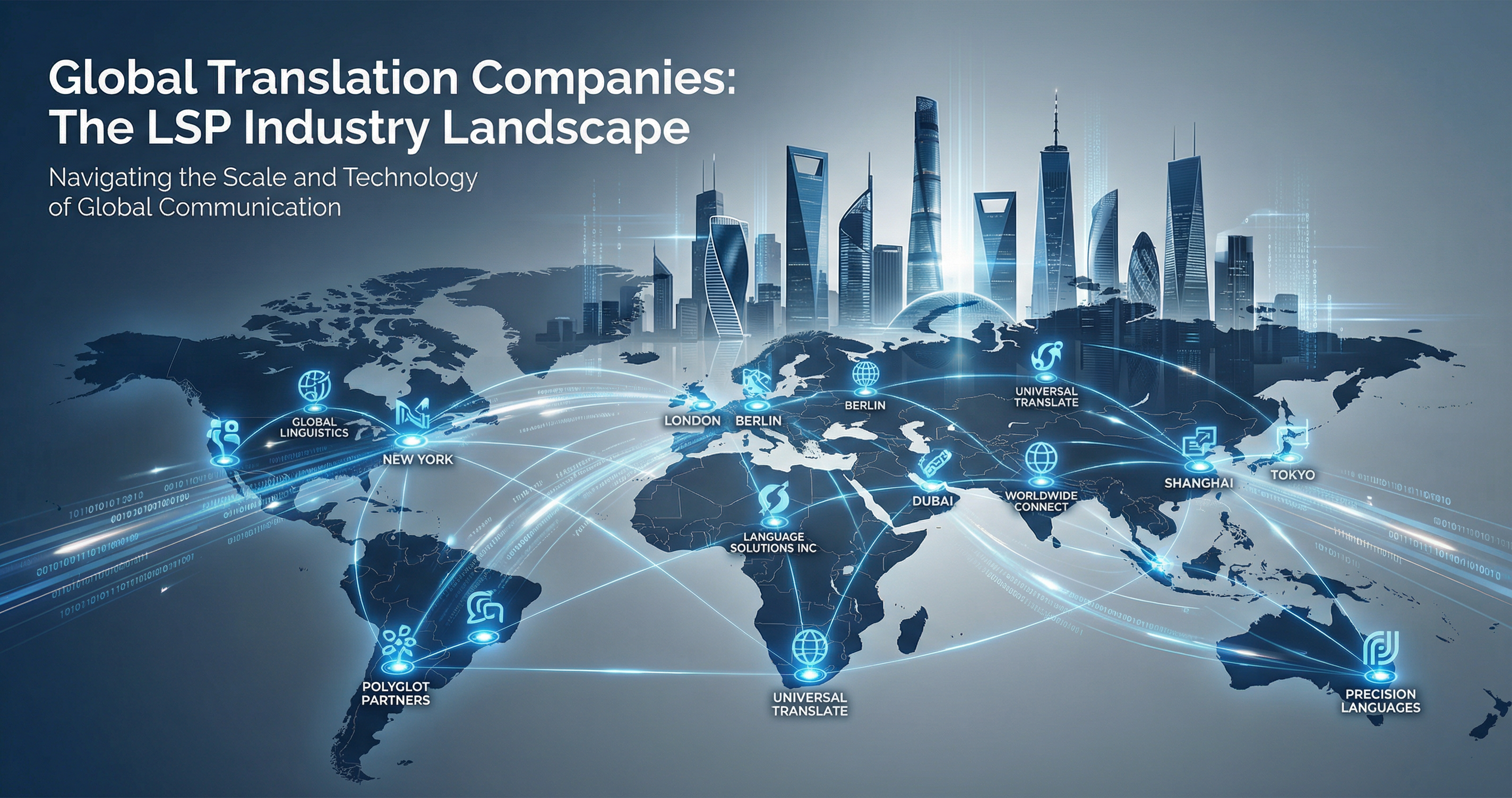
The global translation industry represents one of the most fragmented yet essential service sectors in the modern economy. With over 26,000 Language Service Providers (LSPs) worldwide serving a market valued at USD 60-70 billion, this industry bridges linguistic divides that would otherwise fragment global commerce, diplomacy, and culture. In this comprehensive analysis, we examine the major players shaping this landscape—from billion-dollar super-agencies to specialized boutiques—and explore the market dynamics, consolidation trends, and technological disruptions transforming how the world communicates across languages.
Executive Summary
The global language services market has evolved into a sophisticated ecosystem of enterprises ranging from individual freelancers to multinational corporations generating over a billion dollars in annual revenue. Industry estimates place the global market size between USD 60-70 billion in 2025, with projected growth to USD 80-90 billion by 2030. This expansion is driven by globalization, digital transformation, e-commerce proliferation, and the increasing complexity of cross-border regulatory compliance.
The industry structure reveals extreme fragmentation alongside concentration at the top. While the five largest LSPs control approximately 15-20% of total market revenue, the remaining 80-85% is distributed across thousands of mid-market agencies, boutique specialists, and freelance practitioners. This fragmentation creates both opportunities and challenges—clients benefit from extensive choice and specialized expertise, but face complexity in vendor selection and quality assurance.
Consolidation has emerged as the defining trend of the past decade. Private equity firms have invested billions in platform-building strategies, acquiring LSPs and consolidating operations to achieve economies of scale. TransPerfect, Lionbridge, RWS, and Keywords Studios have all participated in this consolidation wave, using acquisitions to expand geographic reach, vertical expertise, and technology capabilities.
Technology disruption represents both threat and opportunity for industry incumbents. Neural Machine Translation (NMT) has commoditized basic translation services while creating demand for higher-value post-editing and quality assurance. Cloud-based Translation Management Systems (TMS) have democratized access to enterprise-grade technology. Most critically, Artificial Intelligence—including Large Language Models (LLMs) and generative AI—is reshaping service delivery models, pricing structures, and competitive positioning across the entire industry value chain.
Global Translation Market at a Glance
Industry Structure and Segmentation
Understanding the global translation industry requires appreciation of its complex segmentation across multiple dimensions. No single classification system adequately captures the diversity of providers, as LSPs may simultaneously belong to multiple categories based on size, specialization, geography, and service model.
Market Segmentation by Revenue Scale
The most fundamental segmentation divides LSPs by revenue scale, revealing distinct market tiers with different competitive dynamics, client relationships, and strategic imperatives.
Super-Agencies (USD 500M+ revenue) represent the apex of the industry pyramid. This exclusive club includes fewer than ten companies globally: TransPerfect (~USD 1.2B), Lionbridge (~USD 750M), LanguageLine Solutions (~USD 600M), RWS (~GBP 700M), and Keywords Studios (~EUR 600M). These organizations operate as true multinationals with 100+ offices across continents, thousands of employees, and extensive freelance networks. They serve Fortune 500 clients with complex, multi-language, multi-service requirements that smaller competitors cannot efficiently fulfill.
Large LSPs (USD 50-500M) constitute the industry's upper-middle tier, numbering approximately 50-100 companies globally. This segment includes established players like Welocalize, Acolad Group, ULG, Argos Multilingual, and Semantix. These companies typically operate in 10-30 countries, serve mid-market to enterprise clients, and often maintain specialization in specific verticals or geographies. Many in this tier are actively growing through acquisition, aspiring to super-agency status, or positioning themselves as attractive acquisition targets for larger competitors or private equity.
Mid-Market LSPs (USD 10-50M) represent the industry's most competitive and fragmented segment, comprising several hundred companies. These agencies typically operate regionally—serving specific countries or continental markets—while developing expertise in particular industries such as legal, medical, technical, or marketing translation. Mid-market LSPs face intense competitive pressure from both larger competitors with superior scale and smaller boutiques with deeper specialization.
Small LSPs (USD 1-10M) number in the thousands globally. These companies often operate in single countries or cities, serving local business communities with personalized service and competitive pricing. Many successful small LSPs have carved out defensible niches through exceptional quality, deep industry expertise, or strong local relationships that larger competitors cannot easily replicate.
Boutique and Specialized LSPs (<USD 1M) represent the industry's artisanal tier. These micro-agencies and specialized practices often consist of founder-operators with exceptional expertise in rare language pairs, esoteric subject matters, or high-stakes contexts such as literary translation, diplomatic interpretation, or academic publishing. While small in revenue, these providers command premium rates for irreplaceable expertise.
The Freelance Ecosystem underpins the entire industry pyramid. Industry estimates suggest 500,000+ professional translators and interpreters operate globally as independent contractors. This freelance workforce provides the linguistic capacity that enables agencies to scale operations while managing fixed costs. The freelance-agency relationship varies widely—from preferred vendor arrangements with top-tier freelancers to platform-mediated gig work at the lower end of the market.
Service Type Segmentation
Beyond size-based classification, the industry segments by service type, creating distinct sub-markets with unique competitive dynamics.
Translation Services—the conversion of written text between languages—represents the industry's historical core, accounting for approximately 50-55% of total market revenue. This segment has experienced significant commoditization pressure from Machine Translation, with pure human translation increasingly reserved for high-stakes content where accuracy and nuance are paramount. Translation services further segment by content type: legal, medical, technical, financial, marketing, and general business, each with distinct quality requirements, pricing structures, and competitive landscapes.
Localization Services extend beyond translation to encompass cultural adaptation, technical implementation, and market-specific customization. This USD 15-20 billion sub-market includes software and website localization, multimedia adaptation, and transcreation—the creative reinterpretation of marketing content for target markets. Localization demands interdisciplinary expertise combining linguistics, cultural anthropology, user experience design, and technical implementation, creating higher barriers to entry than pure translation.
Interpretation Services—oral translation delivered in real-time—constitute approximately 20-25% of industry revenue. This segment divides into simultaneous interpretation (conferences, large events), consecutive interpretation (meetings, negotiations), and remote interpretation (telephone, video). Interpretation requires different skill sets than written translation, with many practitioners specializing exclusively in one modality. The interpretation market has been transformed by Remote Simultaneous Interpretation (RSI) technology, which emerged during COVID-19 and has permanently altered service delivery models.
Media Localization represents a specialized and growing segment encompassing subtitling, dubbing, voice-over, and audio description for film, television, streaming content, gaming, and corporate video. The explosion of streaming platforms—Netflix, Disney+, Amazon Prime, and regional equivalents—has created unprecedented demand for media localization services. This USD 5-8 billion sub-market has attracted significant investment and consolidation, with specialized media LSPs commanding premium valuations.
Machine Translation and AI Services represent the industry's technology frontier. What began as a service offering—MT post-editing—has evolved into technology platform businesses, custom MT engine development, and AI integration consulting. Companies like DeepL, LILT, and Unbabel have built substantial businesses around AI-augmented translation, while traditional LSPs invest heavily in technology capabilities to remain competitive. The boundaries between language services and technology providers continue to blur.
Consulting and Strategy Services represent the industry's highest-value tier. Globalization consulting, language technology strategy, and international content operations consulting generate substantial margins while requiring minimal variable costs. The largest LSPs have developed sophisticated consulting practices advising multinational corporations on global content strategy, technology architecture, and operational excellence.
Geographic Market Segmentation
The translation industry exhibits strong geographic concentration, with distinct regional markets characterized by different growth rates, competitive dynamics, and service requirements.
North America represents the industry's largest geographic market, accounting for approximately 40-45% of global revenue. The United States dominates, with major LSP headquarters concentrated in New York, Boston, Washington D.C., and the West Coast. Canada's bilingual requirements (English-French) create unique localization demand. The North American market is characterized by high enterprise spending, mature technology adoption, and strong demand for Spanish and Asian language services driven by demographic diversity and trade relationships.
Europe comprises 30-35% of global market revenue, with the European Union's multilingual requirements creating substantial institutional demand. The EU operates in 24 official languages, generating continuous translation demand for legislation, policy documents, and administrative communications. Individual European markets vary significantly—Northern Europe (Nordics, Netherlands) shows high technology adoption and mature outsourcing practices, while Southern and Eastern Europe present growth opportunities with lower penetration rates.
Asia-Pacific represents the fastest-growing regional market, currently comprising 15-20% of global revenue but expanding rapidly. China's economic emergence, Japan's continued global business engagement, India's IT services dominance, and Southeast Asia's rising prosperity all drive translation demand. The Asia-Pacific market is characterized by high linguistic diversity (requiring extensive language coverage), rapid technology adoption (particularly mobile-first approaches), and growing domestic consumption (creating demand for inbound localization).
Latin America accounts for 5-8% of global market revenue, dominated by Brazil and Mexico. The region's translation industry serves multinational corporations operating locally, government institutions, and growing domestic enterprises. Portuguese-Spanish bilingualism creates unique market dynamics, while indigenous language translation serves specific social and governmental needs. Economic volatility in the region has historically created boom-bust cycles for LSPs.
Middle East and Africa represent emerging markets with significant growth potential but operational challenges. The Gulf Cooperation Council states (UAE, Saudi Arabia, Qatar) generate substantial demand for Arabic-English and multilingual services related to international business, tourism, and mega-projects. Africa's linguistic diversity—over 2,000 languages—creates both opportunity and complexity, with translation demand growing alongside economic development and digital connectivity.
Industry Consolidation and M&A Activity
The translation industry has undergone profound consolidation over the past two decades, transforming from a cottage industry of independent practitioners into an increasingly corporatized sector dominated by professional management, private equity ownership, and sophisticated operations.
Private equity has been the primary catalyst for industry consolidation. Firms including Warburg Pincus, The Carlyle Group, Hg Capital, and Equistone have invested billions in platform-building strategies—acquiring LSPs, integrating operations, and creating larger entities capable of serving multinational clients efficiently. This consolidation addresses fundamental industry fragmentation: enterprise clients prefer fewer vendors, larger entities achieve economies of scale in technology and operations, and consolidation enables professional management practices previously uncommon in the industry.
Platform aggregators represent a newer consolidation model. Companies like Smartling (before its acquisition by Welocalize), Unbabel, and Blend have pursued technology-enabled aggregation—building platforms that connect enterprise clients with distributed translator networks while maintaining quality through technology. These platforms achieve scale without the overhead of traditional agency operations, though they face ongoing challenges in quality consistency and freelancer retention.
The consolidation trend shows no signs of abating. Industry analysts predict continued M&A activity as private equity seeks exits for mature platform investments, strategic buyers acquire capabilities to fill gaps, and technology convergence drives partnerships between traditional LSPs and AI/MT providers. For smaller LSPs, the consolidation environment creates both existential threat (competition from larger, better-capitalized rivals) and opportunity (attractive valuations for founders seeking exits).
| LSP Tier | Revenue Range | Estimated Count | Market Share |
|---|---|---|---|
| Super-Agencies | USD 500M+ | 5-8 companies | 15-20% |
| Large LSPs | USD 50-500M | 50-100 companies | 20-25% |
| Mid-Market | USD 10-50M | 300-500 companies | 20-25% |
| Small LSPs | USD 1-10M | 2,000-3,000 companies | 15-20% |
| Boutique/Micro | <USD 1M | 5,000+ companies | 10-15% |
| Freelance Ecosystem | Individual practitioners | 500,000+ professionals | 5-10% |
The Super-Agencies: Giants of the Industry
The super-agencies represent the translation industry's elite tier—companies that have achieved extraordinary scale, global reach, and institutional prominence. These organizations function as true multinationals, with hundreds of offices, thousands of employees, and revenue exceeding that of many Fortune 1000 companies.
TransPerfect: The Undisputed Global Leader
TransPerfect stands as the translation industry's largest company by a substantial margin, with estimated annual revenue exceeding USD 1.2 billion— approximately 2% of total global market revenue. Founded in 1992 by Elizabeth Elting and Phil Shawe from a dorm room at New York University's Stern School of Business, TransPerfect has grown through relentless organic expansion and strategic acquisition into a language services empire.
The company's growth trajectory defies conventional business wisdom. From USD 500,000 in first-year revenue, TransPerfect achieved compound annual growth rates exceeding 30% for two decades, reaching the billion-dollar milestone in 2018. This expansion was fueled by aggressive acquisition strategy—TransPerfect has acquired more than 100 companies, absorbing competitors, specialized boutiques, and regional leaders into its ever-expanding portfolio. Major acquisitions include Crimson Language Services, Law Linguists, and numerous regional LSPs across Europe and Asia.
TransPerfect's operational footprint is genuinely global, with 100+ offices across six continents and 5,000+ full-time employees complemented by an extensive network of freelance linguists. The company provides services in over 170 languages, covering virtually every commercially significant language pair. This scale enables TransPerfect to serve the world's largest enterprises—including Fortune 500 companies, major law firms, and government institutions—with complex, multi-language requirements that smaller competitors cannot efficiently fulfill.
The Phil Shawe ownership saga represents one of corporate America's most unusual governance battles. Following the dissolution of Elting and Shawe's personal and business relationship, a protracted legal battle culminated in a Delaware court ruling that ordered the sale of TransPerfect. Shawe ultimately prevailed in a contested auction, securing 100% ownership for approximately USD 770 million—one of the largest private company acquisitions in translation industry history. This ownership resolution, while costly, eliminated the governance paralysis that had threatened the company's competitive position.
TransPerfect's technology portfolio centers on GlobalLink, a comprehensive translation management platform that integrates content management systems, translation memory, machine translation, and quality assurance tools. GlobalLink serves as both internal infrastructure and client-facing product, creating technology-enabled relationships that increase client switching costs. The company has also invested in vertical-specific technologies, including life sciences platforms and legal technology integrations.
Vertical specialization has been central to TransPerfect's strategy. The company maintains dedicated practices for life sciences (clinical trials, regulatory submissions), legal (litigation support, e-discovery, contract management), financial services, retail and e-commerce, technology, and government. These vertical teams combine linguistic expertise with subject matter knowledge, enabling TransPerfect to command premium pricing in high-value segments where accuracy and regulatory compliance are paramount.
Lionbridge: Public Markets Pioneer and AI Data Leader
Lionbridge occupies a unique position in the translation industry as both a pioneering public company and a leader in AI training data services. Founded in 1996 and headquartered in Waltham, Massachusetts, Lionbridge achieved approximately USD 750 million in annual revenue before its 2017 take-private transaction led by private equity firm Warburg Pincus.
The company's public market history (1999-2017) provided rare transparency into large LSP financial performance. As a publicly traded company, Lionbridge filed detailed SEC disclosures revealing margin structures, segment performance, and strategic priorities. This public reporting demonstrated both the industry's scale potential and its operational challenges—translation services margins proved thinner than investors anticipated, while technology investments required substantial capital with uncertain returns.
Lionbridge's evolution from pure translation provider to diversified language and AI services company reflects industry-wide trends. The company identified AI training data—annotated linguistic content used to train machine learning models—as a high-growth adjacent market. Major technology companies require vast quantities of labeled text, speech, and image data to train natural language processing, computer vision, and speech recognition systems. Lionbridge leveraged its existing linguist networks and quality management infrastructure to become a leading provider of AI training data, serving Google, Microsoft, Amazon, and other technology giants.
The GeoFluent platform represents Lionbridge's technology strategy for real-time translation. This enterprise solution provides instant translation for chat, email, and customer service applications, enabling businesses to communicate with global customers without maintaining multilingual staff. While competing with free alternatives (Google Translate API, Microsoft Translator), GeoFluent targets enterprise requirements including security, customization, and integration with corporate systems.
Lionbridge's enterprise client base includes many of the world's largest technology companies, consumer brands, and professional services firms. The company's ability to serve global scale requirements—translating millions of words across dozens of languages with consistent quality and tight deadlines—differentiates it from smaller competitors. Long-term enterprise relationships, often spanning decades, provide revenue predictability that supports ongoing technology investment.
LanguageLine Solutions: Interpretation Dominance
LanguageLine Solutions occupies a distinctive position as the world's largest interpretation provider, with estimated annual revenue of USD 600 million. Founded in 1982 and headquartered in Monterey, California, LanguageLine pioneered telephone interpretation services and has maintained market leadership through four decades of technological and operational evolution.
The company's interpretation network is genuinely massive, comprising 25,000+ professional interpreters covering 240+ languages. This scale enables LanguageLine to provide interpretation services with near-instant connection times—critical for time-sensitive applications including healthcare emergency consultations, legal proceedings, and customer service interactions. The interpreter network combines employee interpreters (for high-volume languages) with independent contractors (for rare languages and overflow capacity).
LanguageLine's market leadership stems from focus. While competitors diversified across translation, localization, and consulting, LanguageLine concentrated resources on interpretation excellence. This specialization enabled deep expertise in interpreter training, quality assurance, and technology platforms specifically designed for real-time communication. The company has developed proprietary routing algorithms, interpreter mobile applications, and integration tools that optimize interpretation delivery.
Video interpretation represents LanguageLine's strategic growth frontier. While telephone interpretation remains the volume leader, video Remote Simultaneous Interpretation (RSI) has grown rapidly, particularly in healthcare where visual communication enhances diagnostic accuracy and patient rapport. LanguageLine's video platform connects interpreters with healthcare providers, courts, and businesses through secure, HIPAA-compliant video connections. The COVID-19 pandemic accelerated video interpretation adoption, with many clients maintaining video-first preferences even as in-person options returned.
The public sector constitutes a significant portion of LanguageLine's business. Government agencies, courts, healthcare systems, and educational institutions require interpretation services to serve linguistically diverse populations. LanguageLine has developed specialized compliance capabilities including security clearances, background checks, and regulatory certifications that enable public sector contracting. Federal, state, and local government contracts provide revenue stability and long-term relationships.
RWS: IP Services Meets Translation Excellence
RWS occupies a unique competitive position as the only major LSP with substantial intellectual property (IP) services alongside traditional translation. Headquartered in the UK and listed on the London Stock Exchange, RWS generates approximately GBP 700 million in annual revenue across translation, patent services, life sciences, and technology platforms.
The SDL acquisition in 2020 transformed RWS from a specialized IP services provider into a full-scale language services leader. SDL, itself a product of multiple acquisitions including the iconic Trados translation technology, brought substantial translation operations, enterprise clients, and technology assets to RWS. The integration created one of the industry's largest technology portfolios, with proprietary TMS, MT engines, and terminology management systems.
Trados ownership provides RWS with distinctive technology assets and market position. Trados Studio, the industry-standard CAT tool used by hundreds of thousands of professional translators, generates substantial recurring revenue through software licensing. Beyond financial contribution, Trados provides RWS with deep insight into translator workflows and technology requirements, informing product development and competitive positioning.
Life sciences specialization represents RWS's highest-value vertical. The company provides translation and regulatory services for pharmaceutical companies, biotechnology firms, and medical device manufacturers. Clinical trial documentation, regulatory submissions, pharmacovigilance reporting, and product labeling demand exceptional accuracy and regulatory compliance. RWS has developed specialized quality systems, subject matter expert teams, and regulatory knowledge that command premium pricing in this high-stakes segment.
Patent translation and filing services constitute RWS's distinctive IP offering. The company translates hundreds of thousands of patent documents annually, supporting inventors, corporations, and law firms in global patent protection. This specialized service requires unique expertise combining technical subject matter knowledge, legal understanding, and precise terminology management. Patent work's complexity and regulatory importance create substantial barriers to competitive entry.
Keywords Studios: Gaming Localization Powerhouse
Keywords Studios has carved out a distinctive position as the world's largest gaming localization specialist, with annual revenue of approximately EUR 600 million. Founded in 1998 and headquartered in Dublin, Ireland, Keywords has grown through aggressive acquisition to become the dominant service provider for the global video game industry.
The gaming localization market presents unique requirements that Keywords has mastered. Video games contain diverse content types—dialogue, UI text, marketing materials, technical documentation—each requiring different localization approaches. Cultural adaptation must preserve gameplay experience while making content accessible to target markets. Tight development cycles demand rapid turnaround that generalist LSPs struggle to match. Keywords has built specialized teams, workflows, and quality systems specifically optimized for gaming requirements.
Keywords' growth strategy exemplifies the industry's consolidation trend. The company has completed 50+ acquisitions, building capabilities through strategic purchases rather than organic development. Acquired companies bring specialized expertise (audio localization, functional testing, art services), geographic presence, and client relationships. This roll-up approach has enabled Keywords to achieve scale rapidly while maintaining entrepreneurial agility through decentralized operations.
Beyond localization, Keywords has expanded into creative services including art production, audio design, and functional testing. These adjacent services leverage the company's gaming industry relationships while providing higher-margin revenue streams than pure translation. The integration of creative and localization services creates one-stop-shop convenience for game developers, increasing client stickiness and contract values.
Keywords' client roster includes virtually every major video game publisher and many independent developers. The company's ability to handle massive concurrent projects—localizing AAA game launches across 20+ languages simultaneously—creates competitive differentiation that smaller providers cannot match. As the gaming industry continues its explosive growth, Keywords' specialized positioning positions it for continued expansion.
Large LSPs: The Upper-Middle Tier
The USD 50-500M revenue tier comprises approximately 50-100 companies that represent the industry's strong middle class. These organizations possess substantial scale, professional management, and often distinctive specializations or geographic strengths. Many are actively pursuing acquisition strategies to reach super-agency status, while others maintain successful independence through differentiation.
Welocalize: Technology-First Transformation
Welocalize has emerged as one of the industry's most technology-focused large LSPs, distinguishing itself through aggressive digital transformation. Founded in 1997 and headquartered in Frederick, Maryland, Welocalize generates approximately USD 200 million in annual revenue across translation, localization, and AI data services.
The Smartling acquisition in 2023 represented a watershed moment for Welocalize's technology strategy. Smartling, a leading cloud-based Translation Management System provider, brought proprietary technology platform, SaaS revenue model, and enterprise technology clients to Welocalize. This acquisition transformed Welocalize from a services-only provider into a technology-enabled platform company, creating recurring revenue streams and competitive differentiation through owned technology.
Welocalize's AI and machine learning integration extends beyond standard MT post-editing. The company has developed proprietary AI solutions for content analysis, quality estimation, and automated project management. These tools reduce manual effort, improve turnaround times, and enable competitive pricing while maintaining quality. The Smartling platform provides additional AI capabilities including predictive analytics and automated workflow optimization.
Argos Multilingual: European Excellence and Life Sciences Focus
Argos Multilingual represents the success story of Central European LSPs building global presence from regional foundations. Founded in Krakow, Poland in 1996, Argos has grown to approximately USD 100 million in annual revenue through specialization in life sciences, technology, and European market expertise.
Life sciences specialization drives Argos's premium positioning. The company provides translation and regulatory services for pharmaceutical, medical device, and biotechnology clients across Europe and North America. Krakow's strong academic tradition in medicine and life sciences provides a talent pool of linguists with scientific backgrounds. Argos has developed ISO-certified quality systems specifically for life sciences requirements, including clinical trial documentation, regulatory submissions, and pharmacovigilance reporting.
Argos's European market expertise extends beyond Poland to encompass the continent's complex linguistic and regulatory landscape. The company provides localization services for EU regulatory compliance, multilingual product launches, and cross-border business expansion. Central European operating costs combined with Western European service standards create compelling value propositions for international clients.
ULG (United Language Group): Private Equity Roll-Up Strategy
United Language Group exemplifies the private equity-driven consolidation strategy reshaping the industry mid-market. Backed by private equity investment, ULG has executed an aggressive acquisition program, purchasing mid-sized LSPs to build scale rapidly. The company generates approximately USD 150 million in annual revenue through this roll-up approach.
ULG's acquisition strategy targets complementary LSPs with specialized vertical expertise, geographic presence, or client relationships. The company has acquired numerous agencies across North America and Europe, integrating operations while preserving acquired brands and client relationships. This multi-brand approach allows ULG to serve different market segments through appropriate brand positioning—from premium boutique to high-volume economy.
The private equity backing that enables ULG's growth strategy also creates timeline pressure for returns. Industry observers anticipate eventual exit through sale to strategic acquirer, additional private equity investment, or potential public offering. ULG's trajectory illustrates both the opportunities and imperatives of private equity ownership in the translation industry.
Acolad Group: European Consolidation Pioneer
Acolad Group stands as one of Europe's largest LSPs, generating approximately EUR 200 million in annual revenue from operations across 20+ countries. Founded in France and headquartered in Paris, Acolad has pursued European consolidation as its core strategy, acquiring LSPs across the continent to build comprehensive coverage.
The Amplexor merger in 2021 created Acolad in its current form, combining two major European LSPs into a consolidated entity. Amplexor, itself the product of multiple acquisitions, brought strong life sciences and regulated industries expertise. The combined organization benefits from operational synergies, expanded geographic presence, and enhanced scale for enterprise client service.
Acolad's European market expertise addresses the continent's linguistic complexity—24 official EU languages plus regional languages and immigrant communities. The company provides localization services for pan-European product launches, regulatory compliance across multiple jurisdictions, and cross-border business operations. Strong presence in Germany, France, Benelux, and Scandinavia positions Acolad as a preferred partner for European market entry and expansion.
Semantix: Nordic Leader with Public Market Experience
Semantix represents Nordic translation industry leadership, with approximately EUR 100 million in annual revenue and dominant market position across Sweden, Norway, Denmark, and Finland. Founded in Sweden, Semantix has historically served the region's export-dependent economies, providing translation for companies conducting international business.
Semantix's IPO and subsequent journey illustrates the challenges facing mid-sized LSPs in public markets. The company's Stockholm Stock Exchange listing provided capital for growth but also subjected it to public scrutiny of margins, growth rates, and strategic direction. After several years as a public company, Semantix returned to private ownership, suggesting that translation industry dynamics may be better suited to private company structures.
The company's Nordic market position creates both strengths and limitations. Strong relationships with major Nordic exporters (IKEA, Volvo, Ericsson, Nokia) provide stable revenue and brand credibility. However, the Nordic market's limited size creates natural constraints on growth, necessitating international expansion. Semantix has pursued growth through geographic expansion beyond the Nordic region while maintaining its core Nordic client relationships.
Regional Leaders: Geographic Market Champions
Beyond the global super-agencies and large LSPs, regional leaders dominate specific geographic markets through deep local knowledge, established relationships, and regulatory expertise. These companies often provide better value than global competitors for region-specific requirements while serving as essential partners for international LSPs seeking local capacity.
North American Regional Leaders
ALTA Language Services, based in Atlanta, has served the Southeastern United States for over 35 years. The company specializes in government, legal, and healthcare interpretation, holding contracts with federal agencies, state courts, and major healthcare systems. ALTA's ISO certification and rigorous interpreter testing distinguish it in a market where quality inconsistency is common.
Morningside Translations (now part of Keywords Studios) built a strong reputation in legal and IP translation from its New York headquarters. The company's legal specialization and rigorous quality processes attracted major law firms and corporate legal departments. Acquisition by Keywords provided scale and resources while preserving specialized expertise.
IVANNOVICH operates as a specialized gaming localization provider from its Los Angeles base, serving the concentration of game developers in Southern California. The company's gaming focus and proximity to clients enable rapid turnaround and deep industry understanding that generalist competitors cannot match.
Acclaro, headquartered in New York, provides high-end localization services for marketing, creative content, and luxury brands. The company's transcreation expertise—creative adaptation rather than literal translation—attracts clients where brand voice and cultural resonance are paramount. Acclaro's boutique positioning commands premium pricing compared to volume-focused competitors.
European Regional Leaders
Interverbum Technology, based in Germany, provides enterprise localization services with particular strength in technical documentation and manufacturing. Germany's export-oriented economy creates substantial demand for translation services, and Interverbum has built deep expertise serving industrial clients. The company's technology focus—integrating with client content management systems and engineering workflows—differentiates it from generalist competitors.
Venga Global, headquartered in the UK, specializes in marketing localization and creative adaptation. The company's transcreation services help brands enter UK and European markets with culturally resonant messaging. Venga's focus on creative quality over volume attracts premium clients in fashion, hospitality, and consumer goods.
Comtec represents UK mid-market LSP strength, providing comprehensive translation services with particular expertise in legal, financial, and technical sectors. The company's ISO certification and quality management systems meet requirements of regulated industries. Comtec serves both UK domestic clients and international companies entering the UK market.
Sandberg Translation Partners, based in Sweden, serves Scandinavian markets with Nordic language expertise and cultural understanding. The company's focus on Nordic languages (Swedish, Danish, Norwegian, Finnish, Icelandic) enables deep specialization that global LSPs cannot match. Sandberg serves international clients requiring Nordic market expertise and Nordic companies expanding internationally.
TextMaster (now part of the Technicis Group) pioneered crowdsourced translation in Europe, building a platform connecting enterprise clients with vetted freelance translators. The company's technology platform enables rapid turnaround and competitive pricing for high-volume content. French market focus with European expansion has positioned TextMaster as a significant mid-market player.
Asia-Pacific Regional Leaders
CSOFT International, headquartered in Beijing, stands as one of China's largest LSPs with global operations spanning 100+ countries. The company provides end-to-end localization services with particular strength in Asian languages and China market expertise. CSOFT's BZT (Business Zen Token) platform represents innovative blockchain-based translator payment and reputation management.
EC Innovations, also China-based, has built substantial operations serving international companies entering Chinese markets and Chinese companies expanding globally. The company's 25+ years of operation have created deep expertise in the linguistic and cultural complexities of China's diverse market. EC Innovations serves Fortune 500 clients with China-specific localization requirements.
HansemEUG, headquartered in Seoul, represents Korea's translation industry leadership. The company serves Korean conglomerates (chaebols) and international companies entering Korean markets. Korea's unique business culture and linguistic characteristics create demand for specialized localization expertise that HansemEUG provides. The company's expansion into Southeast Asian languages addresses Korean companies' regional expansion.
ICON+ (formerly ICON Translation), based in Japan, serves the substantial Japanese market with expertise in the unique challenges of Japanese localization. Japanese language complexity, cultural nuances, and business practices require specialized knowledge that Western LSPs often lack. ICON+'s deep Japanese expertise serves both domestic clients and international companies entering Japan.
ONCALL Interpreters, headquartered in Australia, leads the Oceania interpretation market. The company provides telephone and video interpretation services across Australia's linguistically diverse population, including significant immigrant communities requiring language access services. ONCALL serves government agencies, healthcare providers, and businesses with 24/7 interpretation coverage.
Latin America Regional Leaders
Net-Translators, based in Argentina, serves Latin American markets with Spanish and Portuguese localization expertise. The company provides software localization, website translation, and technical documentation services for technology companies entering Latin America. Argentina's strong technical education produces qualified translators for IT and technical content.
Trusted Translations operates from the United States with focus on Spanish translation for the US Hispanic market and Latin American business. The company's US-based operations address quality concerns sometimes associated with offshore providers while maintaining competitive pricing. Trusted Translations serves government, legal, and corporate clients requiring high-quality Spanish services.
Middle East and Africa Regional Leaders
Arabize, based in Jordan, provides Arabic localization services with deep understanding of Arabic's linguistic diversity across the Arab world. The company serves international clients entering Middle Eastern markets and regional businesses requiring professional translation. Arabize's expertise spans Modern Standard Arabic and regional dialects, critical for marketing and creative content.
Saudisoft, headquartered in Saudi Arabia, serves the Gulf Cooperation Council market with Arabic localization and international business services. The company provides software localization, website translation, and e-learning content adaptation. Saudi Arabia's economic transformation and Vision 2030 initiatives create growing localization demand that Saudisoft addresses.
Specialized and Niche Players: Expertise-Driven Excellence
Beyond the generalist LSPs competing for broad market share, specialized and niche players dominate specific verticals through irreplaceable expertise. These companies often generate exceptional margins by serving high-stakes segments where accuracy, regulatory compliance, or creative excellence justifies premium pricing.
Gaming Localization Specialists
Beyond Keywords Studios' industry dominance, several specialized providers serve gaming's unique localization requirements.
LocalizeDirect, headquartered in Sweden, provides gaming localization with particular expertise in Nordic markets. The company's game-specific workflows and cultural understanding of gaming communities enable authentic localization that preserves gameplay experience. LocalizeDirect serves indie developers and major publishers with equal attention to quality.
Testronic provides comprehensive game testing and localization quality assurance. Beyond linguistic translation, Testronic verifies that localized games function correctly—text displays properly, audio syncs accurately, and cultural content adapts appropriately. This functional testing expertise complements pure translation services.
Pole To Win (PTW), based in Japan, provides end-to-end game services including localization, testing, and player support. The company's Asian market expertise and understanding of Japanese gaming culture provide unique value for games entering or exiting Japanese markets. PTW's comprehensive service portfolio enables single-vendor relationships for game developers.
Life Sciences and Pharmaceutical Specialists
Life sciences translation demands exceptional accuracy, regulatory knowledge, and quality management. Specialized providers have developed capabilities that generalist LSPs cannot easily replicate.
TransPerfect Life Sciences operates as a dedicated division of the super-agency, providing specialized services for pharmaceutical, biotechnology, and medical device clients. The division maintains ISO certifications specific to life sciences, subject matter expert teams with scientific backgrounds, and regulatory knowledge spanning major markets. Clinical trial translation, regulatory submission localization, and pharmacovigilance reporting generate substantial revenue.
Language Scientific, based in the United States, specializes exclusively in life sciences and technical translation. The company's rigorous translator qualification—including advanced degrees in relevant scientific disciplines—ensures accurate handling of complex medical and technical content. Language Scientific's focus on accuracy over volume attracts clients where errors carry significant consequences.
IQVIA Language Services leverages its parent company's dominance in clinical research and healthcare data to provide integrated translation services. IQVIA's (formerly QuintilesIMS) position in clinical trials creates natural demand for trial-related translation, and the company has built substantial language services to address this internal and external demand.
Legal Services Specialists
Legal translation requires understanding of legal systems, terminology precision, and appreciation of the consequences of translation errors. Specialized legal LSPs have developed expertise that commands premium pricing in this high-stakes segment.
Morningside Translations (now Keywords Studios) built its reputation on legal and IP translation expertise from its founding. The company's legal specialization attracted major law firms and corporate legal departments requiring accurate contract translation, litigation support, and patent documentation. Even after acquisition, Morningside's legal expertise remains a differentiated capability within the Keywords portfolio.
Legal Translation Systems operates as a boutique specialized exclusively in legal content. The company's founder-operators typically possess legal backgrounds alongside translation expertise, enabling nuanced understanding of source materials. This specialized focus justifies premium pricing compared to generalist providers.
Financial Services Specialists
Financial translation demands understanding of markets, regulatory requirements, and the implications of translation choices in financial communications.
Alpha Translations specializes in financial and corporate translation, serving investment banks, asset managers, and financial institutions. The company's understanding of financial terminology, regulatory disclosure requirements, and market communication conventions enables accurate translation of complex financial documents.
e2f provides localization services with particular strength in fintech and emerging financial technologies. The company's Silicon Valley presence positions it to serve technology companies developing financial products, while its global operations support international fintech expansion.
Government and NGO Specialists
Government and humanitarian translation serves unique requirements including security clearances, humanitarian sensitivity, and public accessibility.
CLEAR Global (formerly Translators without Borders/TWB) operates as a nonprofit providing humanitarian translation and language technology. The organization's mission focuses on making vital information accessible in marginalized languages. While nonprofit, CLEAR Global's work intersects with commercial translation through partnerships and technology development.
International Language Services specializes in government and international organization contracting, holding security clearances and compliance certifications required for classified and sensitive content. The company's government focus creates stable revenue through multi-year contracts while requiring significant compliance investment.
Media and Entertainment Specialists
Media localization has emerged as a distinct specialization serving streaming platforms, film distributors, and content creators.
Pixelogic Media provides comprehensive media localization including subtitling, dubbing, and audio description. The company's technology platforms enable rapid turnaround for streaming release schedules while maintaining quality standards. Pixelogic serves major studios and streaming platforms with high-volume media localization.
Deluxe Media represents historic leadership in film and television localization, dating to the early sound era. The company's comprehensive services include subtitling, dubbing, access services, and distribution support. Deluxe's legacy relationships with major studios and technical expertise in media formats maintain its market position despite technology disruption.
Iyuno (formerly Iyuno Media Group) has emerged as a major media localization provider through aggressive growth and acquisition. The company provides subtitling, dubbing, and access services to streaming platforms and content creators globally. Iyuno's technology platforms and global operations network enable rapid, high-volume media localization for the streaming era.
Technology-First and Platform Companies
A new generation of translation companies has emerged with technology as the primary value proposition rather than a support function. These platform companies combine AI, automation, and network effects to achieve scale with different cost structures than traditional LSPs.
Unbabel: AI-Powered Translation at Scale
Unbabel represents the AI-first approach to translation, building a platform that combines neural machine translation with human post-editing in optimized workflows. Founded in Lisbon in 2013, Unbabel has raised over USD 90 million in venture capital to build translation infrastructure for high-volume, real-time applications.
The company's core innovation is Quality Estimation (QE)—AI systems that assess translation quality without human review, enabling intelligent routing of content to appropriate quality tiers. High-confidence MT output delivers directly; uncertain segments receive human post-editing. This tiered approach optimizes cost-quality tradeoffs for clients with large content volumes.
Unbabel's Zendesk partnership illustrates platform integration strategy. The company's API-first approach embeds translation directly into customer service workflows, enabling multilingual support without multilingual staff. This integration creates switching costs and recurring revenue that pure translation providers cannot match.
Lokalise: Developer-Centric Localization Platform
Lokalise has built a leading localization platform specifically designed for software developers and digital product teams. Founded in Latvia and backed by over USD 50 million in venture funding, Lokalise provides tools that integrate localization into continuous development workflows.
The platform's Git integration enables seamless incorporation of translation into DevOps pipelines. Developers push code containing translatable strings; Lokalise routes content to translators or MT systems; translated content returns automatically through the same pipeline. This integration eliminates the traditional localization bottleneck that slowed software releases.
Lokalise serves the high-growth SaaS and technology sector, where continuous deployment and rapid international expansion create localization demand that traditional translation workflows cannot satisfy. The company's developer-focused positioning differentiates it from generalist TMS providers targeting enterprise localization managers.
Crowdin: Open Source and Community Localization
Crowdin has built a substantial localization platform with roots in open source software translation. Founded in Ukraine, the company provides collaborative translation tools that enable community-driven localization projects alongside professional translation workflows.
The platform's open source heritage creates natural fit with technology companies, gaming communities, and digital products seeking community engagement alongside professional translation. Crowdin's collaborative features enable fans and users to contribute translations, reducing costs while building community investment in products.
Ukraine's emergence as a technology hub, despite ongoing conflict, has supported Crowdin's development of sophisticated localization technology. The company's success demonstrates how specialized technology providers can achieve global reach without traditional LSP infrastructure.
Smartling: Enterprise Cloud TMS Pioneer
Smartling pioneered cloud-based Translation Management Systems for enterprise clients, building one of the industry's most recognized TMS platforms. Founded in New York in 2009, Smartling raised significant venture capital to build cloud infrastructure before cloud became standard in the industry.
The 2023 acquisition by Welocalize represented strategic consolidation combining Smartling's technology platform with Welocalize's service capabilities. This merger created a technology-enabled LSP with owned cloud infrastructure—different from competitors relying on third-party TMS or traditional server-based systems.
Smartling's enterprise focus—serving major brands with complex, high-volume localization requirements—created recurring revenue through platform subscriptions and usage-based pricing. The company's global delivery network, quality management systems, and integration ecosystem addressed enterprise requirements that pure technology providers often struggle to meet.
Phrase: Memsource Merger Creates Global Scale
Phrase (formerly Memsource) has emerged as a leading cloud TMS through organic growth and strategic merger. Founded in the Czech Republic, Memsource built a substantial user base among LSPs and enterprise clients before merging with PhraseApp and subsequently acquiring other localization technology providers.
The company's machine translation integration—including proprietary AI capabilities and third-party engine connectivity—positions Phrase at the center of AI-augmented localization workflows. Phrase's TMS serves as an orchestration layer combining MT, translation memory, terminology management, and human review in optimized sequences.
Phrase's multi-tenant cloud architecture enables efficient service to thousands of customers from shared infrastructure, creating software economics that differ fundamentally from services-heavy traditional LSPs. This technology-first positioning has attracted significant investment as the industry recognizes technology's growing importance.
DeepL: Neural MT Excellence Expands into Services
DeepL represents a disruptive threat to traditional translation, achieving translation quality that rivals human output for many content types. Founded in Cologne, Germany, by the team behind Linguee (a popular bilingual dictionary), DeepL has built what many consider the world's best neural machine translation engine.
The company's technology breakthrough—producing more natural, accurate translations than competitors including Google and Microsoft—created a consumer and business phenomenon. DeepL's free tier attracted millions of users, building brand recognition and training data that improved the engine further. Premium subscriptions and API access generated revenue while expanding market presence.
DeepL's expansion into B2B translation services represents a direct threat to traditional LSPs. By adding human post-editing, quality assurance, and professional services to its MT platform, DeepL competes for translation revenue while maintaining technology differentiation. This MT-provider-to- LSP trajectory mirrors how technology disruption often reshapes service industries.
Interpretation Specialists: Masters of Real-Time Communication
While many LSPs offer interpretation alongside translation, specialized interpretation providers have developed distinctive capabilities for real-time communication. These companies combine interpreter networks, technology platforms, and operational expertise to deliver interpretation services at scale.
KUDO: Multilingual Web Conferencing Pioneer
KUDO has pioneered integration of multilingual interpretation into web conferencing platforms. Founded in New York with international team distribution, KUDO enables real-time interpretation during video conferences, webinars, and virtual events—addressing the pandemic-accelerated shift to remote communication.
The platform's innovation is seamless integration of interpretation into familiar video conferencing interfaces. Participants select their preferred language channel; interpreters work through KUDO's specialized interface with optimized audio and terminology support. This integration eliminates the need for separate interpretation equipment while enabling global reach.
KUDO's interpretation marketplace connects certified interpreters with clients requiring real-time multilingual communication. The platform handles logistics, quality assurance, and payment, enabling clients to access professional interpretation without maintaining interpreter relationships directly. This marketplace model achieves scale without the fixed costs of employed interpreter pools.
Interprefy: Remote Simultaneous Interpretation Platform
Interprefy, headquartered in Switzerland, has built a leading platform for Remote Simultaneous Interpretation (RSI)—enabling conference-level interpretation without on-site presence. The company's technology delivers broadcast-quality audio with minimal latency, approaching the performance of traditional interpretation equipment.
Swiss heritage informs Interprefy's focus on quality and reliability. Switzerland's interpretation tradition—hosting international organizations and multilateral diplomacy—created demand for the highest standards in remote interpretation technology. Interprefy serves international organizations, corporate events, and hybrid conferences requiring professional interpretation.
The COVID-19 pandemic transformed Interprefy from niche technology to essential infrastructure. As in-person events suspended globally, RSI enabled continuity for conferences, diplomatic meetings, and business negotiations. Post-pandemic, hybrid event models have institutionalized RSI as standard practice, creating sustained demand for Interprefy's platform.
Conference Interpreter Global (CIG): Professional Network
Conference Interpreter Global operates as a network of professional conference interpreters, providing high-level simultaneous interpretation for international organizations, diplomatic events, and corporate conferences. The organization's structure combines freelance interpreter independence with collective quality standards and client access.
CIG represents the professional conference interpretation community's adaptation to market realities. As international organizations reduce staff interpreter positions and technology enables remote work, interpreter networks like CIG provide collective marketing, quality assurance, and client relationship management while preserving interpreter autonomy.
American Language Services: Court and Legal Focus
American Language Services (ALS) provides interpretation with particular strength in legal and court contexts. The company's certified court interpreters serve judicial systems, law firms, and legal proceedings requiring accurate, impartial interpretation with procedural compliance.
Court interpretation demands specialized skills beyond general language proficiency—understanding of legal terminology, courtroom procedure, and the ethical obligations of legal interpretation. ALS's focus on legal certification and training addresses these specialized requirements, creating differentiation from generalist interpretation providers.
MCIS Language Solutions: Social Impact Focus
MCIS Language Solutions operates as a social enterprise providing interpretation and translation services with a mission focus on language access for marginalized communities. Based in Canada, MCIS serves immigrant and refugee communities, healthcare access programs, and social services requiring language support.
MCIS's social enterprise model combines commercial sustainability with social mission. The organization reinvests profits in community language services, interpreter training programs for immigrants, and reduced-cost services for nonprofits. This mission-driven positioning attracts clients and employees who value social impact alongside service quality.
Market Trends and Industry Disruption
The translation industry faces unprecedented disruption from technology, changing client expectations, and new competitive entrants. Understanding these trends is essential for industry participants navigating rapidly evolving market conditions.
Private Equity Activity and Investment Trends
Private equity has fundamentally reshaped the translation industry's ownership structure and competitive dynamics. Major firms have invested billions in LSP acquisitions, platform-building, and operational improvements. This capital influx has accelerated consolidation while introducing professional management practices previously uncommon in the industry.
Hg Capital acquired RWS in 2022, taking the UK-listed company private in a transaction valuing the company at approximately GBP 1.5 billion. This investment reflects confidence in the translation industry's growth potential and the value creation opportunities from operational improvements and strategic acquisitions.
The Carlyle Group has invested in multiple translation and language technology companies, recognizing the sector's recurring revenue characteristics and growth potential. Carlyle's involvement has brought sophisticated operational expertise and acquisition capital to portfolio companies.
Warburg Pincus led Lionbridge's take-private transaction in 2017, investing over USD 1 billion to acquire the publicly traded company. This investment demonstrated confidence in the super-agency model and the value of transforming public company operations under private ownership flexibility.
Equistone and other European private equity firms have actively invested in continental European LSPs, building regional platforms through acquisition. These investments reflect European market fragmentation and the opportunity to build scale through consolidation.
Private equity involvement creates both opportunities and challenges for the industry. Capital availability enables technology investment, geographic expansion, and acquisition strategies that organic growth cannot fund. However, the return expectations and timeline pressures of private equity ownership can create short-term optimization at the expense of long-term capability building. Industry observers anticipate significant private equity exits—through sales to strategic acquirers or public offerings—as investment horizons mature.
Technology Disruption: AI, MT, and Platform Economics
Technology disruption represents the translation industry's most significant transformation since the advent of computer-assisted translation. Neural Machine Translation, Large Language Models, and AI-powered quality estimation are reshaping service delivery, pricing models, and competitive positioning.
Neural Machine Translation (NMT) commoditized basic translation services, reducing the value of human translation for routine content while creating demand for higher-value post-editing and quality assurance. NMT quality improvements have been dramatic—modern engines produce output approaching human quality for many language pairs and content types. This quality improvement threatens traditional LSP revenue models while creating opportunities for providers that successfully integrate MT into efficient workflows.
Large Language Models (LLMs) including GPT-4, Claude, and Gemini introduce additional disruption. These models demonstrate impressive translation capabilities even in zero-shot scenarios, suggesting potential to bypass traditional MT engines entirely. However, LLM hallucinations, context limitations, and cost structures create challenges for production deployment that technology providers are actively addressing.
Platform aggregation is consolidating market share among technology- enabled providers. Companies that successfully combine AI-powered translation with human quality assurance, efficient project management, and seamless client experience are capturing share from traditional LSPs lacking comparable technology infrastructure. This platform consolidation mirrors trends in other service industries transformed by technology.
API-first services are embedding translation into broader business workflows. Rather than treating translation as a discrete service purchased from LSPs, clients increasingly consume translation through APIs integrated into content management systems, customer support platforms, and e-commerce infrastructure. This integration reduces friction but also commoditizes the transaction, pressuring margins for providers without differentiation.
Consolidation Drivers and Market Dynamics
Multiple factors drive continued industry consolidation that will reshape competitive dynamics over the coming decade.
Scale advantages are intensifying as technology investment requirements grow. Building competitive MT engines, developing AI-powered quality systems, and maintaining global operations require capital that smaller LSPs struggle to access. Larger entities can spread technology investment across greater revenue, achieving lower per-unit costs while offering capabilities smaller competitors cannot match.
Client concentration favors larger providers. Enterprise clients increasingly prefer single-vendor relationships for global language services, consolidating spend with providers capable of handling complex, multi-language, multi-service requirements. This concentration creates winner-take-most dynamics in enterprise accounts, leaving smaller LSPs to compete for fragmented mid-market business.
Technology investment requirements create barriers that favor well-capitalized competitors. AI capabilities, cloud infrastructure, and cybersecurity compliance require ongoing investment that stretches smaller providers. The gap between technology leaders and laggards widens as AI capabilities advance, potentially creating structural disadvantages for non-investing competitors.
New Entrants and Competitive Threats
Beyond traditional LSP competition, new entrants threaten to reshape industry boundaries and capture value from incumbent providers.
Technology giants including Google, Microsoft, and Amazon offer translation APIs as commoditized cloud services. While currently positioned as infrastructure providers rather than service competitors, these companies possess resources, distribution, and AI capabilities that could support service expansion. Google's history of entering adjacent markets—from search to productivity software to cloud services—suggests potential for direct competition if market opportunities justify investment.
Freelancer platforms including Upwork, Fiverr, and ProZ provide marketplace infrastructure connecting clients directly with translators. These platforms disintermediate traditional LSPs, enabling clients to source translation directly from freelancers at rates competitive with agency pricing. While quality inconsistency limits adoption for high-stakes content, these platforms capture significant volume in commoditized segments.
AI-first startups including DeepL, LILT, and various generative AI companies are building translation capabilities from technology foundations rather than service heritage. These companies approach the market with different cost structures, value propositions, and growth strategies than traditional LSPs. Their technology-centric approaches threaten to capture the most scalable, profitable segments of the market while leaving lower-margin service work to incumbents.
Business Models and Competitive Strategies
Translation companies have evolved diverse business models addressing different market segments, client requirements, and competitive environments. Understanding these models illuminates strategic options for industry participants and explains the industry's structural diversity.
Full-Service Model: One-Stop-Shop Strategy
The full-service model provides comprehensive language services across translation, interpretation, localization, and consulting. Super-agencies including TransPerfect, Lionbridge, and RWS exemplify this approach, offering clients single-vendor convenience for all language requirements.
This model's advantages include client relationship depth, cross-selling opportunities, and economies of scope in operations and technology. Enterprise clients value the simplicity of managing a single vendor relationship rather than coordinating multiple specialized providers. Full-service providers can bundle services, offering competitive pricing while maintaining profitability through operational synergies.
However, the full-service model faces challenges. Operational complexity increases with service diversity, requiring management attention across disparate capabilities. Specialization depth may suffer compared to boutique providers focused exclusively on specific services. Large organizations risk becoming unfocused, attempting to serve all market segments with average capabilities rather than excelling in specific niches.
Specialization Model: Vertical and Service Focus
The specialization model concentrates resources on specific verticals, services, or capabilities, achieving expertise depth that generalist competitors cannot match. Keywords Studios (gaming), LanguageLine (interpretation), and Language Scientific (life sciences) exemplify this approach.
Specialization enables premium pricing through differentiated expertise. Clients in regulated industries—life sciences, legal, financial services—value providers with demonstrated vertical expertise, quality systems, and regulatory knowledge. Specialization reduces competitive intensity compared to commoditized generalist segments, creating defensible market positions.
However, specialization creates concentration risk. Dependence on a single vertical exposes providers to sector-specific downturns—gaming localization suffered during industry contraction, while legal translation faces pricing pressure from technology disruption. Successful specialists often expand into adjacent verticals to diversify while maintaining expertise depth.
Technology-Enabled Model: Platform and AI Differentiation
The technology-enabled model leverages proprietary platforms, AI capabilities, and automation to achieve scale with different cost structures than traditional service delivery. Unbabel, Lokalise, and various TMS providers exemplify this approach.
Technology differentiation creates competitive moats through platform effects, data advantages, and integration switching costs. Clients integrating with translation APIs become dependent on specific technology infrastructure, creating recurring revenue and reducing churn. AI capabilities improve with usage, creating competitive advantages that widen over time as leading providers accumulate more training data.
However, technology models require substantial upfront investment with uncertain returns. Building competitive AI capabilities, cloud infrastructure, and platform features demands capital that may exceed smaller providers' access. Technology also creates obsolescence risk— today's leading platform may be disrupted by next-generation technology, requiring continuous investment to maintain competitiveness.
Crowdsourcing Model: Distributed Networks and Gig Economy
The crowdsourcing model aggregates distributed translator networks through platform technology, achieving scale without traditional employment relationships. Gengo (acquired by Lionbridge), Unbabel, and various freelance platforms exemplify approaches that leverage gig-economy dynamics for translation services.
Crowdsourcing advantages include variable cost structures, rapid scaling, and access to global talent pools. Platforms can activate thousands of translators for surge capacity without maintaining fixed costs during slower periods. Global distribution enables 24/7 operations and coverage of rare language pairs without geographic concentration.
However, crowdsourcing faces persistent quality challenges. Without direct employment relationships, platforms struggle to ensure consistency, provide training, and enforce standards. Quality variance among distributed networks limits adoption for high-stakes content where errors carry significant consequences. Successful crowdsourcing models invest heavily in quality systems, translator vetting, and ongoing performance management to address these challenges.
Hybrid Models: Combining Strengths for Competitive Advantage
Most successful LSPs operate hybrid models combining multiple approaches. Hybrid strategies blend employed staff with freelance networks, human expertise with AI augmentation, and specialized verticals with broad service portfolios.
Staff-plus-freelance hybrid combines the control and consistency of employed linguists with the scale and flexibility of freelance networks. Core teams handle high-value, complex work requiring institutional knowledge; freelancers provide surge capacity and specialized language coverage. This hybrid balances quality assurance with cost efficiency, enabling competitive positioning across market segments.
AI-human hybrid workflows represent the industry's emerging standard. Rather than viewing AI as replacement for human translators, leading LSPs integrate AI as an acceleration tool—MT for first drafts, AI quality estimation for routing, human expertise for refinement and review. These hybrids optimize cost-quality tradeoffs, delivering acceptable quality at prices that neither pure human nor pure AI approaches can match.
Pricing Models and Value Chain Analysis
Understanding translation industry economics requires analysis of pricing structures, cost drivers, and value distribution across the supply chain. These economic realities shape competitive dynamics and strategic options for industry participants.
Pricing Models and Rate Structures
The translation industry employs diverse pricing models reflecting different service types, client relationships, and value propositions.
Per-word pricing remains the industry standard for written translation. Rates vary dramatically based on language pair (common pairs like English-Spanish cost less than rare pairs like Finnish-Vietnamese), content complexity (general business costs less than specialized medical or legal), quality tier (MTPE costs less than human translation), and urgency (rush delivery commands premium pricing).
Industry rate ranges span an order of magnitude. Budget LSPs and offshore providers may charge USD 0.05-0.08 per word for standard content. Mid- market LSPs typically price at USD 0.10-0.20 per word. Premium providers specializing in high-stakes content may charge USD 0.20-0.40 per word or higher. Super-agencies with full-service capabilities command rates at the upper end of these ranges based on reputation, quality assurance, and enterprise service levels.
Per-hour interpretation pricing reflects real-time service delivery. Telephone interpretation typically ranges from USD 1.00-3.00 per minute depending on language rarity and service tier. On- site simultaneous interpretation for conferences commands USD 500-1,500 per interpreter per day, with teams of 2-3 interpreters required for extended sessions. Video remote interpretation occupies a middle tier, typically priced between telephone and on-site rates.
Project-based pricing is common for localization projects, media services, and complex engagements where per-word or per- hour models inadequately capture value. Project pricing enables providers to account for project management, technology integration, quality assurance, and specialized expertise that unit pricing might undervalue.
Retainer and subscription models are emerging as technology-enabled providers seek predictable recurring revenue. Translation API subscriptions, TMS platform licenses, and managed service retainers provide revenue stability while creating client switching costs. These models shift pricing from transactional to relational, aligning provider incentives with client success over time.
Value Chain and Margin Structure
Understanding value distribution illuminates why industry structure has evolved toward consolidation and technology investment.
Vendor management costs consume significant resources for LSPs of all sizes. Recruiting, testing, training, and managing freelance translator networks requires ongoing investment. Quality assurance processes—proofreading, review, feedback—add cost layers beyond direct translation. Project management overhead for client communication, workflow coordination, and delivery management further reduces margins.
Technology overhead has grown as competitive requirements expand. CAT tool licensing, TMS platforms, MT engine costs, and quality management systems require capital investment and ongoing maintenance. Cloud infrastructure, cybersecurity compliance, and integration development add technology costs that smaller LSPs struggle to absorb.
Margin structures vary significantly across industry segments. Volume-focused providers operating on thin margins (10-15% EBIT) compete on price while requiring operational excellence to maintain profitability. Premium specialists may achieve 20-30% margins through differentiated expertise and pricing power. Technology providers with SaaS models target software industry margins (70%+ gross margins) though customer acquisition costs and ongoing development investment consume significant portions of these margins.
Pricing Pressure and Margin Compression
Multiple factors exert downward pressure on translation pricing, challenging traditional margin structures and forcing industry evolution.
MT commoditization fundamentally altered translation economics. As NMT quality improved, clients increasingly accept MT+ light post-editing for content where previously they required human translation. This substitution reduces revenue per word while shifting value from pure translation to post-editing and quality assurance. LSPs must either participate in lower-margin MT workflows or migrate to high-value segments resistant to MT substitution.
Client consolidation concentrates purchasing power among fewer, larger buyers. Enterprise procurement practices—including competitive bidding, volume discounts, and preferred vendor consolidation—pressure pricing across the industry. Large clients extract favorable terms while smaller LSPs compete for fragmented mid-market business with less pricing power.
Offshore competition from low-cost markets creates price pressure, particularly for commoditized content. Providers operating in lower-cost regions (Eastern Europe, Latin America, parts of Asia) can offer competitive pricing while maintaining profitability. This geographic arbitrage challenges higher-cost providers to demonstrate value differentiation justifying premium pricing.
Quality Standards and Industry Certification
Quality assurance and professional certification play crucial roles in an industry where service quality varies dramatically and clients often cannot directly assess translation accuracy. Standards and certifications provide frameworks for quality management, professional recognition, and client confidence.
Quality Standards and ISO Certification
ISO 17100 represents the translation industry's core quality standard, specifying requirements for translation service provision. The standard covers translator qualifications, project management processes, quality assurance procedures, and service delivery standards. ISO 17100 certification signals professional operations and quality commitment, increasingly expected by enterprise clients and required for procurement eligibility.
ISO 17100 adoption has grown substantially as the industry professionalizes. Leading LSPs across all tiers have achieved certification, while smaller providers increasingly pursue certification to compete for quality-conscious clients. The certification process requires investment in documented processes, quality systems, and audit preparation—barriers that favor well-resourced providers.
ISO 9001 (general quality management) and ISO 27001 (information security) complement ISO 17100 for LSPs serving enterprise clients. These certifications address operational quality and data security requirements that clients expect from professional service providers. Industry-specific certifications such as ISO 13485 (medical devices) support specialized vertical positioning.
Industry Association Memberships
Professional associations provide networking, standards development, and professional recognition that support industry quality and reputation.
GALA (Globalization and Localization Association) serves as the primary industry association for LSPs and language technology providers. GALA provides industry research, best practice resources, networking forums, and standards development. Membership signals professional commitment and provides access to industry intelligence and peer networks.
ATC (Association of Translation Companies) represents UK LSPs, providing member accreditation, industry advocacy, and professional development. ATC membership and accreditation provide credibility markers for clients selecting UK-based providers. Similar regional associations operate across Europe, North America, and other major markets.
ELIA (European Language Industry Association) represents European LSPs, focusing on professional standards, industry promotion, and advocacy on regulatory matters affecting the European translation market. ELIA membership is particularly relevant for LSPs operating in or targeting European markets.
Vendor Quality Programs and Translator Qualification
Beyond industry standards, leading LSPs maintain proprietary quality programs for translator qualification, ongoing evaluation, and performance management.
Translator testing programs assess linguistic competence, subject matter expertise, and translation skills before admitting linguists to vendor networks. Testing typically includes translation samples, subject matter assessments, and live translation exercises. Rigorous testing reduces quality variance and ensures minimum competence standards.
Ongoing evaluation systems monitor translator performance through quality metrics, client feedback, and error tracking. High-performing translators receive preferred assignment access; under- performers receive additional training or network removal. These systems create performance incentives and continuous quality improvement.
Feedback systems capture client quality assessments, enabling data-driven quality management. Systematic feedback collection identifies quality trends, training needs, and improvement opportunities. Leading LSPs integrate feedback into translator scoring, project routing, and quality assurance resource allocation.
Future Outlook: Industry Evolution Through 2030
The translation industry stands at an inflection point. Technology disruption, market consolidation, and evolving client expectations will reshape competitive dynamics over the coming decade. Understanding these trends enables industry participants to position for success in a transformed landscape.
Predicted Consolidation Trajectory
Industry consolidation will continue as scale advantages intensify and private equity seeks returns on platform investments. Several consolidation scenarios appear likely through 2030.
Super-agency expansion will see the largest LSPs continuing acquisition strategies to fill geographic gaps, add vertical expertise, and acquire technology capabilities. TransPerfect, already the industry's largest acquirer, will likely maintain aggressive purchase activity. Private equity-backed super-agencies may pursue acquisitions to achieve scale supporting IPO or strategic sale exits.
Mid-market rollup will consolidate the USD 10-100M tier into larger entities. Private equity platforms will continue acquiring regional LSPs, building continental or global presence through consolidation. Founders of successful mid-market LSPs will face decisions about exit timing as valuations fluctuate with market conditions and buyer activity.
Technology platform winners will emerge from current competition among TMS providers, AI translation platforms, and hybrid service-technology models. Network effects, data advantages, and integration switching costs will concentrate market share among leading platforms. Platform winners may achieve valuations exceeding traditional LSPs based on technology multiples rather than services multiples.
Technology Evolution and Service Model Transformation
AI and technology will continue reshaping service delivery, pricing models, and competitive positioning. Several technology trends will drive industry evolution through 2030.
AI integration will become standard across all service tiers. Leading LSPs will deploy AI throughout the value chain—MT for first drafts, AI quality estimation for routing, generative AI for terminology assistance and quality checking, and predictive analytics for project management. LSPs without AI capabilities will face existential competitive pressure as AI-enabled competitors achieve superior cost structures and service levels.
New service models will emerge as technology enables different value delivery approaches. Real-time translation APIs will embed in business applications, shifting translation from discrete project to continuous service. AI-augmented creative adaptation will expand transcreation capabilities beyond current human-only approaches. Quality-as-a-service models will offer verification and assurance for client-owned translation processes rather than full translation services.
Human role evolution will see translator work shifting from creation to curation, review, and refinement. As AI handles routine translation, human linguists will focus on high-stakes content requiring judgment, culturally sensitive adaptation, and creative transcreation. Interpreters will increasingly work through technology platforms, with human expertise complementing AI interpretation for critical communications.
Market Growth Areas and Emerging Opportunities
While technology disrupts traditional translation, new growth areas present opportunities for forward-looking providers.
Emerging markets will drive volume growth as developing economies increase cross-border business and digital connectivity expands. African markets, currently underserved by professional translation, present significant growth potential as economic development accelerates. Asian markets beyond China and Japan— Southeast Asia, South Asia—continue rapid growth in translation demand.
Media localization will grow explosively as streaming platforms expand globally, gaming reaches billions of users, and short- form video content crosses linguistic boundaries. This USD 5-8 billion sub-market may double by 2030, attracting investment and creating demand for specialized capabilities that generalist LSPs struggle to match.
AI training data represents an adjacent market where translation expertise creates competitive advantage. Technology companies require vast quantities of labeled, translated, and culturally adapted content to train and refine AI systems. LSPs with linguist networks and quality infrastructure can pivot to serve this demand, diversifying beyond traditional translation services.
Regulatory and compliance translation will grow as cross-border business increases and regulatory complexity intensifies. Data privacy regulations (GDPR and equivalents), financial reporting requirements, and product safety standards create ongoing translation demand that AI cannot fully satisfy due to accuracy and liability requirements.
Disruptors to Watch
Several emerging threats and opportunities warrant close monitoring as potential industry reshapers.
DeepL expansion from MT provider to full-service LSP represents a direct competitive threat to traditional providers. DeepL's translation quality leadership, brand recognition, and technology foundation position it to capture significant market share if service expansion succeeds. DeepL's trajectory will signal whether technology- first companies can successfully add service capabilities.
Tech giant moves by Google, Microsoft, and Amazon could reshape industry boundaries. These companies possess resources, AI capabilities, and distribution that could support aggressive expansion into services. Current API-provider positioning may shift to direct competition if market opportunities justify investment and client acquisition.
AI-first startups including generative AI companies will continue entering the translation space with new approaches to quality, pricing, and service delivery. Venture capital funding for AI translation companies remains robust, creating well-capitalized competitors challenging incumbent providers. Successful startups may achieve significant scale or become acquisition targets for larger platforms.
Client in-housing represents a counter-trend to outsourcing as AI capabilities become more accessible. Large enterprises may develop internal translation capabilities using AI tools and small quality teams rather than outsourcing to LSPs. This in-housing threat particularly affects commoditized translation segments where AI quality is adequate without professional service overhead.
Conclusion: Navigating the Global LSP Landscape
The global translation industry presents a complex ecosystem of providers ranging from billion-dollar super-agencies to individual freelancers, from technology platforms to boutique specialists. This diversity reflects the fundamental reality that translation serves infinitely varied requirements—different languages, content types, quality needs, urgency levels, and budget constraints create market space for multiple competitive approaches.
For clients selecting translation providers, this landscape offers both opportunity and complexity. The right provider depends on specific requirements: super-agencies serve global enterprises with complex, multi-language needs; regional leaders provide local expertise and competitive pricing; specialists deliver irreplaceable expertise for high-stakes verticals; technology platforms enable scalable, integrated translation workflows. Understanding this landscape enables informed provider selection matching service approach to specific needs.
For industry participants—whether LSPs, freelancers, or technology providers—the landscape presents both threats and opportunities. Consolidation, technology disruption, and margin pressure challenge traditional business models. However, growth in emerging markets, media localization, and AI-adjacent services creates expansion opportunities. Success requires strategic clarity: choosing between scale competition, specialization depth, technology leadership, or hybrid approaches that combine multiple strengths.
The industry's evolution through 2030 will likely see continued consolidation among mid-market LSPs, emergence of technology platform winners, and transformation of human roles from creation to curation as AI capabilities advance. Super-agencies will maintain dominance through scale, technology investment, and client relationships. Specialists will thrive in high-stakes verticals where expertise commands premium pricing. Technology-first providers will capture growth in scalable, platform-mediated services.
At Translife, we navigate this landscape daily—competing with global giants, partnering with regional specialists, and investing in technology to deliver competitive value to our clients. The translation industry's evolution reflects broader economic transformation: globalization, digitalization, and AI integration reshaping service industries across the economy. The providers that thrive will be those that adapt to these forces while maintaining the linguistic expertise and quality commitment that remain translation's fundamental value proposition.
About Translife Translation Services
Translife is a leading Malaysian translation agency serving clients across legal, medical, corporate, and technical domains. With offices in Kuala Lumpur, Penang, and Johor Bahru, we provide comprehensive language services including translation, interpretation, localization, and certified document services to clients navigating the global language services landscape.