AI has transformed how we interact with language — from real-time translation to grammar correction and intelligent dictionaries. But while English-language AI tools have reached impressive levels of maturity, Bahasa Malaysia (BM) remains significantly underserved. This comprehensive guide explores the current state of AI technology for Bahasa Malaysia, the challenges unique to BM, the tools available today, and what the future holds for over 30 million BM speakers in the era of kecerdasan buatan.
1. The State of AI for Bahasa Malaysia in 2026
Key Insight: Despite being spoken by over 30 million people across Malaysia, Brunei, Singapore, and parts of Indonesia, Bahasa Malaysia remains a “medium-resource” language in AI — far behind English, Chinese, and even several European languages in terms of available training data, specialised models, and production-ready tools.
The explosion of large language models and AI-powered applications over the past few years has created a new paradigm for language technology. English speakers now have access to sophisticated writing assistants, grammar checkers, AI-powered dictionaries, and translation tools that feel almost magical. These tools can rewrite paragraphs, explain idioms, correct subtle grammatical errors, and even generate content that reads naturally.
For BM speakers, however, the landscape is starkly different. Most mainstream AI tools treat Bahasa Malaysia as an afterthought — or worse, conflate it with Bahasa Indonesia. The result is a significant gap in AI capability that affects students, professionals, translators, and businesses operating in Malaysia.
This gap matters for several reasons:
- Education: Malaysian students learning BM need accurate AI tools for tatabahasa (grammar) checking, vocabulary building, and essay writing assistance
- Business: Companies localising content for the Malaysian market need AI translation that understands Malaysian — not Indonesian — conventions
- Government & Legal: Official documents, dokumen rasmi, require precise BM terminology that generic AI often gets wrong
- Cultural Preservation: As AI increasingly shapes how languages are used and taught, BM risks being marginalised if purpose-built tools are not developed
The good news? Things are changing. Purpose-built BM language tools are emerging, including our own AI-powered Kamus Bahasa Malaysia that combines traditional dictionary databases with AI to deliver accurate, standards-compliant definitions and translations. In this guide, we explore where BM AI technology stands today and where it is heading.
2. The Challenges of AI Translation for Bahasa Malaysia
Building effective AI tools for Bahasa Malaysia is harder than it might seem. While BM and English share the Latin script — removing the complexity of script conversion — several unique challenges make BM a particularly tricky language for AI systems.
2.1 BM vs BI (Bahasa Indonesia) Confusion
This is arguably the single biggest problem with AI and Bahasa Malaysia. Most large language models are trained on massive internet corpora where Indonesian content vastly outnumbers Malaysian content. Indonesia has a population of over 270 million, compared to Malaysia's 33 million. The result? AI models overwhelmingly learn Indonesian patterns and vocabulary, then apply them when asked to produce Bahasa Malaysia.
Common AI Mistakes: AI frequently outputs Indonesian words like “merek” (instead of BM “jenama”), “perusahaan” (instead of “syarikat”), and “gratis” (instead of “percuma”). These are not just alternative spellings — they are entirely different words that immediately signal non-Malaysian origin. For a deep dive into these errors, see our guide on common Bahasa Malaysia mistakes made by AI.
The BM-BI problem is not just about vocabulary. Grammar structures, formal register, and even spelling conventions differ. For example, BM uses “mesyuarat” where BI uses “rapat”, and the formal tone expected in Malaysian government documents differs significantly from Indonesian administrative language. We have a comprehensive comparison in our Bahasa Malaysia vs Bahasa Indonesia guide.
2.2 Limited BM Training Data
AI models learn from data, and the quantity and quality of BM-specific data available online is limited compared to English. Wikipedia in Bahasa Malaysia has a fraction of the articles compared to English. Academic papers, technical documentation, news articles, and literary works in BM are far less digitised. This data scarcity means AI models have less material to learn BM patterns from, leading to lower accuracy and more frequent errors.
2.3 DBP Standard vs Colloquial BM
Dewan Bahasa dan Pustaka (DBP) maintains the official standard for Bahasa Malaysia, including spelling (ejaan), grammar (tatabahasa), and vocabulary. However, colloquial BM — the language actually used in everyday conversation, social media, and informal writing — often deviates significantly from DBP standards.
AI models trained on internet data pick up colloquial patterns, slang (like “lah”, “kan”, “gak”), and mixed-language usage (BM-English code-switching common in Malaysia). This creates a challenge: should AI tools produce DBP-standard BM or reflect how Malaysians actually write? For formal applications — legal documents, academic work, government communications — DBP compliance is essential. But for marketing copy or social media, a more natural tone may be appropriate.
2.4 Spelling Inconsistencies (Ejaan)
BM spelling has undergone several reforms over the decades, and older spellings persist in many texts that AI models train on. Words like “perkataan” vs “perkataan”, the use of hyphens in compound words, and the treatment of loanwords all present inconsistencies. The 2015 Ejaan Rumi Bahasa Melayu standard from DBP clarified many rules, but AI models often produce a mix of old and new spellings, especially for technical terms and loanwords.
These challenges compound each other. An AI system that confuses BM with BI, has limited training data, mixes formal and informal register, and produces inconsistent spellings will generate output that — while superficially readable — falls short of the quality required for professional use. This is precisely why specialised BM AI tools, rather than general-purpose models, are necessary.
3. AI-Powered Language Tools for Bahasa Malaysia
Despite the challenges, a growing ecosystem of AI-powered tools is emerging for Bahasa Malaysia. These range from traditional dictionary databases enhanced with AI to purpose-built grammar checkers and translation systems.
3.1 Dictionary Tools: From PRPM to AI-Powered Kamus
The foundation of any language technology ecosystem is a reliable dictionary. For Bahasa Malaysia, the gold standard has long been the Pusat Rujukan Persuratan Melayu (PRPM), maintained by DBP. PRPM provides comprehensive word definitions, usage examples, and etymological information — but its interface and search capabilities have not kept pace with modern expectations.
This is where AI-enhanced dictionary tools come in. Our free AI Kamus Bahasa Malaysia bridges the gap between traditional dictionary databases and modern AI. Rather than simply returning a definition, it provides contextual explanations, usage examples, related words, and peribahasa (proverbs) — all grounded in authoritative BM language data rather than AI hallucination.
Why AI Kamus Matters: Traditional dictionaries give you a definition. An AI-powered kamus gives you understanding — contextual usage, related vocabulary, grammar notes, and cross-references to peribahasa and simpulan bahasa. Try it free at translife.co/kamus.
3.2 Grammar Checkers: Tatabahasa AI
Grammar checking is one of the most impactful applications of AI for any language. For English, tools like Grammarly have become indispensable. For Bahasa Malaysia, equivalent tools are still in their infancy, but progress is being made.
BM grammar checking presents unique challenges. The imbuhan (affixation) system — where prefixes (awalan), suffixes (akhiran), and circumfixes (apitan) modify root words — is one of the most complex aspects of BM grammar. A robust tatabahasa AI needs to understand rules like meN- prefix assimilation (where “mem-”, “men-”, “meng-”, “meny-” change based on the root word's first letter), peN- prefix patterns, and the subtle differences between active and passive voice in BM.
Current AI-powered grammar tools for BM can handle basic errors — subject-verb agreement, common spelling mistakes, and obvious BI-contamination. However, they still struggle with nuanced issues like correct imbuhan usage, formal register requirements, and the proper use of kata sendi (prepositions), which differ significantly between BM and English.
3.3 Translation Tools: EN to BM and BM to EN
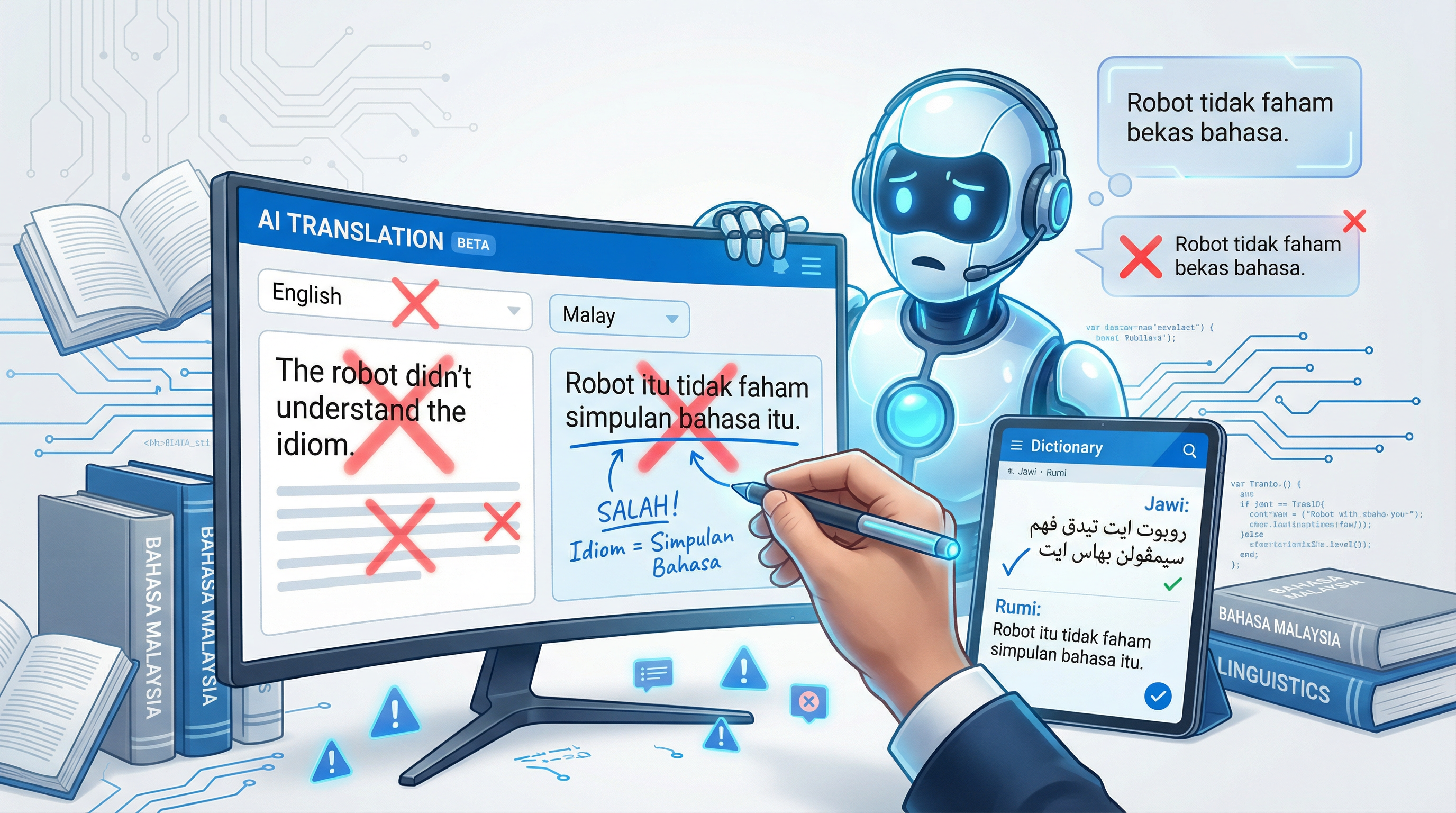
English-to-BM and BM-to-English translation remains one of the most sought-after AI applications in Malaysia. While general-purpose AI translation has improved dramatically, BM-specific accuracy still lags. The core issue remains the BM-BI conflation problem: most AI translation systems produce output that is closer to Indonesian than Malaysian.
Professional translators in Malaysia routinely report spending significant time correcting AI-generated translations — replacing BI vocabulary with BM equivalents, fixing register issues, and adjusting sentence structures to match Malaysian conventions. For businesses, this means AI translation is useful as a starting point but rarely sufficient as a final product. For more on this topic, see our analysis of AI vs human translation accuracy.
3.4 Peribahasa and Simpulan Bahasa Databases
Peribahasa (proverbs) and simpulan bahasa (idioms) are fundamental to BM mastery, especially for students preparing for SPM Bahasa Melayu. AI tools that can explain, contextualise, and help users find relevant peribahasa are immensely valuable.
Our Kamus AI tool includes an extensive peribahasa database with AI-powered search — you can describe a situation and the AI will suggest relevant proverbs, complete with meanings and usage examples. This goes far beyond traditional databases that only allow exact-text search.
3.5 Comparison of Available BM AI Tools
| Tool Type | Strengths | Limitations | Best For |
|---|---|---|---|
| General AI Translation | Fast, handles many languages | BM-BI confusion, inconsistent register | Quick drafts, gist translation |
| PRPM (Traditional Dictionary) | Authoritative, DBP-standard | Limited search, no AI features | Official reference, academic work |
| AI Kamus (TRANSLIFE) | AI-enhanced, contextual, peribahasa support | Focused on dictionary/reference use | Students, writers, translators |
| BM Grammar Checkers | Catches basic errors | Struggles with imbuhan, formal register | Casual writing, quick checks |
| Professional Translation Services | Human accuracy, cultural context | Slower, higher cost | Legal, official, published content |
4. How AI Kamus Technology Works
Understanding how AI dictionary technology works helps explain both its capabilities and its limitations. The approach used by modern AI kamus tools — including ours at translife.co/kamus — is fundamentally different from simply asking an AI chatbot to define a word.
4.1 Retrieval-Augmented Generation (RAG) for BM
The core technology behind reliable AI language tools is called Retrieval-Augmented Generation (RAG). Instead of relying purely on an AI model's training data (which, as we discussed, is biased towards Indonesian), RAG first retrieves relevant information from a curated, authoritative database and then uses AI to generate a helpful response based on that retrieved information.
For Bahasa Malaysia, this means:
- User queries a word — e.g., “bersemangat”
- System retrieves data — The tool searches its curated BM dictionary database for the word, pulling definitions, usage examples, related words, and any associated peribahasa
- AI generates response — Using the retrieved data as ground truth, the AI composes a clear, contextual explanation with examples
- Post-processing validates — The output is checked against BM spelling rules, ejaan standards, and known BI-contamination patterns
This RAG approach is crucial because it prevents the AI from “hallucinating” — generating plausible-sounding but incorrect definitions or Indonesian-influenced output. The AI is constrained to work with verified BM data.
4.2 Combining Traditional Databases with AI
The best AI kamus tools combine multiple data sources to provide comprehensive results:
- Dictionary databases: Comprehensive word lists with definitions, parts of speech, and usage examples following DBP standards
- Peribahasa collections: Extensive databases of Malay proverbs with meanings and contextual usage
- Simpulan bahasa databases: Idiomatic expressions with explanations and example sentences
- Ejaan rules engine: Spelling validation against current DBP orthographic standards
- Tatabahasa rules: Grammar validation for imbuhan patterns, kata sendi usage, and sentence structure
When these structured databases are combined with AI's natural language understanding, the result is a tool that is both authoritative (grounded in verified data) and accessible (presented in clear, natural language with helpful context).
4.3 Post-Processing for BM Accuracy
Even with RAG, AI output requires post-processing specific to Bahasa Malaysia. This includes:
- BI-to-BM vocabulary filtering: Detecting and replacing Indonesian words that the AI may still slip in (e.g., replacing “merek” with “jenama”)
- Ejaan validation: Checking output against current DBP spelling standards, especially for loanwords and compound words
- Register consistency: Ensuring formal BM output maintains consistent register (not mixing bahasa baku with colloquial forms)
- Imbuhan verification: Validating that prefixes and suffixes are correctly applied according to BM morphological rules
4.4 Why Standard AI Alone Is Not Good Enough for BM
To illustrate why purpose-built tools matter, consider what happens when you ask a standard AI chatbot to define the BM word “berketrampilan”:
Standard AI response: May produce a generic definition, potentially confusing it with BI usage, missing the nuance between “berketrampilan” (skilled/competent in BM) and offering incorrect example sentences using Indonesian grammar patterns.
AI Kamus response: Retrieves the verified BM definition from the dictionary database, provides correct DBP-standard usage examples, lists related words like “ketrampilan” and “trampil”, and may suggest relevant peribahasa about skill and competence.
The difference is reliability. For casual use, a standard AI chatbot might be “good enough.” But for students studying for SPM, translators working on official documents, or writers crafting professional BM content, accuracy is non-negotiable. That is why specialised tools like our Kamus AI Bahasa Malaysia exist.
5. Practical Applications: Who Benefits from BM AI Tools?
AI-powered BM language tools serve a wide range of users, each with distinct needs and use cases.
5.1 Students and Academia
For Malaysian students — from primary school through university — AI BM tools are increasingly essential. SPM Bahasa Melayu requires mastery of grammar (tatabahasa), essay writing (karangan), peribahasa, and comprehension. An AI-powered kamus that explains words in context, suggests related vocabulary, and provides peribahasa examples is a powerful study companion.
University students in linguistics, translation studies, and Malay literature programmes can use AI tools for research, comparing word usage across contexts, and analysing language patterns. Academics studying the evolution of BM can leverage AI to process and analyse large text corpora efficiently.
5.2 Professional Translators
Professional English-to-BM translators are among the most sophisticated users of BM AI tools. They use AI translation as a starting point, then apply their expertise to correct BI contamination, adjust register, and ensure terminological accuracy. AI kamus tools help them quickly verify definitions, find the precise BM equivalent for English terms, and check ejaan when uncertain.
The key insight for translators is that AI is a productivity tool, not a replacement. The best translators use AI to handle routine lookups and first-draft generation, freeing their expertise for the nuanced work that requires human judgment. For more on this dynamic, see our analysis of the future of translation in the AI era.
5.3 Content Writers and Copywriters
Malaysian content writers producing BM marketing copy, website content, and social media posts face a unique challenge: the content must sound natural and engaging while maintaining appropriate language standards. AI tools help with vocabulary enrichment — suggesting more precise or expressive BM words — and grammar checking to catch errors before publication.
For copywriters localising English content into BM, AI translation provides a useful first draft. But the magic is in the editing: adapting tone, replacing generic translations with culturally resonant BM phrases, and ensuring the content speaks to a Malaysian audience rather than sounding like translated text. Our website localisation guide for Malaysia covers this process in detail.
5.4 Government and Legal Professionals
Government departments, legal firms, and regulatory bodies require the highest standard of BM accuracy. Official documents, legislative texts, court proceedings, and policy papers must use precise, DBP-standard Bahasa Malaysia. In this context, AI tools serve as verification aids — checking terminology against established standards and flagging potential errors.
Legal BM (bahasa undang-undang) has its own specialised vocabulary and conventions. AI tools trained on general BM often struggle with legal terminology, making specialised resources essential. For a comprehensive look at this domain, see our guide on legal writing in Bahasa Malaysia.
5.5 Businesses Localising for the Malaysian Market
International companies entering the Malaysian market need to localise their products, websites, and marketing materials into Bahasa Malaysia. This goes beyond translation — it requires cultural adaptation, appropriate register, and terminology that resonates with Malaysian consumers. AI tools accelerate this process, but human expertise remains essential for quality assurance.
Common pitfalls include using Indonesian instead of Malaysian terms, applying overly formal language for consumer-facing content, and failing to adapt measurements, currencies, and cultural references. TRANSLIFE provides professional BM translation and localisation services that combine AI efficiency with human accuracy for businesses entering Malaysia.
6. The Future of Bahasa Malaysia AI
The trajectory for BM AI technology is encouraging, driven by growing demand, increasing data availability, and a recognition that medium-resource languages like BM deserve better AI support.
6.1 Growing Demand for BM-Specific AI
As AI becomes embedded in education, business, and government workflows, the demand for BM-specific tools is accelerating. Malaysian schools are increasingly exploring AI-assisted learning, businesses need efficient BM localisation, and the government's push for penggunaan bahasa kebangsaan (national language usage) in official contexts creates ongoing demand for high-quality BM language tools.
Malaysia's national AI roadmap recognises language technology as a strategic priority. The development of BM-capable AI systems is not just a commercial opportunity — it is a matter of digital sovereignty and cultural preservation.
6.2 The Role of DBP and Academic Institutions
Dewan Bahasa dan Pustaka, as the custodian of BM standards, plays a critical role in the future of BM AI. DBP's dictionary databases, grammar references, and language standards form the foundation that AI tools build upon. Greater collaboration between DBP and technology developers — including open access to language resources — would accelerate the development of better BM AI tools.
Malaysian universities — particularly UKM, UM, and UPM — have active research programmes in computational linguistics and natural language processing for Malay languages. These academic efforts are producing BM-specific language models, annotated corpora, and linguistic resources that will underpin the next generation of BM AI tools.
6.3 Open-Source BM Language Resources
The open-source community is making important contributions to BM AI. Projects developing BM tokenizers, morphological analysers, and annotated datasets are laying the groundwork for better AI tools. Open-source BM language models — while still less capable than their English counterparts — are improving rapidly and enabling developers to build BM-specific applications without depending on proprietary systems.
The availability of open BM language data is perhaps the single most important factor for the future of BM AI. More data means better models, which means better tools for end users. Initiatives to digitise BM literary works, academic papers, and government documents will have outsized impact on AI capability.
6.4 Vision: Making BM a First-Class Citizen in AI
The ultimate goal is for Bahasa Malaysia to be treated as a “first-class citizen” in AI — with the same quality of tools, models, and applications available to English speakers. This means:
- AI translation that correctly produces BM (not BI) with consistent quality
- Grammar checkers that understand the full complexity of BM morphology and syntax
- AI writing assistants that can generate natural, culturally appropriate BM content
- Voice assistants and speech-to-text systems optimised for Malaysian accents and BM
- Comprehensive, AI-enhanced dictionaries that make BM vocabulary accessible to learners and professionals alike
We are not there yet, but the progress is real. Every new BM language tool, every academic paper on Malay NLP, and every digitised BM text brings us closer to that vision.
7. Conclusion: Embracing AI for Bahasa Malaysia
AI technology for Bahasa Malaysia has come a long way, but significant work remains. The challenges are clear — BM-BI confusion in AI models, limited training data, the gap between DBP standards and colloquial usage, and spelling inconsistencies. Yet the solutions are emerging: purpose-built tools using RAG technology, growing academic research, and increasing demand driving investment.
For anyone working with Bahasa Malaysia — whether you are a student, a translator, a content writer, or a business professional — the message is clear: use AI tools, but use the right ones. General-purpose AI chatbots will give you Indonesian-contaminated BM. Specialised tools grounded in authoritative BM data will give you accurate, reliable results.
Try Our Free AI Kamus: Experience the difference that purpose-built BM AI tools make. Our AI-powered Kamus Bahasa Malaysia provides accurate, DBP-grounded definitions, contextual usage examples, peribahasa, and more — free for everyone. Try it now at translife.co/kamus.
For further reading on related topics, explore our comprehensive guides:
- Common Bahasa Malaysia Mistakes Made by AI — A deep analysis of systematic AI errors in BM
- Bahasa Malaysia vs Bahasa Indonesia: Complete Comparison — Understanding the critical differences AI often misses
- Common Bahasa Malaysia Mistakes: Complete Guide — Avoid the most frequent BM errors
- AI Translation Technology: A Technical Deep-Dive — How modern AI translation actually works
- The Future of Translation in the AI Era — Where the industry is heading
The future of Bahasa Malaysia in the age of AI depends on continued investment in BM-specific technology, open language resources, and tools built by people who understand the language. At TRANSLIFE, we are committed to building that future — one word at a time.