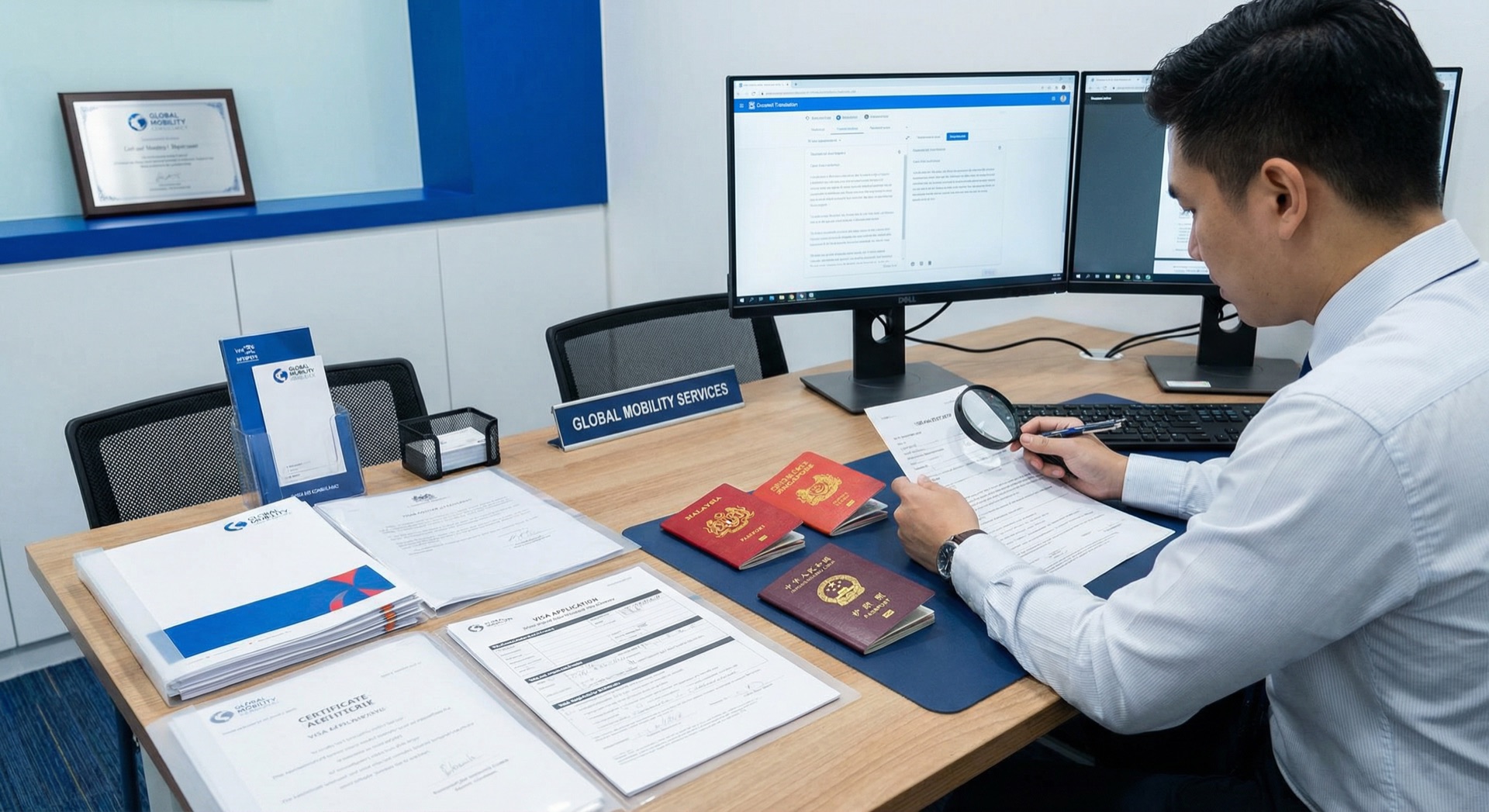
If you're applying for permanent residence, citizenship, a Long-Term Visit Pass, or any other immigration status in Singapore, you've almost certainly encountered the requirement for notarised translation of your foreign-language documents. The Immigration & Checkpoints Authority of Singapore (ICA) has strict, specific requirements for how translated documents must be certified, notarised, and authenticated before they will be accepted. Getting this wrong can delay your application by weeks or even months. This comprehensive guide explains everything you need to know about notarised translation for ICA submissions in 2026, from the three-tier certification system to step-by-step processes, costs, timelines, and the most common mistakes applicants make.
What Is Notarised Translation in Singapore?
A notarised translation is a translated document that has been officially witnessed and authenticated by a Singapore-commissioned Notary Public. Unlike a simple certified translation, which carries only the translation company's own certificate of accuracy, a notarised translation involves a qualified legal professional who verifies the translator's identity, witnesses their signature, and affixes an official notarial seal and ribbon to the document. This additional layer of legal verification gives the translation a higher degree of official standing and is specifically required by ICA for immigration applications in Singapore.
In the Singapore context, notarised translation is distinct from both certified translation and apostilled translation. While a certified translation includes a professional translator's declaration of accuracy, a notarised translation adds a legal attestation by a Notary Public. An apostilled translation goes one step further by including authentication from the Singapore Academy of Law (SAL) under the Hague Apostille Convention, which gives the document international recognition across all 129 contracting states.
The legal framework for notarisation in Singapore is governed by the Notaries Public Act 1959 (Chapter 208), which establishes the qualifications, appointment process, and fee structure for Notaries Public in Singapore. Under this legislation, only practising advocates and solicitors with at least seven years of experience (and typically 15 years, per the Board's guidelines) may be appointed as Notaries Public. This ensures that every notarised document in Singapore carries the authority of a seasoned legal professional.
For ICA submissions specifically, notarised translation is not optional. ICA's official position, published on its website for PR, citizenship, and LTVP applications, states that translated documents must be provided by the embassy of the issuing country, by a Notary Public in Singapore or the issuing country, or privately translated and then attested by the relevant embassy or notarised by a Notary Public. Since October 2019, all notarised documents must also be authenticated by SAL, adding a third mandatory layer to the process. Understanding this multi-layered system is crucial before you begin your ICA application.
Why ICA Requires Notarised Translations
Singapore's immigration system is one of the most rigorous in the world, and the notarised translation requirement exists for several important reasons. First and foremost, it serves as a fraud prevention mechanism. By requiring that translations be witnessed and sealed by a Notary Public, ICA ensures there is a verifiable chain of custody from the original foreign-language document to its English translation. The Notary Public's involvement means that a qualified legal professional has personally verified the identity of the translator and confirmed that the translation was made from a genuine original document.
Second, the requirement ensures translation accuracy and completeness. ICA explicitly does not accept partial translations or summaries. The translated document must mirror the format and content of the original, including all seals, stamps, signatures, and marginal notes. A notarised translation from a professional translation company provides a much higher assurance of completeness than a self-translation or machine translation, both of which ICA explicitly rejects.
Third, the requirement creates legal accountability. A Notary Public who witnesses a fraudulent or inaccurate translation can face professional consequences, including being struck off the register of Notaries Public. This legal liability incentivises thoroughness and accuracy throughout the translation and notarisation process. Similarly, professional translation companies stake their reputation and business on the accuracy of their certified translations.
Finally, the notarised translation requirement brings Singapore into alignment with international standards for document authentication. Since Singapore's accession to the Hague Apostille Convention in 2021, the notarisation and SAL authentication chain creates a standardised pathway for verifying translated documents that is recognised by authorities worldwide. This is particularly important for applicants who may need to use the same translated documents in multiple jurisdictions.
ICA's Three-Tier Certification System Explained
One of the most confusing aspects of preparing documents for ICA is understanding the three distinct levels of certification that must be applied to your translated documents. Many applicants mistakenly believe that a βcertified translationβ alone is sufficient, only to have their documents rejected because they lacked notarisation or SAL authentication. Here is a detailed breakdown of each tier and why all three are required for ICA submissions.
Tier 1: Certificate of Translation Accuracy
The first tier is the foundation of the entire process. A Certificate of Translation Accuracy is issued by the professional translation company that performed the translation. This certificate is a formal declaration that the translation is true, complete, and accurate, and it is signed by the translator or an authorised representative of the translation company. The certificate typically includes the translator's name and qualifications, the language pair of the translation, the date the translation was completed, the company's official stamp or letterhead, and a reference number for tracking purposes.
It is important to note that while a Certificate of Translation Accuracy alone is sufficient for submissions to some Singapore government agencies such as the Ministry of Manpower (MOM), the Ministry of Education (MOE), the Accounting and Corporate Regulatory Authority (ACRA), and the Registry of Marriages (ROM), it is not sufficient for ICA submissions. ICA requires all three tiers, which is why it is essential to work with a translation company that understands the full ICA notarisation process and can guide you through all three steps.
Tier 2: Notarial Certificate
The second tier involves a Singapore-commissioned Notary Public. The Notary Public does not re-translate the document or verify the accuracy of the translation itself; that responsibility lies with the translation company in Tier 1. Instead, the Notary Public performs several critical functions. They verify the identity of the translator or the authorised representative of the translation company, witness the signing of the Certificate of Translation Accuracy, sight the original foreign-language document to confirm it is genuine and matches the translation, and execute a Notarial Certificate that attests to the above, which is then affixed to the translation with an official ribbon and seal.
The Notary Public's fees for this process are fixed by the Notaries Public Rules (Schedule 1) and are not negotiable. The standard Notarial Certificate fee is S$75 per document for the first person, plus S$40 for notarial execution, with additional charges for attachments and exhibits. This is a regulated profession, and the fee structure ensures consistency across all Notaries Public in Singapore. Most notarisation appointments can be completed within 15 to 30 minutes per document.
Tier 3: SAL Authentication Certificate
The third and final tier was made mandatory on 1 October 2019 under the Singapore Academy of Law (Amendment) Rules 2019 and the Notaries Public (Amendment) Rules 2019. Since that date, all notarised documents in Singapore must be authenticated by the Singapore Academy of Law (SAL). SAL verifies that the Notary Public who executed the notarial certificate is a validly appointed Notary Public in Singapore, and then issues an Authentication Certificate that is attached to the document.
This step is crucial because, according to SAL's own FAQ, a notarised document without an authentication certificate is considered invalid. The SAL Authentication Certificate costs S$87.20 (inclusive of 9% GST) per document and can be obtained over the counter at SAL's office at The Adelphi, 1 Coleman Street, #08-06, Singapore 179803. The process is typically completed on the same day or the next working day, and no prior appointment is required. SAL's office hours are Monday to Friday, 9:00 AM to 4:30 PM.
Key Takeaway
All three tiers are mandatory for ICA submissions. A document that has only a certified translation (Tier 1) or only a certified translation plus notarisation (Tiers 1 and 2) will be rejected by ICA. You must complete all three tiers: certified translation, notarisation, and SAL authentication. Working with an experienced notarised translation service can ensure nothing is missed.
Certified vs Notarised vs Apostilled: Key Differences
One of the most common sources of confusion for ICA applicants is the difference between certified, notarised, and apostilled translations. These terms are often used interchangeably in everyday conversation, but they refer to distinct levels of document authentication with very different legal standing. Understanding these differences is critical for ensuring your documents are properly prepared.
| Feature | Certified Translation | Notarised Translation | Apostilled Translation |
|---|---|---|---|
| What it includes | Translation company's certificate of accuracy | Certified translation + Notary Public's seal and certificate | Notarised translation + SAL Authentication Certificate (Apostille) |
| Legal authority | Translation company | Singapore Notary Public | Singapore Academy of Law |
| Recognised by | MOM, MOE, ACRA, ROM, LTA, SPF, CPF | Domestic authorities when combined with SAL authentication | ICA, plus 129 Hague Convention countries |
| Accepted by ICA? | No (insufficient) | No (must include SAL authentication) | Yes (all three tiers complete) |
| Typical cost per document | S$30 β S$80 | S$150 β S$250 | S$200 β S$350 |
| Typical turnaround | 1 β 3 business days | 2 β 5 business days | 3 β 7 business days |
As you can see from the table above, what ICA actually requires is the full apostilled translation, which encompasses all three tiers of the certification system. When ICA says it accepts documents that have been βnotarised by a notary public,β it implicitly includes the mandatory SAL authentication step that has been required since October 2019. For a deeper dive into apostille processes and how they interact with embassy attestation, see our comprehensive guide to apostille and embassy attestation.
It is also worth noting that the alternative to notarised translation that ICA accepts is embassy attestation. If the embassy of the document's issuing country provides the translation directly, or attests to a privately obtained translation, ICA will accept this without notarisation. However, the embassy route is often slower, more expensive, and less predictable than the notarised translation route, particularly because embassy processing times can vary significantly and some embassies have limited translation capabilities. Most applicants find the notarised translation route through a professional translation company to be faster and more reliable.
ICA Application Coming Up?
Get Your Documents Notarised and Translated Correctly the First Time
Translife handles all three tiers of ICA's certification system β certified translation, notarisation, and SAL authentication β so you can submit with confidence. We support 40+ languages and offer same-day notarisation for urgent applications.
Get a Free Quote for ICA TranslationDocuments That Need Notarised Translation for ICA
ICA requires that every foreign-language document submitted as part of an immigration application be accompanied by a notarised English translation. This applies to any document not originally issued in English, regardless of the language or country of origin. Below is a comprehensive list of the documents most commonly requiring notarised translation, organised by category.
Personal Identity Documents
- Birth certificates β Required for virtually all ICA applications. Must include all marginal notes, amendments, and official annotations. Chinese hukou (household registration) documents are often submitted alongside or in place of birth certificates for PRC applicants.
- Passports and travel documents β While the biodata page of most passports includes English, some passports from countries like Japan, South Korea, China, and several Middle Eastern nations contain significant non-English text that may need translation.
- National identity cards β Required when the ID card contains information not found in the passport, such as address history or family details.
- Name change certificates or deed polls β If you have legally changed your name and the relevant documents are in a foreign language, they must be translated and notarised.
Family and Relationship Documents
- Marriage certificates β Essential for spouse-based applications (LTVP, DP, PR, citizenship). Both the original marriage certificate and any supplementary documents must be translated.
- Divorce certificates and decrees β If you are divorced and remarried, or if your current application references a previous marriage, the final divorce decree (not an interim order) must be translated and notarised.
- Children's birth certificates β Required for dependent applications and for establishing family relationships in PR and citizenship applications.
- Adoption papers β Court-issued adoption orders in foreign languages require full notarised translation.
- Death certificates β Required in certain circumstances, such as when a previous spouse has passed away and the applicant has remarried.
- Household or family registers β Particularly relevant for Chinese hukou, Japanese koseki touhon, and Korean hojuk or gajeokgwangye-jeungmyeongseo (family relation certificate).
Educational Documents
- Academic transcripts β From secondary school level onwards. These documents often contain subject-specific terminology that requires expert translation.
- Degree and diploma certificates β University and polytechnic qualifications. Some institutions issue bilingual certificates, but if the English portion is incomplete, a full translation may still be required.
- Professional certifications and licences β Industry-specific qualifications, vocational certificates, and professional memberships.
- School leaving certificates β Such as Malaysian SPM/STPM certificates (issued in Bahasa Malaysia) or equivalent national examinations.
Employment and Financial Documents
- Employment letters and contracts β Must be dated within three months of application for PR, stating occupation, employment start date, and current basic and gross salary.
- Pay slips β The last six months of pay slips are typically required for PR and citizenship applications.
- Tax assessment notices β While ICA now accesses IRAS data directly for Singapore tax assessments, overseas tax documents still need translation.
- Business registration documents β For self-employed applicants, including company incorporation certificates, shareholder agreements, and financial statements.
Legal and Official Documents
- Police clearance certificates β Required from your home country and any country where you have resided for 12 months or more in the past five years. These are critical documents, and inaccurate translations can raise red flags.
- Court orders β Including custody orders, maintenance orders, and other legal judgments relevant to your application.
- Medical examination reports β ICA prescribes its own medical examination form for Student Pass applications exceeding six months, which must include laboratory reports for HIV testing and chest X-rays with official English translation.
- Military service records β Required for male applicants from countries with compulsory military service, such as South Korea and Taiwan.
ICA Application Types and Document Requirements
Each ICA application type has its own specific document requirements and processing timelines. Understanding exactly which documents you need, and which of them require notarised translation, is the first step in preparing a successful application. Below is a detailed breakdown of the major application types.
Permanent Residence (PR) Application
The Singapore PR application is administered by ICA through the e-PR system and has a processing time of approximately six months. The application fee is S$100 per applicant, and upon approval, you will pay S$20 for the Entry Permit, S$50 for the Re-Entry Permit, and S$50 for the NRIC. All documents are uploaded digitally in PDF or JPG format, with each file under 2MB.
The following documents are required for a PR application, and any that are not in English must be accompanied by a notarised translation:
- Passport-sized digital photograph (400 x 514 pixels, white background)
- Valid passport (with at least six months' validity)
- Birth certificate or household register showing parents' names
- Marriage certificate (if applicable)
- Divorce certificate or deed of separation (if applicable)
- Children's birth certificates (if including dependants)
- Educational certificates and transcripts
- Professional skill certificates or licences
- Employment letter dated within three months, stating occupation, employment date, and salary details
- Last six months' pay slips
2026 Update
ICA has simplified the PR application process. The Annex A employer declaration form is no longer required, and ICA now accesses IRAS tax data directly, so you no longer need to upload Notices of Assessment for Singapore income. However, overseas income documentation and all foreign-language documents still require notarised translation. Refer to the official PR document checklist for the most current requirements.
Singapore Citizenship Application
The Singapore citizenship application is the most document-intensive of all ICA applications, with a processing time of up to 12 months. Eligibility requires at least two years of PR status for most categories. The application fee is S$100.
In addition to all the documents required for a PR application, citizenship applicants typically need the last three years of income tax assessments from overseas jurisdictions, a more detailed employment history, and additional supporting documents demonstrating integration into Singapore society. The notarised translation requirements are identical to PR applications, with the same three-tier certification system applying to all foreign-language documents. Given the longer processing time and higher stakes, ensuring your translations are perfectly prepared from the outset is even more critical.
Long-Term Visit Pass (LTVP)
The Long-Term Visit Pass is commonly used by spouses, parents, and other family members of Singapore citizens and permanent residents. Processing times vary: approximately six months for spouses of Singapore citizens (reduced to six weeks if the Pre-Marriage Long-Term Visit Pass Assessment, or PMLA, has been completed), and approximately six weeks for spouses of permanent residents. The application fee is S$45, with S$60 for LTVP issuance and S$30 for the Multiple Journey Visa at approval.
LTVP applicants must submit original documents along with their official translations. ICA requires that copies of foreign-language documents be retained, meaning you should prepare additional certified copies alongside the notarised translations. Key documents include the marriage certificate, the Singapore citizen or PR sponsor's NRIC and passport, the applicant's passport and birth certificate, and proof of the relationship. The official LTVP document checklist provides the full list.
Student Pass
Student Pass applications are submitted through ICA's SOLAR+ system, with a processing fee of S$30 and an issuance fee of S$60. Required documents include a Registration Acknowledgement Letter from the educational institution, passport biodata page, birth certificate, passport-sized photograph, and, for studies exceeding six months, a Medical Examination Report using ICA's prescribed form.
A critical detail that many Student Pass applicants overlook is that the Medical Examination Report must include laboratory reports for HIV testing and chest X-ray results, and these reports must have official English translations if originally issued in another language. Additionally, vaccination records for foreign-born children aged 12 and below must be verified and translated.
MOM Work Passes: EP, S Pass, DP, and Work Permit
While work passes such as the Employment Pass (EP), S Pass, Dependant's Pass (DP), and Work Permit are administered by the Ministry of Manpower (MOM) rather than ICA, they are included here because many applicants confuse the two agencies' requirements. MOM's translation requirements are significantly less stringent than ICA's.
For MOM submissions, a certified translation (Tier 1 only) from a professional translation company is generally sufficient. Notarisation and SAL authentication are not typically required. MOM requires that the original document and its English translation be merged into a single PDF file, with the translation page first. The minimum qualifying salary for an Employment Pass in 2026 is S$5,600 per month, and for an S Pass it is S$3,300 per month. Since September 2023, all post-secondary qualifications for EP applications must also be verified by one of 12 MOM-accredited background screening agencies, at a cost of approximately S$105 to S$150 per qualification.
MOM explicitly states for Dependant's Pass applications: βFor non-English documents: upload the original document together with an English translation as 1 file.β This confirms that MOM does not require the full three-tier notarisation chain. However, if you are planning to convert from a work pass to PR status later, you may wish to obtain notarised translations from the start to avoid having to re-translate documents for your future ICA submission.
Multiple Documents to Translate?
We Handle Bulk ICA Translation Packages
Whether you're applying for PR, citizenship, or LTVP, Translife offers complete document translation packages that include certified translation, notarisation, and SAL authentication for all your documents. Bulk pricing available for 5+ documents.
Request Bulk Translation QuoteStep-by-Step: Getting Your Documents Notarised and Translated
Now that you understand the three-tier certification system and which documents need notarised translation, here is a detailed step-by-step guide to completing the entire process from start to finish. Following these steps carefully will help you avoid the most common delays and rejections.
Step 1: Identify Required Documents
Begin by reviewing the official ICA document checklist for your specific application type. ICA publishes detailed checklists for PR applications and citizenship applications. Go through the checklist item by item and identify every document that is not in English. Make a complete list, including documents you might not initially think of, such as the reverse side of identity cards, marginal notes on birth certificates, and any annotations or stamps on your original documents.
Step 2: Prepare Your Original Documents
Gather all original documents that require translation. The Notary Public will need to sight the originals before notarising the translations, so photocopies alone will not suffice at this stage. Ensure all originals are in good condition, with no missing pages, torn sections, or illegible portions. If any original documents have been damaged or are missing, contact the issuing authority in your home country to obtain replacements before proceeding. Also check that the names on all your documents are consistent. Name discrepancies are one of the most common reasons for ICA application delays.
Step 3: Get Professional Translation
Engage a professional certified translation service to translate your documents from their original language into English. The translation must meet several specific requirements for ICA acceptance. It must be a complete translation, not a summary or paraphrase. It must mirror the format of the original document as closely as possible. It must include translations of all content, including seals, stamps, signatures, marginal notes, and any handwritten annotations. Self-translations are not accepted by ICA, nor are translations produced by AI or machine translation tools. The translation must be performed by a qualified human translator with expertise in the relevant language pair and document type.
Upon completion, the translation company will issue a Certificate of Translation Accuracy (Tier 1 of the three-tier system), which serves as the foundation for the subsequent notarisation process. Choose a translation company that has experience with ICA submissions and can coordinate the entire three-tier process, rather than one that only provides the translation and leaves you to arrange notarisation and SAL authentication separately.
Step 4: Notarisation by a Singapore Notary Public
The translated document, together with the Certificate of Translation Accuracy and the original foreign-language document, is taken to a Singapore-commissioned Notary Public. The Notary will verify the translator's identity (or the identity of the translation company's authorised representative), witness the signing of the certificate, sight the original document, and execute a Notarial Certificate. The Notary then affixes an official ribbon and seal to the document package.
The standard fees prescribed by the Notaries Public Rules include S$75 for the Notarial Certificate and S$40 for notarial execution for the first person, with S$10 per attachment or exhibit. Most notarisation appointments are completed within 15 to 30 minutes per document. If you are using a full-service translation company like Translife, the company will typically arrange the notarisation appointment on your behalf, saving you the time and effort of finding and scheduling with a Notary Public independently.
Step 5: SAL Authentication
After notarisation, the document must be taken to the Singapore Academy of Law (SAL) for authentication. SAL verifies that the Notary Public who executed the notarial certificate is a validly appointed Notary Public, and then issues an Authentication Certificate. The fee is S$87.20 per document (inclusive of 9% GST), and the process is handled over the counter at SAL's office at The Adelphi, 1 Coleman Street, #08-06, Singapore 179803. No appointment is necessary. SAL operates Monday to Friday, 9:00 AM to 4:30 PM, and authentication is typically completed on the same day or the next working day.
Step 6: Submit to ICA
Once all three tiers of certification are complete, your documents are ready for submission to ICA. For PR applications, documents are uploaded digitally through the e-PR portal in PDF or JPG format, with each file under 2MB. Scan the complete document package, including the translation, the Certificate of Translation Accuracy, the Notarial Certificate, and the SAL Authentication Certificate, into a single PDF file for each translated document. For LTVP and certain other applications, you may need to present original documents in person at ICA's office.
Keep the original notarised and authenticated documents in a safe place even after uploading digital copies, as ICA may request to view the physical originals during processing. A best practice is to maintain both physical and digital copies of all submitted documents for your records.
Notary Public vs Commissioner for Oaths in Singapore
A frequently asked question among ICA applicants is whether a Commissioner for Oaths can serve the same function as a Notary Public for translation notarisation. The short answer is no. While both are authorised to administer oaths and witness documents, they serve fundamentally different purposes, and only a Notary Public's certification is accepted by ICA for translated documents.
| Aspect | Notary Public | Commissioner for Oaths |
|---|---|---|
| Jurisdiction | Documents recognised internationally | Documents for use in Singapore only |
| Must be a lawyer? | Yes β practising advocate and solicitor | No β can be a lawyer, court interpreter, or government official |
| Experience required | Statutory minimum: 7 years. Board guideline: 15 years active practice, minimum age 40 | Must be a βfit and proper personβ |
| Foreign language documents | Can witness and notarise | Cannot witness foreign-language documents |
| Fees | Fixed by Notaries Public Rules (not negotiable) | Fixed by SAL Senate |
| Accepted by ICA for translations? | Yes | No |
The distinction is important because Commissioners for Oaths charge lower fees and are more widely available. Some applicants, seeking to save money, have had their translations witnessed by a Commissioner for Oaths only to find that ICA does not accept the resulting documents. This can cause significant delays, as the documents then need to be re-processed through a Notary Public and SAL. Always confirm that the legal professional handling your document notarisation is a Notary Public, not merely a Commissioner for Oaths.
SAL's Role in Document Authentication
The Singapore Academy of Law (SAL) plays a central role in Singapore's document authentication system, serving as the country's designated Competent Authority under the Hague Apostille Convention. Since 20 January 2021, SAL took over the legalisation function from the Ministry of Foreign Affairs (MFA), streamlining the previously multi-step process into a single point of contact for document authentication.
SAL's authentication process serves as a guarantee that the Notary Public who notarised your translated documents is a legitimately appointed official. When SAL issues an Authentication Certificate, it confirms that the Notary's appointment is valid, their seal is genuine, and the notarial act was performed within their authority. For ICA submissions, this authentication step has been mandatory since October 2019, making SAL an indispensable part of the notarised translation process.
Singapore and the Hague Apostille Convention
Singapore deposited its instrument of accession to the Hague Convention of 5 October 1961 Abolishing the Requirement of Legalisation for Foreign Public Documents (commonly known as the Apostille Convention) on 18 January 2021. The Convention entered into force for Singapore on 16 September 2021, making Singapore the third ASEAN member state to join after Brunei and the Philippines. The domestic legislation enabling Singapore's participation is the Apostille Act 2020, which was passed by Parliament in November 2020.
The significance of this for ICA applicants is twofold. First, the SAL Authentication Certificate now takes the form of an Apostille for documents destined for use in any of the approximately 129 contracting states of the Hague Convention. Second, it means that notarised translations obtained in Singapore and authenticated by SAL are now accepted without further legalisation in these countries, simplifying the process for applicants who may need to use their translated documents in multiple jurisdictions. For detailed guidance on how the apostille process interacts with document attestation, see our dedicated guide.
e-Apostille: Singapore's Digital Innovation
In 2025, SAL launched the e-Apostille system in collaboration with the Infocomm Media Development Authority (IMDA), making Singapore one of the first countries globally to offer digital apostilles. The e-Apostille is currently available for ACRA documents such as Business Profiles and Business Certificates, at a cost of S$10.70 per e-Apostille. The service delivers authenticated documents by email within minutes, representing a dramatic improvement over the traditional in-person process.
While the e-Apostille is not yet available for notarised translations submitted to ICA, SAL has indicated plans to expand the system to cover additional types of public agency documents. When this expansion occurs, it could significantly streamline the final step of the three-tier certification process for ICA applicants, potentially reducing the current same-day or next-day turnaround to near-instant digital delivery. This is a development worth watching for anyone planning future ICA applications.
Confused by the Process?
Let Translife Handle the Entire Notarisation Chain
From certified translation to notarisation to SAL authentication, we manage the complete three-tier certification process for your ICA documents. You provide the originals β we deliver submission-ready translated documents.
Start Your ICA Translation TodayCommon Languages Requiring Translation for ICA
Singapore's diverse, multicultural population means that ICA receives documents in dozens of languages from all over the world. As of December 2024, Singapore's foreign workforce numbered approximately 1,576,500, with Employment Pass holders numbering around 202,100, S Pass holders at 178,200, and Work Permit holders at 1,165,900. In 2024 alone, 35,264 individuals were granted permanent residence, the highest number since 2010, with approximately 92% from Asia and 60% from Southeast Asia. Below are the most commonly encountered languages for ICA translation, organised by volume.
Tier 1: Highest-Volume Languages
- Chinese (Simplified and Traditional) β The single largest group of ICA translation requests. Documents from the People's Republic of China include hukou (household registration), degree certificates, birth certificates, marriage certificates, and police clearance certificates. Documents from Hong Kong and Taiwan use Traditional Chinese characters. Chinese name romanisation is a frequent source of complications, as Hanyu Pinyin, Wade-Giles, and regional dialects can produce different romanised spellings of the same name.
- Malay (Bahasa Melayu) β Malaysian documents are the second most common category. Key documents include JPN-issued birth certificates, marriage certificates, SPM and STPM examination certificates, and police clearance certificates. While Malay and English share the same Latin script, the legal and administrative terminology in official documents requires professional translation.
- Tamil β India's Tamil Nadu state produces a significant number of ICA applications. Tamil documents include birth certificates, educational certificates, marriage certificates, and police clearance certificates. Tamil's unique script and the complexity of Indian bureaucratic documents make professional translation essential.
Tier 2: High-Volume Languages
- Hindi β India is the largest single source of EP holders, comprising approximately 25% of all Employment Pass holders in Singapore. Hindi-language documents from northern Indian states are extremely common.
- Bengali (Bangla) β Commonly encountered from both Bangladesh and the Indian state of West Bengal. Bangladesh is a significant source of Work Permit holders in Singapore.
- Indonesian (Bahasa Indonesia) β While similar to Malay, Indonesian has distinct vocabulary, spelling conventions, and legal terminology that require specialised translation. Indonesia contributes a large number of domestic workers and construction workers to Singapore's workforce.
- Vietnamese β Vietnam is an increasingly significant source of workers and PR applicants in Singapore. Vietnamese documents use a modified Latin script with extensive diacritical marks that must be accurately captured in translation.
Tier 3: Moderate-Volume Languages
- Japanese β Approximately 37,000 Japanese citizens reside in Singapore. Japanese documents, particularly the koseki touhon (family register), are uniquely complex, containing historical family information in a format quite different from Western-style certificates.
- Korean β Korean documents include the gajeokgwangye-jeungmyeongseo (family relation certificate), educational certificates, and military service records for male applicants.
- Thai β Thailand is a significant Non-Traditional Source (NTS) country for Work Permits. Thai script is complex, and official documents often include multiple seals and stamps that must be accurately translated.
- Burmese (Myanmar) β Myanmar is another major NTS country. A unique challenge with Burmese documents is the historical use of two different encoding systems, Zawgyi and Unicode, which can affect how names and text are rendered.
- Tagalog (Filipino) β The Philippines is an approved source country for multiple work pass categories. While many Filipino official documents include English text, some, particularly older documents from rural areas, are in Tagalog only.
- Other languages β Translife also regularly handles ICA translations from Sinhala, Telugu, Kannada, Malayalam, Gujarati, Marathi, Punjabi, Khmer, Lao, Urdu, Arabic, French, and Dzongkha (Bhutan was newly added as an NTS country from June 2025).
ICA vs MOM: Different Translation Requirements
One of the most common sources of confusion for immigrants in Singapore is the difference between ICA and MOM translation requirements. Many applicants who have successfully submitted certified translations for their work pass applications at MOM are surprised to learn that the same translations are not acceptable for their subsequent PR or citizenship applications at ICA. The table below summarises the key differences across all major Singapore government agencies.
| Authority | Translation Required? | Notarisation Required? | SAL Authentication? |
|---|---|---|---|
| ICA (PR, Citizenship, LTVP) | Yes β certified | Yes β Notary Public | Yes β mandatory since Oct 2019 |
| MOM (EP, S Pass, WP, DP) | Yes β certified | Generally not required | Generally not required |
| MOE (Student admissions) | Yes β certified | Generally not required | Generally not required |
| ROM (Marriage registration) | Yes β certified | Generally not required | Generally not required |
| ACRA (Business registration) | Yes β certified | Generally not required | Generally not required |
| LTA, SPF, CPF | Yes β certified | Generally not required | Generally not required |
As the table shows, ICA is the only Singapore government agency that requires all three tiers of certification. If you are transitioning from a work pass to PR, or from PR to citizenship, this is a critical distinction. The certified translations you used for your MOM work pass application will need to be upgraded to notarised translations with SAL authentication before they can be submitted to ICA. This is another reason why working with a translation company that offers the full three-tier service from the outset can save you time and money in the long run.
A practical tip: if you are currently on a work pass and planning to apply for PR in the future, consider obtaining notarised translations of your documents from the start, even though MOM only requires certified translations. The additional cost of notarisation and SAL authentication at the time of your initial translation is relatively small compared to the cost and hassle of having documents re-translated and re-certified later. For more information about certified translation in Singapore, see our comprehensive guide.
Common Mistakes That Delay Your ICA Application
Having processed thousands of ICA translation requests, we have identified the most common mistakes that lead to application delays and document rejections. Avoiding these pitfalls can save you weeks of waiting and hundreds of dollars in re-processing fees.
- Submitting certified-only translations without notarisation
This is by far the most common mistake. Many applicants, particularly those transitioning from work passes, assume that the certified translations they used for MOM submissions will also be accepted by ICA. They will not. ICA requires all three tiers: certified translation, notarisation, and SAL authentication. - Missing the SAL authentication step
Even applicants who correctly obtain notarised translations sometimes forget that SAL authentication has been mandatory since October 2019. A notarised document without SAL authentication is considered invalid and will be rejected by ICA. - Name discrepancies between documents
This is especially prevalent with Chinese, Korean, and Japanese names, where different romanisation systems can produce different English spellings. If your birth certificate shows βZhang Weiβ but your passport shows βCheung Wai,β this discrepancy must be explained and ideally supported by a statutory declaration or name correlation letter. A good translation company will flag these issues before submission. - Submitting partial translations or summaries
ICA requires complete translations that mirror the original document's format and content. Partial translations, summaries, or abstracts are not accepted. Every element of the original must be translated, including marginal notes, stamps, seals, and handwritten annotations. - Using self-translations or machine translations
ICA explicitly does not accept translations prepared by the applicant themselves, by family members, or by AI and machine translation tools. The translation must be performed by a qualified professional translator and carry a company-issued Certificate of Translation Accuracy. - Forgetting to translate all marginal notes on birth certificates
Birth certificates from many countries contain marginal notes (annotations added after the original issuance) that record events such as adoptions, name changes, or corrections. These marginal notes are part of the official document and must be included in the translation. - Exceeding the 2MB file size limit for e-PR uploads
When scanning notarised translations for upload to the e-PR portal, the resulting PDF or JPG file can easily exceed 2MB, especially when it includes multiple pages with notarial seals and SAL certificates. If your file is too large, reduce the scan resolution or use PDF compression tools, but ensure that all text and seals remain clearly legible. - Not keeping originals available for inspection
Even after uploading digital copies, ICA may request to view your original documents. Keep all originals and their notarised translations in a safe, accessible location throughout the processing period. - Using a Commissioner for Oaths instead of a Notary Public
As detailed earlier in this guide, a Commissioner for Oaths cannot notarise foreign-language documents for ICA submissions. Only a Singapore-commissioned Notary Public has the authority to execute the notarial certificates that ICA requires. - Submitting expired translations
While there is no official expiry period for translations, best practice is to use translations that are no more than six months old. Some ICA officers may query translations that appear to be significantly older than the application date, particularly if the original documents have been updated or reissued since the translation was made.
Timeline Planning: When to Start Your Translation
Proper timeline planning is essential for a smooth ICA application process. Starting too late can mean rushed translations, missed notarisation appointments, and potentially delayed applications. Here is a realistic timeline for the complete notarised translation process, from initial document preparation to ICA submission.
| Stage | Standard Timeline | Urgent Timeline | Notes |
|---|---|---|---|
| Document gathering and preparation | 1 β 2 weeks | 2 β 3 days | Assumes originals are already in hand. Add 2 β 6 weeks if documents need to be obtained from overseas. |
| Professional translation | 3 β 5 business days | 1 β 2 business days | Depends on document complexity and language pair. Urgent fees may apply. |
| Notarisation | 1 β 3 business days | Same day | Most notarisation appointments take 15 β 30 minutes per document. |
| SAL authentication | Same day β 1 business day | Same day | Over-the-counter service at SAL, no appointment needed. |
| Document scanning and upload preparation | 1 business day | Same day | Ensure each file is under 2MB for e-PR upload. |
| Total | 2 β 4 weeks | 3 β 5 business days | Excludes time needed to obtain original documents from overseas. |
Our recommendation is to start the translation process at least four to six weeks before your planned ICA submission date. This provides comfortable buffer time for any unexpected issues, such as discovering that an original document is missing, finding name discrepancies that need to be resolved, or dealing with complex documents that take longer to translate. If you need documents obtained from overseas, add an additional four to eight weeks to account for shipping and potential bureaucratic delays in the issuing country.
For applicants who need faster turnaround, Translife offers expedited services with same-day notarisation and priority SAL authentication. Our expedited ICA translation service can deliver submission-ready documents within three to five business days for standard document sets, and within 24 to 48 hours for individual documents on an urgent basis.
Cost Breakdown: Notarised Translation for ICA
Understanding the full cost of notarised translation for ICA helps you budget accurately and avoid surprises. The total cost comprises three components: the translation fee, the notarisation fee, and the SAL authentication fee. Below is a detailed breakdown.
| Cost Component | Typical Range | Notes |
|---|---|---|
| Certified translation | S$30 β S$100 per page | Varies by language pair, document complexity, and urgency. Common languages (Chinese, Malay) tend to be at the lower end; rare languages at the higher end. |
| Notarial Certificate | S$75 per document | Fixed by Notaries Public Rules. Additional S$20 for each extra party on the same document. |
| Notarial execution | S$40 per document | First person. S$20 for second party, S$10 for each additional party. |
| Exhibits and attachments | S$10 per attachment | Each attachment or exhibit bound to the notarial document. |
| SAL Authentication | S$87.20 per document | Fixed fee inclusive of 9% GST. S$80 + GST = S$87.20. |
| Total per document (estimated) | S$200 β S$350 | All-inclusive: translation + notarisation + SAL. Multi-page documents cost more for translation but notarisation and SAL fees remain the same per document. |
For a typical PR application requiring five to eight documents to be translated and notarised, the total cost for the translation and certification process can range from approximately S$1,000 to S$2,800, depending on the number of pages, language pairs, and document complexity. This is in addition to ICA's own application fee of S$100 per applicant.
Many translation companies, including Translife, offer bundle pricing for applicants who need multiple documents translated and notarised. These packages can provide significant savings compared to processing documents individually. When comparing quotes from different providers, always confirm whether the quoted price includes all three tiers (translation, notarisation, and SAL authentication) or whether notarisation and SAL fees are additional. Some companies quote attractively low translation fees but then charge separately for notarisation coordination and SAL submission.
Transparent Pricing
Get an All-Inclusive Quote for Your ICA Translation
Translife's quotes include everything: certified translation, notarisation, SAL authentication, and document handling. No hidden fees, no surprises. Tell us what documents you need translated and we'll provide a complete price breakdown.
Get Your All-Inclusive QuoteHow Translife Helps with ICA Notarised Translation
Translife is a professional translation and document services company that specialises in notarised translations for ICA submissions. We understand the complexity of Singapore's three-tier certification system and have built our processes to handle every step seamlessly. Here is what sets our ICA translation service apart.
- End-to-end service β We handle the complete three-tier process: certified translation by our professional translators, notarisation arranged with our panel of Singapore Notaries Public, and SAL authentication submission and collection. You provide the original documents; we deliver the fully certified, notarised, and authenticated translations ready for ICA submission.
- 40+ languages supported β Our team of native-speaking translators covers all the languages commonly required for ICA submissions, including Chinese (Simplified and Traditional), Malay, Tamil, Hindi, Bengali, Indonesian, Vietnamese, Japanese, Korean, Thai, Burmese, Tagalog, Arabic, and many more.
- ICA format compliance β Every translation we produce mirrors the format of the original document, includes all seals, stamps, and annotations, and is formatted for digital upload to ICA's e-PR portal within the 2MB file size limit.
- Name discrepancy handling β We proactively identify and flag name romanisation discrepancies across your documents and can prepare supporting statutory declarations or name correlation letters when needed.
- Same-day notarisation available β For urgent applications, we offer same-day notarisation and expedited SAL authentication, with delivery of submission-ready documents in as little as 24 hours.
- Quality guarantee β If ICA rejects any document due to a translation quality issue, we will re-translate and re-process the document at no additional charge.
- Bundle pricing β We offer competitive package pricing for applicants who need multiple documents translated, with significant discounts for bulk submissions.
Whether you are applying for PR, citizenship, LTVP, or any other ICA-administered pass, Translife's experienced team can ensure your documents are prepared correctly and completely, giving your application the best possible chance of success. Visit our certified translation services page to learn more, or request a free quote to get started.
Frequently Asked Questions
What is the difference between certified and notarised translation for ICA?
A certified translation includes only the translation company's Certificate of Translation Accuracy (Tier 1). A notarised translation adds a Notary Public's seal and certificate (Tier 2) and SAL authentication (Tier 3). ICA requires all three tiers. A certified-only translation, while sufficient for MOM, MOE, and most other Singapore government agencies, will be rejected by ICA.
Can I translate my own documents for ICA?
No. ICA does not accept self-translations, translations by family members, or translations produced by AI or machine translation tools. All translations must be performed by a professional translator and carry a company-issued Certificate of Translation Accuracy.
How long does the notarised translation process take?
The standard process takes approximately two to four weeks from document submission to receipt of fully certified, notarised, and SAL-authenticated translations. For urgent requests, the process can be expedited to three to five business days. Individual document notarisation appointments typically take 15 to 30 minutes, and SAL authentication is usually completed on the same day or the next working day.
How much does notarised translation cost for ICA?
The total cost per document typically ranges from S$200 to S$350, which includes the certified translation fee (S$30 to S$100 per page), the Notary Public's fees (approximately S$115 to S$135 per document), and SAL authentication (S$87.20 per document). For a typical PR application with five to eight documents, the total cost ranges from approximately S$1,000 to S$2,800. Bundle pricing is available for multiple documents.
Do I need notarised translation for a MOM Employment Pass?
No. MOM generally requires only a certified translation (Tier 1) for work pass applications, including Employment Pass, S Pass, Dependant's Pass, and Work Permit. Notarisation and SAL authentication are not typically required for MOM submissions. However, if you plan to apply for PR later, consider getting notarised translations from the start to avoid re-processing.
Can a Commissioner for Oaths notarise my translated documents for ICA?
No. Only a Singapore-commissioned Notary Public can notarise translated documents for ICA submissions. A Commissioner for Oaths is limited to documents for domestic use and cannot witness foreign-language documents. Always verify that the legal professional handling your notarisation is a Notary Public.
Is SAL authentication mandatory for ICA submissions?
Yes. Since 1 October 2019, all notarised documents in Singapore must be authenticated by SAL. According to SAL, a notarised document without an authentication certificate is considered invalid. The SAL Authentication Certificate costs S$87.20 per document (inclusive of GST) and can be obtained over the counter at SAL's office at The Adelphi, 1 Coleman Street, Singapore.
What languages does Translife translate for ICA submissions?
Translife supports 40+ languages for ICA translations, including all the most commonly required languages: Chinese (Simplified and Traditional), Malay (Bahasa Melayu), Tamil, Hindi, Bengali, Indonesian, Vietnamese, Japanese, Korean, Thai, Burmese, Tagalog, Arabic, Sinhala, Telugu, Kannada, Malayalam, Gujarati, Marathi, Punjabi, Khmer, Lao, Urdu, French, Dzongkha, and many more.
What happens if ICA rejects my translated documents?
If ICA rejects your documents due to a translation quality issue, you will need to have the documents re-translated and re-processed through the full three-tier certification chain. This can add several weeks to your application timeline. Translife offers a quality guarantee: if any document is rejected due to a translation error on our part, we will re-translate and re-process the document at no additional charge. To minimise the risk of rejection, always use a professional translation service with experience handling ICA submissions.
Do notarised translations expire?
There is no official expiry period for notarised translations in Singapore. However, best practice is to use translations that are no more than six months old at the time of ICA submission. ICA officers may question translations that are significantly older than the application date, particularly if the underlying original documents have been updated, amended, or reissued since the translation was made.
Can I use embassy-translated documents instead of notarised translations?
Yes. ICA accepts translations provided directly by the embassy of the country that issued the document, as well as privately translated documents that have been attested by the relevant embassy. However, the embassy route is often slower and more expensive than the notarised translation route. Embassy translation services can have wait times of several weeks, and not all embassies offer translation services for all document types. Most applicants find the notarised translation route through a professional translation company to be faster and more convenient.
What is the file size limit for uploading translated documents to ICA's e-PR portal?
ICA's e-PR portal accepts documents in PDF or JPG format, with a maximum file size of 2MB per file. When scanning notarised translations that include multiple pages (the translation, Certificate of Translation Accuracy, Notarial Certificate, and SAL Authentication Certificate), ensure the complete document package is scanned into a single file under this size limit. If the file is too large, reduce the scan resolution or use PDF compression, but ensure all text and seals remain legible.
What is a hukou and why does it need special attention for ICA translation?
A hukou is the Chinese household registration document that records a person's birth details, family relationships, and residential address. For many PRC nationals, the hukou serves as the primary birth certificate equivalent. Translating a hukou for ICA requires particular expertise because the document contains abbreviated Chinese characters, may use non-standard formatting, and includes information about multiple family members across several pages. The name romanisation from hukou can also differ from the applicant's passport spelling, creating discrepancies that must be carefully addressed in the translation. Translife has extensive experience with hukou translations for ICA and can handle these complexities efficiently.
Ready to Start?
Get Your ICA Documents Translated, Notarised, and Authenticated
Translife provides the complete three-tier certification service for all ICA immigration applications. From certified translation to notarisation to SAL authentication, we handle everything so you can focus on your application. Contact us today for a free, no-obligation quote.
Get Your Free ICA Translation Quote